


How Red Bull took French GP "payback" on a day of Mercedes mistakes
The French GP has been a stronghold for Mercedes since Paul Ricard's return to the calendar in 2018. But that all changed on Sunday, as a clever two-stop strategy guided Red Bull's Max Verstappen to make a race-winning pass on the penultimate lap - for once leaving Mercedes to experience the pain of late defeat it has so often inflicted on Red Bull

“We just didn't want to be in the same position as Barcelona.”
Last month in Spain, Christian Horner’s Red Bull squad suffered a deja vu defeat against Mercedes, as Lewis Hamilton charged late on to make a perfect, unexpected and aggressive two-stop strategy work to win a race where he’d sacrificed track position. At the 2021 French Grand Prix, Horner’s team was not caught out again – as Max Verstappen reversed the late-race drama and ultimately triumphed in an engaging contest that was also laced with several familiar themes from other races this season.
PLUS: How Red Bull’s deja vu set Hamilton on the winning path in Spain
But Verstappen was “caught out” at the opening corners at Paul Ricard. When the lights went out, Verstappen did not need to defend on the run down to Turn 1 as he led Hamilton off the line. But just as Verstappen went from exiting the left-hander to positioning his car left again for the quickly ensuing Turn 2 right, it all went wrong.
“I don’t think I braked too late,” he later explained. “I just lost a lot of grip suddenly. It was not one moment; it was like three or four. I lost the rear and had to go off the track.”
Verstappen’s attempts to catch the slide put him on the inside of Turn 2, where he didn’t go around the two arrow-marked blocks deep in the runoff, as required in the race director’s event notes. But the stewards did not investigate this outcome because “it would have been physically impossible to get to that point”, according to F1 race director Michael Masi, who also said it was deemed that Verstappen had “slowed and lost a position and rejoined in a safe manner”, therefore no further action was necessary.
As Verstappen slipped off the road, Hamilton roared through Turn 2 and took an unexpected lead, with Valtteri Bottas chasing hard in third place.
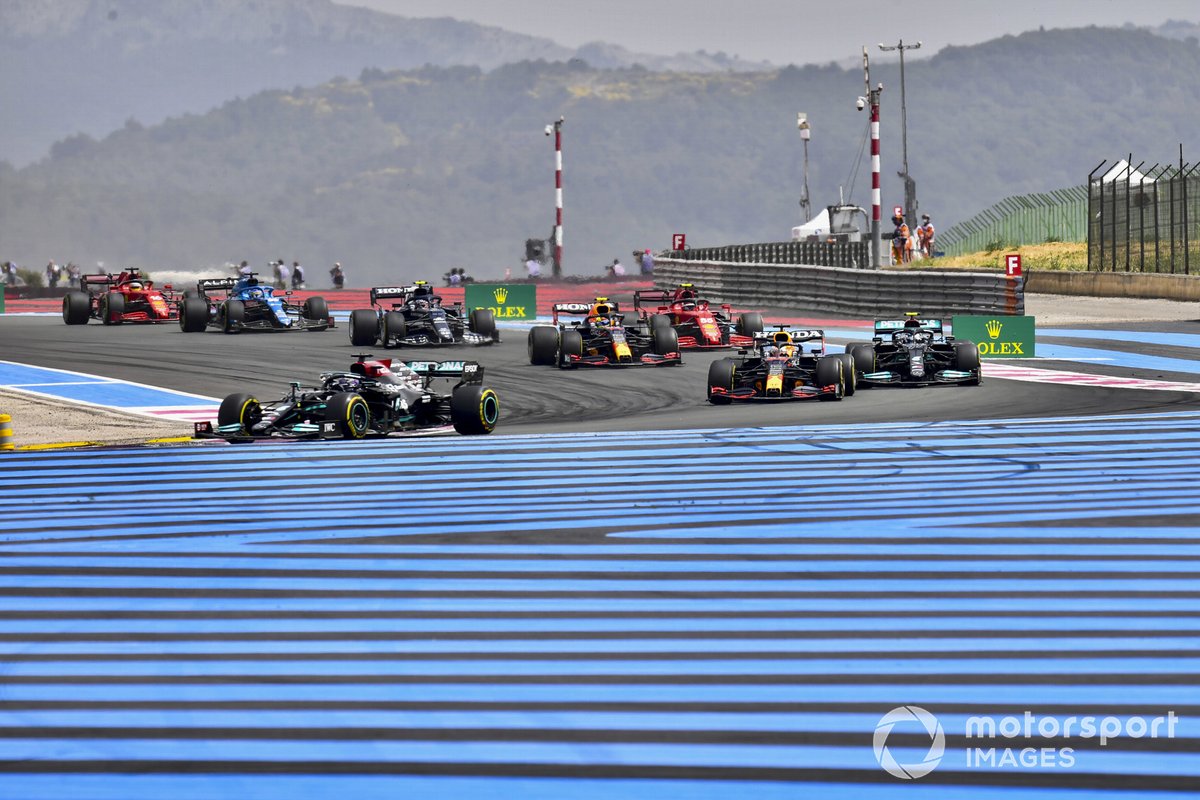
Lewis Hamilton, Mercedes W12, Max Verstappen, Red Bull Racing RB16B, Valtteri Bottas, Mercedes W12, Sergio Perez, Red Bull Racing RB16B, and Carlos Sainz Jr., Ferrari SF21
Photo by: Jerry Andre / Motorsport Images
Horner reckoned, “the tailwind down to Turn 1 was so strong it caught Max out” and indeed the Dutchman felt he was struggling to keep his RB16B under control at this point – and the corners crossing that tailwind further on in the first sector, before Turn 6 that takes the drivers back on themselves and onto the Mistral Straight – throughout the first stint.
As his title rival was somewhat flailing, Hamilton looked to be in total command up front. He’d come across the line at the end of lap one with a 1.5-second lead and over the race’s next 16 laps he edged away from Verstappen at a rate of 0.1s a lap. But Hamilton was in fact struggling, with his car feeling “just inconsistent all the way around the lap”.
The conditions on race day were markedly different to the rest of the weekend. Rain on Sunday morning had washed away the rubber previously put down and track temperatures were 10 degrees lower than they had been in the sun-soaked, critical, FP2 race preparation practice session on Friday afternoon.
Although he’d lost time to the leaders in the early laps, Perez was not completely out of position and contention for the podium places – as he had been in Spain. This time, his higher placing took away a relatively simple strategy choice for Red Bull’s rival, and would later allow his team to make the race-winning strategy call
Come Sunday, cloud cover, strong, swirling winds and the lost rubber were all playing havoc with the drivers’ tyre management tactics. Ahead of the opening pitstops, this was really hurting Red Bull. As Verstappen lost ground against Hamilton, his medium compound starting tyres were wearing out as he slid more catching the car through the unexpected gusts and as a result of the typical dirty air effect when following the leader.
Also struggling in the conditions, Sergio Perez, running fourth, had rather disappeared from the lead fight. During the laps Hamilton built his lead to maximum of 3.1s, Perez had fallen back to 10.4s behind the leader – unable to match the leading trio’s times.
“For the first five or 10 laps the car was pretty much undriveable with the wind,” Perez explained. “We obviously ran less downforce today, so it was pretty hard to keep up behind. But then the wind was getting calmer and the track was getting better, and I started to pick up my rhythm.”
Red Bull left Perez out until lap 24. But, critically, although he’d lost time to the leaders in the early laps, he was not completely out of position and contention for the podium places – as he had been in Spain. This time, his higher placing took away a relatively simple (if risky) strategy choice for Red Bull’s rival, and would later allow his team to make the race-winning strategy call.

Sergio Perez, Red Bull Racing RB16B
Photo by: Mark Sutton / Motorsport Images
But, before that moment arrived, Mercedes made several small mistakes, which added up considerably.
Bottas had pleased his team with his pace across the opening stint, being just 5.5s behind Hamilton after 16 laps and generally remaining just out of DRS threat behind Verstappen. But on lap 12 he had made a critical error.
The Finn locked up at the near 90-degree right of Turn 3 and skated straight on, cutting the inside of Turn 4 left (this was also assessed by the FIA, but it was deemed the off was punishment enough) shipping 0.9s to Verstappen on that tour. But it was the damage he’d done to his right-front medium that would prove costly.
Charles Leclerc and Ferrari then kicked off the pitstop phase by coming in at the end of lap 14, which was four laps earlier than had been estimated ahead of the race. Mercedes also had to come in earlier than it ideally wanted to because of Bottas’s lock-up and ensuing flatspot. The vibrations he picked up combined with the problem all the drivers had unexpectedly been having since the opening exchanges – the left-front tyre graining, exacerbated at long corners such as Turn 11, caused by the cooler temperatures and refreshed track surface.
“[The vibration] was starting to get to levels where we will box the car for reliability concerns,” said Mercedes’ trackside engineering director Andrew Shovlin. “The focus was on making sure that we didn't have an issue on track with him, so that was why we did it.”
Bottas pitted at the end of lap 17 to switch to the hards, when Hamilton held a 3.1s lead over Verstappen. Red Bull reacted by bringing its lead car in a lap later, with Verstappen rejoining comfortably in front of Bottas, who’d been 2.7s behind at the end of the lap before he stopped.
This was somewhat of a surprise, given Leclerc had been able to jump three places and run a net P5 - having been seventh before stopping - with a powerful undercut given his early stop. But Mercedes was in for a bigger shock yet.

Valtteri Bottas, Mercedes W12, in the pits
Photo by: Steve Etherington / Motorsport Images
Hamilton came in the lap after Verstappen – two laps after Bottas had “triggered the pitstops at the front of the grid”, according to Shovlin. His 2.2s service was 0.1s quicker than the Red Bull’s, but when the Mercedes was racing back up to speed at the pitlane exit, Verstappen was suddenly bearing down.
They raced towards Turn 1, where Verstappen atoned for his earlier error by striving to reach the turn-in point just ahead. The lead, suddenly and somewhat shockingly, was back in the Dutchman’s command.
Mercedes still doesn’t know what went so wrong, but it’s clear it badly underestimated the undercut’s power. Hamilton felt he was “definitely down on my in-lap” as “my tyres were getting worse”, and this translates into a 1m58.684s in-lap compared to Verstappen’s 1m58.099s and a loss of 0.5s. But that still does not explain how the gap Mercedes thought meant it was “safe from the undercut”, per Shovlin, had disappeared.
“We had a solid three-second gap to protect against the undercut, and that wasn’t enough. And from then on, we were on the back foot” Toto Wolff
“We can [only] account for about two and a half seconds of the three seconds,” Shovlin added.
It's just possible that hitting the gas fractionally later than Verstappen at the pitlane-exit speed limit line cost Hamilton, who Mercedes had told would have a 1.5s lead and then had to urgently update him that his rival was alongside heading into Turn 1, but it was a small thing. There was also a 0.4s difference between their overall time spent in the pitlane in Verstappen’s favour, but the undercut under-estimation had made the crucial difference, as Verstappen put in an out-lap that was 0.269s quicker than Bottas had just managed.
“We had a solid three-second gap to protect against the undercut, and that wasn’t enough,” Mercedes team boss Toto Wolff later reflected. “And from then on, we were on the back foot.”
There was indeed more pain to come for Mercedes, but its decision not to bring Hamilton in the lap after Bottas stopped, which surprised Red Bull, was because it was unsure how its opposition was reacting itself to the first, early Black Arrows stop. In the end, by making sure it “went for it” with Verstappen to cover Bottas’s undercut and try to threaten Hamilton, per Horner, Red Bull’s timing paid off handsomely.

Max Verstappen, Red Bull Racing RB16B, leads Sir Lewis Hamilton, Mercedes W12, and Valtteri Bottas, Mercedes W12
Photo by: Charles Coates / Motorsport Images
Now though, it had another tough decision to ace. Hamilton and Bottas were all over Verstappen during the initial laps on the hards, with the Dutchman getting cross with race engineer Gianpiero Lambiase for not giving him the gap to the hotly pursuing world champion when he felt he needed it each time running onto the Mistral Straight – to understand if he had to defend approaching the Turns 8/9 chicane. Lambiase ordered his charge to calm down and weather the storm.
For the first 10 laps after Hamilton’s stop, the gap between the two leaders never grew beyond 1.2s and was generally well under that. But here, once it was clear Hamilton was not simply going to storm back into the race lead, Mercedes suggested he think about preserving his rubber for a late-race attack – likely remembering Red Bull’s late-stint rear tyre woe at Barcelona.
Returning to Horner’s words at the top of this article, the Spanish race’s outcome was firmly on his team’s mind as well. By lap 28, “Max was being pushed really hard, he wasn't able to be managing the tyres”, according to Horner, and so Red Bull weighed up what it thought Mercedes was doing as well: possibly switching to a two-stopper.
“The feedback from the car was that he didn't think you'd get to the end,” Horner explained. “So, the strategist presented the options in front of me and said ‘we have got nothing to lose’. So, we pulled the trigger.”
And so, Verstappen did what no French GP winner had done since the event returned to the F1 calendar in 2018 – he came in for a second stop. At the end of lap 32, Red Bull fitted a used set of mediums and set him out on a charge to pass three cars and close an 18.2s gap to the first place he’d just given up.
Here, Perez’s position was crucial. Although Hamilton felt “the only option I really had was to stay out” and not immediately convert to a two-stopper because “again he was undercutting me, so he would come out ahead and I wouldn’t be able to get past as they were too quick on the straights”, Mercedes had actually already decided that wasn’t an option.
“Converting Lewis to a two-stop wouldn't have worked the same, because Max only just got us and we would have had to get through Sergio,” Shovlin explained.

Max Verstappen, Red Bull Racing RB16B
Photo by: Drew Gibson / Motorsport Images
Naturally, this was no problem for the net-leading Red Bull. Verstappen’s pace after his second stop was scintillating, as he trimmed roughly two seconds out of Hamilton’s lead on each of the first five times past the pits (on lap 37 he took 2.6s).
On lap 35, he’d arrived at Perez’s rear, with the Mexican playing the team game to perfection by getting off the gas between Turns 10 and 11. Considering Perez was also on different sort of charge, attempting to make his tyre-life offset advantage pay versus Bottas, this was great teamwork from Red Bull, for which Verstappen was grateful.
But battling by Bottas was by no means a given. Once Verstappen had moved up to third, Bottas was 2.9s adrift of Hamilton, having slipped back from a six-lap stint in DRS range of his team-mate following the Briton’s stop. Eight laps after passing Perez, Verstappen was within a second of reclaiming second, which was now 4.2s adrift of Hamilton, and he didn’t need a second go at getting ahead.
Verstappen started the penultimate tour 0.7s behind his title rival and, just as with Bottas, he didn’t need to make two moves. Unlike in Bahrain, where Verstappen’s offset rubber-life advantage in the final stint led to a not-too-dissimilar late surge, his sole passing move stuck
Verstappen closed in rapidly as the pair ran down the first half of the Mistral Straight, the Red Bull benefiting from its Honda engine’s power punch, DRS and the lower overall downforce level the team had opted to race with after trialling two different rear wing specifications in Friday practice.
Bottas defended the inside line into the Turn 8 left part of the chicane that divides Paul Ricard’s main straight in modern F1’s configuration, but this meant he went deep past the apex and lost momentum running through the Turn 9 second part of the complex. Verstappen was therefore able to get alongside as they exited and shot ahead on the inside as they surged through the famously fast Signes, the Turn 10 right.
Now, he had nine full laps to close the 5.2s gap to Hamilton.
“The backmarkers were not making it easy to clear them and gain a lot of time every lap,” said Verstappen. He went from taking 1.8s a lap out of Hamilton in the first five tours of his surprise third stint (during which he set the race’s fastest lap at 1m36.404s) to 0.5s in the time between he passed Bottas and caught Hamilton for the race’s decisive moment, as the leader eked out impressively strong times on his ageing hards.
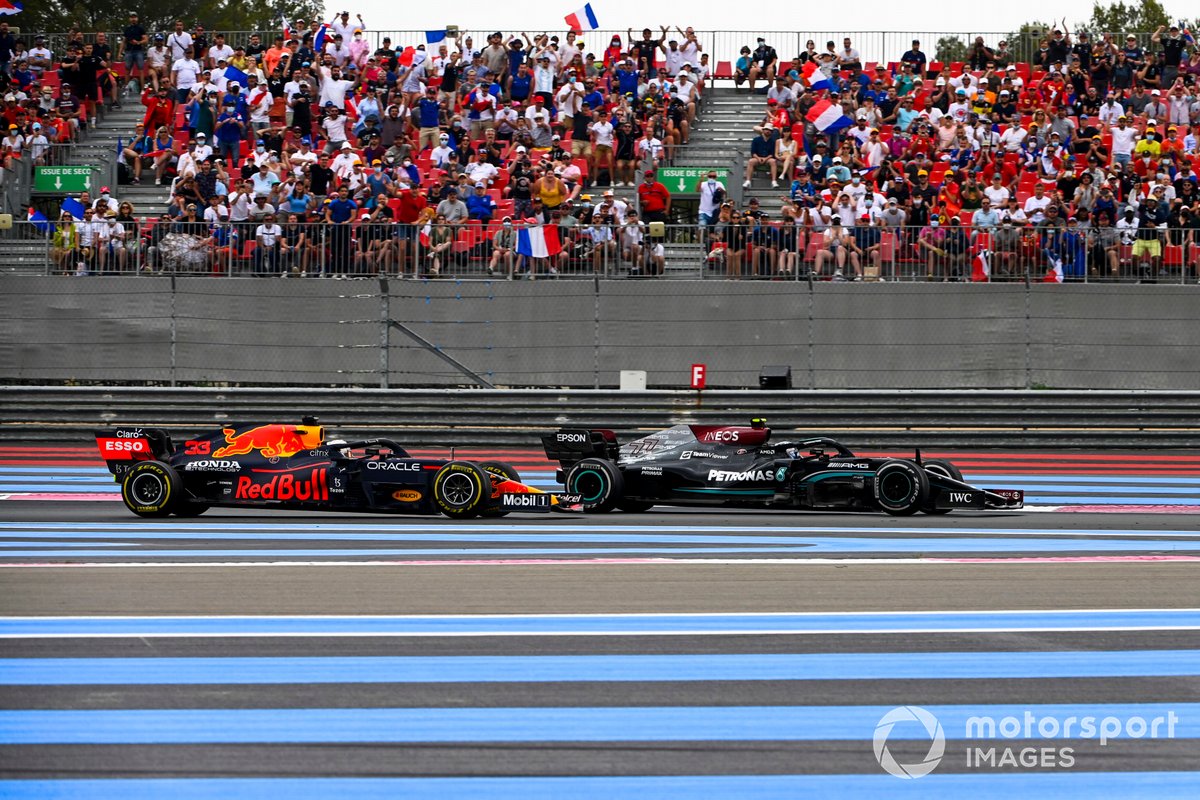
Valtteri Bottas, Mercedes W12 and Max Verstappen, Red Bull Racing RB16B battle
Photo by: Mark Sutton / Motorsport Images
Verstappen started the penultimate tour 0.7s behind his title rival and, just as with Bottas, he didn’t need to make two moves. Unlike in Bahrain, where Verstappen’s offset rubber-life advantage in the final stint led to a not-too-dissimilar late surge, his sole passing move stuck.
Like Bottas, Hamilton moved to defend the inside run to Turn 8 but thought “there’s marbles on the inside” so didn’t “want to make my tyres any worse than they already were”. Verstappen therefore stole further to the left and nipped ahead under braking for the first part of the chicane. As the crowd roared, Hamilton had felt “it was pointless to defend any harder”.
“I just had no front end,” he added. “He would have got me either way.”
Even Red Bull being unable to hear most of Verstappen’s radio messages during his third stint charge had no impact on an enthralling set of circumstances, rather familiar ones after the 2019 Hungarian GP and 2021 Spanish GP that Red Bull, for a change, had won.
“It was great to get Lewis and it was a little bit of payback for Barcelona earlier in the year with a lap and a half to go,” said Horner.
Perez had already played his part in giving Red Bull victory in circumstances where it had previously only known defeat against Mercedes, but he wasn’t finished. Between his out-lap and the end of lap 48, he’d homed in on Bottas at a rate of 0.7s a lap, and passed the second Mercedes driver – furious that his team had not also opted to switch to a two-stopper – at Signes four tours from the finish.
But this was not without controversy as he ran wide exiting the corner, which the stewards’ investigated but opted not to penalise because “the overtaking manoeuvre had actually been completed” before Perez ran beyond the Signes exit kerbs, per Masi, who added: “Once he did leave the track the stewards deemed that he gave back any lasting advantage immediately.”

Max Verstappen, Red Bull Racing RB16B overtakes Lewis Hamilton, Mercedes W12
Photo by: Mark Sutton / Motorsport Images
Mercedes did not bring Bottas in to chase the fastest lap point on fresh tyres in the hope of Perez being penalised, but it was to no avail.
Wolff reckoned his team “got it wrong” on strategy but, really, a two-pronged Red Bull had been the one able to gain through tactics. The winner was also aided by getting “back into a nice balance” on car handling by the middle of the race after “just oversteering a lot in the beginning” in the tricky conditions.
“It is sweet being the hunter,” Lambiase told Verstappen as he crossed the line, a third season win, from a second 2021 pole, in the bag. Verstappen’s lead of a championship battle for the ages is now 12 points.

Lewis Hamilton, Mercedes, 2nd position, and Max Verstappen, Red Bull Racing, 1st position, on the podium
Photo by: Drew Gibson / Motorsport Images


Why Britain’s role in Formula 1 endured a troubled start

Why Bottas believes his F1 reserve driver role is the fastest route back to a race seat

Why Norris is now ready for his final exam

The key advantage for Bottas vs Perez in the 2026 F1 return race

Why Ferrari's management is under pressure after its bad start to F1 2025, not Hamilton or Leclerc

Why Red Bull can’t solve its second F1 car problem with a simple paint job

Hirakawa replaces Doohan at Alpine for Japanese GP FP1 outing

How Alonso and Bortoleto can be F1 rivals in a unique driver management deal

Acosta's long road to his maiden MotoGP win

MotoGP Austrian GP: Acosta finally claims maiden win

Great debate: Which circuit should host the F1 2026 finale if the calendar has to change?

Live: MotoGP Austrian Grand Prix updates as it happens
Subscribe and access Autosport.com with your ad-blocker.
From Formula 1 to MotoGP we report straight from the paddock because we love our sport, just like you. In order to keep delivering our expert journalism, our website uses advertising. Still, we want to give you the opportunity to enjoy an ad-free and tracker-free website and to continue using your adblocker.


Top Comments