


How Mercedes made the “blind faith” call that won Hamilton his 100 milestone at Sochi
Until rain turned the Russian Grand Prix on its head in the closing stages, Lando Norris was set to convert his first Formula 1 pole position into a maiden win. But having recovered well from being shuffled back at the start, Hamilton and his Mercedes team called the changing conditions spot-on for a landmark 100th F1 victory

The 2021 Russian Grand Prix was a fascinating race even before its thrilling wet-weather climax, where the two leading British drivers had wildly contrasting fortunes.
Lewis Hamilton went on to take another incredible career milestone with his 100th Formula 1 win, a first for any driver in the championship’s history. Lando Norris lost a first grand prix career victory as the knife-edge call on when to pit as the rain came down in the final laps went in Mercedes’ favour for several key reasons.
The start
Norris at least leaves the Sochi weekend with one major F1 career achievement – his first pole position. That came after McLaren had made the right judgement on when to take slicks in Q3 as Hamilton and Mercedes floundered – the reverse of what was to come late in the race the next day.
But well before the late drama, Norris first had to tackle a couple of problems – the first being how to defend the lead on Sochi’s lengthy run from the grid to the first big stop, the Turn 2 right.
He’d said after topping qualifying that “probably the only place I wouldn’t want to be pole is here” and it was obvious why when the lights when out. Carlos Sainz Jr made “the best possible start on the dirty side” from alongside Norris on the front row, but as George Russell enjoyed better grip from his shock third place on the racing line, the Williams was quickly alongside the Ferrari.
But all was not lost for Sainz, as he was able to survive “nearly banging wheels [with Russell] to see who was the one catching Lando’s tow”. Sainz held firm and was able to surge into the McLaren’s slipstream, close in rapidly after the straight unfurled past the Turn 1 kink, and then swoop to the outside at the braking point.
He just got things stopped with a locked right-front to avoid taking a costly trip to the runoff – where Fernando Alonso led Pierre Gasly, Antonio Giovinazzi and the last-starting Max Verstappen through the mandatory rejoining path, and Gasly clipped a bollard.

Sainz locked up but just made Turn 1 ahead of Norris as Hamilton got boxed in on the inside
Photo by: Mark Sutton / Motorsport Images
Sainz therefore led Norris and Russell through Turn 3, with Alonso somewhat messily handing a place back to the fast-starting Lance Stroll before being overcome bravely by Daniel Ricciardo. The second McLaren had also battled by Hamilton (boxed in and then braking cautiously on the inside at Turn 2 and so trapped in the pack from fourth on the grid) as they initially chased Alonso.
Stint one, part one
In the lead, Sainz enjoyed a 1.3-second advantage over Norris by the end of the first lap of 53, after which he pulled 6.3s clear of Russell in the next 11 tours, with the McLaren still pressuring the Ferrari. The Williams driver felt he was “the fastest car on the straight” and so was able to hold back the chasing pack – which remained static once Hamilton and Sergio Perez’s Red Bull had dispatched Alonso in successive laps.
Sainz felt he was “leading the race quite comfortably for the first seven, eight laps”, but then, after a slight threat of early rain had passed, a familiar problem struck. The Saturday deluge had rather refreshed the track surface, which meant the medium compound starters – all the leaders bar Alonso and Perez, on the hards like those starting down the order – encountered front-left graining. Sainz had “so much degradation” his lead fell from a high of 2.2s at the end of lap six to 0.8s in three laps.
In clear air, Hamilton was unleashed and cut 2.243s from his own gap to Norris in the laps that followed Ricciardo’s stop before Mercedes brought him in to make the switch to the hards on lap 26
Norris subsequently had small looks at passing his former team-mate, but it wasn’t until lap 13 when he mounted a first proper attack. He didn’t need a second go, closing in rapidly in the second DRS zone and getting ahead on the outside line into Turn 12.
At the end of the following lap, Ferrari called Sainz in – wary of Stroll’s pace on fresh hards after the Aston Martin had kicked off the initial pitstop phase by making a successful undercut pass on Russell with a lap 12 stop. Despite a slow right-front change, Sainz covered Stroll, but never saw first place again.
Stint one, part two
The main reason for this was because Norris and the other remaining leaders were able to pass through the graining phase as they stayed out on the mediums. Norris, who had said his front-left was “was completely gone” on lap 12, could then set lap times (in the mid-high 1m40s) on his aging mediums that were as competitive as Sainz was doing in clear air in a gap that had opened up behind Valtteri Bottas in 10th.
For the seven laps after Sainz stopped, Norris extended his lead over the chasers – now led by Ricciardo – from 7.607s to 12.234s. Ricciardo then stopped on lap 22, with Mercedes ordering Hamilton to “box opposite” to the Australian.

Ricciardo held up Hamilton until his pitstop, after which the Mercedes was unleashed
Photo by: Andy Hone / Motorsport Images
A slow left-front change cost Ricciardo, with Sergio Perez’s 8.9s service later on adding to the series of bad pitstops that have followed the rule change clamping down on automation technology previously used in wheel changes, enforced since the summer break.
In clear air, Hamilton was unleashed and cut 2.243s from his own gap to Norris in the laps that followed Ricciardo’s stop before Mercedes brought him in to make the switch to the hards on lap 26. Norris did likewise two tours later, which put him back in free air and 8.0s clear of Sainz, with the yet-to-stop Gasly in between.
Up front, Perez led the race ahead of Alonso and Charles Leclerc, who’d gained seven places from his 19th place grid spot with aggressive positioning on the inside of the race’s first corner. He’d then been caught and passed by the charging Verstappen, but stuck with the similarly hard-shod Red Bull as it rose through the pack to just about reach the group Russell had previously been holding up.
Stint two, Hamilton’s charge
Hamilton had emerged from his stop in a pack containing Sainz, Bottas and Stroll, with his team-mate soon to exit for his own stop to swap hards for mediums. Stroll and Sainz were overcome with DRS to the inside run to Turn 2 – the latter just after Toto Wolff had come on Hamilton’s radio to give a spirited message that the win was a possibility. Gasly was quickly dispatched with another DRS blast into Turn 12.
Now there were no cars between Hamilton and Norris, only an 8.0s space. And Hamilton was conclusively quicker over the next phase of the race, eating into Norris’s lead by 0.73s per lap, even as they both passed Leclerc before the Ferrari’s long first stint finally came to an end.
Perez and Alonso pitted out of the British duo’s way on lap 36, with Norris just having reached the Alpine’s rear and heading Hamilton by 3.3s. The Mercedes driver cut the gap nearly in two over the next two tours, but then he was flummoxed.
“They were incredibly quick all of a sudden,” Hamilton said of the moment he reached Norris’s dirty air window. “He was doing a really great job.”

Hamilton zeroed in on Norris on the hard tyres, but was unable to pass the McLaren in dry conditions
Photo by: Mark Sutton / Motorsport Images
Indeed, Norris had upped his pace significantly, moving into the low 1m38s and then to the 1m37s for a string of six metronomic efforts that included the race’s fastest lap – a 1m37.423s, aided by getting DRS while lapping Nikita Mazepin.
“You need a big delta to be able to have an opportunity to overtake here,” Hamilton said of the end of his charge, which also explained why he’d been stuck behind Ricciardo early on “in no-man’s land for a long time in terms of [not really knowing] where I was in the race”.
“[The McLarens] were quick on the straights, very quick out of the last corner,” Hamilton added.
The world champion initially opted to sit back and save his tyres for a late surge. He was edging towards Norris again – on the verge of DRS range – when the race changed completely.
Key decisions in the rain
On lap 46, rain, which had been building in the Black Sea beyond the top of the circuit at Turns 5, 6 and 7, arrived.
Mercedes had Peter Bonnington persuade Hamilton to pit with multiple radio calls, which included telling him “Verstappen has pitted for inters”, as “with Max having stopped then, then he [Hamilton] is certainly keen that we shadow what he's doing”, per team trackside engineering director Andrew Shovlin
Despite Norris sliding off the road at the Turn 5 90-degree right the first time the leaders came through the shower, he actually navigated the early stages of slipperiness better than Hamilton. He pulled from 0.996s and Hamilton’s sole DRS activation to 2.087s clear over lap 48 – despite also taking to the runoff at Turn 7, which the rainfall was also hitting.
On this tour, with three-quarters of the track still dry, Hamilton ignored a Mercedes instruction to pit for inters as he “was like: ‘Yeah, but he’s right there!’ [and] I only had three laps to catch up 24 seconds, so it was like ‘no way’. I wasn’t convinced the first lap.”

After a period of indecision, Hamilton followed team advice to pit while Norris stayed out
Photo by: Mark Sutton / Motorsport Images
On lap 49, several critical small things happened that decided the race’s outcome.
Mercedes had Peter Bonnington persuade Hamilton to pit with multiple radio calls, which included telling him “Verstappen has pitted for inters”, as “with Max having stopped then, then he [Hamilton] is certainly keen that we shadow what he's doing”, per team trackside engineering director Andrew Shovlin.
Mercedes could also deduce the rain was set to intensify via information on the Meteo France-produced weather radar the FIA provides to the teams and it was monitoring the team radio messages of other cars in the Turns 5-7 sequence that contained reports confirming that situation.
It was enough to bring Hamilton in – the decision made even easier because there was a 47.3s gap to Perez in third, the Red Bull having finally just got the jump on Ricciardo and then Sainz that his long stop had earlier thwarted.
“It was just blind faith at the end there,” said Hamilton afterwards. “I can’t take credit for that amazing decision.”
Mercedes knew that at worst the decision “might leave the door open for Lando to take the win”, again according to Shovlin. But it ultimately didn’t because McLaren had played things differently when dealing with its driver.
Norris’s lap 49 had comparatively little radio communication, especially after he’d barked at Will Joseph to “shut up!” over information regarding track conditions and other cars going off in front of him. Later on, when asked what he thought about taking inters, Norris firmly opted for “No!”.

Hamilton's stop was perfectly timed, suckering McLaren into staying out in the hope that rain wouldn't get worse
Photo by: Steve Etherington / Motorsport Images
The die was cast at this point. Norris told McLaren “we've just got to commit to staying [out]” once he’d spotted Hamilton pit, with the Mercedes driver, once he’d reached Turn 2 on the inters, in turn being told he was “currently unsafe to Norris by 1.5 seconds” if the leader did pit for wet tyres at the end of lap 50. Three corners later, Bonnington told Hamilton he was then “four seconds safe to Norris” and the race was essentially won.
As Mercedes had predicted, the rain intensified and had even begun to fall heavily at the final corners – the furthest inbound from the coast – by the time Norris next came by the pits. He slithered over the kerbs here and struggled to accelerate onto the main straight, Hamilton already having gained 10s to be 15s behind with three tours left, easily enough pace in hand to catch up with time to spare.
He simply didn’t need any. The rain had reached such intensity at Turns 5-7 that drivers were being warned of possible standing water, plus heavy spray, into which Norris plunged off at Turn 5. He’d already been sideways tip-toing through Turn 3 and briefly into the runoff at Turn 4, but when he slid off at Turn 5 he came to a halt – barely keeping his left-rear out of the barriers as Hamilton raced by – into the lead for the first time.
“I decided to stay out because the team said it was only meant to be drizzling like that and that's as hard as the rain was gonna get,” Norris explained afterwards, referring to a lap 47 radio message from Joseph that stated: “This intensity will stay to the end of the race, we think” – just after Norris had reported the rain was “spitting”.
"We didn't overrule him as a team. So, that's something we need to look into to see what we could have done better because of course, in hindsight it was the wrong decision" Andreas Seidl
“For whatever reason we didn't know or see or anticipate that it was not just going to be a drizzle. It was going to be a lot of rain and that's where we went wrong at the end of the day.”
McLaren team boss Andreas Seidl explained how the final laps played out from his point of view, presenting a united front.
“It's a communication between the driver and the pitwall using all the information we have available in terms of weather forecast, what other cars are doing, trying to brief Lando and at the same time get feedback from Lando on how the track conditions are,” he said. “That's how the decision had to be made what to do – to pit or not. Lando, with the information he got from us and how he was feeling on track, he felt good staying out there on the slicks.
“And in the end, we didn't overrule him as a team. So, that's something we need to look into to see what we could have done better because of course, in hindsight it was the wrong decision we made as a team.”

Norris tumbled back to eighth after his late stop, before passing Raikkonen on the final lap for P7
Photo by: Andy Hone / Motorsport Images
Final laps produce a familiar result
Hamilton was clear in the lead, with Norris pitting at the end of lap 51 to finally take the inters. He slipped over the pit-entry lines and kerbs on his way in but escaped harsh sanction because the stewards’ ruled they did not consider “that the crossing of the painted area was intentional or predictable” in the circumstances. The long-time leader came home a dejected seventh after battling by Kimi Raikkonen on the last lap.
The winning margin in Hamilton’s 100th triumph, where Sainz ended up third thanks to being in the second group of runners to take inters, was 53.3s. But what took some of the shine off the result for Mercedes was who was second: Verstappen.
The Red Bull driver had made his dry stop on the same lap as Hamilton, from two places and 6.0s behind his title rival after his impressive opening stint – only not making a 2018 Sochi-esque climb higher in the early laps because “with the midfield being so competitive this year it’s really hard to get by”.
From there he’d made solid progress past the early stoppers but was held back by the graining on the mediums, which he’d taken at his first stop. That was exacerbated by the low-downforce rear wing he’d been given to aid overtaking and having to run close to other cars to do so, damaging the rubber further as he slid around.
Verstappen’s tyre situation meant that when the long-running Perez and Alonso finally pitted and rejoined, he couldn’t even close on his team-mate for Red Bull to enact a swap and the Alpine was able to sail by to claim sixth at Turn 2 one lap later. Leclerc had also climbed back to his rear after the Monegasque’s late dry stop had dropped him well down the order.
But the rain changed everything for Verstappen, who was seventh when it arrived.
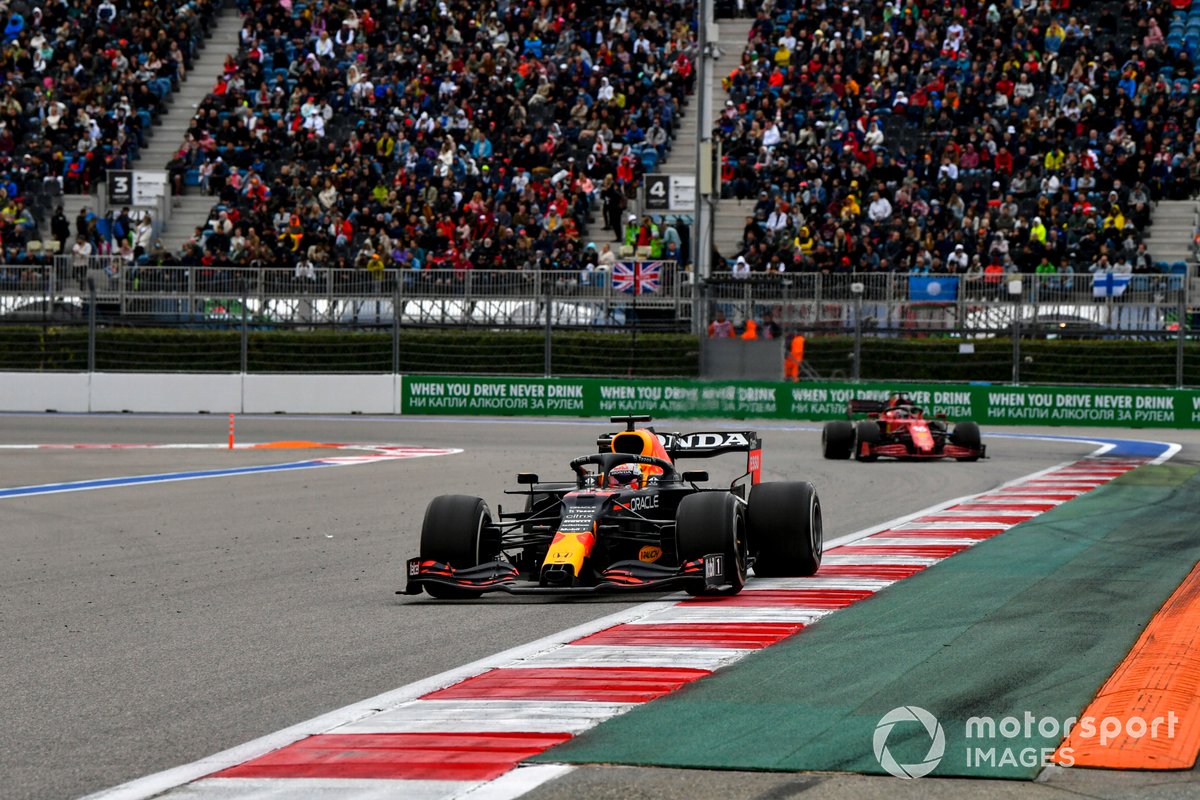
Verstappen made superb progress through the field, but was stuck in P7 before pit call helped him onto the podium
Photo by: Mark Sutton / Motorsport Images
He decided lap 47 was not wet enough to pit and “would have destroyed the inters”. That was when Russell, Bottas and Raikkonen became the first drivers to change from slicks, which helped the Finns take previously unlikely points finishes. Russell also recovered the 10th place he’d been excellently holding in the second stint despite lacking any fresh inters after his successful qualifying strategy used them up on Saturday.
Verstappen, no doubt buoyed by his sudden change in fortune, even had the presence of mind to report the conditions were “perfect for inters” – just in case the FIA was considering throwing a red flag
But after passing Ricciardo when the McLaren slipped off at Turn 7 on lap 48 (Verstappen did so too but didn’t go as deep), he plumped for the inters – finally explaining his decision approaching Turn 12 as he’d been previously engaged fighting to stay on the road to reach his radio button. A “great call”, said Christian Horner, who revealed Red Bull’s highest pre-race hope in an all-dry event was fifth.
When Perez, Alonso and Leclerc delayed their decision to pit – Leclerc disastrously opting not to come on lap 50 amid a flurry of confusing Ferrari radio messages – his path up the order was eased decisively. Verstappen, no doubt buoyed by his sudden change in fortune, even had the presence of mind to report the conditions were “perfect for inters” – just in case the FIA was considering throwing a red flag.
Norris’s late stop also moved Verstappen into second – a result Horner called “like a victory” for Red Bull on a day when Hamilton made actual history.

Hamilton now leads the standings, but Verstappen delivered an excellent exercise in damage limitation to recover second
Photo by: Steve Etherington / Motorsport Images


Why Britain’s role in Formula 1 endured a troubled start

Why Bottas believes his F1 reserve driver role is the fastest route back to a race seat

Why Norris is now ready for his final exam

The key advantage for Bottas vs Perez in the 2026 F1 return race

Why Ferrari's management is under pressure after its bad start to F1 2025, not Hamilton or Leclerc

Why Red Bull can’t solve its second F1 car problem with a simple paint job

Hirakawa replaces Doohan at Alpine for Japanese GP FP1 outing

How Alonso and Bortoleto can be F1 rivals in a unique driver management deal

How Toyota destroyed the competition to seal the WEC crowns

McLaren retains Fornaroli as F1 reserve and hands him WEC programme for 2027

How Andrew Jordan realised his teenage rallycross dream

Inside the competition building F1’s future engineering talent
Subscribe and access Autosport.com with your ad-blocker.
From Formula 1 to MotoGP we report straight from the paddock because we love our sport, just like you. In order to keep delivering our expert journalism, our website uses advertising. Still, we want to give you the opportunity to enjoy an ad-free and tracker-free website and to continue using your adblocker.


Top Comments