


How Ferrari missed its big chance to end a painful F1 wait
When Charles Leclerc built a 46-point gap over Max Verstappen after three races of the season, expectation soared in Maranello - only to deflate amid embarrassing capitulation that prompted the departure of team boss Mattia Binotto. Unreliability, strategy errors and driver errors all had their part to play as the team faced an unexpectedly close challenge to hold onto second in the constructors' standings

Ferrari has moved to replace its team principal with former Alfa Romeo boss Frederic Vasseur. That’s how badly the wheels fell off its oh-so-promising title challenge. Perplexing strategy and the legacy of ruinous unreliability were the main culprits in a highly anticipated chess match giving way to a Red Bull monopoly.
The goalposts moved for the Prancing Horse when its svelte F1-75 initially came up trumps. It was lighter than its rivals out of the blocks. That agility paid off handsomely at lower speeds and enabled strong corner-exit driveability to fire it rapidly onto the straights to keep the Red Bull RB18 and its higher top speed at bay. Although the boardroom-level expectation had been for Ferrari to be a regular race winner in 2022, a victory for Charles Leclerc in Bahrain and his utter domination in Australia soon made it clear that there was capacity to dethrone Max Verstappen to end a Maranello title drought dating back to 2008.
What’s more, a brace of fuel-system faults forced Verstappen to retire from two of the first three rounds. He was already 46 points down on Leclerc and supposing that it would take “45 races” to get back on top. Red Bull had left the stable door open, and Ferrari had seemingly bolted. There were chinks in the armour, though. The way Verstappen toppled top qualifier Leclerc at an inclement Imola and did similar at a scorching inaugural Miami Grand Prix spoke of the way the F1-75 chewed through the soft Pirelli rubber.
PLUS: How Verstappen and Red Bull went from disaster to record breakers
For that heightened tyre degradation, Ferrari had let go of a few points. But then it started to give them away almost for fun. Leclerc had capitalised on Verstappen’s off in a gust of wind in Spain. He was 13 seconds up the road and poised for a return to winning ways. Then the turbo and MGU-H packed up completely. Unbelievably, lightning would strike twice.
A 13s lead again proved unlucky when the internal combustion engine exploded spectacularly in Azerbaijan as Leclerc was trying to pull off a bold strategy. Verstappen had been handed two wins on a plate and the lead in both championships was lost for good. It was still only June.
To make matters worse for Ferrari, the Barcelona and Baku blow-ups had sandwiched a strategic shocker in Monaco. As conditions dried on Leclerc’s front doorstep, the pitwall kept its drivers out too long on full-wet tyres, dragged them in for the briefest of stints on the intermediates before finally settling on slicks. A promising 1-2 was squandered as Red Bull better navigated the drying track to help Sergio Perez to the principality spoils. Silverstone was similarly askew when a late safety caught Ferrari in the headlights. It pitted Carlos Sainz, who ended up seizing his first top-flight win, while lead charge Leclerc was left defenceless on old rubber for a late fall to fourth.
After the tumultuous reign of former team principal Maurizio Arrivabene, successor Mattia Binotto had worked hard to eliminate much of the Ferrari finger-pointing. But under this shift to a ‘no blame’ culture, no one was taking responsibility. Leclerc and Sainz cut immensely frustrated figures in the paddock, while Binotto insisted his team was getting everything right. He was protective to a fault.

Binotto defended his team but ultimately had to fall on his sword for Ferrari's failures
Photo by: Glenn Dunbar / Motorsport Images
“What would they have done differently then?” he said of the fan backlash to Silverstone. “I think the decisions we took were the right ones and the proper ones at each single time.
“We will not change people. It has been proven that what is more important in sport is stability and that we make sure we are improving day by day and race by race. We have got great people in the team, and I have no doubt on that. It takes years and experience for all teams to be at the front, and I think there is no reason why it should be different for ourselves.”
By now, the team’s strategy had become a punchline. The drivers were overriding calls to pit as Ferrari worked its way down the alphabet to an occasional ‘plan F’. And it wasn’t just the tactics that were highly questionable. A sticking wheelnut here, unready tyres there – the pitstop execution was also lacking. There was a sense that Leclerc and Sainz were wincing every time they stopped in fear of either a slow pitstop or an ill-timed one.
“It’s very simple: we need to be better at executing races,” says Sainz. “We’ve had an inherent problem in the clutch that doesn’t allow us to start well. The second point is strategy and getting the right calls and the right tyres into the car on Sunday. This is something that we’re working on for next year… It could have been a very easy year to give up on, the first half, being so far behind.”
"In terms of development, Red Bull had a clear route, which was reducing the weight of the car, which was not our case. For us, it was more complicated because it was really through aero developments and trying to improve the car from the concept. The development we did was not sufficient" Mattia Binotto
With Ferrari 63 points adrift of Red Bull after the British GP and Leclerc trailing Verstappen by 43, hope of a Ferrari return to power was fading fast. The second sprint contest of the season in Austria didn’t help, as the pitwall was again dimwitted by allowing the team-mates to delay one another in a squabble for track position as Verstappen waltzed to the spoils.
But 24 hours on, Ferrari excelled in a fashion not seen for four months. It wasn’t even close, with Leclerc passing Verstappen on track three times. The notoriously robust racer simply accepted his fate and barely put up a fight. The F1-75s were that fast. But in what had become the norm, a 1-2 was thrown away when Sainz’s machine combusted. Leclerc then wonderfully worked around a sticking throttle to seal the spoils. Few might have predicted that a Ferrari racer wouldn’t top the podium again all season.
Burdened with the pressure of carrying his clumsy team, Leclerc binned it big time in France as he tried to build a cushion to the undercutting Verstappen. And when the Red Bull protagonists gifted an opportunity in Hungary by qualifying on the cusp of the top 10, Ferrari arguably hit its nadir.
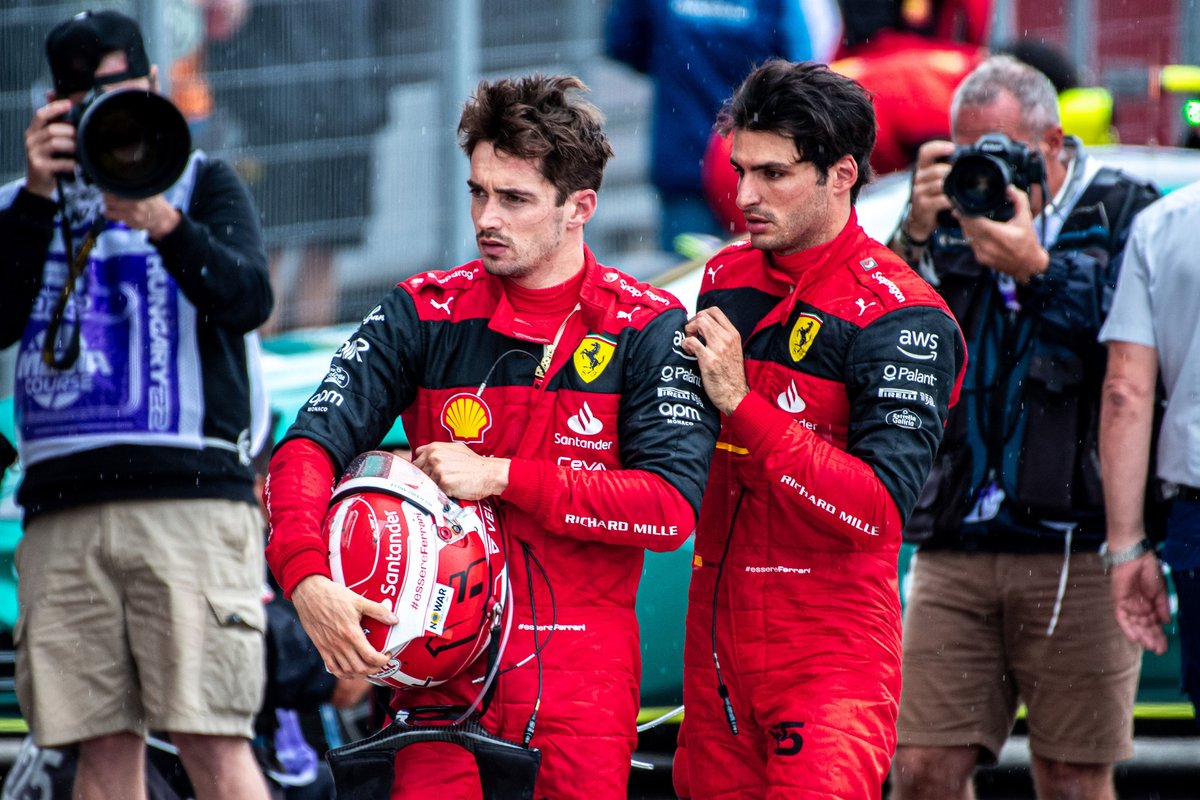
Both Leclerc and Sainz were left disgruntled by Ferrari strategy calls, which hit a low in Hungary
Photo by: Ferrari
For one, it let the out-of-sorts Mercedes W13 of George Russell nick pole. Then, to combat the recovering Verstappen, it switched both cars to hard tyres. This was an unfathomable decision. Not just because the rock-hard rubber was slow. For this critical call, Ferrari bet everything on a compound it hadn’t run for so much as a single lap up to that point in the weekend. It was going in blind.
The month-long summer break provided respite and an internal assessment. The conclusion the technical team came to was that Ferrari might further be hobbled by unreliability. As such, the engines were turned down for the rest of the term.
While the team still hadn’t fully acknowledged in public the effect of the anti-porpoising FIA technical directive that came into effect from Spa in late August onwards, the tyre-taming woes were back. Losing out in the development race owing to the constraints of the cost cap made matters worse. All told, it was only Verstappen enduring a torrid 11s pitstop in the United States and Leclerc’s chase of Perez in Singapore that remotely looked like returning a Ferrari victory.
Binotto explains: “In terms of development, Red Bull had a clear route, which was reducing the weight of the car, which was not our case. Somehow, they knew what to tackle to get performance out of the car itself. For us, it was more complicated because it was really through aero developments and trying to improve the car from the concept. The development we did was not sufficient.”
After an unmatched 12 poles, Ferrari had blown it. Verstappen was crowned the drivers’ champion in Japan, and Red Bull secured the constructors’ glory the round after. Three races in the Americas and an Abu Dhabi curtain call were all that remained. The pragmatic decision was that these should be treated as a dress rehearsal for 2023. Make sure the pitstops were perfect and strategy seamless.
The turbos being turned down even further in Mexico to create the team’s most uncompetitive showing of the season, and Leclerc being the only driver (not even his team-mate, who was carrying a grid penalty) to gamble on intermediate tyres in Q3 in Brazil, says a lot about how the dry run went…
At least a much-improved final outing, grounded in sound tyre management and an expertly executed one-stop, ensured Leclerc and Ferrari of second in their respective championships and ended the campaign on a positive note. Just not enough of one to prevent Binotto from jumping before he was pushed.

Leclerc beat Perez to the runner-up spot in the F1 drivers' standings which was small comfort to what could have been for Ferrari in 2022
Photo by: Mark Sutton / Motorsport Images
Too many cockpit calamities
Fallible pitstops, fragile power units and falling behind Red Bull in the development race put Ferrari under immense scrutiny. But Charles Leclerc and Carlos Sainz do not escape the year without blame.
Think of Max Verstappen gaffes in 2022, and errors that still prefaced wins in Spain and Hungary come to mind. As for the Mercedes pair, both notably shunted in Q3 in Austria, but those were blamed on the bucking W13 rather than slam-dunk driver errors. The scarlet duo, though, were firmly at fault in a string of high-profile spills.
Sainz’s struggles to master the twitchy F1-75 for the first third of the campaign led to him careering across the grass in Australia and beaching it in the gravel. The back end again breaking free during a greasy Imola qualifying resulted in the same outcome – even if it was Daniel Ricciardo who was at fault for knocking the Ferrari into retirement in the race. And while conditions were treacherous on the opening lap in Japan when Sainz skated off the road, he was nevertheless the only driver to find the barriers.
"I could have pushed less on some occasions, like in France… It’s more about getting the details right and being at my 100% as often as possible" Charles Leclerc
Leclerc also bagged an unwelcome hat-trick. He was much too greedy over the slippery Imola kerbs while chasing Sergio Perez, and wound up sixth instead of third. He was admittedly giving his all to offset the team’s blunders with a run at victory in France, but asked far too much of his rear tyres when he turned in too hot and too fast to ping into the wall. And, although comparatively small, it was his cutting of the chicane at Suzuka that ultimately decided that Max Verstappen had been successful in his title defence.
Asked for a self-assessment, Leclerc says: “If anything, I could have pushed less on some occasions, like in France… It’s more about getting the details right and being at my 100% as often as possible. This is where I will try to focus on next year to try and be on my 100%.
“I’m confident that whenever I’m at my 100%, I am really good.”

Both Sainz and Leclerc made critical errors to compound Ferrari's painful season
Photo by: Andy Hone / Motorsport Images


Marko: Perez improved F1 form because 2025 contract talks are at stake

Russell explains how low-fuel runs expose Mercedes F1 inconsistency

Leclerc: No answer for "once in a season" Japan F1 qualifying struggle

Sainz: Now time to "speed up" talks to find 2025 F1 seat

Hamilton: Vettel an "amazing option" as Mercedes F1 replacement

Sargeant to race repaired F1 car in Suzuka; no spare Williams until Miami

Pirro leaves role as McLaren F1 academy chief

The impatient pair who’d hoped to be a thorn in Red Bull’s side again

How Antonelli is proving unbeatable, even when he's beaten

F1 drivers push for Madring changes after "very poor" Spanish GP: "I almost fell asleep"

WRC Chile: Solberg seals victory as Toyota wraps up manufacturers’ crown

Marquez: MotoGP rivals gave me a “present” - and it tastes “sweet”
Subscribe and access Autosport.com with your ad-blocker.
From Formula 1 to MotoGP we report straight from the paddock because we love our sport, just like you. In order to keep delivering our expert journalism, our website uses advertising. Still, we want to give you the opportunity to enjoy an ad-free and tracker-free website and to continue using your adblocker.


Top Comments