


How Ferrari's F1 2026 rear wing is reminiscent of 2011 Mercedes
Ferrari surprised the F1 paddock with its rotating rear wing during testing, but that's not the only curious feature


Lewis Hamilton, Ferrari
Photo by: Rudy Carezzevoli / Getty Images
If there was one team that really surprised the Formula 1 paddock with its imaginative designs during pre-season testing, it was Ferrari.
In Bahrain, the Scuderia not only brought a new feature to the area behind the exhaust, designed to make the most of the volume allowed by the new-for-2026 regulations, but also a rear wing with an innovative opening mechanism as it flips 180 degrees.
But beyond this, there are other equally interesting aspects to explore with the SF-26, starting with the way in which the entire control system that allows the wing to move has been redesigned. To ensure a 180-degree rotation, Ferrari's engineers had to design a completely different actuator: it could no longer be the central one located on the mainplane, which would have limited movement because of the physical space it occupied.
So for this reason, the engineers integrated the actuator that controls the movement of the flaps directly inside the endplate. This is an extremely sophisticated design, which also has to withstand very high loads. Generally, rear actuators are rather bulky, to the point that some teams try to mask any losses due to the control by redesigning the central section of the last element.
It is reminiscent of Mercedes in 2011, when the Brackley-based outfit presented an actuator located in the endplates and this was controversial at the time, because it was the starting point for the German marque's eventually banned double DRS. Ferrari obviously didn't use that as the basis for developing the rotating rear wing, but it is interesting how certain concepts from the past can re-emerge.

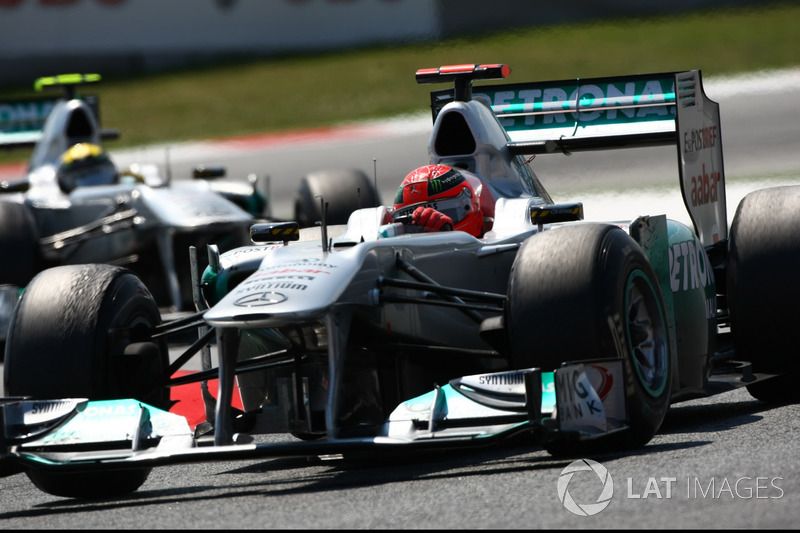
The basic concept is different, as is its implementation, as the SF-26's control system must guarantee a rotation of 180 degrees and, when closed, it must work with significantly higher loads - not only because of the higher top speeds, but also because the flaps are much larger.
Also considering that on some tracks the system will be activated up to four times per lap, it will be used more frequently than in the past, so reliability will become a critical issue. All this puts a completely miniaturised control inside the endplate to the test, which, according to regulations, must still guarantee a safety mechanism capable of returning the movable flaps to the closed position in the event of a malfunction.
To create the new wing, however, moving the actuator was not the only intervention made by Ferrari. In the comparison, it can be seen that the pivot on which the wing rotates has been moved more towards the centre, at the point where it connects to the actuator, while the end of the first element has been enlarged to accommodate this new geometry.
At the regulatory level, there was also discussion about the possibility that this wing exceeds the maximum permitted volume, especially during rotation, when at a certain point it becomes almost vertical. But the regulations, precisely because of the freedom granted to teams to reduce drag on the straights and thus limit energy consumption, have opened up new design possibilities, with the FIA giving its legal approval to the solution.
Even today, there is a volume within which the wing must remain when closed, but when opened, the regulations provide for some exceptions. Starting from a key point: the wing no longer has to remain entirely within the regulatory box during movement, thus ensuring greater freedom of rotation.


Share Or Save This Story


Alpine brings back folding rear wing at Italian GP as Gasly grabs pole

The underlying upgrade that boosted McLaren's performance jump

How Mercedes has worked to solve its F1 weakness


Ferrari not yet switching focus to 2027 F1 car

Russell and Hamilton concede F1 2026 title chances as Antonelli dominates

Hamilton and Vasseur recall GP2 title and 'most impressive race ever', 20 years on

Why F1's Madring debut was a wasted opportunity

Bruising F1 2026 will not be the end for Russell - Wolff

Haas confident of getting 2027 F1 budget closer to cap with new partner talks

Top 10 Can-Am drivers
Subscribe and access Autosport.com with your ad-blocker.
From Formula 1 to MotoGP we report straight from the paddock because we love our sport, just like you. In order to keep delivering our expert journalism, our website uses advertising. Still, we want to give you the opportunity to enjoy an ad-free and tracker-free website and to continue using your adblocker.


Top Comments