


How F1's tech restrictions could shake up the 2021 order
This year’s carryover designs initially pointed to a continuation of Formula 1’s 2020 pecking order, but now it appears that the required aero tweaks may shake things up for the entire grid
When the decision was made to shove Formula 1’s technical overhaul and return to true ground-effect cars back a year, the suggestion was that 2021 would end up as something of a holding year. But, following the condensed pre-season testing at the Bahrain International Circuit, it seems that the mandated technical changes to the aerodynamics have actually thrown some of the teams a loop. Instead of the 2020 carbon copy that many had been wary of, testing suggested that 2021 may actually offer one of the closest-fought seasons in years.
The biggest changes involve the floor, and the introduction of a triangular exclusion zone ahead of the rear wheel to strip the cars of some of the aerodynamic tools that teams used to improve the underbody downforce. The slots along the floor’s edge are gone, and the diffuser and the brake-duct winglets situated at the rear of the car have also been trimmed back to culminate in a suggested 10% downforce reduction.
Of course, some of the teams have already found ways to claw that back and, despite predictions that 2020’s cars will be the fastest for some time, testing times hint at the possibility of the 2021 machinery getting close to last year’s pace, if not surpassing it.
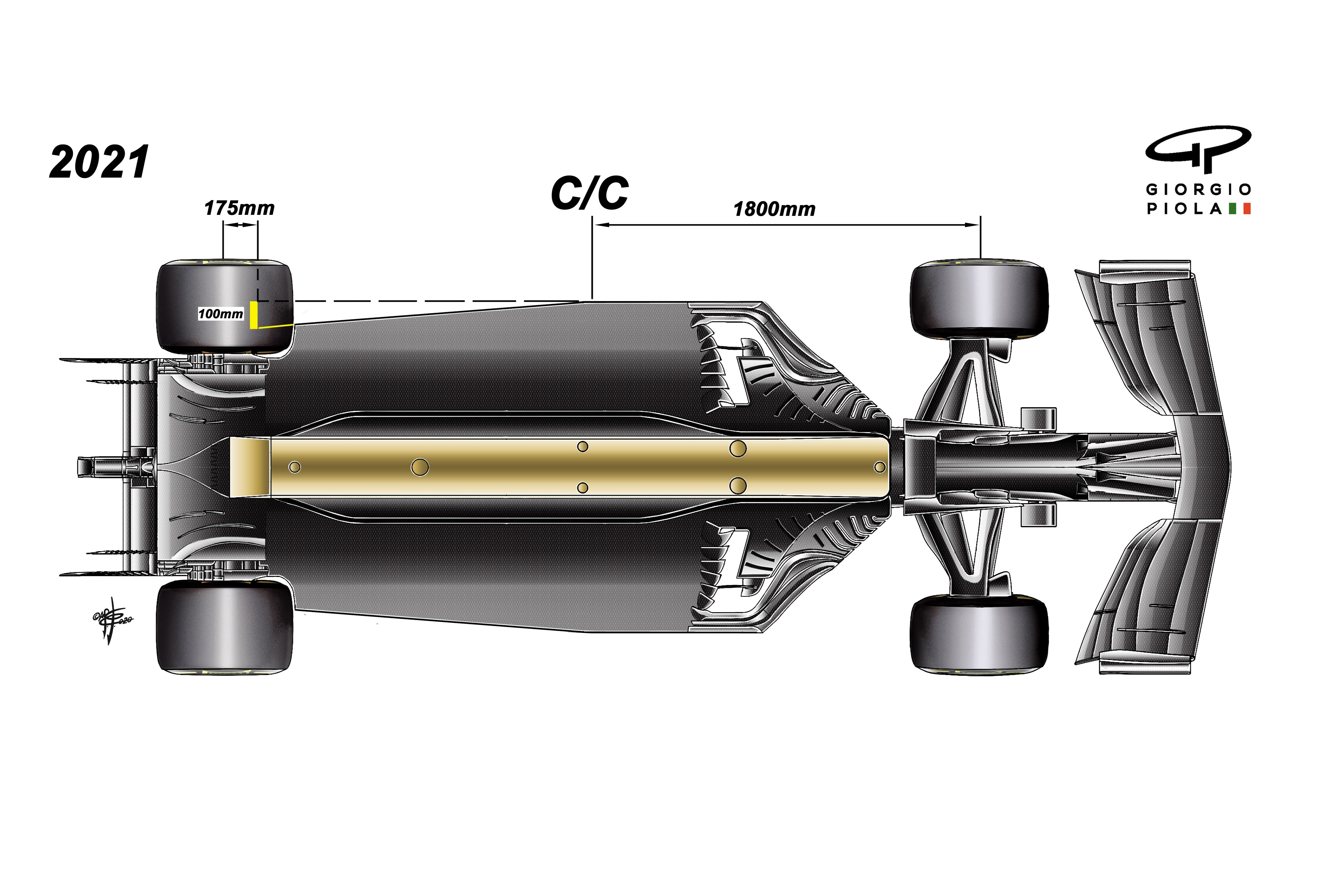
F1 2021 floor rule changes
Photo by: Giorgio Piola
Testing’s biggest story was the Freaky Friday-style reversal in fortunes for Mercedes and Red Bull. The Brackley squad’s W12 looked skittish at the rear end, and Valtteri Bottas explained that it felt “snappy and unpredictable”, while the Red Bull looked particularly stable. The original-grade RB16 was a difficult beast to tame, but the B-spec version suggests that Red Bull has sedated its bucking bronco and found a potent turn of pace.
Then there’s the midfield, which looks even more tightly compressed than last year. McLaren and AlphaTauri enjoyed an excellent weekend in the desert, while the Alpine A521 also looked to be a competitive prospect. Ferrari’s ailments from 2020, according to team principal Mattia Binotto, have been largely cured, but the team still finds itself within the midfield pack. Aston Martin endured iffy reliability but should still factor in the fight, while Alfa Romeo looks to be knocking on the door.
One interesting aspect of the current floor rules is that there seems to be no singular consensus of how best to approach them. Despite (or because of?) the loss of the various tools previously available, the teams have got creative with overcoming those challenges – and that’s what we like to see.
Mercedes versus Red Bull – a true title scrap?
As tantalising as the prospect of an actual title fight can be, Mercedes boss Toto Wolff says that the team has found the hair in the soup. Be that as it may, the Red Bull camp is particularly happy with the way pre-season testing went, and the purveyors of caffeinated fizz have certainly looked energised over the sojourn in Bahrain.
Red Bull introduced an updated rear suspension package on its RB16B, placing its tokens on updating the rear of the car, including the gearbox casing, to dial out the waywardness that plagued the team in the early part of last season. It has persevered with the split-end upper wishbones to open up the passage of airflow at the rear, placing the suspension components as high up as possible to improve its interaction with the diffuser.
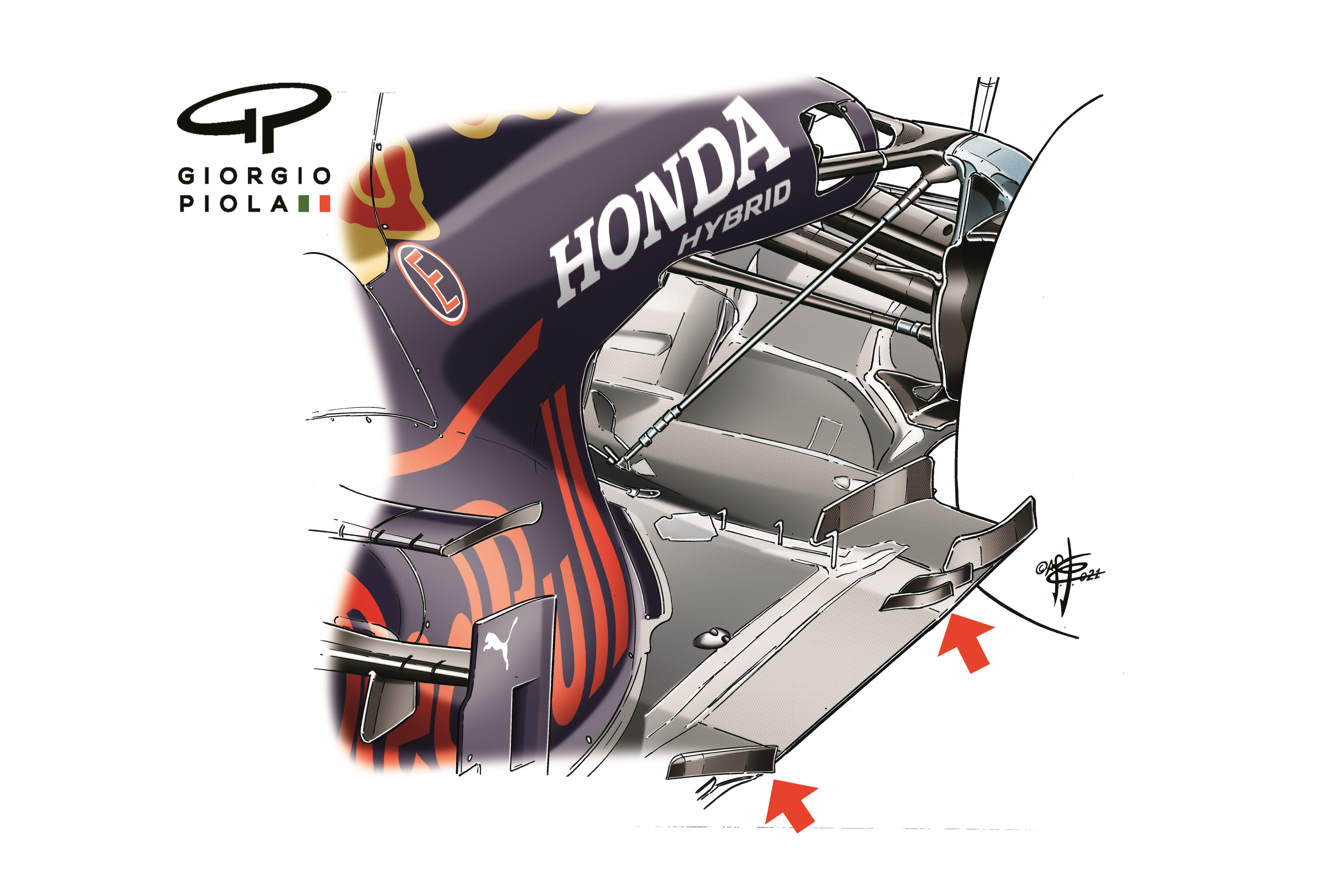
Red Bull rear suspension
Photo by: Giorgio Piola
In front of the rear tyres, the team has introduced a number of fins – three in the rear corner (above), which appear to be placed to assist with sealing off the diffuser. Further forward, a much larger fin has also appeared to aggressively turn airflow outwards, and the slight overhang in its interaction with the lip towards the front of the floor should also help to compartmentalise the clean underbody flow and any turbulence attempting to enter.
The changes at the rear have also helped the team to open up some of the floor space on top, allowing Red Bull’s aerodynamicists to help build the right levels of pressure to allow the underside to work its magic.
PLUS: How Red Bull won F1 2021 pre-season testing
Mercedes, meanwhile, has a completely different approach to the redefined floor formula. Both it and Red Bull took great pains to hide their new floors; neither team was willing to unveil theirs early and hand rivals a chance to develop their own adaptations. Nonetheless, there’s nothing to hide in testing – to some degree at least – and Mercedes eventually had to show its scalloped floor in public.

Mercedes W12 floor
Photo by: Giorgio Piola
Teams have been using scrolls in this area for years, helping to add a little extra downforce by increasing the possibility for airflow to expand underneath the car, particularly when the car is in yaw during cornering. One theory behind Mercedes’ use of five miniature scrolls (above) is that, much in the same way as a diffuser uses internal fences to ensure that it remains more effective by reducing the chance for airflow to mix and create turbulence, breaking up the scroll does so too.
It also features a square cut-off before the floor tapers in, which should introduce a tip vortex that can help to seal the floor, an addition that numerous teams have pursued. The bank of fins at the rear suggests that pursuing the outwash path is still in vogue to extricate dirty airflow away from the diffuser zone. At the front, Mercedes also flipped its brake ducts (below) upside down, which should interact better with the front-wing geometry.
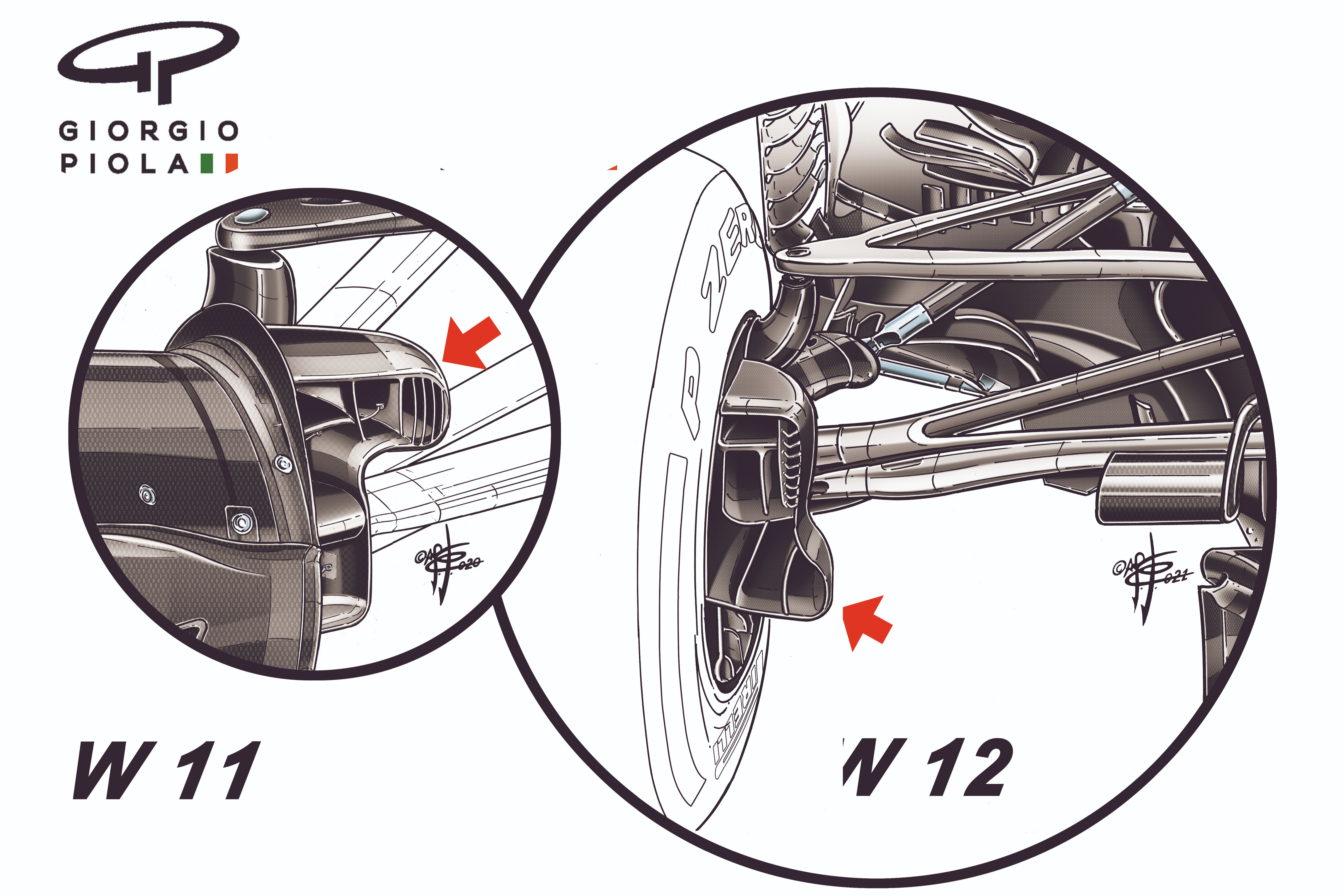
Mercedes W12 brake ducts
Photo by: Giorgio Piola
McLaren and AlphaTauri push the limits
The constructors’ championship positions between third and seventh could, theoretically, fall in any order. If McLaren continues its progress, having enjoyed a successful test, there’s every chance that it could repeat that feat from 2020.
You’d have forgiven McLaren for enduring a few teething problems during the Bahrain test, as switching to a new engine supplier and adapting a car to fit it is hardly the work of a moment. But the MCL35M showed no signs of that being the case.
The team was also responsible for one of the more high-profile tech finds of the Bahrain prelude, having found a workaround to the new diffuser restrictions. The FIA had made the decision to trim the fences within the diffuser by 50mm to reduce its overall effectiveness, pairing that with the floor-size reduction to inhibit downforce.
McLaren, however, found a way to embed the fences in the central part of the diffuser (below), dropping below the 50mm cut-off to find extra performance. It seems that, by shallowing out the centre part of the diffuser, McLaren has found a space to fit those added fences in. The area that the fence height applies to is from 250mm either side of the centreline of the car, and so it seems that the design is very much legal – in fact, the other teams have reached that consensus too.
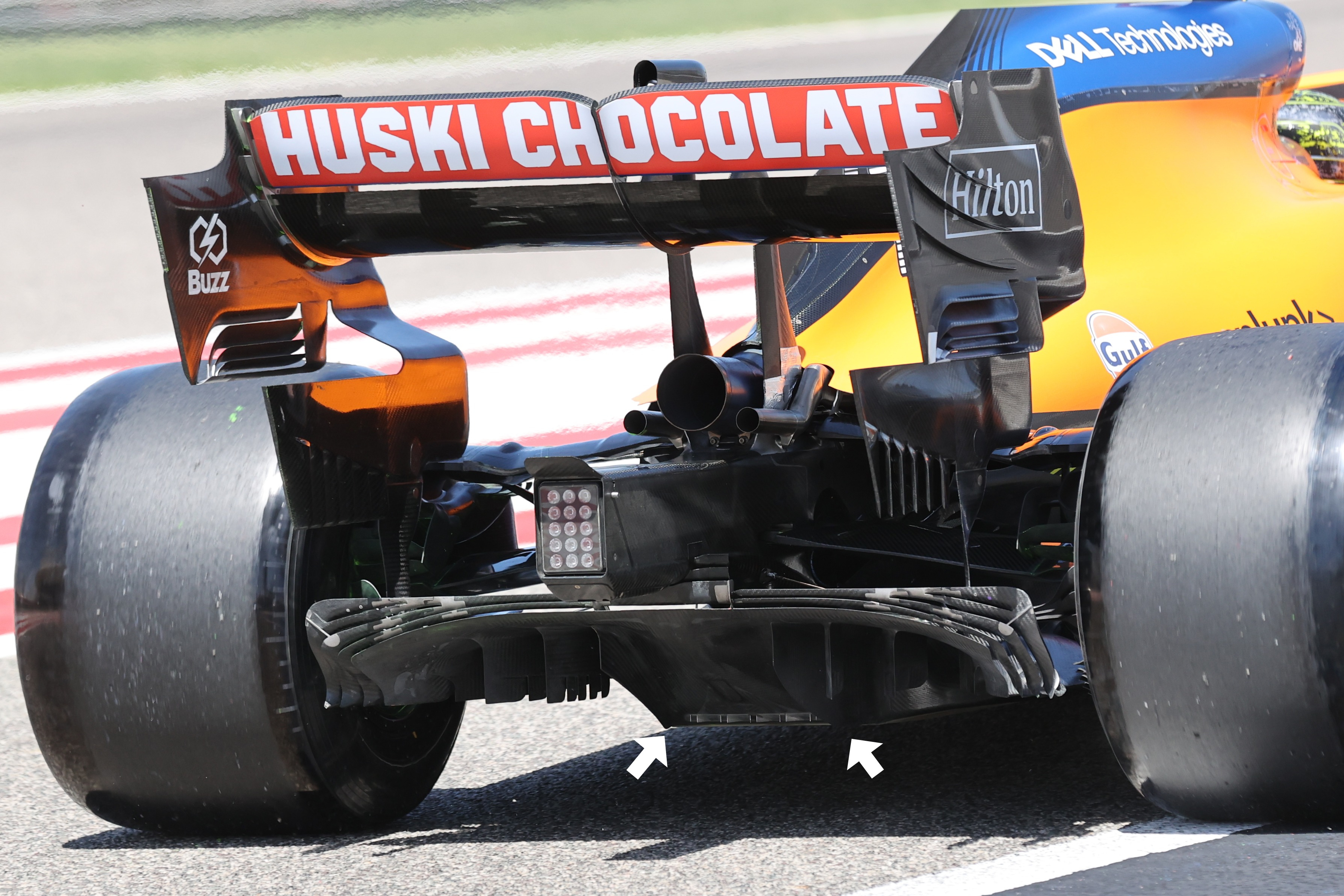
McLaren MCL35M
AlphaTauri also impressed in testing, as the AT02 looked to be a very benign-handling car that also proved to be reliable. Logging 422 laps – the joint most with Alfa Romeo – the Italian team has started 2021 in a surefooted manner, culminating in rookie driver Yuki Tsunoda setting the second-quickest time of the test, a tenth off Max Verstappen’s 1m28.960s headline time.
The team put its tokens onto its new nose, opting for a more tapered design without the thumb-tip crash structure used in recent seasons. Although the team therefore could not use tokens to change the front of the chassis and introduce the entire Red Bull front-suspension package, which uses a double-bulkhead arrangement to fit a continuous lower wishbone, it has taken the Red Bull concept from last season and adapted it for its own purposes.
AlphaTauri can buy in Red Bull’s 2020 suspension without using any tokens, as it is already a homologated component, but must use it in a way that does not require any changes to the chassis. It modified the position of its steering arm, although steering geometry can be changed free of tokens, so long as it doesn’t affect the inboard part of the suspension. It has ditched the split upper wishbone for a more conventional conjoined version, but has seemingly followed Red Bull’s lead in introducing the split lower wishbone, although it seems that the two legs connect within the wheelhub.
The rest of the midfield fight
Now dressed in its striking new blue livery, Alpine also looked strong – if a little under the radar at times. One of the most talked-about aspects of the car was its large air-intake assembly, and Alpine spent its tokens on fixing up the rear part of the A521.
By reducing the size of the sidepods, Alpine crammed some of its cooling solutions within the airbox to draw comparisons to the Ligier JS5 – helpfully fuelled by the similar colour schemes.
In truth, the previous Renault RS20 engine cover had been pretty massive, but was masked slightly by the black colour scheme, but the 2021 car has taken that a step further. Alpine executive director Marcin Budkowski quipped that he was “surprised by the amount of body-shaming” of the 2021 car, but explained that the team found more gains by slimming down the sidepods and, even though there was the danger of upsetting the car’s centre of gravity, the aerodynamic benefit offsets that.
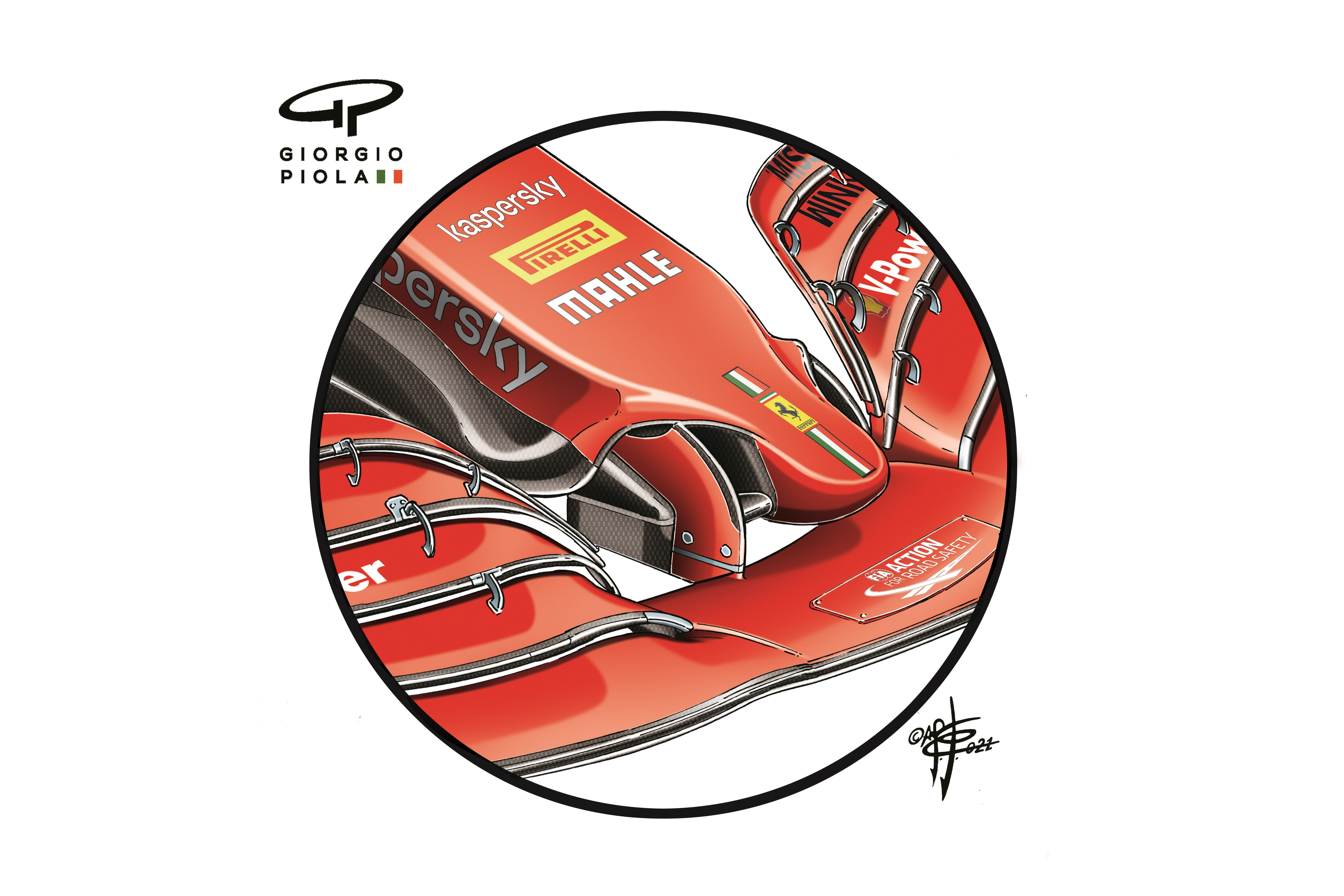
Ferrari SF21 nose
Photo by: Giorgio Piola
Ferrari logged a lot of laps too and, although the team had put a lot of effort into redefining the rear end in tandem with its engine, it also made a number of changes at the front, reshaping the nose without the use of any tokens. Moving the mounting pylons (above) further inboard opened up the cape section alongside the nose, also assisted by the more gradual transition to the tip of the crash structure.
But the team also found a space at the rear to place a series of fins on top of the floor ahead of the diffuser. These direct airflow slightly outwards, and this can guide it into that space next to the rear tyre and attempt to attack head-on the turbulence produced by the tyre drifting inwards. This should help preserve the rear-end downforce.
Aston Martin, for all the fanfare with its green livery, endured a tricky weekend at the Sakhir circuit. Gearbox and turbo-boost issues plagued Sebastian Vettel, although Lance Stroll was able to put some healthy mileage on the AMR21. It, like Mercedes, opted for an aggressive approach towards the front of the floor (below), although was in a less-rippled formation compared to that of its engine supplier.
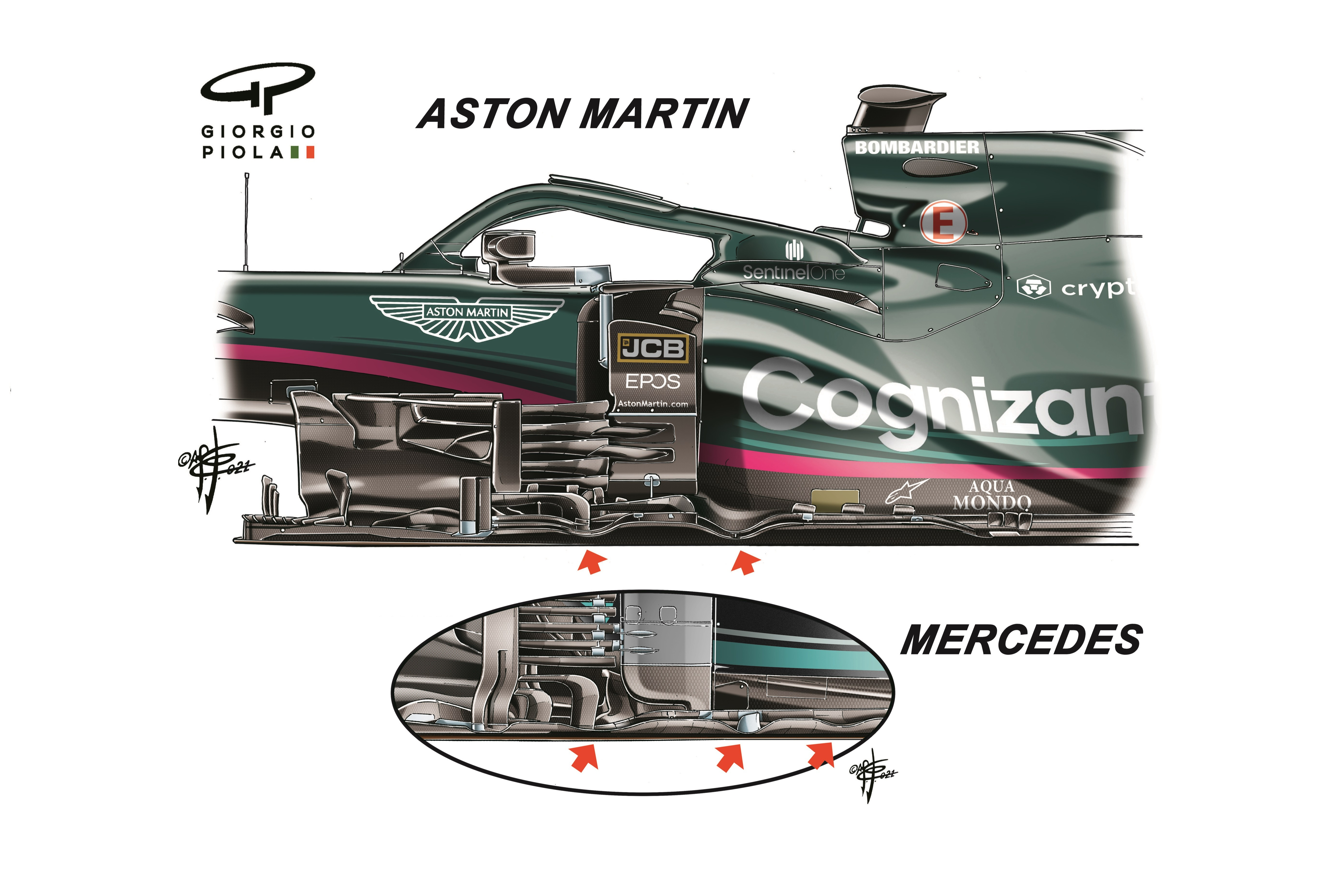
Aston Martin and Mercedes comparison
Photo by: Giorgio Piola
The team has also poured a lot of resource into its redefined bargeboard package over the winter, given its transition to the higher-mounted inlets ahead of the new season. Like many, it has opted for the Venetian blind-style array of winglets mounted to the sidepods, which should provide a slight downforce boost and help with the movement of airflow down the car’s flanks.
Alfa Romeo, too, could theoretically factor at the lower end of the midfield battle on a more regular basis. The team has a new nose and has also worked at the rest of its front end; the front-wing endplates now feature a footplate slot, looking to add to the effective surface of the endplate and improve its outwash capability. Although Kimi Raikkonen’s Sunday best lap was on low fuel, the Finn says his first impressions of the C41 are much better than last year’s car, so the team should, theoretically, move forward a bit.
The battle against the wooden spoon
Williams looks in better nick this season, after putting its tokens into the car’s internal components to slash weight, so the team now has ballast to play with. Its bargeboard array looks more complex than last year’s, and Williams has also redefined its front-wing package, as it seems to be focusing on controlling the air nice and early.
The team has admitted that it has created a deliberately wind-sensitive car to extract more performance when the conditions are more serene. “We’ve opted to go down a bit of a route to give more downforce at the expense of being a bit more sensitive,” George Russell explained. “Ultimately, we recognised that we only need a couple of [good races], and if we were consistently at a set pace, as we probably were last year, we consistently won’t be scoring points.”
Haas, meanwhile, has done very little with its 2021 package. The VF-21 seems to be, essentially, the VF-20 with the new floor (below), although it seems that a few new bits and pieces will arrive for the opening round. The American team is focusing on 2022 off the bat, and therefore elected to spend none of its allotted tokens on the car that scored only three points last year. If Williams can make the most of the days on which its car can excel, then Haas, by standing still, may go backwards.
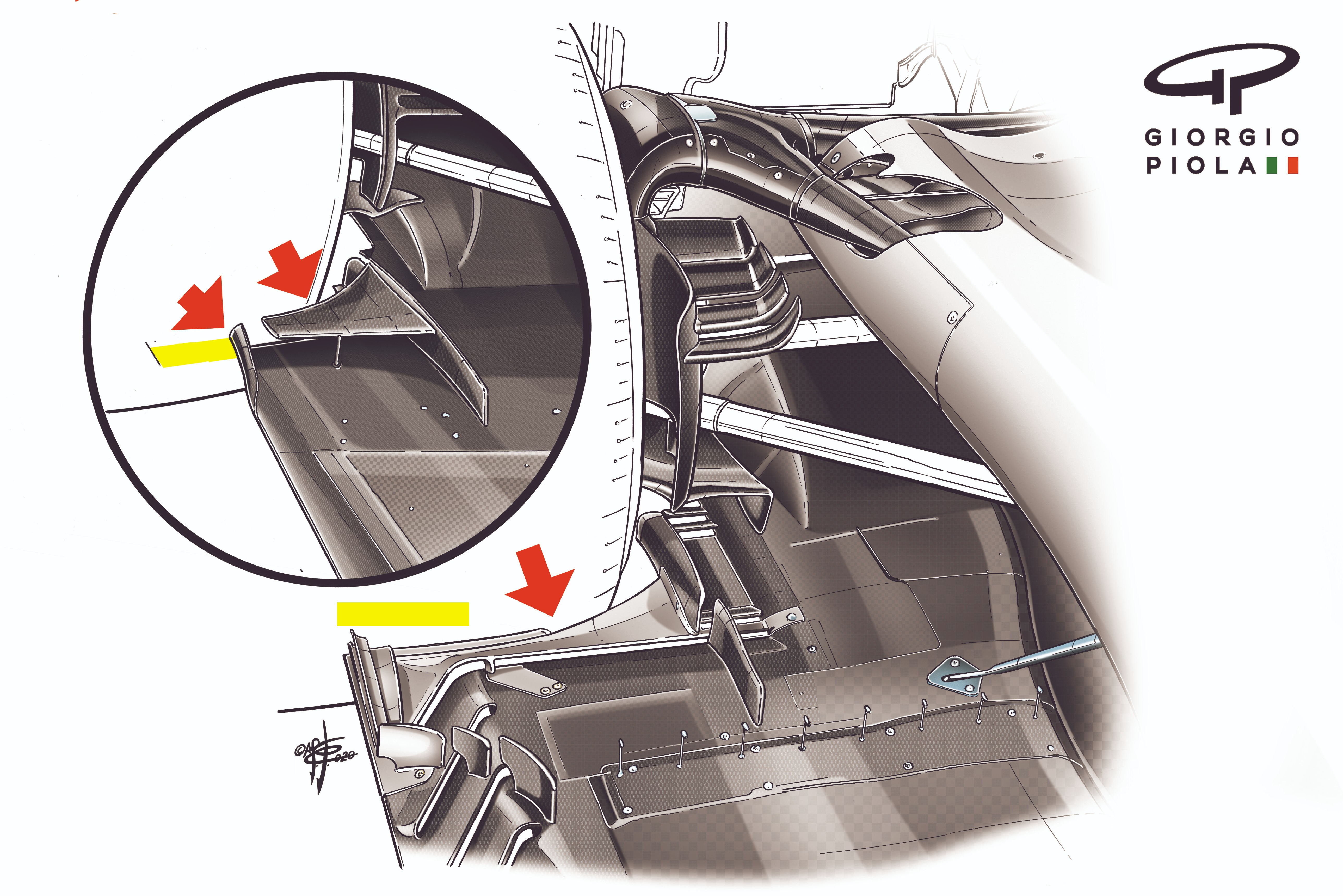
Haas VF-21 and VF-20 floor comparison
Photo by: Giorgio Piola


Bahrain Grand Prix in Malaysia Driver Ratings 2026

The slick tyre gamble that hurt McLaren and Ferrari's chances in Bahrain GP in Malaysia

The wide world of strategy options expected in F1's Bahrain GP in Malaysia

McLaren explains recurring Norris straightline speed issue after Bahrain GP qualifying

How drivers waiting in the wings can still make their presence count in F1

What we learned from Friday practice at the 2026 Bahrain GP in Malaysia

Mercedes introduces new floor, sidepods for F1 Bahrain GP

The problem with Ferrari’s endless team principal speculation

Six champions crowned, new winners and lap records fall at Castle Combe

How Evans made WRC history in Hollywood blockbuster Sardinia decider

The dire consequence of Russell's Bahrain GP in Malaysia retirement

Whales glide to victory in Equipe Silverstone Super Sprint event
Subscribe and access Autosport.com with your ad-blocker.
From Formula 1 to MotoGP we report straight from the paddock because we love our sport, just like you. In order to keep delivering our expert journalism, our website uses advertising. Still, we want to give you the opportunity to enjoy an ad-free and tracker-free website and to continue using your adblocker.


Top Comments