


How F1 finally cracked America
The United States hosts two Formula 1 races this year, expanding to three in 2023, and has become a keystone of F1 owner Liberty’s strategy – thanks to a certain fly-on-the-wall docuseries and avoiding the mistakes of the past

A quarter of a million people pre-registered to buy the 80,000 available tickets for this weekend’s inaugural Miami Grand Prix. Little wonder they have since been trading for over $2000 – that’s 150% more than a grandstand seat at Austin’s Circuit of The Americas, which attracted 400,000 spectators last year for the US GP. They are selling for nearly seven times the cost of entry to the Indianapolis 500, and eight times the fee to see the Daytona 500 – the blue-riband IndyCar and NASCAR events that, last century, went a long way to capping Formula 1’s US appeal.
It’s the first time since Dallas and Detroit in 1984 that two American rounds have featured in a single F1 season. A night race on the iconic Las Vegas Strip will then join the calendar in 2023. For that, in an extraordinary move, F1 and its owner Liberty Media will promote the race rather than hand responsibility to a local organiser.
The relationship between F1 and the US is far more interdependent than when ex-McLaren team principal Martin Whitmarsh declared ahead of the maiden Austin race in 2012: “We have to remember, America doesn’t need F1.” Now, it has an almost unquenchable thirst.
As the championship enjoys a global popularity boom, cracking the US market has been the flagship success story. It’s been a remarkable turnaround under Liberty Media, which agreed to buy F1 from CVC Capital in September 2016 for £3.3billion. The series now generates half that figure in revenue every year. If Liberty Media wanted to sell up, the value of F1 would be closer to £10.5billion.
ANALYSIS: Why the Miami Grand Prix weekend will be a game changer for F1
The Colorado-based media conglomerate’s first order of business was to establish F1 on its home soil and with a new generation of fans who didn’t remember the 2005 United States GP aberration. Problem was, Liberty took control when all motorsport was suffering a low ebb in the US.

250,000 fans applied for 80,000 Miami GP tickets when the F1 race was announced
Photo by: Sam Bloxham / Motorsport Images
ESPN didn’t renew its contract with NASCAR at the end of 2014, bringing its 30-year coverage to an end. It did similar with IndyCar ahead of the 2019 campaign. Liberty, therefore, offered an adapted version of Sky Sports’ (which paid £1billion for the exclusive UK rights deal) package to ESPN for free to get as many eyeballs as possible. Then came what has been termed “the most effective content campaign in history”.
On 8 March 2019, Netflix subscribers were offered a new documentary series called Formula 1: Drive to Survive. In an inadvertent masterstroke, Mercedes and Ferrari weren’t involved, so the production focused on the cut and thrust of the midfield. Remarkably, given the rewards F1 has reaped, Netflix has been paying for the privilege of filming in the paddock.
Haas driver Kevin Magnussen, who featured in the first three seasons of the smash-hit show before racing in IMSA SportsCar in the US last year, says: “I feel like American motorsport fans and the public in general have discovered Formula 1 from Drive to Survive. That really made an impact.
"There’s a growing love in the States. There are massive sporting fans out there. Miami is going to be an experience for all of us" Lewis Hamilton
“When I spent time over there at the races or in the cities, I met a lot of people who said they saw me on Drive to Survive. You really feel that impact there. It’s going to be cool to be in Miami. We already know what kind of demand there is for that race. Austin last year was crazy as well.”
Since Drive to Survive first aired, the American audience tuning in to F1 races has risen 40%. In the time the 40 episodes have been filmed, edited and uploaded, F1 has logged seven of its 10 most-watched races in history. There’s more.
According to TV ratings number-cruncher Nielsen, F1 gained 73 million fans in 2021. The ‘Netflix effect’ was credited as the main driver for that 20% rise. And so far, it doesn’t appear as though audience apathy has crept in as record viewing figures were reported for the fourth series.
F1 and teams’ marketing departments worked rapidly to ride the crest of the wave as drivers popped up all over. Seven-time champion Lewis Hamilton was in the company of Barack Obama, Jay-Z and Kim Kardashian by being the focus of an episode of My Next Guest Needs No Introduction, hosted by IndyCar team co-owner and US talk show behemoth David Letterman. Similarly, Daniel Ricciardo starred in of a couple of GQ Sports videos that racked up millions of YouTube hits as he revealed ‘10 things he can’t live without’, and analysed the fakery in famous movie driving scenes.
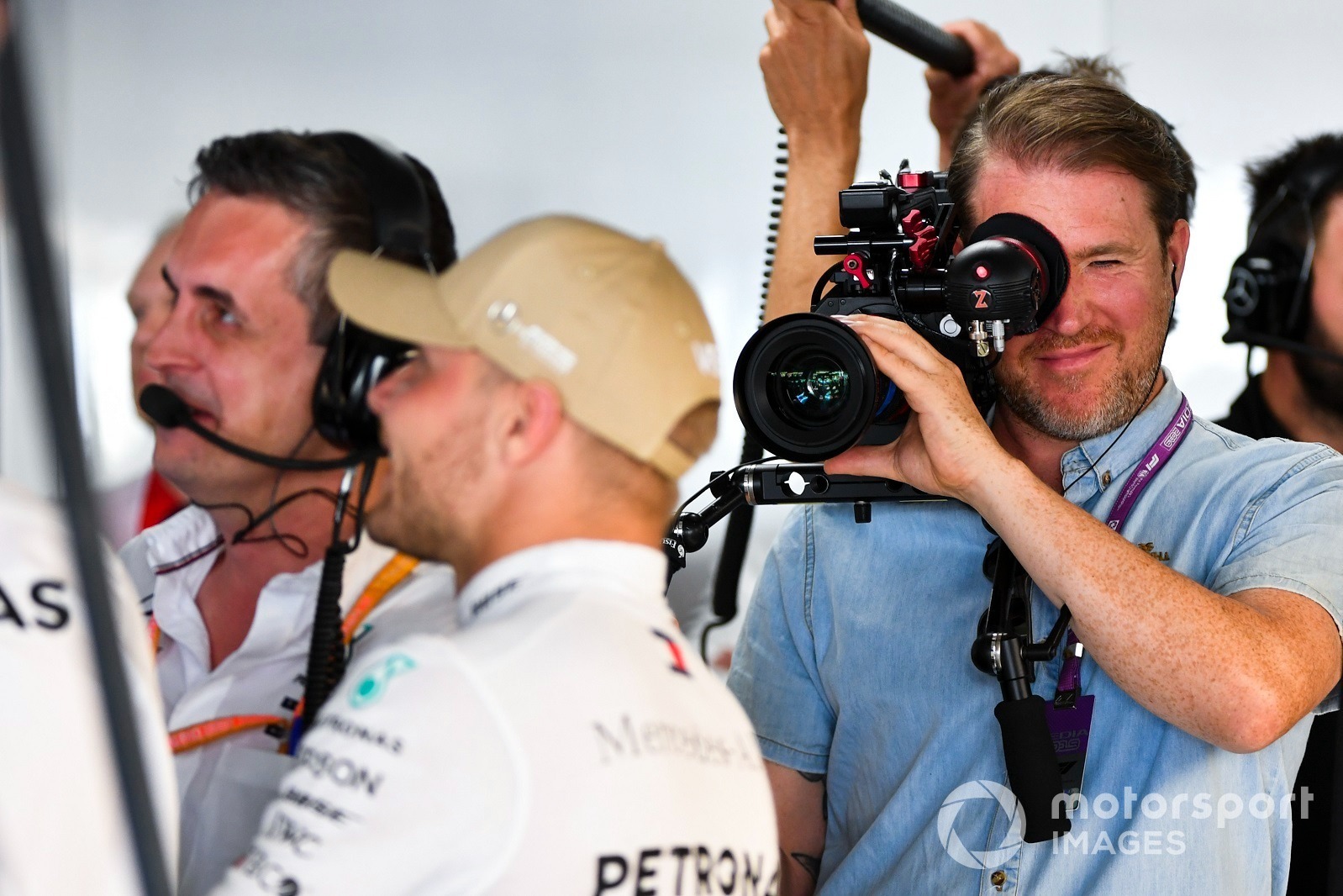
The Drive to Survive effect has been credited with a huge rise in F1 interest in the US
Photo by: Mark Sutton
On terrestrial TV, the Australian was also a guest with Ellen DeGeneres and Trevor Noah. He was alongside Max Verstappen and Valtteri Bottas when, as part of the Jimmy Kimmel Live! chat show, remarkably, they shut down Hollywood Boulevard for an F1 car demonstration. More recently, Ricciardo was joined by McLaren team-mate Lando Norris, Pierre Gasly and Esteban Ocon for a Vanity Fair feature.
That means an average American Netflix viewer might have binge-watched Drive to Survive, seen their favourite driver feature in a viral social media campaign, then watched them on a primetime chat show. Curiosity piqued, they have ultimately tuned into the live F1 race broadcast at the weekend. That’s been the end goal for Liberty.
For those new fans, there could hardly have been a better time to watch given the titanic title battle that played out between Hamilton and Verstappen last year. And while the finale in Abu Dhabi descended into farce, it might be judged the perfect blockbuster climax to entice and retain viewers.
In 2021, according to Disney-owned ESPN, the average US audience per race was 949,000. That made it the most-viewed season in history as a 56% rise was chalked over 2020. Critically, the key 18-34 age group had swollen. The round-by-round numbers have only gone in one direction, too. A week after a record-breaking audience tuned in to the 2022 F1 opener in Bahrain to witness the dawn of the second ground-effect era, the Saudi Arabian Grand Prix surpassed it.
ESPN’s audience peaked at 1.82million viewers for the Jeddah event. That was 54% greater than the maiden 2021 Saudi contest, despite this time it not being at the business end of a title fight for the ages or a contest in which the main championship protagonists collided. Only the 1995 Brazilian GP has garnered a bigger audience, when people then turned over to see how the life of Ayrton Senna would be celebrated in a race won by Michael Schumacher.
As the mass oversubscription for tickets for Miami and COTA – the Texan track has increased its capacity with larger grandstands in the final sector – also reveals, the TV attention is being converted to bums on seats. One of the many impacts of the pandemic is that, while lockdowns have forced people to remain indoors and resort to Netflix, as restrictions ease there has been an insatiable appetite to attend live events. The 420,000-strong weekend attendance at the Australian GP last month, the first F1 race in the country since 2019, is testament to that.
PLUS: Why the Miami GP is a central chapter of F1 2022's biggest storyline

COTA recorded its biggest-ever F1 crowd for last year's United States GP
Photo by: Mark Sutton / Motorsport Images
F1 has come an incredibly long way since it quietly departed the Indianapolis road course for the final time in 2007. Hamilton, winner of that Indy swansong, says: “Growing up knowing how amazing this sport is and seeing there was still quite a disconnect between the US and the rest of the world in terms of the passion for this sport, it’s really amazing to see that finally we’ve cracked it.”
The Briton, who has the biggest social media following of his contemporaries and is reportedly in talks with Brad Pitt to produce an F1-based movie, continues: “There’s a growing love in the States. There are massive sporting fans out there.
“Miami is going to be an experience for all of us, for the racing community, for the fans out there that are watching, the fans that are going to be flying in that maybe have never been there before. The US has a lot to offer in that space. It’s super-exciting.”
"To think that next year we’re going to have three races in the US, if you think back a couple of years, you would say you are crazy" Stefano Domenicali
Cynics might argue that F1’s time as a Stateside sensation is finite. The bubble might burst, given the poor critical reception copped by the ‘poetic licence’ in the fourth season of Drive to Survive. Netflix’s stock price also fell 35% in April when it projected a loss of 2 million subscribers, the abatement of the pandemic cited as a factor.
But Stefano Domenicali, not unexpectedly, disagrees. Summing up the US growth, the F1 CEO says: “If you think where we were three years ago, it was difficult to have one [US] grand prix full of people. Now we are heading to a situation where this year we are going to have two events totally sold out. It’s giving you the magnitude of what the US will represent for Formula 1. We feel the vibes, we feel it is really something that needs to belong to this country. This is a huge opportunity.
“To think that next year we’re going to have three races in the US, if you think again back a couple of years, you would say you are crazy. We are focused on making sure this would be one of the most important markets for F1, not forgetting of course that we were born in Europe, and we are a worldwide sport.”
With Michael Andretti and his investors sniffing around to buy a team, and the consistent links that IndyCar race winner Colton Herta has to an F1 race seat, the interest has plenty of potential to remain. That could help write another chapter in America’s hate-love story with F1.

With F1's interest in the US on the rise, can it be sustained?
Photo by: Andy Hone / Motorsport Images


Marko: Perez improved F1 form because 2025 contract talks are at stake

Russell explains how low-fuel runs expose Mercedes F1 inconsistency

Leclerc: No answer for "once in a season" Japan F1 qualifying struggle

Sainz: Now time to "speed up" talks to find 2025 F1 seat

Hamilton: Vettel an "amazing option" as Mercedes F1 replacement

Sargeant to race repaired F1 car in Suzuka; no spare Williams until Miami

Pirro leaves role as McLaren F1 academy chief

The impatient pair who’d hoped to be a thorn in Red Bull’s side again

Mekies extends contract as Red Bull's F1 team boss
What to expect from WEC's Barcelona debut

Acosta proposes new idea for monitoring tyre pressure in MotoGP

Horner's inside story of how Red Bull built its own F1 engine
Subscribe and access Autosport.com with your ad-blocker.
From Formula 1 to MotoGP we report straight from the paddock because we love our sport, just like you. In order to keep delivering our expert journalism, our website uses advertising. Still, we want to give you the opportunity to enjoy an ad-free and tracker-free website and to continue using your adblocker.


Top Comments