


How Aston Martin broke into F1’s lead pack
Three podiums in the first three races of the 2023 Formula 1 season demonstrates the extraordinary progress that Aston Martin has made. Financial muscle to fund an extensive recruitment drive, an aversion to technical arrogance and the impetus of a highly motivated double world champion have seen the green team join the frontrunners

For most people fortunate enough to attend the 2022 and 2023 editions of the Australian Grand Prix, the two events appeared very similar. Dominant winners in the forms of Charles Leclerc and Max Verstappen, their glory secured in front of packed grandstands and a party atmosphere banishing the hideous pandemic memories in Melbourne.
Although Leclerc and his Ferrari squad had little to celebrate this time around, their negative 12-month turnaround was nothing compared to the positive progress secured by Aston Martin in the opposite direction. Earlier this month, behind Verstappen and Lewis Hamilton, Fernando Alonso secured a hat-trick of third-place finishes, with Lance Stroll eventually classified fourth in the other AMR23.
Even in Friday practice, Autosport had been keeping an eye on the green machines thrashing around Albert Park. They had been there or thereabouts with Red Bull, if not occasionally leading it, in the on-track sessions from the first two rounds of 2023.
“Can you believe it?” Autosport’s Supercars correspondent Andrew van Leeuwen asked as we wandered down to climb a photographer’s tower overlooking the opening corners. “This time last year those blokes couldn’t even keep it on the road, remember?”
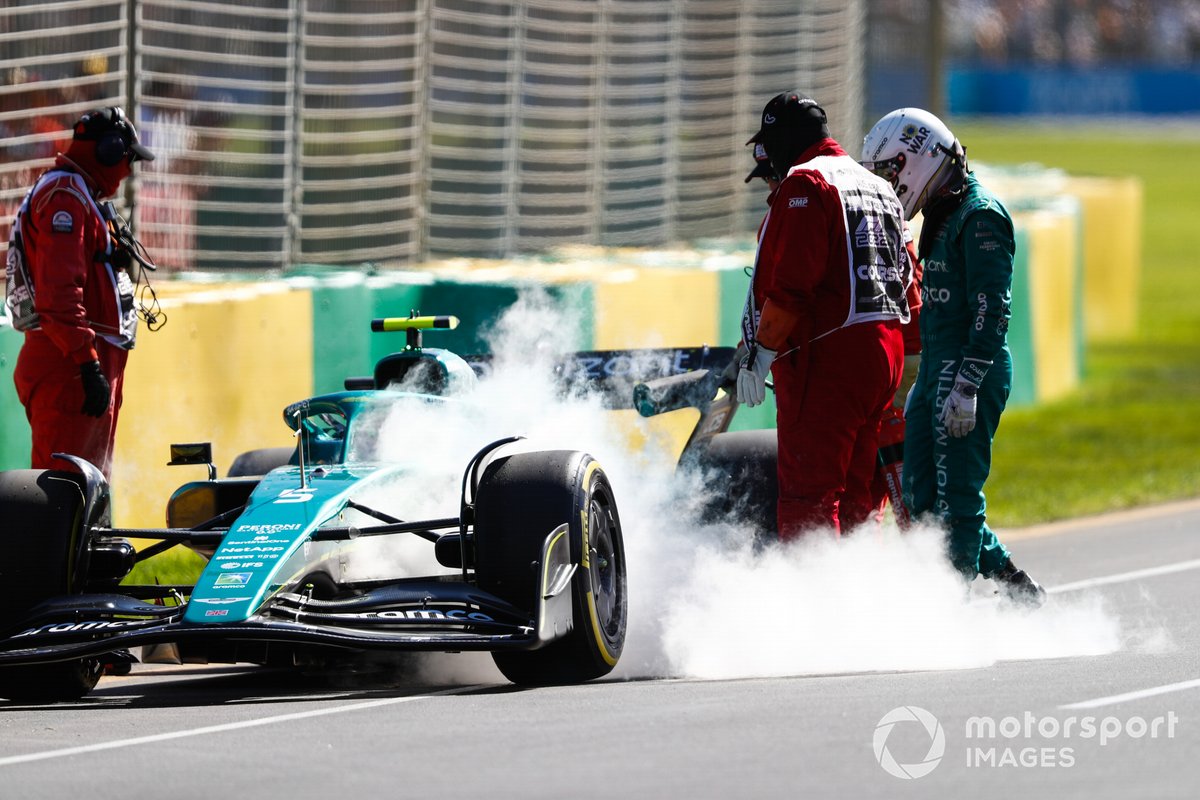
The Australian races are important reference points in the Aston Martin story. Wind back to the post-Melbourne jetlag adjustment in 2022, and many in the paddock were rather wincing in Aston’s direction. Sebastian Vettel, only just returned from missing the first two races of F1’s new groundeffect era after contracting COVID-19, had crashed in front of the vantage point Autosport had found inside the rapid Turns 9-10 complex in FP3.
Just two hours later, Lance Stroll tagged Nicholas Latifi’s Williams and smashed his AMR22 across the track so much that the resulting red flag delay meant the repairs on Vettel’s car could be completed in time for a Q1 shot the German had been at risk of missing. In the race, Vettel crashed hard again, spearing his car into the brutally close Albert Park walls exiting the deceptively tricky Turn 4 left.
“It was very difficult 12 months ago here,” recalls Aston team principal Mike Krack, “because we were the only team who had not scored any points, with a car that was difficult to drive – very slow. And with drivers that were starting to lose confidence in the team, in the car.

A trying weekend in Australia marked the nadir of Aston's 2022 and underlines the improvement made in the 12 months since
Photo by: Carl Bingham / Motorsport Images
“From that point, we said, ‘OK, there’s only one way to get out of this, by sticking together and working hard.’ And this is what we went on with. I think we managed quite well to get ourselves out with AMR22 last year, over the course of the season.”
Twelve months on, Aston is second in the 2023 F1 constructor points and in the podiums league table, sitting with Ferrari as the closest challenger to Red Bull’s RB19 on pure pace. Critically, the AMR23 is much gentler on its tyres than the Ferrari, allowing Alonso and Stroll to make considerable progress in races, while Leclerc and Carlos Sainz must heavily manage their rubber.
PLUS: Why Aston Martin’s surge has left its F1 rivals feeling conflicted
Mercedes resides in that mix too and was able to exploit things slightly getting away from Alonso and Aston in qualifying last time out in Australia. Both the AMR23 and Mercedes W14 have drag problems – especially compared to Red Bull – but in one key area the former is demonstrating class-leading form.
This is braking, where Alonso is typically later on the pedal than even Verstappen and Sergio Perez, based on GPS traces logged from the opening three rounds. Add to that the AMR23’s slow-corner speed and tight-turn prowess, and it’s clear why other squads mired in the midfield are looking to Aston’s year-on-year gains as inspiration rather than just the typical ‘Piranha Club’ sniping. And it’s been done with a team owner not minded to accept mediocrity.
Aston did get on the 2022 scoreboard immediately following its Melbourne misery, but running ninth was not in Stroll Sr’s masterplan. What happened next, really, finally kicked that off
But to tell the Aston story fully, we must again rewind to early 2022. Vettel’s absence – replaced by Aston/Racing Point supersub-turned-2023-Haas racer Nico Hulkenberg – and the hefty Australia repair bill may have stood out most from the team’s disappointing start to the new era. But these were subplots to the central, underwhelming thrust.
Like so many other teams, Aston had been hoping to scale F1’s pecking order and leap into victory contention via the delayed rules reset finally coming to life. It had been funded by Lawrence Stroll’s Yew Tree Investments consortium for nearly four years and, at the end of the Force India/Racing Point era, the Canadian fashion mogul’s extra resources were considered a major boost for a design team so long considered F1’s best ‘pound-for-pound’.
But the initial AMR22, with its high-waisted, heavily undercut sidepods, was a dud. It porpoised badly and, like the Mercedes W13, was conceived with impressive theoretical downforce levels in mind. But because the bouncing meant its ride height had to be raised so far, what the wind tunnel suggested couldn’t be hit in reality. Aston did get on the 2022 scoreboard immediately following its Melbourne misery, but running ninth was not in Stroll Sr’s masterplan. What happened next, really, finally kicked that off.

Stroll has splashed the cash to trigger Aston Martin's rise up the order
Photo by: Mark Sutton / Motorsport Images
After the Aston marque had been brought back into F1 for the first time since 1960, the team had achieved an impressive feat in securing a series of lucrative sponsorship deals based on the premium brand strength of the luxury-road-car company Stroll had also acquired. It beat off intense interest from massive entities from across global sport to secure title sponsorship from IT services company Cognizant for 2021, which was then essentially matched in positioning with Saudi Arabian state oil company Aramco last year.
This all helped Aston move up to operating at the limit of F1’s new cost cap requirements, rather than downsizing as Red Bull, Mercedes and Ferrari had to do. The extra funding also enabled Aston to invest in a complete rebuild of its Silverstone factory, constructed back in 1990 under the team’s founded guise as Jordan and considered small by modern F1 standards.
But with massive infrastructure change that’s still not quite complete, the impact of Aston’s new financial muscle was still felt elsewhere early in 2022, and much more visibly. This was the results of the team’s sweeping hiring spree the year before, when former technical director Andy Green went out and looked to bolster Aston’s design team with people and expertise that had made Red Bull and Mercedes the leading squads by the end of F1’s previous ultra-high-downforce rules era.
This expansion was headlined by the signing of ex-Red Bull aero chief Dan Fallows – for 16 years a key lieutenant for Adrian Newey – as technical director. Also coming on board were Eric Blandin, formerly Mercedes’ aero leader, as Aston’s deputy technical director, ex-Alfa Romeo design chief Luca Furbatto as engineering director, and another former Red Bull aerodynamicist, Andrew Alessi, as head of technical operations.
Krack was installed as team principal once Otmar Szafnauer had left to join Alpine at the end of the 2021 campaign, apparently unhappy with how his responsibilities as team boss would look once the newly established Aston Martin Performance Technologies division was created to sit above Aston’s F1 operation. This has been helmed by former McLaren team boss and company CEO Martin Whitmarsh as AMPT Group CEO since late 2021.
Once F1 rocked up at the 2022 Spanish GP six weeks on from Aston’s Melbourne shocker, the potential of this new group was revealed. The AMR22 was transformed, now running a Red Bull-style floor and sidepod design that so closely resembled the tweaked versions by then fitted to the RB18 that Aston’s car was dubbed a ‘green Red Bull’.
The FIA investigated whether the team had breached its restrictions on reverse-engineering other designs, which followed a court case with Red Bull over when Fallows would be allowed to join before 2023. But Aston was cleared – its official explanation for the major design convergence was that it had embarked on twin development plans late in 2021, and made a commitment to pick the path that appeared best based on the early results in 2022.

In Spain last year the 'green Red Bull' grabbed the attention of the F1 paddock
Photo by: Zak Mauger / Motorsport Images
Initially, progress up the pecking order was slow, with Stroll having a harder time than Vettel in adapting to the new package’s performance requirements. But after the summer break Aston began to make serious progress, climbing to nearly deprive Alfa of sixth in the constructors’ standings, with porpoising addressed and an existing traction strength combining with better results in the downforce-dependent high-speed stuff.
The AMR22 was also feeling the benefit of running Mercedes-produced engines, gearboxes and suspension systems – albeit with individual aerodynamic surfaces on the last listed parts tested in Mercedes’ renowned Brackley wind tunnel.
“At the end of the year, with finishing seventh, I think that did not reflect 100% where the car was at the time,” says Krack, who had seen his squad get close to leading the midfield in Baku and Singapore, and trouble the frontrunners at Austin. “I think we were better than that at the end of last year.”
On the outside, it appears that Aston refined and evolved the AMR22’s final concept into the one the AMR23 is using so successfully now, the influence of its 2021 hiring programme finally fully coming to bear after the various periods of gardening leave had been completed. But team insiders speak of the car being 90-95% all-new – a remarkably high figure given the lack of major rule changes and parts carryover considerations under a cost cap.
Aston’s signing splurge wasn’t quite over – another very important member of its current staff only fully joined on 1 January 2023. That was the day when Alonso officially made his switch from Alpine
But dig a little deeper and the AMR23 features several significant developments that have aided its success so far this season. There are the deep excavations in the downwash sidepods, which have been dubbed ‘slidepods’ and boost airflow to the critical diffuser and underfloor aero surfaces. Then there’s Aston’s new front-brake arrangement, which has so visibly aided driver confidence compared to this time last year, plus small but intricate front and rear-wing upgrades.
In the case of the front wing, this builds on the work initially made by Mercedes, which paddock sources suggest has contributed to making car-following – and therefore racing – fractionally harder, while remaining perfectly legal per the rules wording. This all follows Aston’s commitment to be “not technically arrogant”, in the words of Fallows at the launch of the AMR23, and builds upon the team’s previous philosophy of aggressively developing innovations created at other squads. This was so famously seen in Racing Point’s 2020 RP20 ‘pink Mercedes’ that forced the FIA to tighten the rules mentioned above.
The combination of all the work on the AMR22/23s resulted in a near-two-second year-on-year gain relative to the front of the grid from Melbourne 2022.
“We continued on the [2022 car] baseline over the winter, trying to really make some further steps, which I think we managed,” says Krack.

Aston's AMR23 gained almost two seconds on its predecessor around Albert Park
Photo by: Glenn Dunbar / Motorsport Images
As it turned out, Aston’s signing splurge wasn’t quite over – another very important member of its current staff only fully joined on 1 January 2023. That was the day when Alonso officially made his switch from Alpine, having turned out in an unbranded AMR22 at the Abu Dhabi test that concluded the 2022 campaign.
There, Aston figures were quick to note the efficient, direct manner of Alonso’s feedback on car performance, with the Spaniard himself left feeling “100+%” happy after his first taste of green F1 action – he’d been “90% happy” with his decision to join Aston once Vettel’s retirement was announced last summer.
Alonso’s enduring energy has impressed his new team, while his impact alone is credited for improving its results alongside the refined AMR23 design. New Williams team principal James Vowles notes that “they have an extraordinary driver who’s in the car”. Plus, Alonso’s communication skills have apparently been as effective in engaging a workforce now reaching the 1000-person mark as they are in creating media headlines.
After sealing his Jeddah podium behind the dominant Red Bulls, Aston’s mechanics were captured loudly singing Alonso’s name, something Krack says was “a confirmation, basically, of where he’s standing in the team. He brought a lot of positiveness when he arrived. He is leading by example at all times. He’s there very early, he’s working really hard and it is this lead by example that everybody just sees and grabs on and gives an extra level of motivation.”
PLUS: How Aston Martin and Alonso can save F1 2023 from Red Bull domination
Krack himself also represents a key part in Aston’s current success. He’s a former karter who raced alongside future F1 stars Jarno Trulli and Giancarlo Fisichella in the 1980s before embarking on a much more successful engineering career that led him to a lengthy F1 stint with Sauber through its BMW days, before going on to work on the ultra-successful Porsche 919 LMP1 programme and BMW’s Formula E squad.
With Whitmarsh aiding day-to-day company responsibilities from above in AMPT, Krack – much like how his former Sauber colleague Andreas Seidl did so recently for McLaren – can quietly and effectively lead Aston’s F1 race squad. His data analysis and race engineering experience are helpful boosts in making key decisions on car development, while Krack is also a thorough communicator in the modern team principal role as public figurehead – even seen eyeing rival squads’ designs during the pre-practice pitlane car presentations that are now a feature of each F1 weekend. Overall, Krack leads a team where staff are encouraged to work with a freedom and intensity deployed so well in recent years at Mercedes and Red Bull.
“It’s surprising,” he replies when asked to compare what it’s like leading a midfield squad to one that’s finally made the leap to join the ‘Class A’ elite. “The approach is not that much different but you are obviously much more exposed. I think if we make mistakes on pitstops, on strategy, it is maybe spotted more than it would potentially have been before.

Led by Krack, Aston Martin has reached the 'Class A' runners, but can it maintain its position?
Photo by: Zak Mauger / Motorsport Images
“But other than that, the job itself is not very different. Now it’s easier to speak about three podiums than what we spoke about 12 months ago here in Australia – that was very difficult!”
Now comes the much harder part for Krack and co: maintaining Aston’s position among the frontrunners and even closing the chasm to Red Bull up ahead. Krack has been open in acknowledging that Mercedes and Ferrari can be considered to have underperformed, design-wise, in 2023 compared to the steps those teams were expected to make following their 2022 disappointments.
Yet at the same time, Aston should be credited for being the first team to recommit to what is clearly the best design avenue of F1’s new groundeffect rules era, once it had been established by Red Bull. Williams took a similar approach several months further into 2022, while Alpine first deployed the downwash ‘slidepods’ Aston has seemingly refined for 2023. Now, Mercedes is abandoning the W13/W14 concept and is soon expected to more resemble Red Bull’s challenger, as Aston once did, while Ferrari is thought to be waiting until 2024 before making such a drastic change – if it ever does.
Aston reaped the rewards of making its concept change so early and so decisively, allied to an effective and successful 2022 upgrade plan. But can it repeat all that with a car package closer to a performance ‘ceiling’ in 2023?
"We need to learn and we need to grow as a team because we are racing against Red Bull, Mercedes, Ferrari" Fernando Alonso
“We have managed last year to develop the car substantially,” says Krack. “We started from a higher baseline this year, so it will not be as easy as it was last year. But we have to make progress if we want to stay where we are because if we do nothing we will go backwards. I am quite confident that we can bring performance upgrades to the car but because it is all related, we will only in time [know] if it is efficient or not.”
For another two months, Aston will benefit from having 37% more wind-tunnel operating time than Red Bull – and 25% and 20% over Ferrari and Mercedes respectively – based on F1’s sliding scale of restrictions on such work, plus associated CFD design tools. This resets halfway through each year and, should Aston still be running second to Red Bull by that stage in 2023, it’s aero development allowances would reduce to 75% of what it has now, while Mercedes and Ferrari would gain 5% and 10% over it respectively. Red Bull will still be 5% down once its cost-cap penalty ends in October.
Whatever the change ends up being, it will force Aston to be even more efficient as it chases further gains, while Alonso wants his new team to learn to become a consistently winning operation, like those he’s now racing against.

Alonso made it three out of three podium finishes to complete Aston Martin's remarkable 12-month transformation
Photo by: Steve Etherington / Motorsport Images
“For us, it’s all happy days at the moment,” he says when asked how he sees the 2023 ‘Class A’ battle playing out, which Aston seems set to remain part of now it has proven that its Bahrain form can be replicated at differing, front-limited, tracks. We never expected to be on the podium, maybe even throughout the season, and in three races we have three. So, everything that comes now is a plus.
“We need to learn and we need to grow as a team. Also maybe now off-track because we are racing against Red Bull, Mercedes, Ferrari – teams that are used to this kind of pace of development. And maybe we are just in a learning process. So, we take this 2023 in a very humble manner and let’s see how it’s going.”
But what of Aston’s most important figure? How has the new level of his team gone down with Lawrence Stroll following its Melbourne 2022 low ebb, and what does that tell F1 about Aston’s future?
“It’s quite easy – Lawrence’s mission statement is pretty clear,” concludes Krack. “He has not been having any delay in telling us when are we going to win the next one. Obviously he’s happy that we have made a step but this is not enough for his ambitions. The good thing with Lawrence is you know where you stand. He wants more and we will have to deliver more.”

Aston Martin's overall target to reach the very top of F1 remains unwavering
Photo by: Glenn Dunbar / Motorsport Images
Did Vettel leave too soon?
Formula 1 moves on fast. A world champion can be at the top of their game one race, then, perhaps through a massive mistake or the fallout from a winter car change, things are suddenly very different. Eventually, the stopping point comes for all. Living legends step off the carousel, only their achievements remaining in memories. And these too fade.
Kimi Raikkonen, not Fernando Alonso, now Sebastian Vettel. Except the former Aston Martin driver and four-time world champion with Red Bull has been in the headlines rather a lot since his farewell in Abu Dhabi at the end of 2022. This mainly centred on the possibility of Aston calling Vettel up as a one-off replacement for the injured Lance Stroll at the start of the season. The team admitted it considered asking Vettel, given his experience of recent Aston packages, but ultimately decided to respect his decision to fully leave F1 and decreed that reserve driver Felipe Drugovich would step up to replace Stroll if required, which he was not.
Now there’s talk in the paddock about exactly what Vettel stepped away from given Alonso’s three successive podiums at the start of the 2023 campaign as the German’s replacement – a higher total than Aston managed in the two years when Vettel was its champion.
“I think [Sebastian] has his merits in where the car is today, because we had many meetings last year where he gave us a hint – ‘do this or do that’ or ‘do not do this with the new car’" Mike Krack
“Well, if [he’s] retired too early or too late, that is something you have to ask him!” Mike Krack jokes when asked if he thought his former charge – for whom he was chief race engineer at BMW Sauber for Vettel’s 2007 United States Grand Prix F1 debut – had ended his F1 story at just the wrong time with Aston finally coming good.
“I think [Sebastian] has his merits in where the car is today, because we had many meetings last year where he gave us a hint – ‘do this or do that’ or ‘do not do this with the new car’. So, I think he has his merits in here.
“And then we have to respect the decision that he took. He reflected for a long time before he made that decision and, when he made it, we had to move on and he has to move on. And if it’s a shame for him, yes or no, this you should ask him.”
Should Vettel have stayed on another year?
Photo by: Carl Bingham / Motorsport Images


Why Britain’s role in Formula 1 endured a troubled start

Why Bottas believes his F1 reserve driver role is the fastest route back to a race seat

Why Norris is now ready for his final exam

The key advantage for Bottas vs Perez in the 2026 F1 return race

Why Ferrari's management is under pressure after its bad start to F1 2025, not Hamilton or Leclerc

Why Red Bull can’t solve its second F1 car problem with a simple paint job

Hirakawa replaces Doohan at Alpine for Japanese GP FP1 outing

How Alonso and Bortoleto can be F1 rivals in a unique driver management deal

How Toyota destroyed the competition to seal the WEC crowns

McLaren retains Fornaroli as F1 reserve and hands him WEC programme for 2027

How Andrew Jordan realised his teenage rallycross dream

Inside the competition building F1’s future engineering talent
Subscribe and access Autosport.com with your ad-blocker.
From Formula 1 to MotoGP we report straight from the paddock because we love our sport, just like you. In order to keep delivering our expert journalism, our website uses advertising. Still, we want to give you the opportunity to enjoy an ad-free and tracker-free website and to continue using your adblocker.


Top Comments