


How 2021's midfielders have taken lessons from F1's top teams
Formula 1’s latest Imola adventure turned into an expensive trip for many teams due to several crashes throughout the weekend. While balancing the books is an added factor in 2021 with the cost cap, a few midfield teams have cashed in early on development investments

Let’s review the opening two races of the 2021 Formula 1 calendar, shall we? The season-opener at Bahrain was a great start, with a battle between Lewis Hamilton and Max Verstappen only spoiled by the unsavoury matter of track limits. Nonetheless, the closeness of the front two teams appeared to be a good omen for further thrilling events to unfold.
Returning to Europe for the F1 Pirelli Gran Premio Del Made In Italy Beef It’s What’s For Dinner 300 e dell’Emilia Romagna presented by Jiffy Lube, at Imola, the championship delivered yet another corker of a race – helped by the sudden deluge of rain that turned the track surface into a waterpark. In places, at least.
The battle between Verstappen and Hamilton once more began to heat up, as the Dutchman forced the polesitter into taking the sausage kerbs at Turn 1 and wrested control of the race away from the Mercedes ace. Throughout, the two protagonists traded blows as Hamilton sought to overcome the damage to his front wing, but the battle then swung into Verstappen’s favour as Hamilton slid off at Tosa trying to clear traffic.
While Hamilton was fortunate to be making his recovery following a red flag, which brought the rest of the pack into his line of fire, he swashbuckled his way through the drivers ahead of him with aplomb. He had to work for second place, however, with Lando Norris defending for all his worth – but the reigning champion eventually swept past to keep a tenuous grasp on the lead of the championship.
PLUS: How the Emilia Romagna GP result hinged on three crucial saves
And that's just the lead battle. Further down the field, the midfield battle rages hotter than ever before; McLaren, Ferrari and AlphaTauri all look well matched and, if Aston Martin and Alpine can find form, they’ll still play their part too. Alfa Romeo can be occasional points presences, and Williams proved at Imola that it can be too – provided it doesn’t lose both cars to heavy impacts before the end of the race.

Lance Stroll, Aston Martin AMR21, Pierre Gasly, AlphaTauri AT02
Photo by: Andy Hone / Motorsport Images
The technical arms race of 2021, which will admittedly become truncated this season as the field will inevitably switch its focus to the all-new 2022 ruleset early, has brought a couple of teams back into play – and those developments should help F1 to retain the compact field that it has neatly cultivated over the past couple of years. Red Bull and Mercedes’ battle will surely become more bitterly fought over the next few rounds – but it’s further down the field where Imola’s array of new developments helped spark a revival in fortunes.
It took one round before the flock of F1 teams found some convergence with the 2021 floor rules - which was inevitable, really. With less floor space afforded to the teams following the triangular cut-off ahead of the rear wheels, all eyes during testing were on the solutions at the Bahrain test and opening round of the season. That's exactly why Mercedes - and, by all accounts, Red Bull - decided not to show off their floors at their respective launches lest their competitors have their own versions in the windtunnel before the opening race.
Both Ferrari and Williams appeared to be the two most-improved teams at Imola, with the Scuderia notching up another strong double-points finish as Charles Leclerc and Carlos Sainz Jr collected fourth and fifth
Their decisions appear to have been vindicated as the design that the two teams had chanced upon, with a "Z-shape" profile, have now been adopted by both Ferrari and Williams. Although cutting more out of the floor sounds counterproductive, it actually offers the aerodynamicists an additional corner to play with, allowing the aerodynamicists to tack winglets and strakes onto the top of it to help seal the floor.
The more technologically involved description is that the corner will produce a tip vortex at this stage as it sheds off the floor, and with clever management and direction of airflow using the tools on the top of the floor, this can create a buffer. This rolls along the edge of the rest of the floor and keeps the floor protected.

Ferrari's latest floor development
Ferrari's floor features a single fin on that corner, which is going to divert airflow outwards while it builds this sealing vortex, and will help ensure that the minimum of turbulence can drift underneath the car and peel off efficiency from the diffuser. Ferrari's collection of fins at the rear of the floor seem to be taking airflow that's drifting outwards and bring it in slightly, perhaps to turn it along the edge of the diffuser to enhance that sealing effect.
Williams' new floor employs a trio of small fins on the edge of the added corner, again replicating the same effect - although using multiple smaller fins allows the airflow to be turned outwards without detaching within a shorter space of time. Behind that, there's three more fins with an extruded upper edge which also appear to take any airflow drifting outwards and direct it inwards to be worked by the final fin at the rear.
Both Ferrari and Williams appeared to be the two most-improved teams at Imola, with the Scuderia notching up another strong double-points finish as Charles Leclerc and Carlos Sainz Jr collected fourth and fifth - despite a shaky start to the race. The two had a couple of off-piste moments in the first half of the race, but scooped up their cars and continued to display Ferrari's vastly improved 2021 form.
Insight: 10 things we learned from F1's 2021 Emilia Romagna GP
Where the car still lacks is in its straight-line performance. At full pelt with DRS, Leclerc was tracking Norris in the battle for second – a few laps before Hamilton forced the two to acquiesce to his greater pace in the Mercedes. Although Leclerc had the tyre advantage, running on mediums as Norris had to manage his softs, the Monegasque didn’t possess enough of a rocketship to corral Norris into defending into the Tamburello chicane. Once Hamilton did pass Norris, the McLaren had enough in reserve to ensure Leclerc couldn’t inch back into DRS range – ensuring that the orange car was parked up alongside Max Verstappen’s Red Bull at the end of the race, not the matte red one.
Williams, meanwhile, looked strong throughout practice and both cars were well ahead of main rivals Haas and Alfa Romeo in qualifying. Particularly, Nicholas Latifi was on the ball from the beginning, looking the most comfortable he ever has done in F1 during Friday practice. Although George Russell was able to surpass him by Saturday, the duo nonetheless rallied to more than just a token Q2 appearance – lugging the FW43B to 12th and 14th on the grid.
But Latifi peaked too early. After sliding off at Acque Minerali on the opening lap, he rejoined and myopically drifted into the firing line of the hapless Nikita Mazepin. The spin-prone Russian had been in the wars enough over the weekend, but this time found himself blameless as Latifi earned himself a trip to the wall to slash Williams’ chances of ending its points drought.
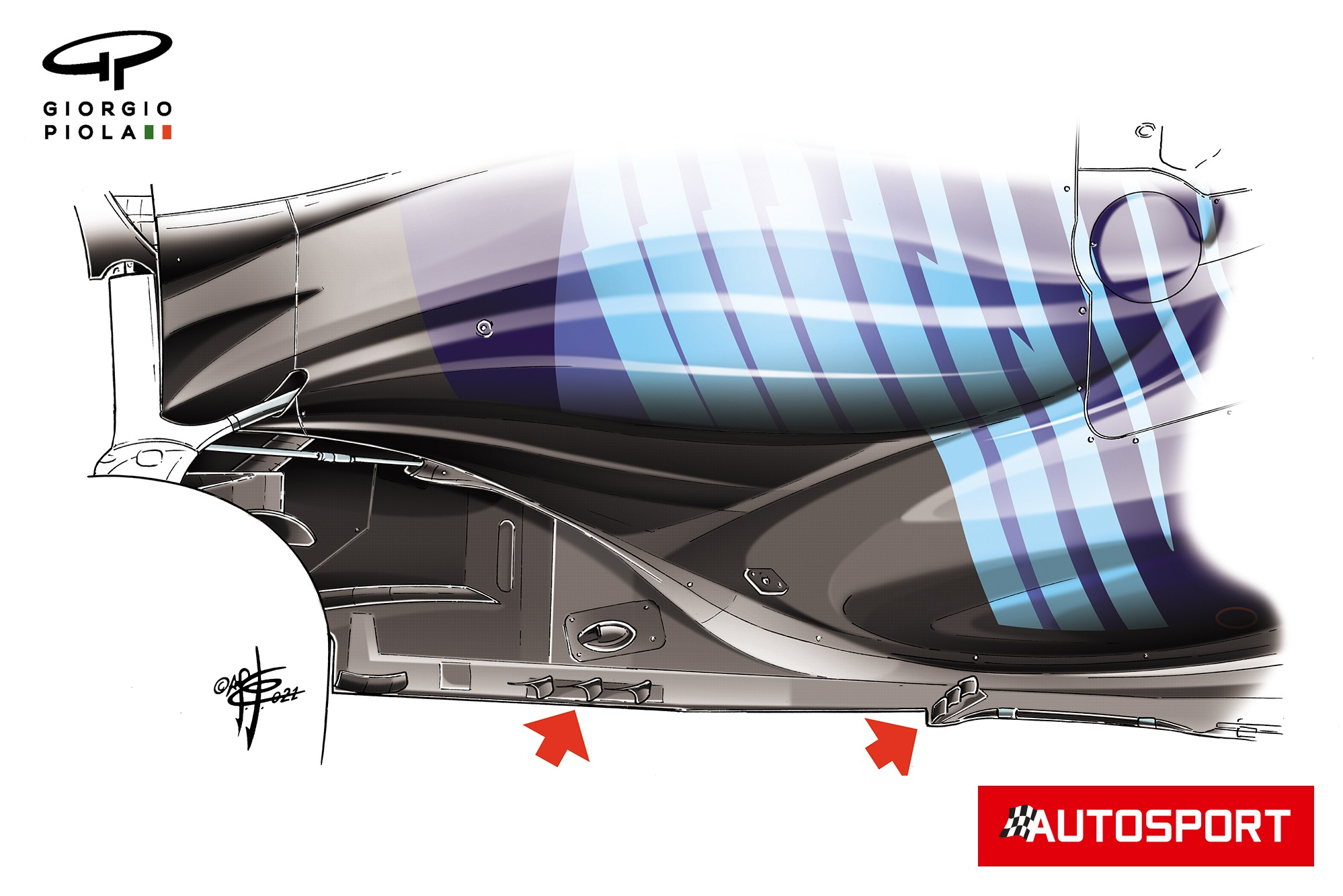
The new Williams floor design
Russell, on the other hand, looked excellent in the opening half of the race. Having worked his way up to 10th, he was closing up the Mercedes of Valtteri Bottas – who had been recently dispatched by Lance Stroll. In one of his dramatically off-the-boil weekends, Bottas was treading water in the mid-pack, but soon found himself floundering in the Turn 1 gravel as Russell slipped on the wet grass and red-shelled his way into Bottas. Perhaps blinded by the allure of swiping a position away from a works Mercedes driver, Russell could have been spooked by the slight drift right from Bottas to culminate in their wild collision – and on another day, there’s no doubt he’d have done things differently.
The resulting helmet-slap (no, not like that) from Russell and Bottas’ middle finger ‘to whom it may concern’ was certainly no Queensbury rules-style bout between Nelson Piquet and Eliseo Salazar at the 1982 German GP. Although Slappy George and Bottas’ subsequent flip-off hints at a more physical representation of their bids to stake their claim for the second Mercedes seat, it might have done Mercedes more harm in the long run.
“The whole situation is absolutely not amusing for us, to be honest,” said Mercedes team principal Toto Wolff. “It’s quite a big shunt. Our car is a write-off in a cost-cap environment that is certainly not what we needed, and probably it’s going to limit upgrades that we’re able to do.”
The midfielders should take note of Wolff’s words, and put them in a place easy to refer to in the heat of battle should the championship be even tighter than last year
Whether Wolff’s comments are just post-crash melodrama or an honest assessment of the financial implications of the Russell-Bottas collision remains to be seen. Regardless, it’ll be music to the ears of a Mr. C. Horner and his Red Bull team.
But the midfielders should take note of Wolff’s words, and put them in a place easy to refer to in the heat of battle should the championship be even tighter than last year. One crash won’t just ruin a race, it might wipe a development budget too.

Marshals clear the damaged car of Valtteri Bottas, Mercedes W12, from the gravel trap
Photo by: Charles Coates / Motorsport Images


A strategic masterclass: How Antonelli put himself on the cusp of F1 title at the US GP

Leclerc and Hamilton's differing theories behind Ferrari's Austin qualifying disappointment

What we learned from Friday practice at the 2026 United States GP

The reasons behind Ferrari's US GP upgrades

Mission control: Inside the FIA and F1's remote operations centre

FIA expects F1 races in Qatar and Abu Dhabi to run as planned

Why Piastri has struggled to show his best with this year's McLaren MCL40

Lights, Camara, action: How Haas picked F1's latest rookie for 2027

Why being "very adaptive" gave Norris the edge over Piastri at US GP

Smyth makes Formula Ford Festival history as he wins despite clash with team-mate Murray

Taken for a ride? The less heralded flaw of the 2026 F1 regulations

Sainz set for Rally1 outing in latest gen WRC car
Subscribe and access Autosport.com with your ad-blocker.
From Formula 1 to MotoGP we report straight from the paddock because we love our sport, just like you. In order to keep delivering our expert journalism, our website uses advertising. Still, we want to give you the opportunity to enjoy an ad-free and tracker-free website and to continue using your adblocker.


Top Comments