


How the Emilia Romagna GP result hinged on three crucial saves
Rain before the start of the Emilia Romagna Grand Prix promised to spice up the action, and the race certainly delivered on that. Max Verstappen got the best launch to win from Lewis Hamilton, but both got away with mistakes that could have had serious consequences

The 2021 Emilia Romagna Grand Prix stage was set for a chess match – tense, slow-burning, unlively. The race’s final bow was a result that came via a war zone scene – dramatic, thrilling, controversial.
The teams had been aware of possible Sunday rain showers but, as ever in Formula 1, this particular crowd-pleaser wasn’t guaranteed. Yet the rain did arrive, 45 minutes before the start – falling in such a manner around the elongated Imola layout that it created an interesting challenge, with the lap’s first half soaking and the rest slippery-to-dry.
And it was this pre-race precipitation that created the thriller, one that had five distinct phases, and the make-up of the event’s final act – Max Verstappen triumphant on the podium ahead of polesitter Lewis Hamilton – was ultimately decided by three critical saves.
Phase 1 – Contact at the start
The field had had time to sample the conditions ahead of the race with their practice start laps to the grid. It was clearly treacherous, helpfully proved by Fernando Alonso breaking his front wing against the Tosa wall when he slid off on intermediates. And it was on those green-walled tyres that most drivers started the race.
When the lights went out, there was a clear winner. Verstappen hadn’t quite known what to expect when it came to launching in slippery conditions as here, he said, Red Bull “always struggled in the wet” in 2020. But the result of the team’s off-season work to improve this was a stunning launch that quickly drew him alongside team-mate Sergio Perez. Then Verstappen was moving left having initially gone right, such was his momentum, Hamilton’s pole advantage immediately disappearing as he was slower away compared to the Red Bulls with a “bit of a mistake” – too much wheelspin in the second launch phase.

Hamilton bounces over the Tamburello kerbs after contact with Verstappen at the start
Photo by: Andy Hone / Motorsport Images
Verstappen, nearly on the grass, nosed ahead as the duo reached the really wet part of the track on the approach to the Tamburello chicane. He had the inside line, but Hamilton just wasn’t giving up – braking later initially then carrying greater speed to stay alongside his rival at the sequence’s first apex. Verstappen wasn’t conceding either, holding the racing line through the turn and edging his rival out wide.
There was contact, light enough that Verstappen claimed not to have noticed at the time, but enough to force Hamilton clattering over the kerbs at Tamburello’s second apex, damaging Hamilton’s left-side front wing endplate. Tough, but fair. Neither driver complained – it wasn’t this clash involving a Mercedes driver at Tamburello that ignited with searing, scotch bonnet spice.
"I was slightly ahead going into Turn 2, but I was basically avoiding us coming together. Max was just coming across. We had that touch and I had to use the exit" Lewis Hamilton
“We went into Turn 2, side-by-side, but it’s difficult to expect the grip on the first lap,” said Verstappen. “I also ended up a bit wider than I wanted and then Lewis was also there…”
“…I didn’t get a good start,” picked up Hamilton. “Max got a better start than me and then I think I was slightly ahead going into Turn 2, but I was basically avoiding us coming together. Max was just coming across. We had that touch and I had to use the exit.”
The result of taking to the kerbs meant Hamilton had to gather his car exiting Tamburello, just holding off Perez – soon to lose third to Charles Leclerc by sliding off coming out of Variante Alta – to maintain second. But Verstappen was gone, four seconds clear by the time the race’s first safety car was called just as he started lap two.
Phase 2 – The intermediates age
The race was suspended because Nicholas Latifi had gone off at Acque Minerali, the same spot where Leclerc had been lucky his race had not been doomed before the start as he dropped his Ferrari in a similar manner on the formation lap. But whereas Leclerc was able to scamper away unscathed – and retake his position ahead of the grid reforming – Latifi came back onto the track and moved into the path of Nikita Mazepin’s oncoming Haas, spearing off right and into the wall when they collided.
The resulting wreckage needed cleaning up, but the safety car period was extended due to an incident involving the other Haas. For the second race in a row, Mick Schumacher dropped his VF-21 all by himself – this time while warming his full-wet tyres in the safety car snake – and consequently wiped his front wing off against the pitlane exit wall.

Verstappen follows the safety car after Latifi's crash
Photo by: Zak Mauger / Motorsport Images
Clearing all the debris meant the race got going again on lap seven of 63, with Verstappen just having enough Honda grunt to stay ahead of Hamilton’s restart charge – again on the outside of the Tamburello approach. The two leaders, plus Leclerc, immediately dropped Perez, but Hamilton then had to catch a wild slide going through Acque Minerali that helped Verstappen complete the lap with a 3.3s lead.
The Red Bull driver maintained that advantage throughout the ensuing 20 laps, gradually extending it through the ebbs and flows on the drying track versus Hamilton to a maximum of 6.1s. Mercedes suspected that Red Bull had better tyre warm up in the early laps – a problem that particularly impacted Valtteri Bottas in the pack having started eighth – but there was an additional factor impacting Hamilton’s pace in the early stages.
The Tamburello clash had damaged the footplate on the left edge of his front wing’s endplate, but the louvred aero part did not completely come off in the incident. It was left “flopping around” according to Mercedes’ director of trackside engineering Andrew Shovlin, as it was “held on by some pressure tappings, and that was causing a lot of very inconsistent flow further down the car”.
Shovlin reckoned the resulting impact this had on the airflow to the rear of Hamilton’s car was costing him around half a second a lap, until the footplate eventually came off. After that, the team believed the loss was only worth two-three tenths and Hamilton certainly recovered considerable ground as this particular phase of the race drew to a close.
On laps 23-25, Hamilton halved Verstappen’s lead from its maximum, then brought it down to two seconds on the next tour. The Red Bull’s inters “were finished,” according to the leader, “so to keep on going was difficult, a lot of sliding around”. Verstappen also had to deal with the first pack of non-Haas cars to be lapped, all while he and his team were negotiating when to make the switch to slicks, which Sebastian Vettel had become the first runner to do on lap 20.
After being undercut in Bahrain, this time Red Bull went aggressive – calling Verstappen in at the end of lap 27, while Mercedes gave Hamilton one tour to try and make a difference as the race’s next phase abruptly began.

Verstappen's switch to slicks kept him ahead of Hamilton
Photo by: Glenn Dunbar / Motorsport Images
Phase 3 – The slick changes
Red Bull turned Verstappen around in 2.2s and he produced a 1m51.2s out-lap – two seconds faster than Hamilton would soon manage. But the Mercedes driver’s first lap also on mediums was still in second in any case, as his right-front had come off slowly, costing him 1.8s extra in stationary time and undoing a rapid in-lap.
And so began the second shortest chapter in this tale, but the one that shaped the final result more than any other, as Hamilton’s resumed chase of Verstappen lasted only until he made his first major in-race error since failing to notice the closed pitlane in the 2020 Italian GP.
On lap 31, Verstappen had just lapped Bottas, who was struggling even more with tyre warm-up after switching to the mediums two tours earlier. As the leader roared clear of a five-car traffic train, Hamilton was getting stuck into the backmarkers behind his team-mate – Lance Stroll, George Russell, running 10th after making solid progress in the race’s opening phases, Schumacher (now two laps down) and Kimi Raikkonen.
After Hamilton passed the Alfa on the pitstraight and the Haas exiting Tamburello, Russell then stayed right and gave him a fractionally tighter approach for the Tosa hairpin. Hamilton went onto a damp patch and, after getting ahead of the Williams, had to catch an oversteer snap as he got back onto the racing line that sent him further right and onto the still-wet part of the track. He slid irresistibly into the gravel and his attempt at saving the situation went disastrously wrong.
He didn’t have the space or steering lock to pull off an initial throttle-blast manoeuvre to his left, not helped by the gravel, and as a result smacked his front wing against the Tosa wall. Then he was stuck.
Later joking that “some secret tyre warming” was going on, he suddenly slid to the inside of the first Rivazza left, the RB16B’s rear wildly coming around before Verstappen could catch it
“It just wouldn’t go into reverse,” Hamilton later explained. “I was holding the reverse button and it took forever to engage. I didn’t think it was going to work. I then tried to kind of do a burnout spin to get going again and [then] I was back in the barrier. So, then it took a long time again to get back in reverse, and when I was reversing, I was like, ‘I’ve just got to keep going backwards and work my way out in reverse’. If I hadn’t done that I would probably still have been there now.”
Peter Bonnington was warning Hamilton of all the approaching traffic, which satisfied race director Michael Masi that his escape was done safely. In any case, Masi soon had a bigger incident with which to be concerned.

Hamilton heads to the pits with a broken front wing
Photo by: Zak Mauger / Motorsport Images
As Hamilton limped back to the pits for a front wing change – the time spent in the gravel and the extra stop meaning he went a lap down against Verstappen – his team-mate and Russell were adding major spice to a storyline concerning both their F1 futures.
After Hamilton had slid across his bows, Russell had continued to chase Bottas, enjoying the benefit of two extra laps warming up the mediums and closing in rapidly as a result. With DRS now activated, Russell gained even more speed against Bottas as they ran down the pitstraight at the start of lap 32 (their 31st). The Williams drew alongside on the approach to Tamburello but “hit an especially damp patch and the car snap yawed, bearing in mind that the car had low downforce in the rear with the DRS open”, per the wording of the inevitable stewards’ report.
It appeared as if Bottas had squeezed his rival, something Russell maintained, but it was concluded that “at no time did either car manoeuvre erratically” and despite the severity of the impact – the flying cars striking the barriers on the inside and outside of Tamburello – it was judged a racing incident. Such was the spread of damage across the track, the red flags were waved.
Phase 4 – The shortest save
After the pack had returned to the pits, it took just over 25 minutes for the circuit to be cleared. When the drivers were released again, the lapped runners were allowed to overtake and form back up ahead of the second start. This was to be a rolling version, as Masi had determined that “the far-left hand side [of the grid was] quite damp” and so used his discretion to avoid a second standing start.
Verstappen of course headed the queue, with Hamilton lining up ninth – but just a few seconds behind the leader thanks to the unlapping allowance. Now, the race’s second major save occurred.
Ahead of the lap 35 restart, Verstappen backed up Leclerc and Lando Norris. The McLaren driver had risen to third after being allowed past team-mate Daniel Ricciardo in the early stages, then gained from Perez being handed a 10s time addition for overtaking Ricciardo and Pierre Gasly under the Latifi/Schumacher safety car, illegally repassing the pair after he’d briefly slid off at Piratella. The Mexican served the time at his stop for slicks, where he also took on a new steering wheel as it had been “moving the differential” throughout the first stint “on its own” due to an electrical issue, and so was fourth at the restart.
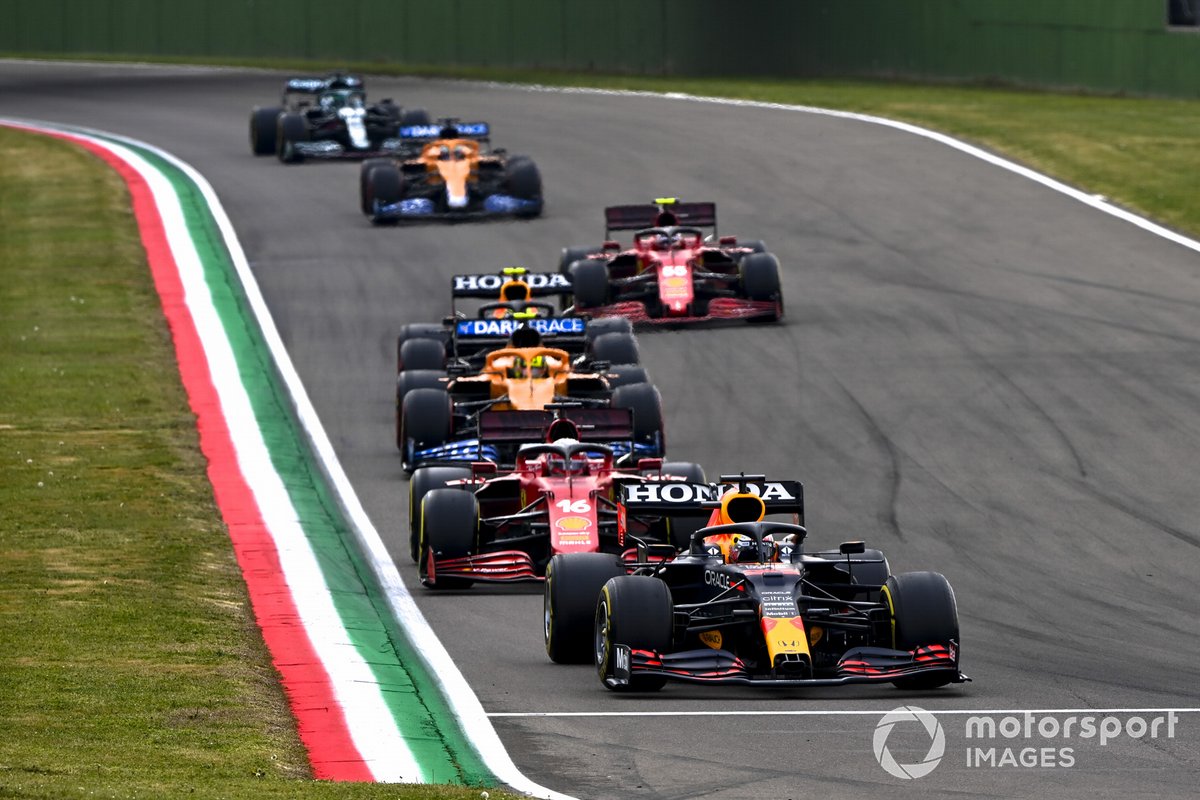
Max Verstappen leads Leclerc and Norris prior to the restart
Photo by: Mark Sutton / Motorsport Images
Verstappen had it all under control – until he didn’t. Later joking that “some secret tyre warming” was going on, he suddenly slid to the inside of the first Rivazza left, the RB16B’s rear wildly coming around before Verstappen could catch it. He was sent stumbling over the kerbs, all four wheels briefly leaving the tarmac as he recovered over the grass.
Leclerc momentarily considered overtaking, but opted not to – and in any case if he had got ahead Verstappen would’ve been allowed to repass before the first safety car line, this lap essentially being considered a new formation lap and the overtaking-under-safety-car rules therefore interpreted differently.
Leclerc’s actual mistake here came just seconds later, as he failed to keep up with Verstappen’s eventual jump back to racing speed, his lead saved in a heartbeat.
“Just before the actual restart he had a small snap,” Leclerc, minus radio communication after the red flag, explained. “I expected him just after the small snap to wait before he [went] again, but he actually went just after a small snap and I got surprised there.”
Phase 5 – Hamilton’s recovery save
Norris capitalised on Leclerc’s error to seize second, helped by his softs firing up faster than the mediums on the Ferrari, which the team picked for the restart as it was wary of the softs graining late on. But Verstappen then simply checked out. He gained 0.77s a lap over his pursuers for the first 25 tours that followed the restart and won by 22s.
On lap 60, Hamilton finally had enough momentum to pull alongside Norris and recover the place he had thrown away 29 tours earlier
Behind, Hamilton had gained a spot thanks to Raikkonen dropping his Alfa on the unlapping tour, but he was actually passed into Tamburello at the restart by the opportunistic Yuki Tsunoda. However, the AlphaTauri driver’s joy was fleeting as he spun across Hamilton’s bows between the chicane’s apexes and dropped to 15th.
From there, Hamilton came alive in his fully repaired car. “It was really encouraging, to see what Lewis could do,” reflected Shovlin, who maintained Mercedes is “still walking away saying we’re not good enough” versus Red Bull. Hamilton moved up to seventh when Perez spun off chasing Leclerc through the Villeneuve chicane on lap 38, then chased down and passed Stroll and Ricciardo on laps 39 and 42 – using DRS to blast alongside on the outside approach to Tamburello each time.

Hamilton tracks down Sainz in the late stages
Photo by: Charles Coates / Motorsport Images
He took eight more before doing likewise to Carlos Sainz Jr to take fourth, then engaged in a thrilling chase with Leclerc and Norris in the closing stages. When Leclerc lost the DRS gap to Norris at the start of lap 55, Hamilton pounced to bounce the Ferrari from a shock home podium.
Norris then looked to be doing just enough to resist Hamilton, positioning his car perfectly into Tamburello each time – despite vibrations stemming from his kneepad hitting his clutch paddle. But on lap 60, Hamilton finally had enough momentum to pull alongside and recover the place he had thrown away 29 tours earlier. The Briton gained so much time with DRS on that lap that he used it to set the race’s fastest lap by 0.8s over Verstappen’s solo effort up front.
The aftermath
In the end, both Verstappen and Hamilton had cause to be mightily relieved and very pleased with their Imola efforts. If the 2021 season is to be the thriller F1 hopes it will, then last Sunday made it 2/2 for the championship’s leading drivers going wheel-to-wheel.
This time, Verstappen nailed his main chance to beat Hamilton, but both drivers made errors in the tough conditions – the latter’s simply far larger. But it would only have taken one of their respective mistakes going ever so slightly differently for the tale of the 2021 Emilia Romagna GP to have ended in another way.
It was, though, a story of three saves, from two heroes. Drama throughout, that left the audience very much wanting more.

Hamilton, Verstappen, Norris on the podium
Photo by: Andy Hone / Motorsport Images


Why Britain’s role in Formula 1 endured a troubled start

Why Bottas believes his F1 reserve driver role is the fastest route back to a race seat

Why Norris is now ready for his final exam

The key advantage for Bottas vs Perez in the 2026 F1 return race

Why Ferrari's management is under pressure after its bad start to F1 2025, not Hamilton or Leclerc

Why Red Bull can’t solve its second F1 car problem with a simple paint job

Hirakawa replaces Doohan at Alpine for Japanese GP FP1 outing

How Alonso and Bortoleto can be F1 rivals in a unique driver management deal

Mekies extends contract as Red Bull's F1 team boss
What to expect from WEC's Barcelona debut

Acosta proposes new idea for monitoring tyre pressure in MotoGP

Horner's inside story of how Red Bull built its own F1 engine
Subscribe and access Autosport.com with your ad-blocker.
From Formula 1 to MotoGP we report straight from the paddock because we love our sport, just like you. In order to keep delivering our expert journalism, our website uses advertising. Still, we want to give you the opportunity to enjoy an ad-free and tracker-free website and to continue using your adblocker.


Top Comments