


Honda power tweak after French GP unlocked race-winning performance
Honda's improved performance since introducing its Spec 3 engine was aided by the previously unknown introduction of a "countermeasure" after the French Grand Prix


Red Bull driver Max Verstappen believes his team's new engine partner stopped being so conservative after the Paul Ricard race, where Honda introduced its second engine upgrade of the season.
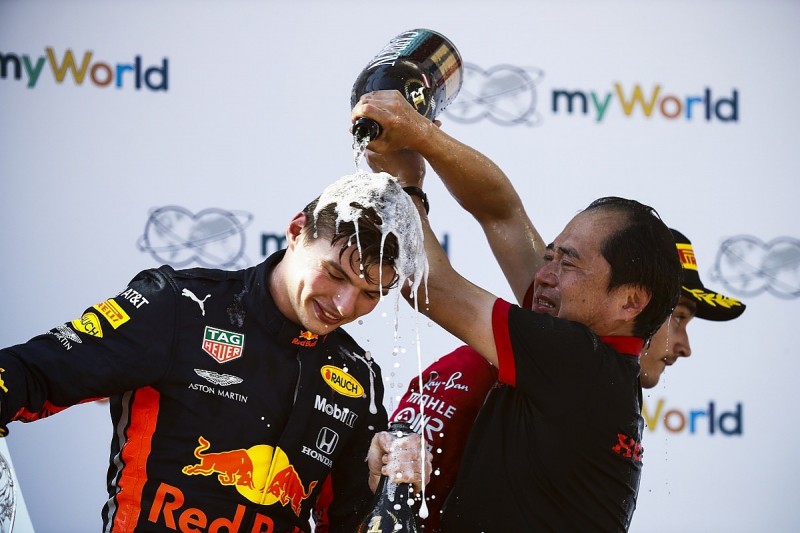
Though Red Bull-Honda was not that competitive in France, Verstappen won the next race in Austria in hot conditions, had podium-finishing pace in Britain, won again in Germany and claimed pole in Hungary.
He told Autosport in Hungary that the partnership had learned to "not be so conservative", and Honda had admitted it was eking more performance from its new-spec engine.
However, the company's F1 managing director Masashi Yamamoto told Autosport this was not just down to learning more about the unit.
"I can understand why Max compares France and Austria," Yamamoto said.
"We learned a lot from Canada and France - for the heat, especially.
"Then we put in a countermeasure before going to Austria and it worked really well.
"I see why Max is saying we learned how to push the engine in certain conditions."
Verstappen's win in Austria was earned in a race in which the benchmark Mercedes team encountered cooling problems and had to restrict its performance.
Honda's countermeasure meant Verstappen had everything he needed to attack and pass Ferrari driver Charles Leclerc for the win.
The next hot race after that, in Germany, Verstappen believes Red Bull was the second-quickest team behind Ferrari and could have outqualified Mercedes on merit without an imperfect qualifying.
Honda's F1 technical director Toyoharu Tanabe told Autosport that the tinkering of its engine did not stop in Austria.
"We learned something from France and then we improved our usage for Austria," he said.
"Then we learned something from Austria and improved something for Germany.
"We tried to make everything optimal.
"It's not perfect [when the engine is first introduced] because of the different conditions we see for the first time, and every time we update the calibration or usage after that kind of experience."
Honda's Spec 3 engine features an encouraging new turbocharger that benefits from the same company jet-engine expertise as the MGU-H it introduced last year.
Both of those components are important in Honda's quest for strong reliability while running at higher performance levels.
Tanabe said: "[If we have] low performance, we can run. But a reliability issue gives a big penalty, it means we cannot run.
"So we always need to make a balance between performance and reliability.
"My point of view, first you need to guarantee a certain level of reliability, and then you need to start the performance.
"Otherwise we cannot run, and it means a very serious problem trackside."
Share Or Save This Story


The driver who can wreck F1's "super exciting" 2020 silly season

Red Bull's Verstappen now has basis for first F1 title challenge

Ferrari: Mick Schumacher a good candidate for seat in Formula 1


Eight shock Formula 1 team principal changes

How Honda F1 missed a two-week window to sign Vettel

Why Red Bull's Honda takeover is a gamechanger for its F1 mindset

Renault to sell former F1 engine facility in Viry

"It's pretty bad" – Why Norris needs headache tablets for bumpy Austin circuit

Why it's now Bearman versus Camara for the next Ferrari vacancy

MotoGP Australian GP: Bezzecchi leads Aprilia 1-2-4-5 in Friday Practice
Subscribe and access Autosport.com with your ad-blocker.
From Formula 1 to MotoGP we report straight from the paddock because we love our sport, just like you. In order to keep delivering our expert journalism, our website uses advertising. Still, we want to give you the opportunity to enjoy an ad-free and tracker-free website and to continue using your adblocker.


Top Comments