


Ferrari tested wet-weather active aerodynamics in F1 Barcelona shakedown
Rain dissuaded several teams from running at Barcelona on Tuesday, but it enabled Ferrari to evaluate the new 'Partial Active Aero Mode' designed for wet-weather running


Charles Leclerc, Ferrari
Photo by: Formula 1
Although only two teams took to the track on the second day of Formula 1's five-day 'shakedown' behind closed doors at the Circuit de Barcelona-Catalunya, there was plenty of material for analysis.
During the morning, as Ferrari focused on data collection and logging mileage on its first proper day of running the SF-26, Charles Leclerc was able to complete his first laps on a soaking track surface as rain set in, taking advantage of Ferrari's decision to carry two sets of Pirelli's new full wet tyres in its allocation.
Over the course of his many laps in the wet, Leclerc was able to test the Partial Active Aero Mode, one of the technical and sporting innovations for the 2026 Formula 1 season.
Active aerodynamics are an extension of the now-retired DRS (Drag Reduction System), which was used from 2011 until the end of 2025. It aims to make the cars more efficient on the straights, via reduced aerodynamic resistance, boosting speed and reducing the energy demand on each car's hybrid system.
Initially envisaged as being either on or off, the active aerodynamics now encompass a third state that Leclerc evaluated on Barcelona's main straight: while the rear wing remains 'closed', the second and third elements of the front wing flatten out.
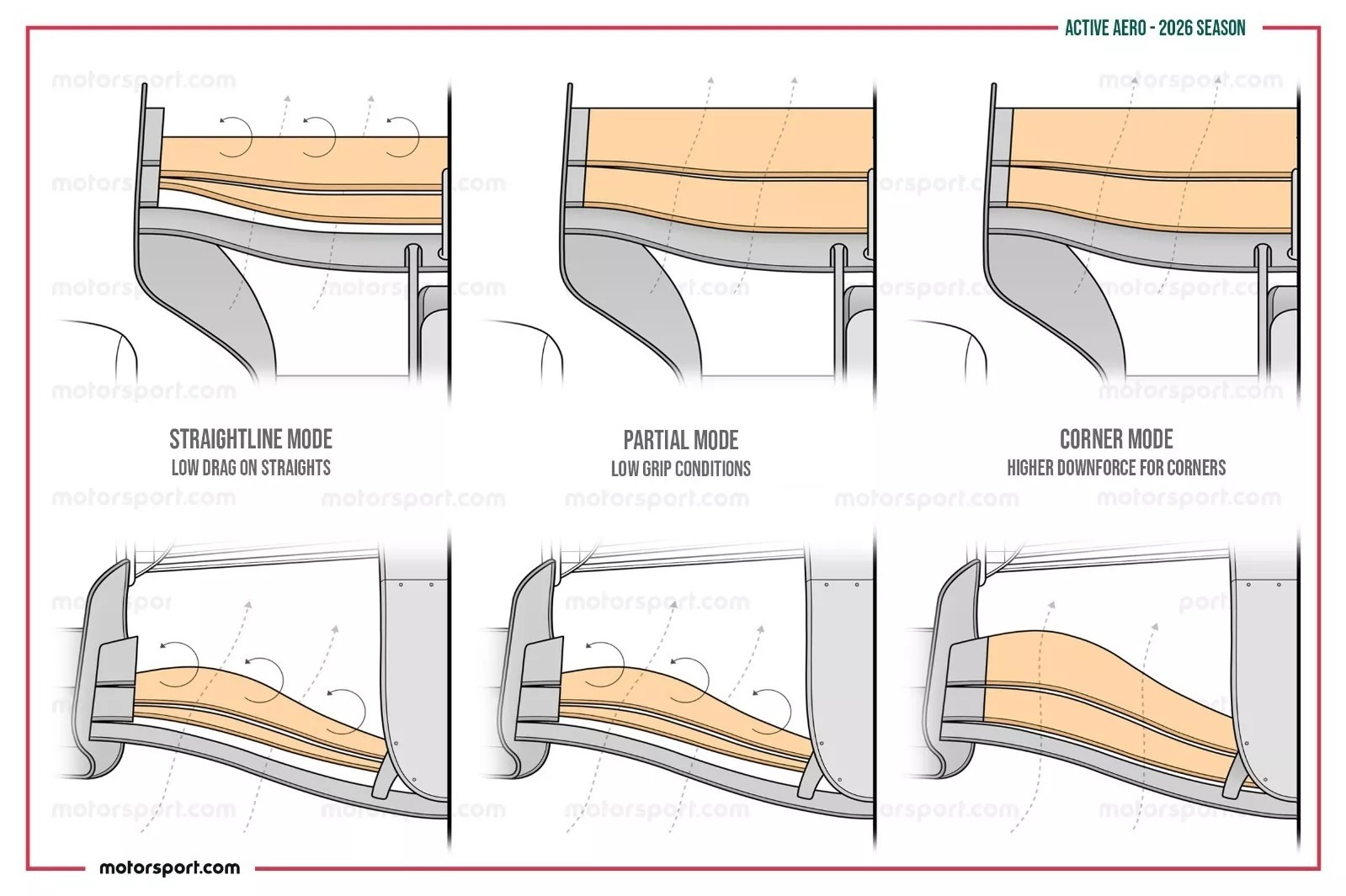
This third mode was introduced as part of the latest draft of the regulations last December. Until then, the rules stipulated that drivers could not use active aerodynamics at all in wet track conditions.
There were two main reasons for adding this mode to the package. Firstly, there remained a worry that running full downforce on the straights would draw too much energy and result in the electrical system running out of battery power, which would damage the spectacle and act as a focus for negative sentiment.
Another pressing concern, with several disqualifications for excess skid block wear last season lingering in the memory, is that high downforce levels on the straights would contribute to high levels of skid wear. It's no surprise, therefore, that this third active aero mode was put on the table in the wake of McLaren's controversial exclusion from the Las Vegas Grand Prix.

Share Or Save This Story


Aprilia boss details why he chose Bagnaia for MotoGP 850cc era

Alex Zanardi dies at the age of 59

The three clues to the F1 start problem Antonelli is aiming to solve


Leclerc and Hamilton's differing theories behind Ferrari's Austin qualifying disappointment

What we learned from Friday practice at the 2026 United States GP

F1 United States GP: Leclerc pips Antonelli to top FP2 while McLaren struggles


F1 United States GP: Ferrari completes perfect practice record as Hamilton tops FP3

The reasons behind Ferrari's US GP upgrades

Why Hamilton’s return to form is not straightforward

Morrow edges Grant as older Formula Fords entertain in Festival support contests

Is MotoGP’s title fight over after the Australian GP swing?

The one aspect of the 2026 US GP that should be a blueprint for F1 2027

Red Bull explains why Verstappen and Hadjar's 'silly' problems won't all be fixed in 2026
Subscribe and access Autosport.com with your ad-blocker.
From Formula 1 to MotoGP we report straight from the paddock because we love our sport, just like you. In order to keep delivering our expert journalism, our website uses advertising. Still, we want to give you the opportunity to enjoy an ad-free and tracker-free website and to continue using your adblocker.


Top Comments