


Why the demise of F1's hypocritical spending habit is cause for celebration
For too long, F1's richest teams have justified being able to spend as much as they want because that's the way they've always conducted their business. STUART CODLING says that's no reason not to kick a bad habit
Many years ago – 2007 in fact – I was sent to grill the team principal of one of the big-name manufacturer outfits (long since gone) for an entry in GP Racing’s 'Long Interview' series. The conversation came round to budget caps which were, as now, among the issues being hotly debated within the lofty inner circle of Formula 1’s powermongers.
“It will never happen,” he said dismissively, waving the question away as if he were enjoying a coffee outside a Parisian bistro and I were a street urchin attempting to sell him clothes pegs or somesuch. “Too difficult to police, I think.”
During the course of whittling the transcript down to fill the allocated space I kicked this section into touch, thinking that GP Racing readers would rightly find the subject dull. Shame, as it turned out, for we could have hoist him by his own petard: not a month later this same individual was quoted in another organ, lavishing such praise upon the notion of budget capping that you might imagine it to be humankind’s most towering achievement since the discovery of fire.
Spurious cant attends this subject like a Greek chorus – and here we are again as, scant months after grudgingly acceding to a budget cap while simultaneously crowing about how generous and far-sighted they have been in permitting it to happen, F1’s most profligate teams are now lobbying to be made an exception.
As talks progress on the putative Saturday sprint-race format being evaluated this year, some teams have flagged up the potential extra costs arising from them. Those who have had to downsize in terms of headcount to meet the cap are now saying a few nerfed front wings in these sprint races might require them to shed still more staff.
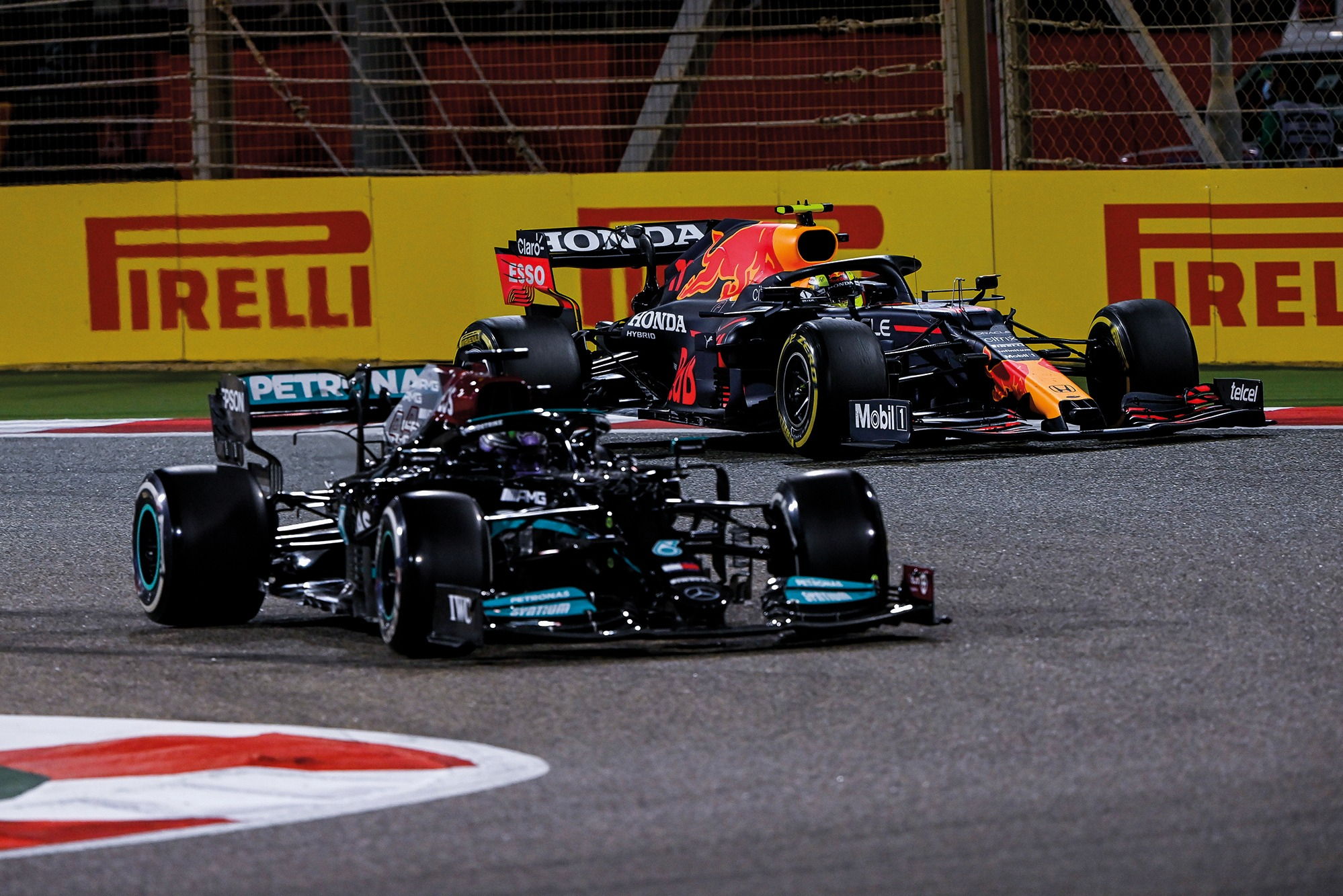
Hamilton leads Perez, 2021 Bahrain Grand Prix
Photo by: GP Racing
This is an emotive argument, but one which loses impetus when viewed objectively through the prism of a world in which the majority of the population has had to make sacrifices to get by, and businesses have faced tough decisions in order to survive and thrive. GP Racing, for instance, operates on a quarter of the full-time staff it had in 2007.
It’s one of the paradoxes of F1 that a category defined by technical innovation is co-steered by bodies who are fundamentally averse to change. F1’s political history is amply garlanded with examples of argumentum ad antiquitatem, the appeal to tradition, a classic logical fallacy: “That’s the way we’ve always done it, so it must be right.”
Painful as the process may be, these outfits must un-learn the spending habits of a lifetime. Things aren’t what they were, they’re what they are. Money-no-object F1 is reaching the end of the road
In Max Mosley’s autobiography he recalls the pushback against his initiative to force manufacturers to build engines which could last for a full race weekend or more. “But we’ve always changed engines on a Saturday night,” spluttered one enraged grandee team principal.
In recent years the likes of Mercedes and Red Bull have in effect monopolised engineering talent by outspending their rivals, pouring almost unlimited resources into R&D and recruiting the finest engineers. The result has been an often stultifying state of competitive affairs on track, while smaller teams struggle both to get by and to hold on to their best staff. F1’s major barometers of health – income and viewer engagement among them – have suffered as a result.
Painful as the process may be, these outfits must un-learn the spending habits of a lifetime. Things aren’t what they were, they’re what they are. Money-no-object F1 is reaching the end of the road.
Hopefully some of the naked hypocrisy will evaporate too.

Bahrain GP start 2021
Photo by: GP Racing

How Ratzenberger beat the odds to realise his cruelly short-lived F1 dream

F1 uncovered: A weekend behind the scenes with a chief mechanic

When McLaren was pipped by Red Bull in a modern F1 classic

The big opportunity Sainz’s Williams switch affords to F1’s latest centurion

Inside the science of F1 fuel

How F1’s plan for rotating races could look in practice

The early decisions that set Sauber’s rookie for success

How F1 media coverage has evolved in line with its subject

MotoGP Australian GP: Marquez wins sprint to seize points lead, Martin crashes

MotoGP Australian GP: Marquez crashes and then takes pole in wet qualifying

What we learned from Friday practice at the 2026 United States GP

Honda rider Marini withdraws from Australian GP due to virus
Subscribe and access Autosport.com with your ad-blocker.
From Formula 1 to MotoGP we report straight from the paddock because we love our sport, just like you. In order to keep delivering our expert journalism, our website uses advertising. Still, we want to give you the opportunity to enjoy an ad-free and tracker-free website and to continue using your adblocker.


Top Comments