


Explained: F1 2026's compression ratio furore
F1's quiet winter period erupted as suspicions emerged that Mercedes and Red Bull had found a loophole in the 2026 engine regulations. But what does it all mean? We tackle the key questions about next year's rules and compression ratios...

Formula 1's 2026 season hasn't even started yet, and the controversy touch-paper has already been set ablaze. Actually, scratch that - we're not even in 2026 yet...
Here's the situation, as it stands: while F1's 2026 regulations have maintained the use of a 1.6-litre V6 turbo engine as its centrepiece, the specifics of the internal combustion engines have changed. The most pertinent one is the reduction in compression ratio, from 18:1 to 16:1. Given much of the incentive behind the powertrain regulations has been to increase the scale of the electrically generated power, the regulations have defined a less powerful internal combustion engine by association. The MGU-K is responsible for around 470bhp of the power output, while the ICE is responsible for the other 530bhp.
This is monitored through an energy flow limit: 3000MJ/h, effectively the combination of fuel flow and measured flow of electrical energy from the battery to the motor. This ensures that F1 teams can't derive any extra power from burning more fuel and, while the new sustainable fuels can be manufactured to offer that extra hit of horsepower, this is limited given the FIA's regulations on composition.
With such tight restrictions, how do you get more bang for your buck? It appears that Mercedes and Red Bull, ever the innovators, have reportedly found a way to weave their merry way around the wording of the regulations for a small boost in outright performance.
German publication Motorsport-Magazin was first to report that both teams had managed to increase the compression ratio of their new internal combustion engines while running hot. It is understood that engineers who had worked at either of the Mercedes or Red Bull powertrain projects before moving to others - Ferrari, Audi, and Honda being the other power unit manufacturers in 2026 - had become aware of the 'trick' and took that to their new employer.
When measured at ambient temperatures, the engine apparently satisfies the 16:1 compression ratio set out in the regulations but, when running, this can increase to a ratio tending towards 18:1. For those who see only numbers and controversy over nothing, stick with me here - and we'll break this down bit-by-bit. And we'll do it together.

55% of 2026's grid will use a Mercedes or Red Bull Ford powertrain
Photo by: Jared C. Tilton / Getty Images
What is the compression ratio?
Engines have reciprocating pistons, which in a four-stroke engine have...well, four stages. First, they provide the clearance volume for the fuel and air mixture to enter the cylinder, they compress the mixture for ignition, they clear the chamber for the gas to expand, and then push the gas out through the exhaust. Or, if you prefer a lewder representation of events: suck, squeeze, bang, blow. It's the (Otto) cycle of life.
The second stage is the key part of the puzzle here. At the point where the fuel/air mixture has been drawn in, the piston is at the bottom of its crank (bottom dead centre) and it's at this point where the volume between piston and cylinder is at its greatest. When the piston is then cranked into the cylinder to compress the mixture, the point at which the volume is smallest occurs (or should occur, assuming your engine timing is correct) when the piston is at 'top dead centre'.
There are two ways to increase the compression ratio: either expand the swept volume of the cylinder or, alternatively, shrink the compression volume
The compression ratio is a ratio between the full swept volume (expressed in the scruffy diagram below as V1) and the volume at top dead centre (V2). Thus, in a 2026 F1 engine, V1 should be 16x that of V2 before the piston retracts again.
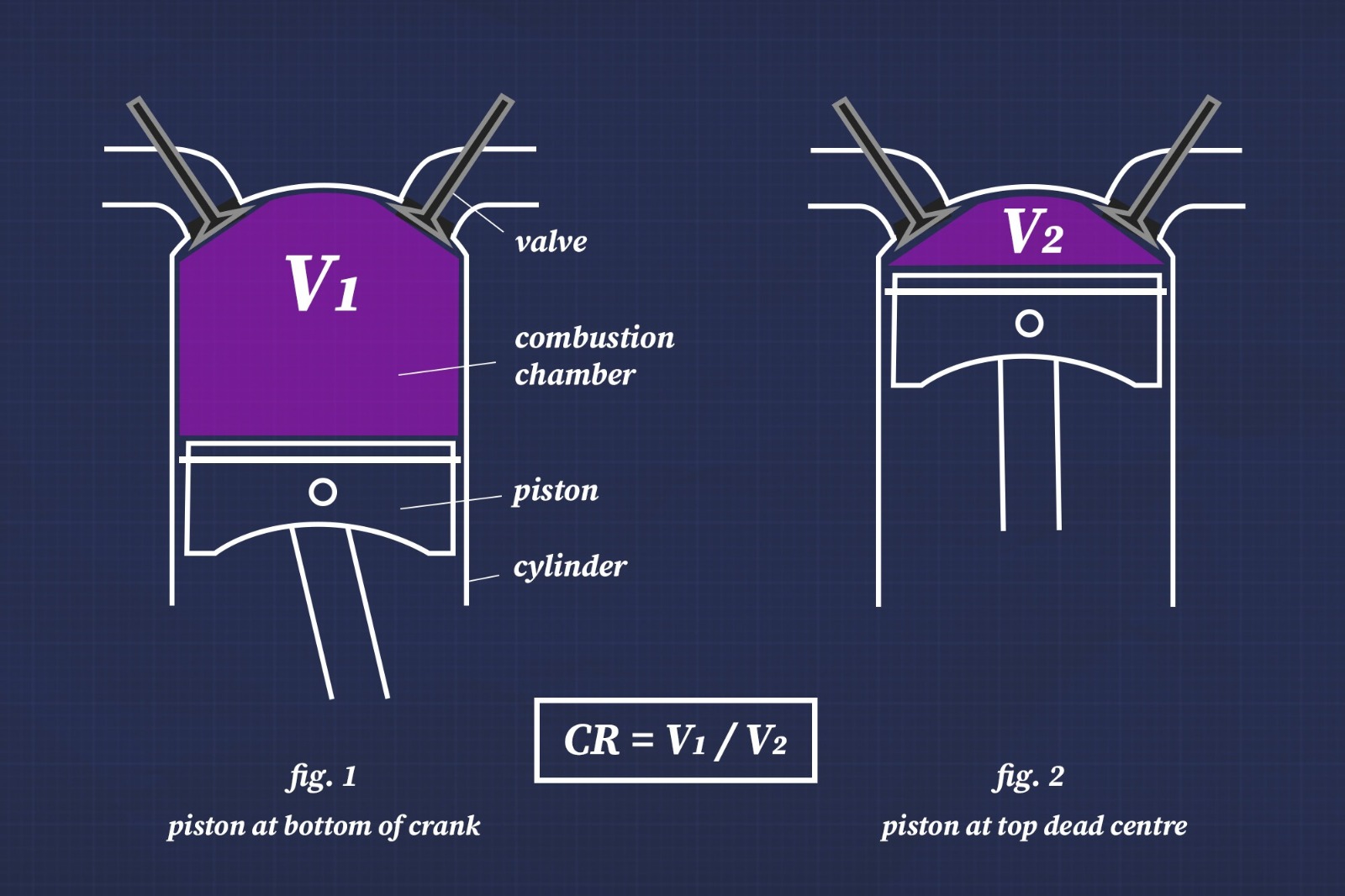
Two pistons, one at full swept volume (V1) and one at full compression (V2)
Photo by: Jake Boxall-Legge
In a high-performance engine, a higher compression ratio is favoured for several reasons: the increased pressure results in a more powerful engine stroke, and the greater concentration of combustable fuel tends to ensure that it burns more cleanly. Less of the potential energy within the fuel is wasted compared to ignition phases with less compression.
In short, the engine does more work, which gives you more power. As an aside, lower compression ratios do have their place, especially in consumer engines where reliability is the priority and often run on lower-octane fuels. Turbocharged consumer vehicles usually run compression ratios at about 10:1, for example.
How can teams surpass the 16:1 ratio?

F1's 2026 power units will deviate from the original turbo-hybrid cycle, with more powerful electrical components
Photo by: Mercedes AMG
There are two ways to increase the compression ratio: either expand the swept volume of the cylinder or, alternatively, shrink the compression volume. To attain an increase from a 16:1 ratio to 18:1, assuming a 260cc cylinder (giving around a 16cc compression volume), the first scenario would require the swept volume to expand to 288cc - which is possible, but it's arguably easier to maintain the 260cc and reduce the compression volume to 14cc.
The widespread suspicion is that the engine manufacturers in question are using materials that expand at high temperatures. To decrease the compression volume, using a piston occupies more space at top dead centre would be the way to do it; assuming that 2cc swing, the engine faces a small setback on overall swept volume assuming the piston retains the same dimensions, but at the gain of much greater compression before ignition.
This being said, it's incredibly difficult to do so while adhering to the FIA's regulations. Pistons must be machined as a single piece from four defined high-strength iron-based alloys: AMS 6487 (a chromium-based, low-carbon steel), 15CDV6 (a chromium-vanadium steel), 42CrMo4 (a chromium-molybdenum hardened steel) and X38CrMoV5‐3 (a 5% chromium steel used in tooling).
"No cylinder of the engine may have a geometric compression ratio higher than 16.0. The procedure which will be used to determine this value may be found in the document FIA-F1-DOC-C042 and executed at ambient temperature" Article C5.4.3
All four have 'normal' levels of thermal expansion coefficients associated with similar steels, at between 11E-6/K and 12E-6/K at the temperatures of 20-100C; in this circumstance, they would be relying on the natural material properties. Even though pistons get hot, it could not deliver the magic level of thermal expansion needed to close up the combustion volume - even by something as small as a couple of cubic centimetres. Thus, this is likely not the solution at play.
Other suspicions are that this is simply a piston geometry solution, one cleverly engineered to provide the 16:1 compression ratio at ambient temperatures and then increasing that ratio at the engine's working temperatures - those being a trigger, perhaps, for something in the engine to work slightly differently.
This seems more feasible, but the 'how' remains unclear. Given the piston clearance only needs to change by about half a millimetre to increase the compression ratio to a more favourable level, it could simply be a change in the piston's motion at higher temperatures.
The regulatory grey area at play

Should suspicions appear to be correct, Wolff may feel Mercedes has a case - Vasseur, meanwhile, would disagree...
Photo by: Kym Illman / Getty Images
It is understood that Mercedes and Red Bull believe that this is legal and within the bounds of the regulations. The article in the technical regulations governing compression ratio - Article C5.4.3 - states the following:
"No cylinder of the engine may have a geometric compression ratio higher than 16.0. The procedure which will be used to determine this value may be found in the document FIA-F1-DOC-C042 and executed at ambient temperature."
The latter four words do the heavy lifting here from a legality point of view. The powertrain manufacturers must demonstrate to the FIA's technical delegates that the compression ratio does indeed reach 16:1 when tested at ambient temperatures - the implication being that the engines cannot be legally tested outwith those conditions. At the high temperatures in which an engine functions, where pistons can reach hundreds of degrees, the regulations do not account for any kind of checks.
From their point of view, then, their engines are compliant with the tests and parameters stated - and it is supposed that the net increase in power of having a 'dynamic' compression ratio is worth around 10bhp - although in practice, it is likely less than this.
The other manufacturers, however, view the first point in the aforementioned article as the arbiter: if both Red Bull and Mercedes indeed surpass the 16:1 compression ratio stated in the rules, then their engines are illegal. However, both sides do apply here - even if the engines do have a higher compression ratio, the FIA cannot check this until the tests are executed in the defined conditions. Hence, we have something of an impasse.
Ultimately, we're talking about a tiny margin on the piston clearance; it's likely that, if there is indeed any inquisition into the engines of Red Bull and Mercedes, they'll argue the toss - if, indeed, this is a genuine scenario that the FIA deems worthy of investigation. Yet, teams generally include the FIA on all matters of development; they'll speak to the governing body about their interpretation of the wording with the intent of receiving the FIA's approval.
Of course, a team may well protest the Mercedes and Red Bull powertrains - but that then offers a final question: will they be able to prove it?

Will any of the other powertrain manufacturers protest - or if they can't beat them, will they join them?
Photo by: Clive Rose / Formula 1 via Getty Images


Lights, Camara, action: How Haas picked F1's latest rookie for 2027

Horner's inside story of how Red Bull built its own F1 engine

Why Mercedes' latest 2026 F1 update is no downgrade

Singapore Grand Prix Driver Ratings 2026

What we learned from the 2026 F1 Singapore GP sprint race and qualifying

The political minefield set out by F1’s recent cost-cap grievances

What caused Mercedes' pace deficit at Sepang despite upgraded W17?

Three kings: F1's generational stars shone at Sepang

Colapinto urges fans to stop online abuse: “You’re not helping me or my future”

Evans given a hero's homecoming after WRC title triumph

How an unspectacular showing in a kart race is such good reason to celebrate

Lights, Camara, action: How Haas picked F1's latest rookie for 2027
Subscribe and access Autosport.com with your ad-blocker.
From Formula 1 to MotoGP we report straight from the paddock because we love our sport, just like you. In order to keep delivering our expert journalism, our website uses advertising. Still, we want to give you the opportunity to enjoy an ad-free and tracker-free website and to continue using your adblocker.


Top Comments