


Could Zandvoort's challenging layout inspire other F1 circuits to change tack?
One of Zandvoort’s many triumphs on its Formula 1 return was its new banked corners adding intrigue to an otherwise tight and twisty track. While not a new concept to circuit designs, it might provide inspiration to other venues on how to spice up its own action

It was absolutely certain that the Dutch Grand Prix, the first in 36 years since Formula 1 last visited Zandvoort, would be packed to the rafters with fervent home fans.
Their orange-tinged rambunctiousness was delightful to behold, creating a bigger sea of orange since the last time the cast of Made in Chelsea took a dip in the Mediterranean. There were more flares than a 1970s clothes shop and a festival atmosphere that could rival Creamfields in its pomp, underpinned by a soundtrack from the Netherlands’ all-star cast of DJs to ignite the atmosphere.
It was also absolutely certain that Zandvoort was going to provide a relatively processional race if it remained safety car free. It duly did so, but it certainly wasn’t for the lack of trying.
In the intervening period between the Dutch circuit’s spells on the F1 calendar, the circuit had been completely remodelled after the Scheivlak, or Turn 7, bearing right into the Mastersbocht and into a greater infield section rather than the outer loop. These changes were put together for the new millennium and has largely remained in the same specification, until the deal to bring F1 to town was signed off.
The concern was that the one-lane nature of the circuit would be not just difficult to pass at but fail to yield the spectacle befitting of the travelling legions of Dutch fans. Hence, Zandvoort and the grand prix organisers were banking on, er, banking to break any potential deadlocks during the race. There was already a pinch of camber at the opening corner, the Tarzanbocht, but the decision was made to completely reprofile Turn 3 and the final corner – named after Dutch racing great Arie Luyendyk – with banking. The latter was particularly fitting, given Luyendyk’s successes in the US racing scene.

Lando Norris, McLaren MCL35M
Photo by: Zak Mauger / Motorsport Images
Now newly minted with banking, the final corner was supposed to offer a chance to hit the DRS button early, but F1 was sensibly circumspect in allowing that just in case the overall downforce levels weren’t as expected. It was still pretty one-lane, but offered a tremendous sight of Formula 1 machinery gunning it through 18-degree banking at full chat, apparently twice the incline of the Indianapolis Motor Speedway.
But Turn 3 was the real breakout star. The level of banking varied through the corner, creating a parabolic curve at its cutaway to create between 4.5 and 19 degrees of banking. While the high line proved to be the option for out-and-out pace on a qualifying lap, the differences in racing line came to the fore during the race; the choice was to hang the car high and get the slingshot out of the corner, or stay low and hope to carry enough speed to mount an overtake – or defensive move – into the undulating stretch up to Turn 7.
"That's how it should be - you make a mistake, there shouldn't be a large tarmac runoff to bail you out" Nicholas Latifi
Turns 7 and 8 also offered their own challenges, surrounded by acres of gravel to ensnare any overly optimistic driving, and the combination of plunging downhill into a moderately cambered configuration of corners could reward and rebuke the brave in equal measure. Lando Norris, for example, used Scheivlak to dispatch Yuki Tsunoda during the race around the outside – while Nicholas Latifi sustained a heavy shunt at the following corner during qualifying amid his bid to crash the Q3 party.
Nonetheless, the Williams driver was effusive in his praise of the circuit’s challenges, and explained that he would rather have more circuits like Zandvoort on the calendar than have to contend with the perfusion of car park-like courses.
“[It was] very refreshing in terms of the old school circuit point of view, mistakes punishing you,” explained the Canadian. “I mean, I'm not mad about that, I'm obviously frustrated with what happened yesterday, but that's how it should be - you make a mistake, there shouldn't be a large tarmac runoff to bail you out.

Nikita Mazepin, Haas VF-21, walks away from his car after beaching in the gravel
Photo by: Jerry Andre / Motorsport Images
“I think from the peripheral aspects about everything outside the white lines and the curves, [it provides the right challenge]. One of the things us drivers are always advocating for is none of the track limits issues - it just makes it really tricky to follow. If you have a kerb, and then gravel, or curb and then grass, that kind of solves everything.
“Yeah, it'll bite you. [I don’t think you] necessarily have to have the walls very close, you can still have walls far away. But you just need to have something penalising you if you go off-track. And that showed multiple times this weekend.”
This author explored that idea following the Paul Ricard weekend. The French circuit is arguably the biggest offender in terms of employing run-off in place of grass and gravel, and it seemed even more problematic in comparison to the Road America IndyCar race held on the same weekend.
PLUS: The IndyCar feature that Paul Ricard desperately needs in F1
Although the return of the Dutch Grand Prix didn’t provide particularly stunning racing, the willingness of the organisers to change its corners to give the spectacle a boost is commendable. In the interests of fun, and as an interesting thought experiment, we shall select a range of the F1 circuits most reliant on run-off and flat corners and give them the Zandvoort treatment.
Ordinarily, Abu Dhabi would make the cut – but it’s embarking on the process of changing things up for us later this year. The dull, off-camber Turns 11-14 will make way for a single sweeping left-hander with some increased camber, hopefully allowing for drivers to try different lines.

What Paul Ricard could look like with some needed changes
Paul Ricard
The most infuriating aspect about Paul Ricard - other than the traffic, the migraine-inducing red and blue stripes lining the circuit and the dull races - is that the circuit is pretty much a blank slate to reconstitute and reprofile into an incredible F1 venue. And yet, it opts for mediocrity.
The variable friction of the stripes around the circuit is supposed to simulate the effect of gravel with little recourse, which is obviously great for the teams’ purse-strings but generates the usual deluge of critique every time track limits issues rear their heads. So, let’s just bin all of that off and replace it with some neatly manicured lawns and gravel traps (as imagined above), and turn our attention to the corner layouts.
In particular, the first sector and the beginning of the second often creates single-track racing, and although the road opens out before Turn 5 and appears to promote late moves into the right-hand corner, it instead funnels the cars into single file. Here, and heading into Turn 6, is a prime opportunity to introduce banking and create a rollercoaster ahead of the Mistral straight. If the circuit is wide enough, it will offer the chance for drivers to improvise in the corner before picking up DRS, and either choose to prioritise defending within the corner itself, or within the following DRS zone.
But there's also the temptation to hypothetically give Le Beausset some banking too...

Lewis Hamilton, Mercedes F1 W11
Photo by: Zak Mauger / Motorsport Images
Sochi
The whole vibe of the Russian circuit is that it winds within the confines of the Winter Olympic village – so it’s difficult to justify laying up a bunch of turf around the edges when it’s, for all intents and purposes, a street circuit. Plus, F1 is set to move to Igora Drive for future instalments of the Russian GP, which does sadly look like another run-off fest.
But, if you squint hard enough, you could theoretically stick some banking at Turn 4. The long left-hander can reward drivers brave enough to stick the car around the outside and hope to keep it there, but moves like that are few and far between.
The danger there is not being able to dial up the banking enough, giving it the feel of a paperclip oval, but there should be enough space to create a decent incline without bumping into the Adler Arena just behind it.

Charles Leclerc, Ferrari SF1000
Photo by: Mark Sutton / Motorsport Images
Monza
Okay, Monza is not a run-off fest – although it’s significantly more paved than it used to be. We won’t be suggesting that F1 uses the old circuit here either, since that would be utter madness and require chopping up the historical track to fit SAFER barriers and the like to get it up to FIA Grade 1 standards.
But Monza could pay tribute to its roots and rework the Parabolica into a banked corner. Keeping the general shape of the corner should slow the cars down enough, but the added incline could pave the way for more overtaking opportunities down the straight, increase the top speed towards the first chicane, and add an extra dimension to a circuit that has been hit-or-miss in the modern era with regards to the sorts of races it puts on.
There’s something wonderfully poetic about the idea of Monza once again putting F1 cars through a banked corner, while putting a modern twist on a classic venue. The only issue there is making sure that the architects get the run-up absolutely spot on, otherwise it could simply be a bigger danger than it already is. But it’s certainly food for thought.
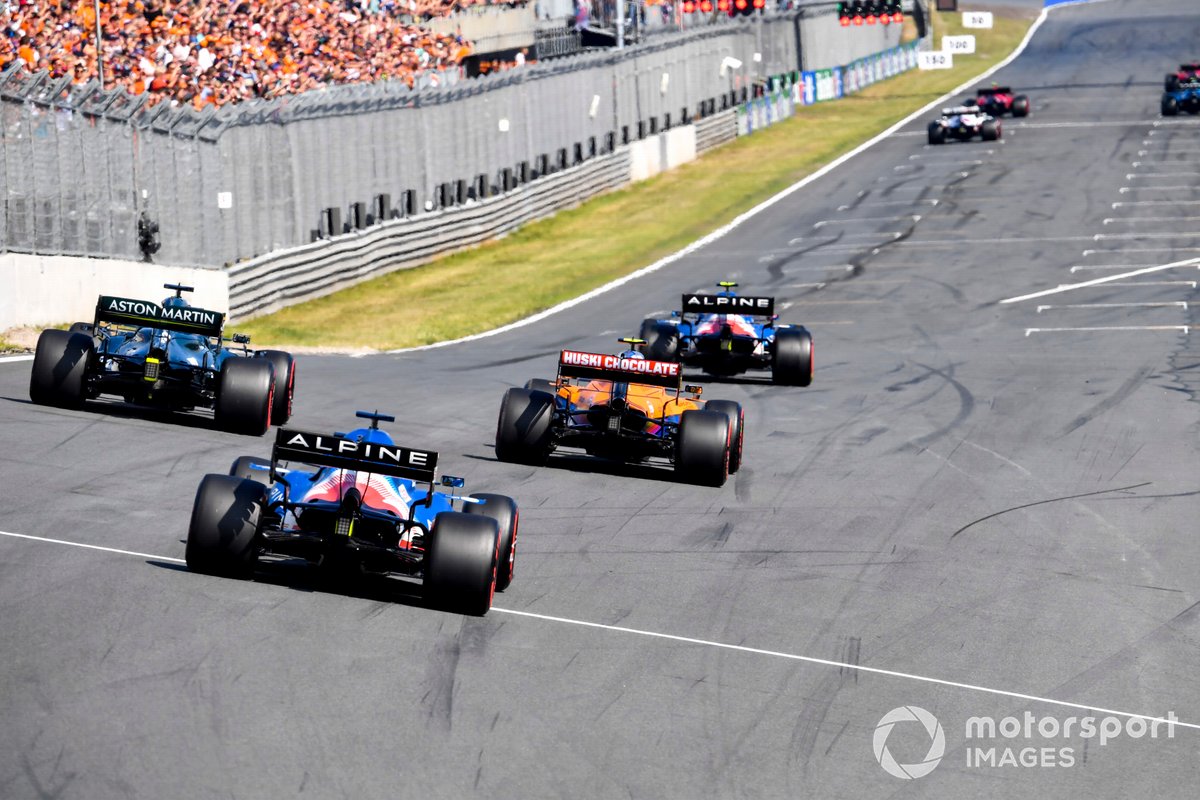
Esteban Ocon, Alpine A521, Lando Norris, McLaren MCL35M, Lance Stroll, Aston Martin AMR21, and Fernando Alonso, Alpine A521
Photo by: Jerry Andre / Motorsport Images


Lights, Camara, action: How Haas picked F1's latest rookie for 2027

Horner's inside story of how Red Bull built its own F1 engine

Why Mercedes' latest 2026 F1 update is no downgrade

Singapore Grand Prix Driver Ratings 2026

What we learned from the 2026 F1 Singapore GP sprint race and qualifying

The political minefield set out by F1’s recent cost-cap grievances

What caused Mercedes' pace deficit at Sepang despite upgraded W17?

Three kings: F1's generational stars shone at Sepang

WEC Barcelona: Genesis secures maiden series pole from Toyota
What drives Bortoleto as his junior rivals hit new heights in F1

How the M8B became the most dominant car in McLaren’s history

What Verstappen knew about Red Bull’s big upgrade when he signed his new F1 deal
Subscribe and access Autosport.com with your ad-blocker.
From Formula 1 to MotoGP we report straight from the paddock because we love our sport, just like you. In order to keep delivering our expert journalism, our website uses advertising. Still, we want to give you the opportunity to enjoy an ad-free and tracker-free website and to continue using your adblocker.


Top Comments