


Connecting two of Ferrari's favourite F1 sons
Gilles Villeneuve's exploits behind the wheel of a Ferrari made him a legend to the tifosi, even 40 years after his death. The team's current Formula 1 star Charles Leclerc enjoys a similar status, and recently got behind the wheel of a very special car from the French-Canadian’s career

"With his generosity, his courage, with the ability he had in driving cars, he taught us what needed to be done so that a driver could defend himself in an unpredictable moment. He was a master of combat and gave so much to Ferrari. I loved him.” If you want to comprehend the impact a driver who scored just six wins for Ferrari had on the Italian marque’s great founder and leader Enzo, his quote on the plaque of the Gilles Villeneuve memorial at Imola sums it up beautifully.
Villeneuve is widely recognised as one of the greatest grand prix drivers never to become world champion, his legacy stretching far beyond a career tragically cut short by his death in a qualifying accident at Zolder in 1982. Forty years later, he is still revered for his bravery, his knack for the spectacular, and for the qualities that made him so loved by Enzo Ferrari.
INSIGHT: The untold Gilles Villeneuve story from inside Ferrari
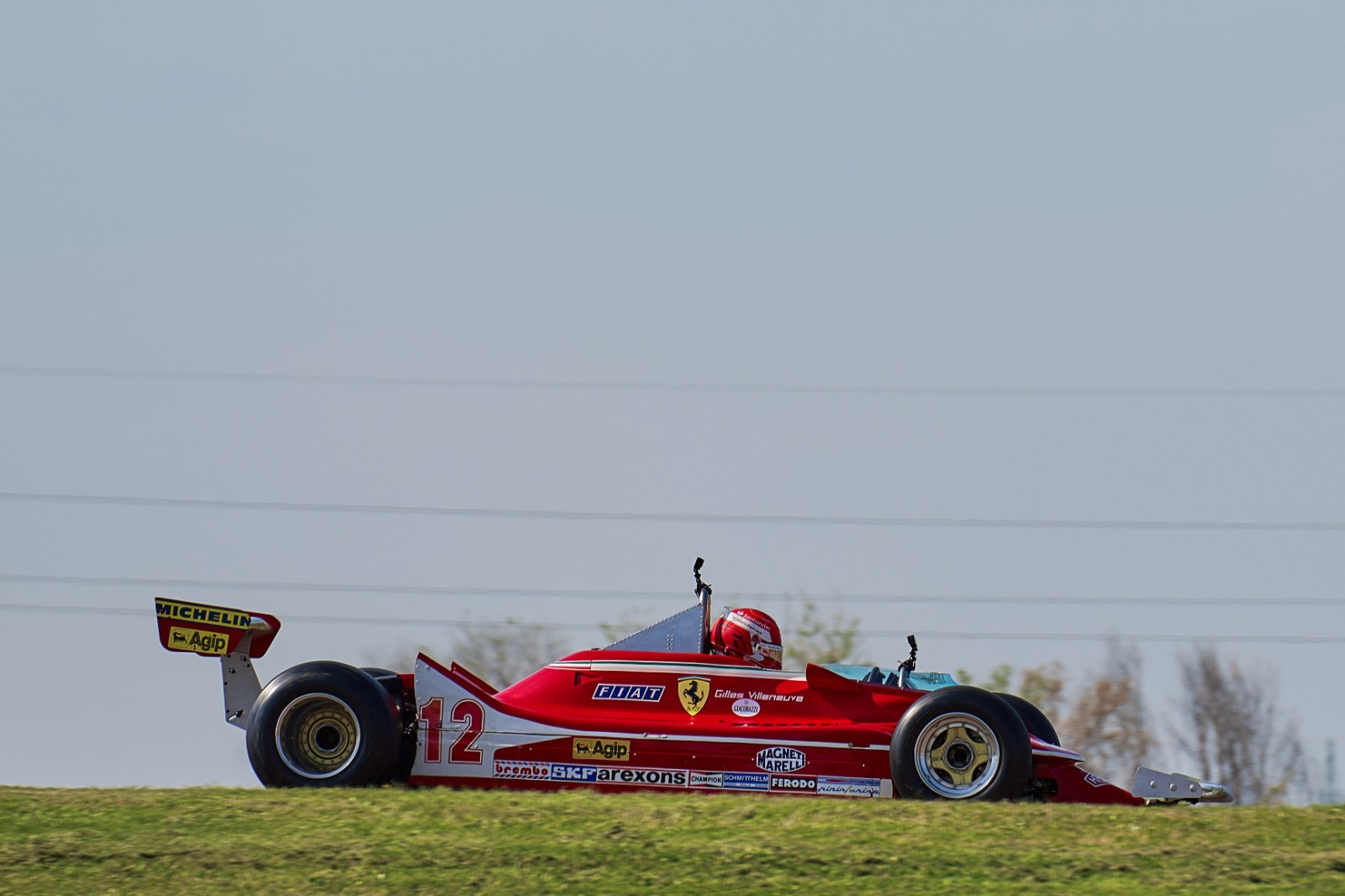
To celebrate Villeneuve’s enduring spirit and place among its history, Ferrari held a special event at Fiorano in April. The team provided its current F1 title fighter, Charles Leclerc, with the chance to sample the great Canadian’s Ferrari 312T4 from 1979, when he scored three wins and finished runner-up in the world championship to team-mate Jody Scheckter.
It’s an experience few F1 drivers are afforded, making it a special moment for Leclerc. But it also draws parallels between Villeneuve and Maranello’s current favourite son, whose abilities and future prospects surely would have won him a similar adoration from Enzo Ferrari. “It is part of the legend of Ferrari, but also of Gilles Villeneuve,” Leclerc says in the video released by F1 to mark the anniversary. “It makes me emotional to be the driver chosen to drive this car today.”
This kind of appreciation for F1 history is something not every driver has, and something even fewer get the opportunity to truly understand. “They are drivers that I’ve never seen in real life, but obviously you get to see a lot now with social media, you get to see a lot of their fights,” Leclerc says. “But you only appreciate how much risk they were taking once you actually get into one of their cars.”
Leclerc’s former team-mate, Sebastian Vettel, has tested many a classic F1 car and even has his own collection, with Nigel Mansell’s famous ‘Red 5’ Williams FW14B among his prized possessions. He says it’s “great fun” and a “unique opportunity” for any driver to get “a great insight of how life or how driving has been back then”.
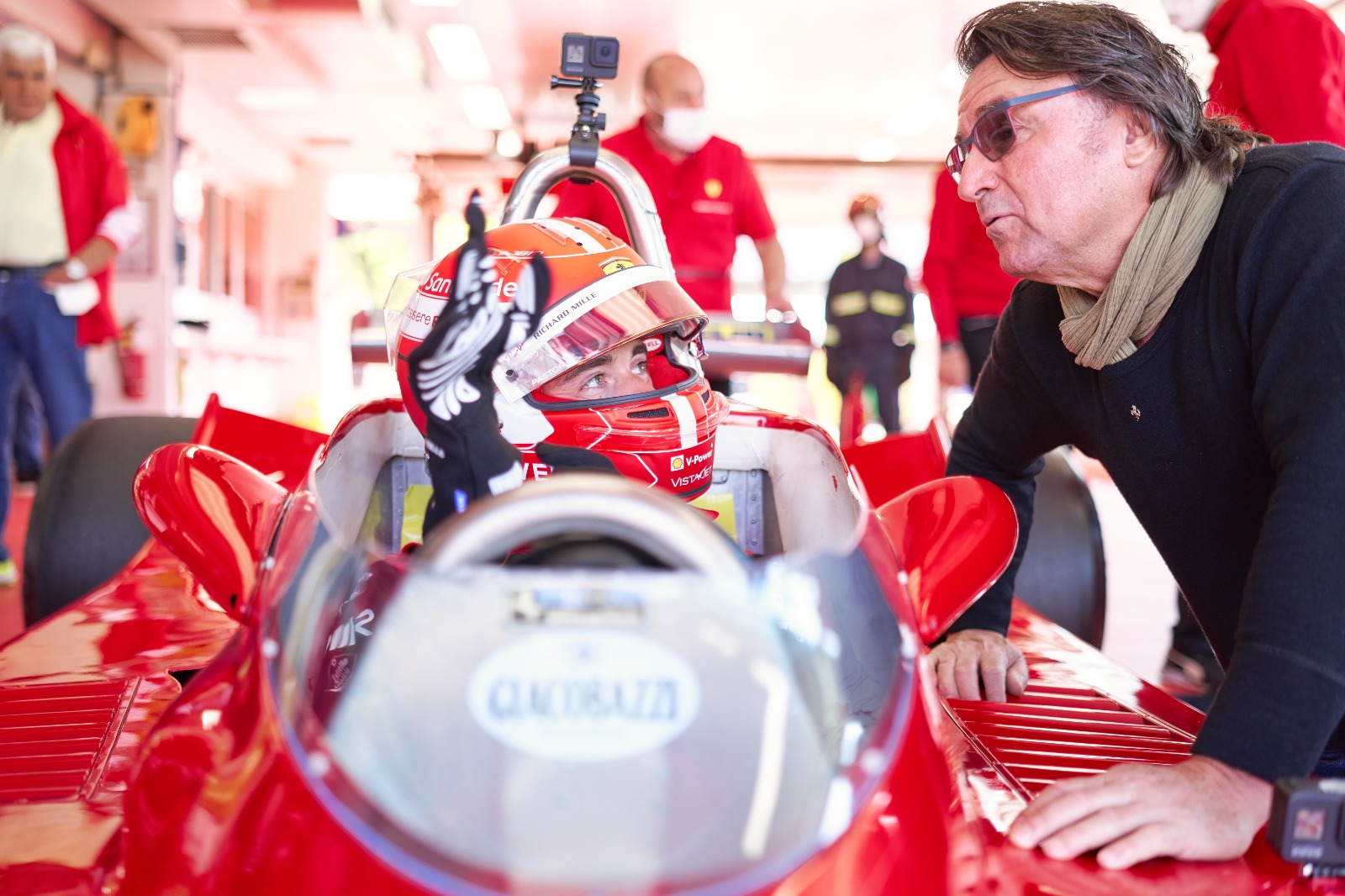
Ex-Ferrari driver Arnoux was on hand to offer advice to Leclerc
Photo by: Ferrari
That’s something that strikes Leclerc from the moment he peels out of the garage at Fiorano after being run through the basic controls by the Ferrari crew. At a fairly slow speed, encountering a lack of grip at first on the same tyres that were on the 312T4 in the museum (which he says feel “like wood”), Leclerc takes his step back in time with a car that is a world away from the F1-75 he is driving this year.
And boy, does he have fun. That same lack of grip gives him free rein to regularly stick the back end out as he completes his laps, fighting the oversteer just enough to stay in control – a very Villeneuve-esque approach. Once his run is over and the engine cut, he turns to the Ferrari mechanics, beaming: “Bella! Bellissima!”
“You can play with the car quite a lot,” Leclerc says. “It’s just crazy. The gears are something that is quite different to our cars now. It’s a bit harder to go from one gear to another, and it’s very, very tricky to drive. The rear is always moving.”
But it also brings home to Leclerc how much risk the drivers in Villeneuve’s era took each time they stepped into the cockpit. In every conversation he has since had about the test, Leclerc has made clear how drastic he found the difference. He gets an unwanted additional understanding about the risks involved a few weeks later when a brake disc failure causes him to crash a 1974 ex-Niki Lauda Ferrari 312B3 at the Monaco Historique.
PLUS: Why Leclerc's historics crash shouldn't put off F1 drivers tasting history
"It was all about who is willing to take more risk, I think. At that time, it was probably more the bravery that was coming out" Charles Leclerc
“You can always feel the danger,” adds Leclerc. “Now we’ve lost a little bit this feeling that is in the car, I feel safe. But when you drive these cars, it puts everything back in a dimension and shows you how much of a step Formula 1 has done since those years in terms of safety.
“Now with our cars, it’s all about the smallest details. Here it was all about who is willing to take more risk, I think. At that time, it was probably more the bravery that was coming out.”
It’s precisely that bravery that Villeneuve brought by the bucketload. From the moment he made his F1 debut at Silverstone with McLaren in 1977, it was clear that his approach was to find the limit by going over it and then working backwards, not by building his way up. It was what marked him out as one of the most spectacular drivers of his generation.

Villeneuve and Arnoux's epic tussle at Dijon in 1979 has gone down in F1 folklore
Photo by: Motorsport Images
Leclerc mentioned the clips of Villeneuve he’s watched online. The most famous, of course, is the fight against Rene Arnoux at Dijon in 1979 (above). Even if you can’t recall it, you’ve probably seen it: the sight of the red Ferrari and yellow Renault dicing back and forth, exchanging positions lap after lap, ultimately separated by just two tenths of a second at the chequered flag. It remains the example of what true racing in F1 should look like; an antidote to whatever mundane definition of ‘track limits’ today’s F1 may necessitate.
PLUS: Gilles Villeneuve's 10 greatest F1 drives
His significance in the story of Villeneuve and the 312T4 meant an invitation to Leclerc’s test was extended to Arnoux, which he gladly took. “This car, it’s special to me,” says Arnoux, who joined Ferrari from Renault in 1983. “Gilles was an acrobat driver, always at the maximum. He used the car for 60 laps. Ten laps before the end, he’s in very big difficulties with the car because he used the tyres very hard, brake, engine and everything. But he adjusted his driving each time. This was Gilles.”
Think of Leclerc. Think of his approach, his hard but fair duels against Max Verstappen through the early part of this season. Think of the times he has crashed by pushing too hard, his all-or-nothing charge leaving him to lament his self-accused stupidity. Every time he steps into the car, he squeezes every single drop of performance out of it. Comparing drivers across eras is difficult and occasionally foolhardy, yet there is definite crossover between the ways that Leclerc and Villeneuve have gone about their business on-track.
Off-track, the similarities are even starker. The fashion in which Leclerc has been embraced by not just Ferrari itself, but its loyal tifosi, is rarely seen. His breakout season in 2019 was rewarded with a bumper long-term contract, signalling to Vettel – who arguably never quite reached such levels of adoration, even during the good times at Maranello – that this was no longer his team.
“Being [part of] Ferrari is somehow trying to enhance the myth of the cavallino [Ferrari’s prancing horse],” says Ferrari F1 boss Mattia Binotto. “There are only few drivers which are capable of doing that, and I think Charles is one of these, as was Gilles.
“Gilles was fantastic. Gilles won only six races, but remains for all the tifosi and the cavallino, the driver. It really was his way of driving, his way of behaving. It’s the passion he showed. And I think Charles has got that, and that’s something which is great. We are passionate as well ourselves, and we hope that he will win more than six races.”
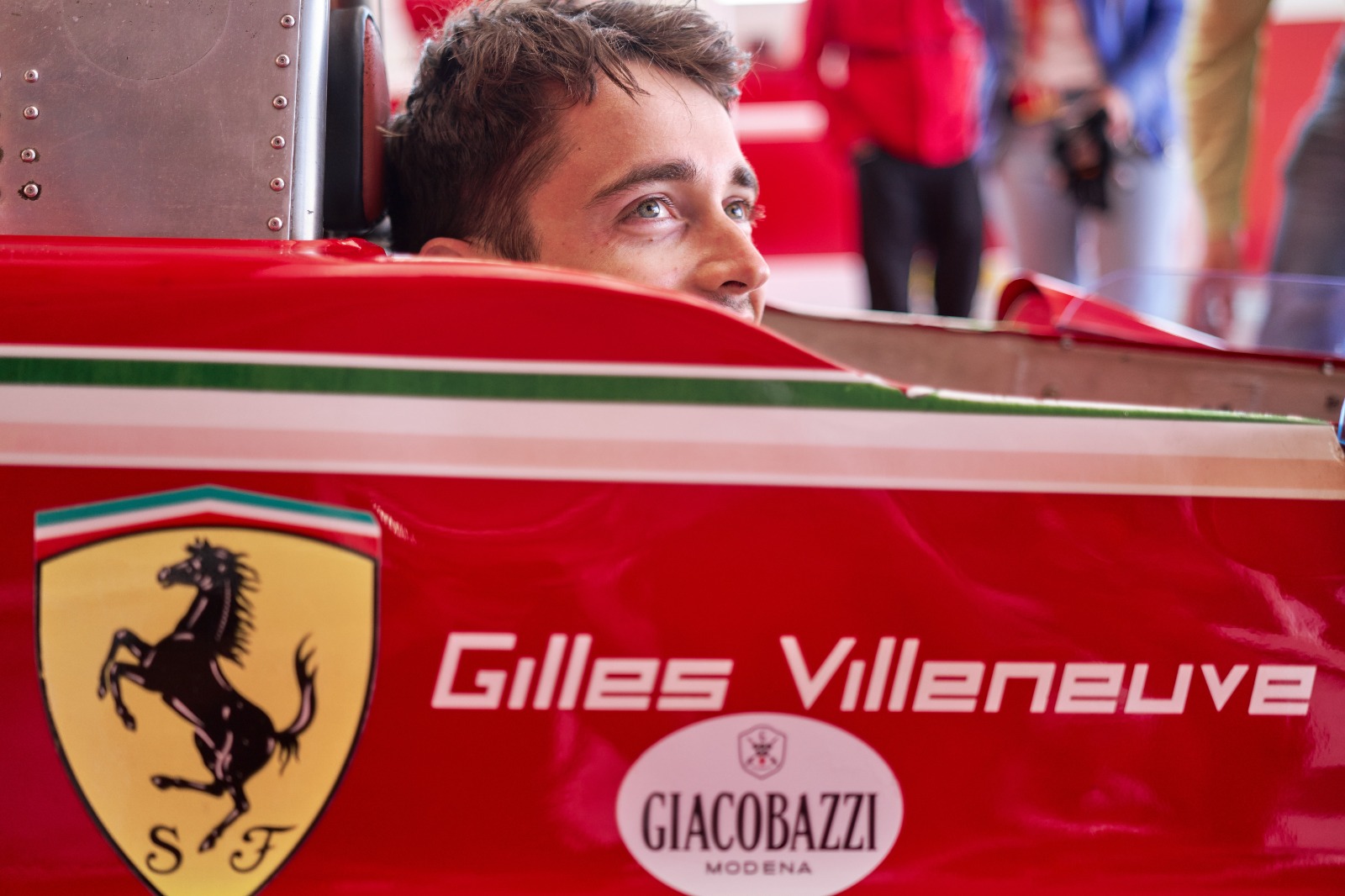
Leclerc joined the Scuderia after just one season in Formula 1, and has become the team's star
Photo by: Ferrari
The passion for Ferrari is something that was instilled in Leclerc at a very young age, when he would take special note of the red cars racing around the streets of Monaco where he grew up. As his racing aspirations grew, encouraged by his late father and his godfather, Jules Bianchi, Leclerc gravitated towards Ferrari. He proved his quality in junior categories, but to be handed a Ferrari F1 seat after just one season, becoming its youngest driver since Ricardo Rodriguez in 1961, was not without risk. Yet just like Villeneuve, he proved he was ready for the opportunity in emphatic fashion.
Few drivers have managed to capture the spirit of the tifosi since the heyday of Michael Schumacher in the way that Leclerc has
The idea of ‘favourite sons’ within F1 teams may be a touchy subject in an era of rules of engagement and team orders. But few drivers have managed to capture the spirit of the tifosi since the heyday of Michael Schumacher in the way that Leclerc has. As Binotto says, it is something that goes beyond simply driving a car or being successful; it’s about adding to the myth of F1’s most famous team through a strong bond and connection with all it embodies.
It may only have been a simple demonstration run, but Leclerc’s chance to sample Villeneuve’s car and the emotional appreciation he showed will only have deepened his connection to the cavallino, sowing the seeds for a burgeoning legacy.
Leclerc has become the tifosi's latest Formula 1 hero
Photo by: Ferrari


1998 Belgian GP: When the Schumachers went to war

F1 Monaco GP 1982 retrospective: Remembering F1's craziest finish

Has Alonso made the right choice gambling on Aston Martin F1?

Hamilton in the process of selecting Brad Pitt’s co-star for F1 movie

How ‘demanding’ Alonso has started life with Aston Martin

Ocon got "very sick" in F1 off-season due to bad lung virus

Brown: No reason not to expand F1 grid if new teams pay "fair" fee

Hamilton: Nothing will stop me speaking up on important issues in F1

Why Norris doesn’t buy Russell’s driving style theory

Evans: Late puncture was “harsh” but WRC title position is still “okay”

How Antonelli is proving unbeatable, even when he's beaten

F1 drivers push for Madring changes after "very poor" Spanish GP: "I almost fell asleep"
Subscribe and access Autosport.com with your ad-blocker.
From Formula 1 to MotoGP we report straight from the paddock because we love our sport, just like you. In order to keep delivering our expert journalism, our website uses advertising. Still, we want to give you the opportunity to enjoy an ad-free and tracker-free website and to continue using your adblocker.


Top Comments