


Can this car take Mercedes back to F1's peak?
Mercedes' run of success came to a shuddering halt when F1 returned to ground effect aero in 2022. Now that's gone, allied to rumours that the new Mercedes power unit is in good shape, can the Brackley squad return to the front?

The end of 2025 couldn't come soon enough for Mercedes. Although the team had enjoyed a smattering of good fortune over the 2022-25 period - and victories, no less - this has been comparatively sparse versus its championship-winning heyday. As Mercedes' key personnel would willingly admit, it entered that generation on the back foot and never really recovered.
Now that ground-effect aerodynamics have been put back on the shelf, Mercedes has reason for optimism. There's pressure on the team to deliver once more; for months, suggestions have been that the German brand's High Performance Powertrains division has got the holeshot with the new powertrain regulations - as it had in 2014 at the birth of F1's turbo-hybrid era. Of course, the pre-season interlude has been rife with rumours of compression ratio tinkering, with Mercedes cited as one of the powertrain manufacturers behind that. For now, it's merely speculation.
Mercedes has now revealed its W17 - or at least, a version of it - to the public. It sticks with the black-and-silver tones used over the past two seasons, now with a block pattern on top of the sidepods rather than the gradient fade used previously. But there's more than just decorations to discuss.
There's not much to talk about when it comes to the front wing of the render-model W17; it's very similar to that seen on the F1/FIA concept model, particularly around the endplates. What we do see is a large vortex-tunnel opening on those endplates, which flattens out slightly towards the trailing edge. A number of teams have taken this route to build a vortex of air, shape it, and then squirt it out around the front tyre to help keep the wake in check. The auxiliary winglet on the outside is almost as you'd see it on the display mode.
A drooping nose features a small bulge underneath to help accelerate the airflow underneath to trim out any pockets of dead air, and behind this Mercedes has stuck with a push-rod front suspension layout - the Brackley squad had resisted the temptation to follow the herd and make the pull-rod switch over the course of the previous regulations. The upper wishbone, like other teams, retains a dropped rear leg to offer some degree of pitch control and also provide some airflow interaction ahead of the sidepods.
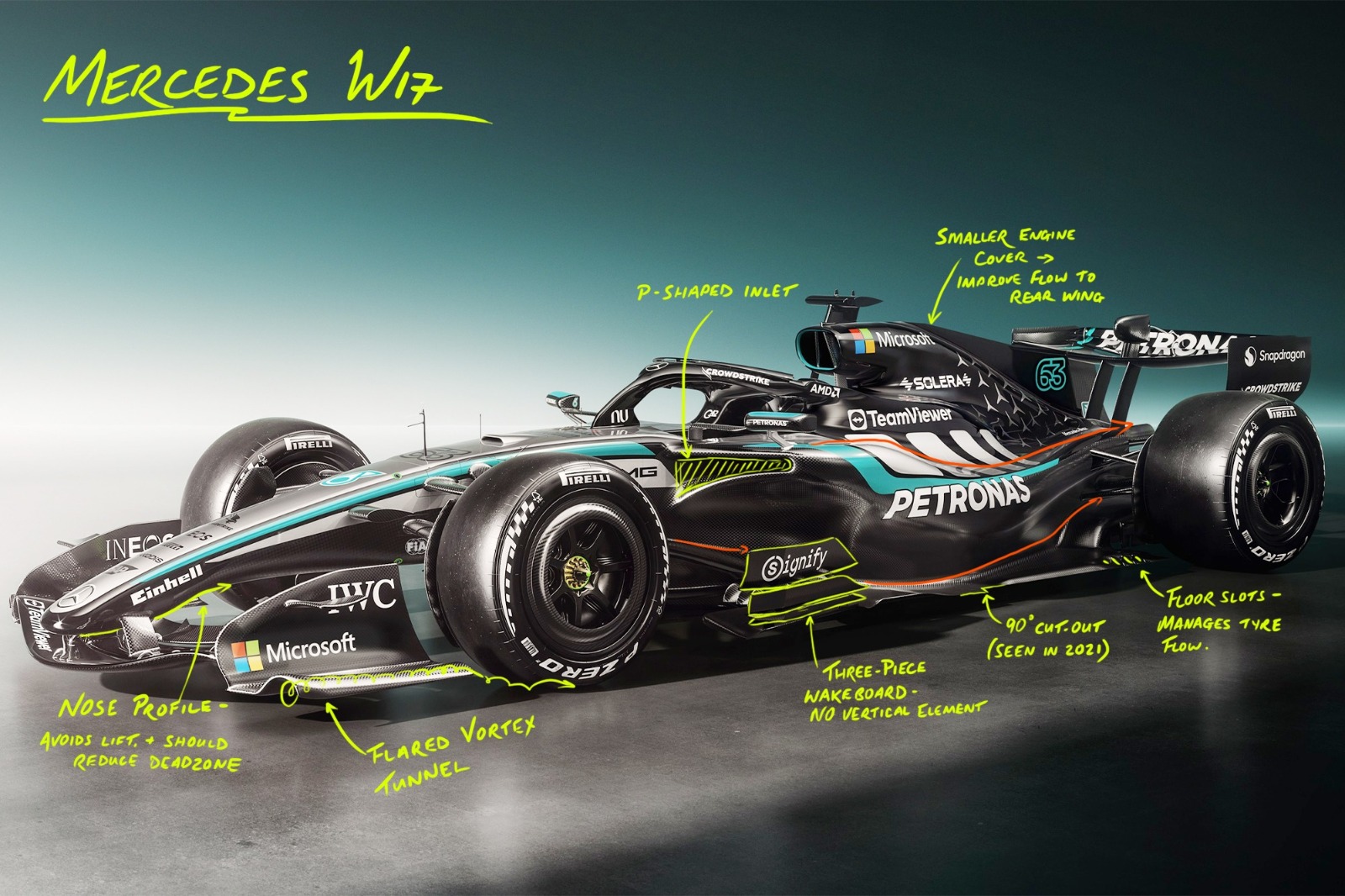
Mercedes offers some key points of differentiation behind the front wheels versus other cars shown to the public. The bargeboard/wakeboard (whatever we're calling it) comes without the vertical front panel, meaning that the three-piece 'slat' section is first to interact with the wheel wake turbulence. The bottom pair of elements here come with little extended tails, offering that last piece of guidance around the sidepods' underside. These are supported by a cross-piece, bolted to the chassis.
And, versus other teams, there's a unique take on the sidepods. The P-shaped inlets feed into a sidepod that sweeps downwards slightly, but never develops into a transition towards the top surface of the floor. Perhaps Mercedes feels that it has been successful in channelling enough air around the floor to draw enough power out of the diffuser, and that the topside airflow simply needs to be controlled by the bodywork's top surface.
The top surface of the sidepods flares out into the centreline cooling outlet, but crucially remains low enough to mitigate the interaction with the rear wing. Having to contend with a less powerful floor, aerodynamicists have needed to ensure the rear wing can operate as effectively as possible to maintain rear-end downforce, which means reducing its exposure to turbulence. One would contend that Mercedes has thus tried to keep its engine cover relatively small and straighten up the airflow ahead of the rear wing with a larger shark-fin.
Of course, knowing Mercedes' approach to sidepod geometries over the past few years, this could all very well change by the time the car hits the circuit in Bahrain - indeed, they looked marginally different towards the trailing edge when Mercedes showed the W17 exiting the garage for its Thursday shakedown run at Silverstone. The long extended outlet had been shortened, opening up the flow around the suspension components and Coke bottle section.
Elsewhere the front-wing endplates were marginally different to the launch renders; the outboard winglet was replaced by a tyre sensor. In its place, a small fin sits atop the footplate to help direct air around the front wheel assembly.
There's a bit of floor detail too, with clear slots ahead of the rear wheels should help to pull a small amount of airflow out of its rotational orbit. Ahead of this, Mercedes has taken a leaf out of the 2021 playbook with a small right-angled cutout along the floor's edge. This forms a tip vortex that can be used to seal the floor, something that might be useful - if well managed - should a team opt to implement a bit of rake into the design.
During the pre-2022 rules, Mercedes was not a proponent of the high-rake designs that steadily proliferated through the field; in short, this is when the rear ride heights are raised to maximise the diffuser expansion volume. Mercedes had kept its rear ride heights fairly low, which produced a more stable platform but perhaps one without the downforce peaks. By comparison, the high-rake Red Bulls from around five years ago could build up downforce, but at the expense of snappy handling. There's no indication of rake in the Mercedes launch renders; rake profile is something we're not likely to see until the cars hit the circuit.
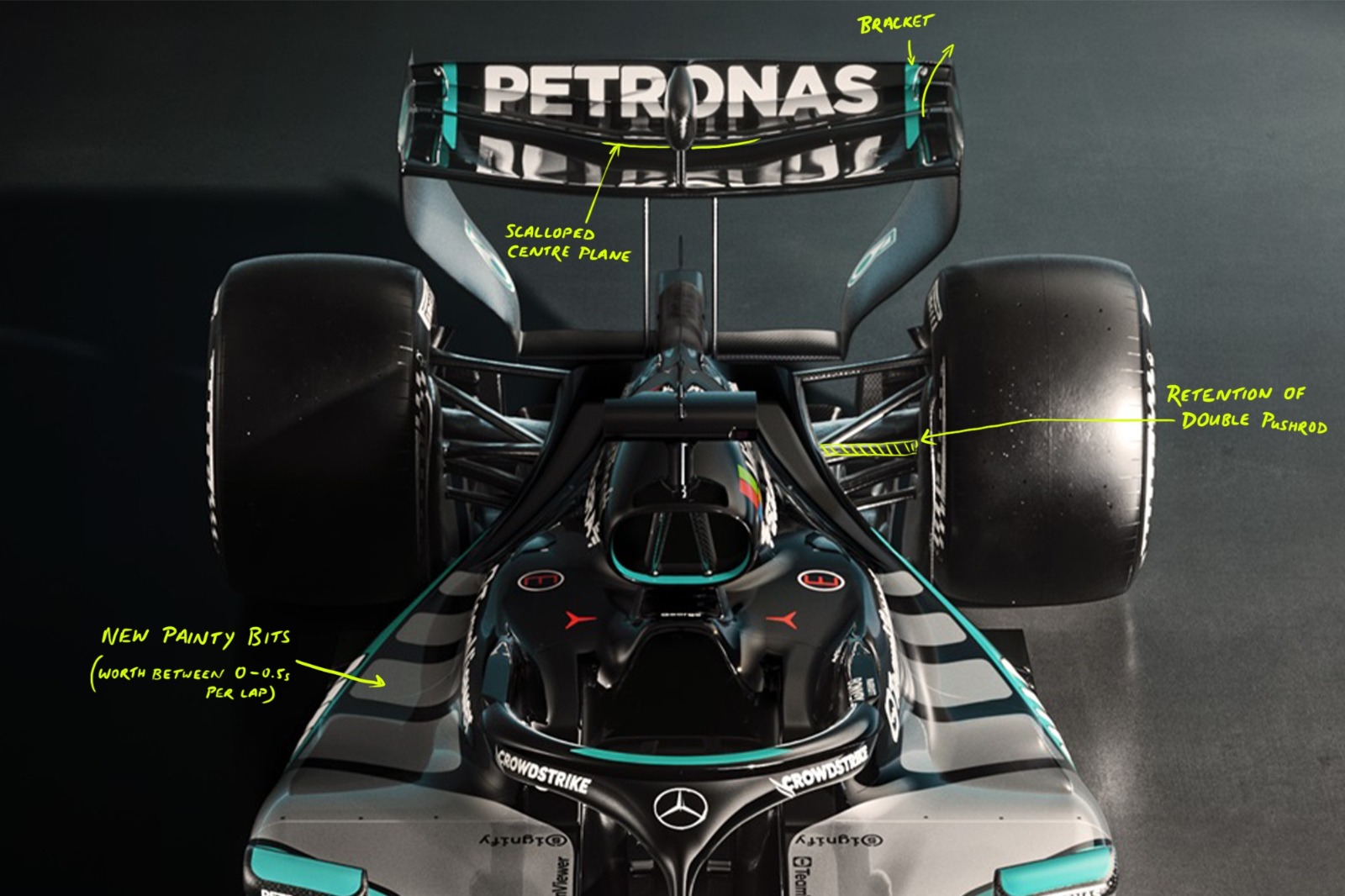
The rear wing looks to be in a similar form and function as the other seen on the grid, with a slightly scalloped middle plane to fit with the spoon-shaped central section. We have the added detail of a curved bracket separating the top two planes, which hints at how it'll help to guide the rear wing's tip vortices outwards.
After falling short in 2022, as its car was heavily affected by the ground effect-induced porpoising, Mercedes will very much hope that its slump in the previous regulations was temporary. The new chassis regulations should share more in common with a ruleset in which the team found phenomenal success, and the struggle to get the ground-effect cars dialled into slow corners (which Mercedes believes caused many of its rear-tyre overheating issues, as it had to ask the drivers to use the throttle to help turn its 2022-25 machines) should be a thing of the past.
There's a wealth of promise here at Mercedes: a theoretically strong powertrain, regulations that should suit its modus operandi, one driver arguably at their peak, and another with heaps of potential. Can it deliver upon that promise?

Mercedes has everything it needs to start winning more regularly again in F1
Photo by: Mercedes AMG


Why Piastri has struggled to show his best with this year's McLaren MCL40

Lights, Camara, action: How Haas picked F1's latest rookie for 2027

Horner's inside story of how Red Bull built its own F1 engine

Why Mercedes' latest 2026 F1 update is no downgrade

Singapore Grand Prix Driver Ratings 2026

What we learned from the 2026 F1 Singapore GP sprint race and qualifying

The political minefield set out by F1’s recent cost-cap grievances
What caused Mercedes' pace deficit at Sepang despite upgraded W17?

Honda confirms Moreira for factory team in 2027; Alonso heads to LCR

Why Piastri has struggled to show his best with this year's McLaren MCL40

How Toyota destroyed the competition to seal the WEC crowns

McLaren retains Fornaroli as F1 reserve and hands him WEC programme for 2027
Subscribe and access Autosport.com with your ad-blocker.
From Formula 1 to MotoGP we report straight from the paddock because we love our sport, just like you. In order to keep delivering our expert journalism, our website uses advertising. Still, we want to give you the opportunity to enjoy an ad-free and tracker-free website and to continue using your adblocker.


Top Comments