





A key question Piastri answered in the Qatar GP
The erstwhile championship leader might not have won in Qatar, but it was through no fault of his own – and his fault-free weekend sent an important message

McLaren, indubitably, has questions to answer after coughing up almost certain victory in Qatar and enabling Max Verstappen's seemingly improbable championship renaissance to gather more momentum into the final round.
But while Oscar Piastri now has a rather steeper obstacle to overcome before he can lay his hands on the drivers' trophy, he laid to rest many of the doubts which have been hovering over him since late summer. He was at his imperious, laid-back best throughout the Qatar weekend: faster than team-mate Lando Norris in every session that mattered; winning the sprint race commandingly; and then knuckling down to the task of rescuing his grand prix without getting in a flap after the McLaren pitwall suffered a collective headfart on lap seven.
Piastri took the championship lead in April after winning in Saudi Arabia, and he remained in command until mid-September. There a rot seemed to set in with a run of poor results, in which DNFs in Azerbaijan and two sprints, plus relatively anonymous placings in Austin, Mexico City and Interlagos proved particularly costly (though the latter was influenced by a contentious penalty). He was also off Norris's pace in Las Vegas before both McLarens were disqualified.
The timing of all this, following an Italian GP in which Piastri was compelled to yield track position to Norris after another operational slip by the McLaren pitwall, prompted the inevitable conspiracy theories to begin. An embarrassing appointment with the wall in Baku followed the Monza farrago and appeared to signal that Oscar was losing the plot, perhaps as a consequence of the supposed Machiavellian machinations which had so triggered the tinfoil-hat brigade.
Had Piastri 'choked' in the title race?
Smiting the barrier in Azerbaijan seemed to be on a similar plane to Jimmy White's precipitous capitulation in the 1994 World Snooker Championship final, when he was tied 17-17 with Stephen Hendry and missed an elementary shot on black while 37-24 up in the final frame. In the hushed cloisters of the Crucible, the crowd's collective intake of breath took on the volume of a jet engine. As Hendry proceeded to clear the table, White had ample time to reflect on his fifth consecutive loss at that stage of the tournament.
Every niche of sport is amply stocked with examples of 'choking'. In this context it would be remiss not to mention England's football team, whose fans are long conditioned to begin planning their exit from the stadium (or, indeed, the pub) when a crucial match goes to penalties.
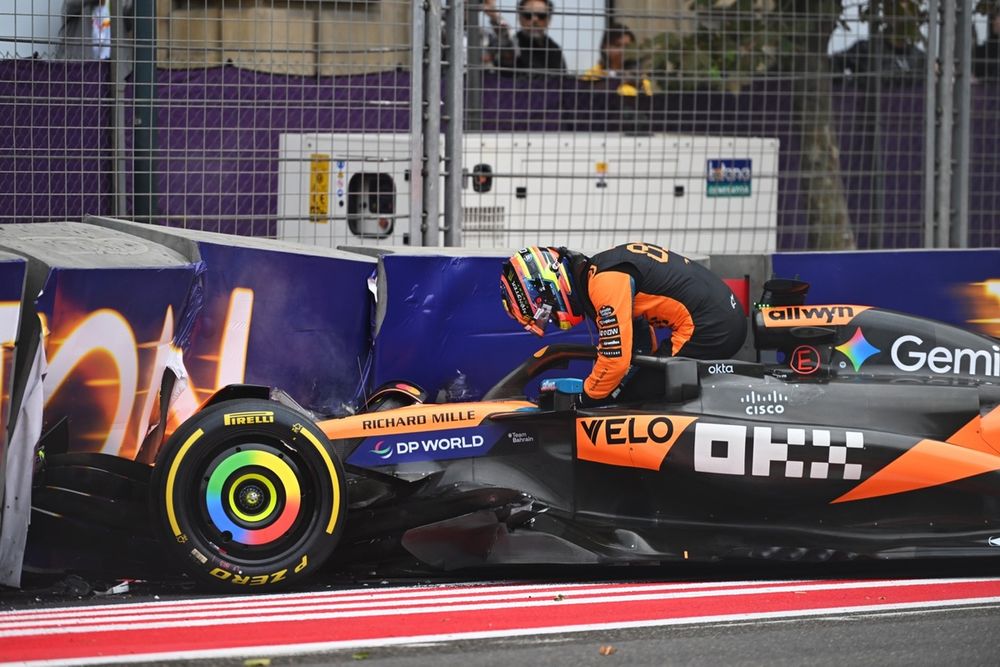
Whispers of choking had been circling Piastri during his late-season slump
Photo by: Rudy Carezzevoli / Getty Images
The sports writer Matthew Syed – who himself choked while representing Team GB at table tennis in the Sydney Olympics – believes neurophysiology explains the phenomenon, which "is triggered when we get so anxious that we seize conscious control over a task that should be executed automatically".
In the context of driving a racing car, for the great exponents of the art the process of actually driving the car quickly – from steering and selecting gears to judging the nervous equilibrium of grip versus slip – becomes almost routine, freeing up mental bandwidth for other tasks. Last year's Qatar GP, where Verstappen clocked that Norris hadn't lifted adequately for a yellow flag simply by glancing in his rear-view mirror, was a case in point.
The choker, by contrast, becomes so discombobulated under pressure that elementary tasks require a greater proportion of mental bandwidth.
"In the category of circuits of high grip, I think Oscar is in his most natural way of driving the car, and he can really maximise the potential" Andrea Stella
So, has Piastri's autumn been a case of choking, sinister sabotage, or more subtle human performance factors? Clearly there are those in Oscar's camp who plump for option two, as evinced by the sharing on one of his social media accounts of quotes from former commercial rights holder Bernie Ecclestone to the effect that McLaren is tipping the scales in favour of Norris.
Piastri was as surprised as anyone to see this and it's understood he ordered its immediate deletion once he became aware of it. This may come as news to some, but dealing with the will-sapping toxicity and utter stupidity which runs rampant on social media is a task which drivers happily delegate to others. You can count the number of F1 pilots who actually operate their own social accounts on the fingers of one foot. Nevertheless, the sharing of the Ecclestone quotes shows that there are those within Team Oscar who believe favouritism to be the case.
A more compelling argument, following the principles of Occam's razor, is the human performance angle: some results within the 'trough' can be explained by Piastri's conditioned driving style, while the rest can be accounted for as human error. Piastri thrives in a car with a firmly planted rear axle, and tends to struggle relative to Norris at circuits where the surface offers less grip and the driver has to induce a controlled slide of the rear axle to help the car to turn.

Piastri has excelled at high-grip circuits, while he has struggled in the opposite situations
Photo by: Lars Baron / LAT Images via Getty Images
How Piastri found an edge over Norris in Qatar
When there is more grip available, Piastri is often not just fractionally quicker than his team-mate over one lap, but better able to manage tyre degradation, which compounds into a bigger gap over a stint. We saw this in Qatar when Piastri pulled away from Norris in each stint – and Norris not only looked more ragged on track, but he also sounded more flustered on the radio, responding to an instruction regarding his 'throttle shape' at Turn 7 by saying, "I need more help here because I can't do it."

McLaren team principal Andrea Stella has emphasised throughout the period where Piastri was struggling that low-grip venues require "adaptations" with which Piastri is not comfortable. He returned to that theme in Qatar.
"Even when we were commenting on Oscar struggling a little bit, I've always emphasised that there are technical aspects in the way the drivers exploit the grip available and the potential in the car," said Stella. "And here in Qatar, we go back to the category of circuits with high grip. And in the category of circuits of high grip, I think Oscar is in his most natural way of driving the car, and he can really maximise the potential available."
In Mexico two years ago, Piastri was eighth on the grid when Norris had shown the McLaren had the pace to be in the mix for pole position (as it happened, Norris himself failed to make it through Q1 after locking up and going off on his first push lap, then losing his second to a yellow flag). Last year Piastri looked ballpark-quick through practice but then was eliminated in Q1, losing one lap to a lock-up and another to a track-limits strike-off.
By a similar token, Austin has not been a happy hunting ground for Piastri these past two seasons either in comparison with his team-mate. In this context his sub-par showing at those venues this season, while disappointing, did not spring unexpectedly from the void.
Publicly at least, this is the view Piastri is taking: "Austin and Mexico were very much a similar problem and similar kind of things going wrong – or things I couldn't get on top of that quickly. I think Brazil, honestly, was not a bad weekend from a pace point of view. The crash I had in the sprint meant that we couldn't get the car in the window.

Despite missing out on victory in Qatar, Piastri still ended a six-race stretch without a podium
Photo by: Steven Tee / LAT Images via Getty Images
"After that, given all the repairs we had to do and the short time frame [between sprint and qualifying], when you factor in some of the things that happened that weekend [i.e. the penalty in the grand prix], the pace was actually quite good.
"So I don't think it's been an ongoing problem after Mexico. Definitely Austin and Mexico were the same issue, but I think the last two weekends [pre-Qatar] have more just been a combination of mistakes and other things outside of pace."
In Qatar Piastri definitively answered those critics who suggested he lost the plot this autumn. It's a shame that the circumstances of the race left him with questions of his own…

Piastri nailed the Qatar GP weekend but was let down by McLaren's strategy
Photo by: Clive Rose / Formula 1 via Getty Images


'Senior moment' or breakdown of trust? The implications of Hamilton's Singapore GP meltdown

Why Verstappen's dominance left rivals scrabbling for alternatives in Singapore

A "better job" or more engine power? Verstappen's Singapore pole unpicked

FIA reveals "human error" caused latest software glitch in Singapore sprint qualifying

F1 Singapore GP live commentary and updates - Verstappen takes sprint pole

F1 Singapore GP live commentary and updates - Verstappen wins sprint while McLarens collide

F1 Singapore GP live commentary and updates - Verstappen on pole

LIVE: F1 Singapore GP - Verstappen dominates to victory from Leclerc, nightmare for Hamilton

Top five roles on Motorsport Jobs this week

Champions crowned at incident-filled Donington Park 750 Motor Club meeting

Why Toyota’s 2026 WEC triumphs have put it into the all-time greatest endurance racing team debate

Cobra is King while battle for second rages in Silverstone Pall Mall Cup contest
Subscribe and access Autosport.com with your ad-blocker.
From Formula 1 to MotoGP we report straight from the paddock because we love our sport, just like you. In order to keep delivering our expert journalism, our website uses advertising. Still, we want to give you the opportunity to enjoy an ad-free and tracker-free website and to continue using your adblocker.


Top Comments