


Push for new Formula 1 engine rules amid "left behind" fear
Formula 1's stakeholders have begun debating the direction of its next generation engine rules, amid fears it could be "left behind" if it does not increase its hybrid/electric element


The existing hybrid V6 regulations, which were introduced in 2014 and which will be tweaked for 2021, are expected to operate until at least 2024 and be replaced in 2025 or '26.
Renault F1 managing director Cyril Abiteboul said the championship is being in danger of losing relevance unless it starts planning for a formula that is more relevant to the future of road cars, and at the same time is cost effective for the manufacturers.
"If I look the pace at which the world is changing, in my opinion there is a huge risk that F1 is left behind," said Abiteboul.
"Look at the Greta Thunbergs of this world, look at electrification.
"Things that people are saying today that they would not even have considered six months ago - Ferrari talking about a full electric car.
"So the world is moving at a very fast pace, and we have to be very careful not to be left behind the road car industry.
"Whatever we think of electrification, it's not going to go away.
"Basically what that means is I'm trying everything I can and urging everyone to fast track the consideration for a new power unit, what it should be, what it should look like, what it should cost, and stopping spending a crazy amount of money - because we're spending a crazy amount, all together, all four engine manufacturers - and start spending on what would be relevant for the future."
Abiteboul believes that in the build-up to a new formula the current engines should be frozen, to cap spending on their development.
"Probably that would mean at some point slowing down the investment in the internal combustion engine, and increasing development towards the electric parts, but maybe also consider new sources of energy, like the fuel cell, or things like that, which will probably be the future of F1," he explained.
"Right now we are more in the process of structuring a plan with a progressive freeze of the engine, and reduction in the number of specs per year, so we can ramp up to a new power unit in 2026.
"But frankly it's seven years from now, it seems super far, and I'm thinking not just for myself, I'm thinking for F1 as a community."
Mercedes motorsport boss Toto Wolff reiterated the long-held argument that F1 should make more of the impressive efficiency of the current power units.
But he also acknowledged that there will be changes for the long term.
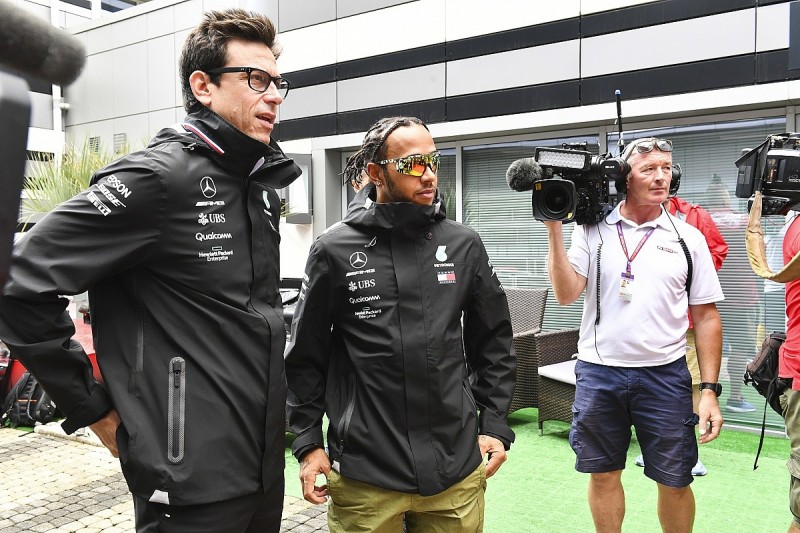
"From a cost perspective we would be keen, together with the FIA and Liberty, to keep the current formula," said Wolff.
"It's a very efficient hybrid power unit and we are just not good enough at transporting that to the world. But it is.
"Nevertheless the world is changing, we have millions of people on the streets protesting or cheering about climate change.
"For us at Daimler sustainability has become more important than just a marketing tool. Sustainability happens.
"We have to ask ourselves the question as PU suppliers, what is the vision for the future formula 1 engine?
"Bearing in mind the costs, bearing in mind the hybrid component needs to be substantially larger, and this is something we are looking at because obviously it's not easy without having additional costs related to it."
Wolff hinted that change could come earlier than currently scheduled.
"All of my colleagues from the other suppliers, we are looking at the vision engine for 2025 and how that could look," he said.
"The question is do we need to bring that forward? Because the world is moving faster than in the past, and this is a discussion we need to have."
Share Or Save This Story


Krack: Aston Martin F1 team no longer in “no-man’s land”

Gasly rues costly floor damage from Ocon contact in F1 Japanese GP

How an F1 underachiever became a Japanese political player

Camara over Ocon - did Haas make the correct call for F1 2027?

Camara to make F1 debut as Ocon's replacement at Haas in 2027

Mekies under the microscope: How different is his leadership at Red Bull from Horner?

Rwanda turns to F1 as it moves forward from a chequered past
Subscribe and access Autosport.com with your ad-blocker.
From Formula 1 to MotoGP we report straight from the paddock because we love our sport, just like you. In order to keep delivering our expert journalism, our website uses advertising. Still, we want to give you the opportunity to enjoy an ad-free and tracker-free website and to continue using your adblocker.


Top Comments