
Remembering Colin McRae’s final WRC win
The Safari Rally returns to the World Rally Championship this weekend for the first time since 2002 - when crowd favourite Colin McRae set aside the maximum attack style for which he was renowned to deliver a textbook third win

Nobody could have predicted it at the time, but Colin McRae’s record-breaking drive to victory at the 2002 Safari Rally would be his final World Rally Championship win and the last hurrah of Kenya’s gruelling test of man and machine.
This weekend sees the Safari return to the WRC after a 19-year hiatus and the landscape and the stages will be familiar, but it will be a sprint compared to the 1000km goliath of the past – where it was an achievement just to reach the finish.
Rewind back to 2002 and it is perhaps a touch ironic that the wildest rally of them all would produce the most controlled of drives from arguably the WRC’s wildest edge-of-the-seat entertainer, McRae – who had proven his mettle on the Safari after winning the 1997 and 1999 editions. As Autosport’s John McIlroy noted, “while others were occasionally quicker, no-one could match the blend of speed and dogged reliability of the pair, their Focus WRC and its Pirellis”.
“This really has to go down in my books as Colin’s most controlled drive throughout his career,” said McRae’s Ford team manager Malcolm Wilson at the time. “He never got drawn in to attack and he has just produced a flawless drive.”
The Safari Rally was one of motorsport’s last great adventures, an epic trial across the Great Rift Valley’s harshest terrain on open roads where road traffic and wild animals could cause havoc at any moment. It was an event where having a spotter helicopter to identify oncoming cars and the odd giraffe, elephant or zebra was just as valuable as accurate pace-notes and where a durable car was worth its weight in gold.
It was perhaps fitting therefore that the 25th victory in the esteemed career of 1995 world champion McRae, who died in a helicopter crash in 2007, made the Scotsman the most successful driver in WRC history at the time.
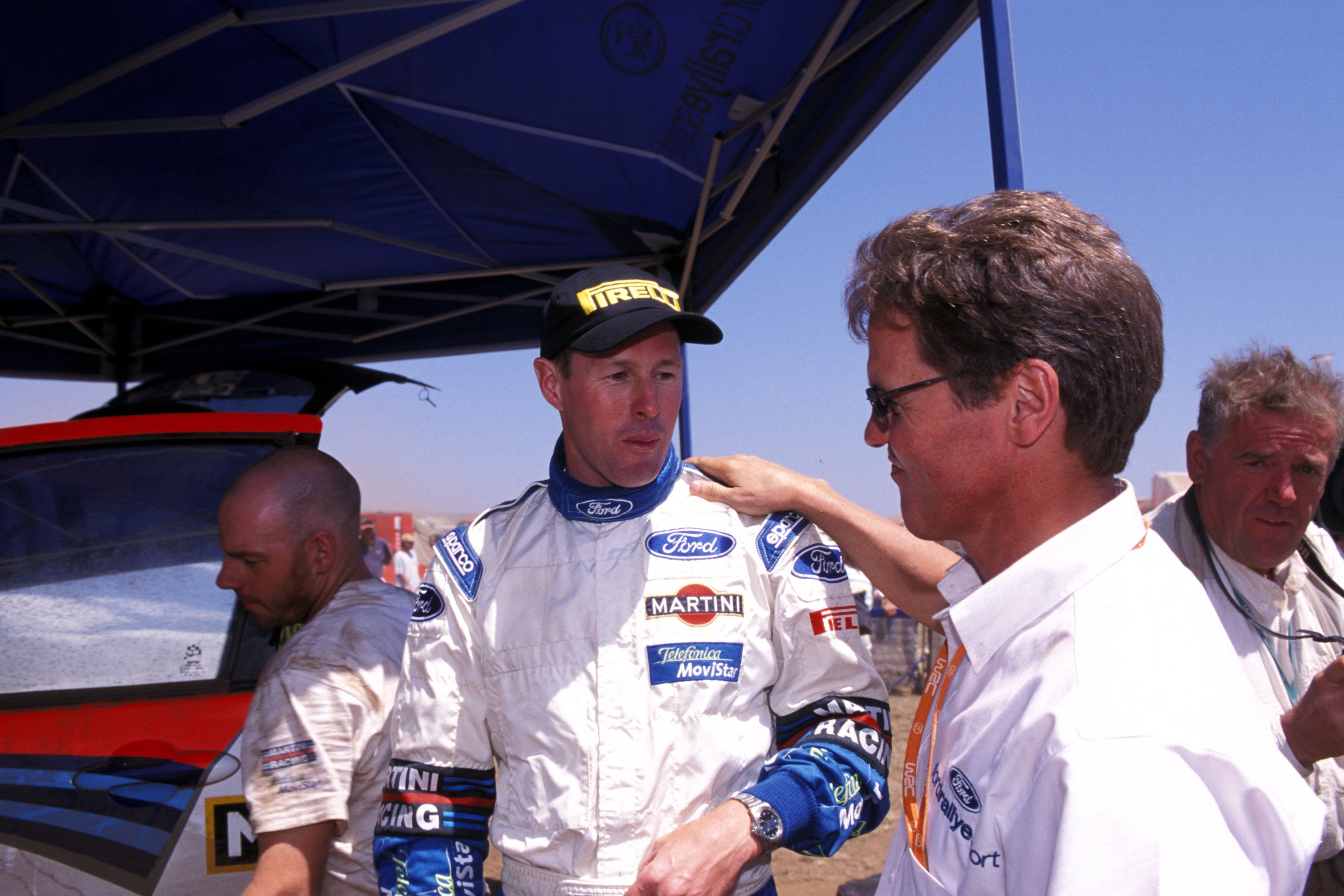
Malcolm Wilson congratulates Colin McRae on his 2002 Safari win
Photo by: Motorsport Images
The WRC was then enjoying arguably the height of its popularity in the UK, helped by McRae’s rivalry with Richard Burns that peaked as the two fought over the 2001 title. The battle reached its crescendo at the Rally GB season finale, played out on free-to-air television, with a tense four-way decider that also included McRae’s Ford team-mate Carlos Sainz and Mitsubishi’s four-time champion Tommi Makinen. Burns prevailed after championship leader McRae crashed out while leading on Friday, with third enough to make Burns the first English WRC champion by two points.
For 2002, McRae was back with Ford while Burns had taken the number 1 to Peugeot and it was the French manufacturer that led the standings heading into Kenya, courtesy of Marcus Gronholm. However, McRae and co-driver Nicky Grist were closing in after winning the preceding Acropolis Rally in Greece.
McRae was acutely aware what was required to win the event, while the sheer brutality of the Safari was not lost on Gronholm either, the 2000 champion targeting points – not a charge for victory – “as that is the only way to finish the rally”.
The Finn’s words would turn out to be bang on the money and were certainly adhered to by McRae, who set his swashbuckling driving style aside and found a comfortable pace that he stuck to. It would prove a wise decision.
"We found a pace we were happy with and we went with it. When Tommi was pulling away we didn’t respond to it because with this rally it is generally a matter of time before the clocks turn and there is a problem" Colin McRae
Before the first 106km was over, the Safari had claimed its first victim – and it was a big one in the context of the title race. Championship leader Gronholm was stranded on the stage, his Peugeot 206’s engine calling time.
Subaru’s Petter Solberg also suffered a clutch failure just metres into the stage, while Sainz and Peugeot tarmac expert Gilles Panizzi also sustained punctures after running over Kenya’s tyre-cutting rocky sections that forced drivers to a crawl.
It was another Subaru – that of 1996 and 2001 Safari winner Makinen, who had replaced Burns at the Prodrive team – that set the pace, while McRae was only seventh. Opting for grass sections rather than the rough open roads to protect his car, McRae did win Stage 2, but again it was a measured approach knowing just how suddenly the Safari can bite. And bite it did for his rivals, with 19 retirements by the end of the first day including Gronholm, Freddy Loix (Hyundai), Armin Schwartz (Hyundai), Solberg, Toni Gardemeister (Skoda) and Francois Delecour (Mitsubishi).

Colin McRae/Nicky Grist Ford
Photo by: Motorsport Images
Burns was lucky to survive the first leg, he and co-driver Robert Reid having to put out a fire after oil from a broken suspension unit triggered a blaze. Team-mate Panizzi managed to continue after a roll, while a fresh-faced Sebastien Loeb – driving for Citroen in the Xsara’s first attempt at the Safari – damaged his back over the rocky sections which required co-driver Daniel Elena to drive back to service.
McRae suffered a broken damper on Stage 3 that meant Makinen was almost three minutes to the good, but courtesy of a second stage win on the fourth test, where Makinen had to drive 60 miles without updates of McRae’s progress from his helicopter crew, the Scot headed into Saturday only 16s adrift. As Autosport noted, that was “nothing in Safari terms”.
“We found a pace we were happy with and we went with it,” McRae explained. “When Tommi was pulling away we didn’t respond to it because with this rally it is generally a matter of time before the clocks turn and there is a problem.”
Makinen claimed he wasn’t worried by McRae looming large behind him, but his confidence was soon dented on the first of Saturday’s car-breaking stages. The Finn broke a shock absorber running over a rocky section and was forced to limp through the stage, dropping into the clutches of McRae – who was next on the road.
McRae had his own trouble, albeit minor compared to Makinen’s, as he struck a bird and broke his windscreen. But when he caught Makinen, he found the Subaru driver in no mood to pull over, leaving McRae trapped in his dusty wake. Makinen, who lost eight minutes and the lead to McRae in the stage, later apologised and cited a radio issue that meant he had no instruction to pull over.
Suffice to say, McRae was frustrated, admitting he “thought of giving him a tap to get him out of the way”. “It wasn’t very sporting of him,” he fumed.
Makinen suffered a puncture 25km from the end of Stage 7 and dropped a further three minutes, effectively ending his victory hopes. The final nail in the coffin was hammered into place on Stage 8, when front suspension failure resulted in retirement.
Two more big names fell as Safari continued to dish out its harsh lessons. Sainz, who briefly inherited second after Makinen’s plight, went out after his oil pressure dropped while Burns suffered one of the most bizarre retirements in WRC history.

Tommi Makinen/Kaj Lindstrom, Subaru
Photo by: Motorsport Images
After winning Stage 7, his left-front suspension had broken 500m from the end of the test. “At first, it didn’t seem too serious a problem,” wrote Autosport, as Burns “drove the 30 miles of road section with the wheel at the damaged corner simply tucked up into its arch.”
But at the entrance of the service park, drama struck as the car became bogged in deep sand. Their watching team was unable to assist as the unbelievable and somewhat farcical situation unfolded.
Burns and Reid tried lowering tyre pressures, putting rocks under the wheel of the car and even used an advertising banner in an increasingly desperate effort to gain traction to free the sinking 206. But try as they might, they couldn’t haul the car through the gate and into service.
A measured drive across the final two tests – McRae never "looked troubled on Sunday," remarked Autosport – earned he and Grist a hard-fought but deserved victory by 2m50s over Rovanpera
“After half an hour of back-breaking, dust-inhaling, filthy work, they went over their time limit – within sight of the Peugeot trucks,” wrote Autosport. Cue scenes of a visibly dusty and distraught Burns, with heads in hands, as he had to admit an ignominious defeat.
“It’s easily the most disappointing retirement in a rally I’ve ever had,” he said. “To do 50 kilometres of road section and then retire here is an insult to everyone in the championship.”
As the end of brutal second day ended, McRae had not only survived but thrived – now armed with a 2m26s lead over Peugeot’s Harri Rovanpera, while incredibly Citroen on debut occupied third and fourth with Thomas Radstrom and Loeb, who won the final stage of the day in a flavour of what was to come over the next decade.
Just three stages remained on Sunday for McRae, whose case was helped when Rovanpera suffered a right-front puncture on the first test which effectively ended his slim victory hopes.
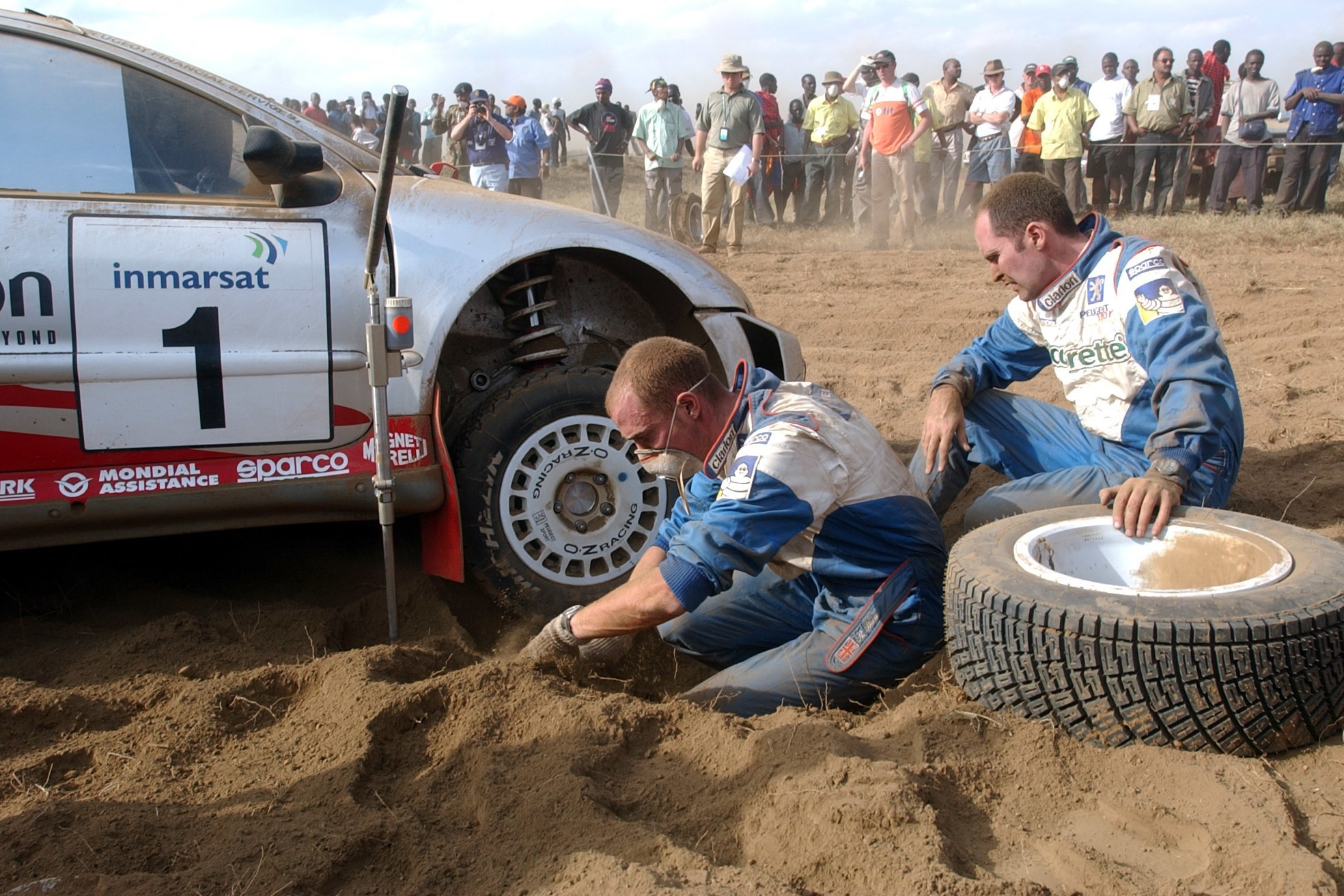
Richard Burns, Robert Reid Peugeot
Photo by: Motorsport Images
A measured drive across the final two tests – McRae never “looked troubled on Sunday,” remarked Autosport – earned he and Grist a hard-fought but deserved victory by 2m50s over Rovanpera.
“It worked out in the right way in the end,” said McRae. “It was certainly the toughest rally for the car, for sure it is hard because it is completely different to the rest of them.”
“Only 12 of the 48 starters reached Nairobi, which makes McRae’s victory even better,” said Autosport. “Supreme self-belief is needed to drive at the sort of controlled pace that makes such wins look matter-of-fact and seems to ensure bullet-proof reliability.”
Radstrom completed the podium for Citroen with team-mate Loeb in fifth after a misfire dropped him behind Ford’s Markko Martin.
When asked how it felt to be the most successful rally driver ever, McRae replied: “Great. The important thing is the win here in Safari, but to have 25 wins is something a bit special and it is quite nice record to have.
“It is never easy here, it is just so different to everywhere else. You have got to find a pace and be happy with it. We found that in day one and managed to hold it all the way through.”
McRae’s victory would be his last in the WRC. His 2002 campaign unravelled thereafter with three retirements in the final six rallies, leaving him fourth overall as Gronholm took the title. Moving to Citroen for 2003 to join Loeb and Sainz, a rule change for 2004 that meant only two drivers could score manufacturer points left McRae on the sidelines – although he demonstrated his abundant ability with a giant-killing drive for Skoda on the 2005 Rally Australia that should have yielded a podium had it not been for a clutch change that over-ran in service.
As the Safari Rally returns to the WRC calendar this weekend, perhaps some of the crews will take McRae’s approach to heart and once again prove that slow and steady can win the race.

Colin McRae and Nicky Grist celebrate victory
Photo by: Motorsport Images


WRC Sardinia: Evans suffers puncture ahead of Power Stage in title decider

Evans set for “all in or nothing” approach to WRC title showdown

WRC Sardinia: Title wide open as Solberg takes Sardinia lead into final day

How the FIA plans to differentiate between Rally1 and Rally2 in WRC 2027

WRC Sardinia: Solberg storms into the lead to boost title chances against Evans

Evans names Solberg the “danger man” in WRC title fight

WRC Sardinia: Neuville snatches lead from Fourmaux as Hyundai remains on top

What a revival of the World Rally Championship could look like

Russell: “You’ve got to laugh” at bad luck as F1 title drifts away

WRC Sardinia: Evans suffers puncture ahead of Power Stage in title decider

F1 Bahrain GP in Malaysia: Verstappen wins chaotic race from Antonelli as Russell retires late on

LIVE: F1 Bahrain GP in Malaysia - Verstappen wins from Antonelli, Russell DNFs after late engine failure
Subscribe and access Autosport.com with your ad-blocker.
From Formula 1 to MotoGP we report straight from the paddock because we love our sport, just like you. In order to keep delivering our expert journalism, our website uses advertising. Still, we want to give you the opportunity to enjoy an ad-free and tracker-free website and to continue using your adblocker.


Top Comments