
Why an F1-snubbed British world champion has no regrets in retirement
He may not have won the Le Mans 24 Hours - falling agonisingly short in 2016 - and didn't get the opportunities in Formula 1 his talents merited. But after calling time on his professional career last month, Anthony Davidson says his pride in his performances with Peugeot and Toyota in LMP1 mean more than the results he achieved

A love affair started at Paul Ricard late in 2008. Anthony Davidson got behind the wheel of a prototype for the first time, Peugeot's 908 HDi turbodiesel LMP1, and was smitten. The love turned out to be unrequited, at least initially.
But when it was belatedly returned, the Brit kicked on with a sportscar career that earned him the right to call himself a world champion. That's not to forget a total of 14 big wins, the Sebring 12 Hours included, across multiple series during eight seasons with Peugeot and then Toyota.
"I remember driving that car for the first time at Ricard and falling in love with it and LMP1," recalls Davidson in the wake of calling time on his professional racing career after this year's World Endurance Championship finale in Bahrain last month. "I just loved it, it really suited my style and I was quick in it. Sometimes you just click with a racing car; it was like an extension of my body."
Yet Davidson didn't get the opportunity to race the 908 the following year. His chances were undone by a change of top brass at Peugeot Sport. He had a draft contract — in French — but the place earmarked for him in a three-car team at the Le Mans 24 Hours was taken by David Brabham.
Davidson was adamant that LMP1 was his future after his brief two-day flirtation with the category in the south of France. That explains why he ended up in one of Lola-based Aston Martin coupes fielded by the Prodrive-run factory squad at Le Mans in 2009. Prodrive boss David Richards was well known to him after his stint as team principal of the British American Racing Formula 1 squad while Davidson was on its books as a test driver.
"I didn't get the Peugeot drive, but I thought, hang on a minute, these cars are brilliant fun," recalls the 42-year-old. "I better get my myself into one; this is what I have to be doing."
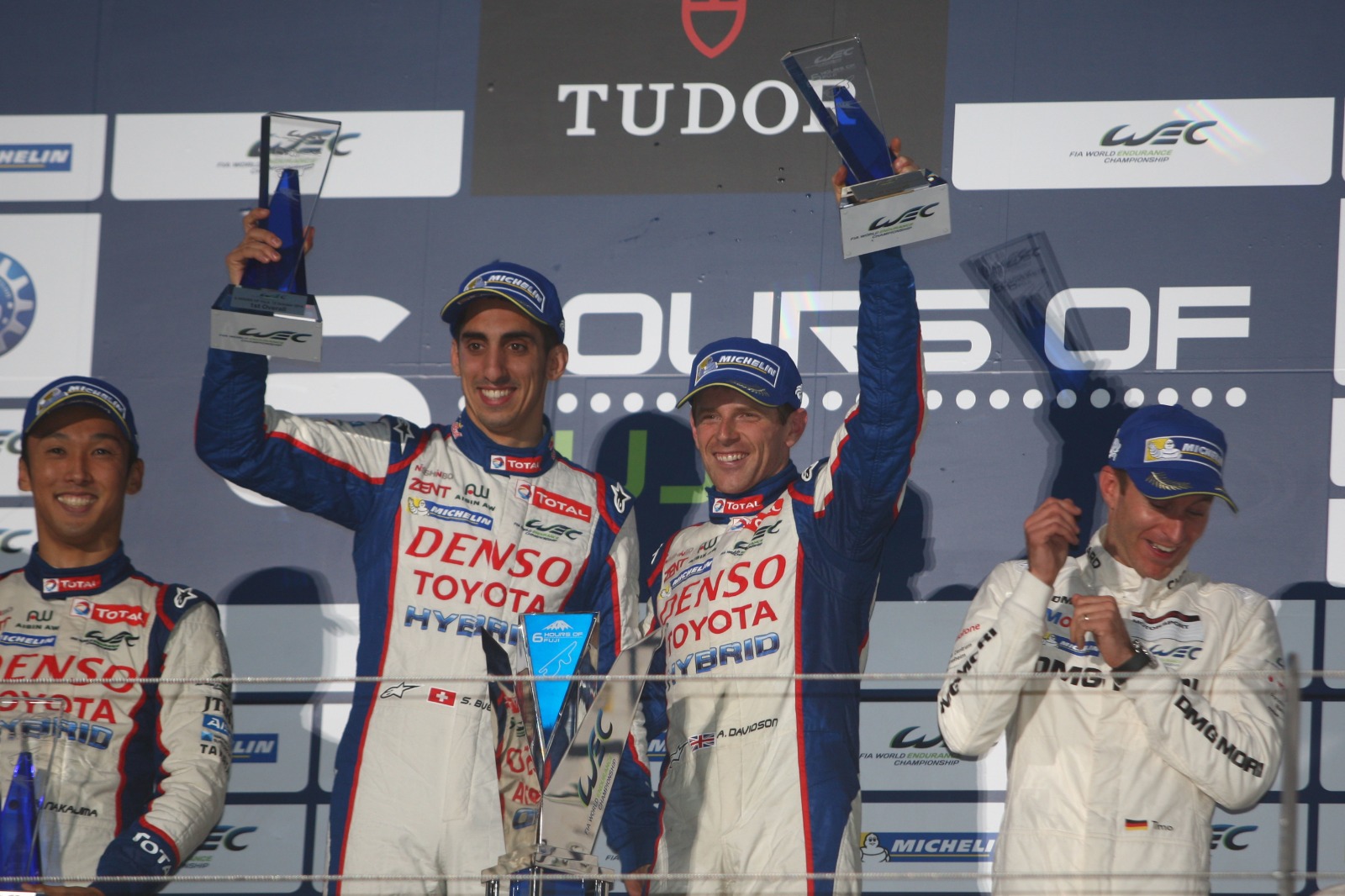
Teaming up with Buemi, Davidson won the WEC title in 2014
Photo by: Motorsport Images
The chance to race full-time in the category came late. It was already February 2010 when Davidson was contacted again by Peugeot and ended up contesting five races including Le Mans that year. Within weeks of the call, he was racing at Sebring, claiming the win with Alex Wurz and Marc Gene.
Davidson feels privileged to have raced through what he correctly calls "a golden era" for the top-flight of sportscars with Peugeot and then, after the French marque's withdrawal on the eve of the rebirth of the WEC in 2012, Toyota. He was quickly picked up the Japanese manufacturer when it expanded its programme to fill the void left by his former employer.
"I feel lucky in that respect because the cars were amazing and the competition with Audi and Porsche was fierce," he says. "LMP1 also gave me the opportunity to show what I always knew I could do, what I believe I had been doing in F1 but maybe the big wide world didn't always see or appreciate."
Davidson's LMP1 successes included the WEC title in 2014, that Sebring win in the American Le Mans Series in 2010, four wins in the Intercontinental Le Mans Cup that segued into the WEC, and then nine in the world championship itself. He doesn't include the rain-shortened Fuji 6 Hours in 2017 when he didn't get behind the wheel but was still awarded points.
"It was one of the best drives of my career: I was flying, made no mistakes and helped get us into a position to win. Kazuki was cruising, bringing it home, and then there was a problem with the car" Anthony Davidson on Le Mans 2016
What he didn't do, however, was win Le Mans. He fell six minutes short in that aim. Together with Sebastien Buemi and Kazuki Nakajima, he was on course for victory in 2016 when an engine issue robbed the car of power with a lap and a half to go. They weren't even classified after the ailing Toyota TS050 HYBRID completed the final lap outside of the minimum required by the rules.
Davidson has come to terms with that loss. In fact, he's now entirely at ease with it.
Top 10: Ranking the most heartbreaking retirements at the Le Mans 24 Hours
"It was heartbreaking at the time, one of the lowest moments of my career," he says. "I don't have the trophy at home, but in my mind I won that race in terms of the job I did. It was one of the best drives of my career: I was flying, made no mistakes and helped get us into a position to win. Kazuki was cruising, bringing it home, and then there was a problem with the car. There's a sugar coating to the bitter taste it left, because I know I did such a good job."

Davidson, Nakajima and Buemi were on the cusp of victory in 2016 when they were denied by mechanical problems in gut-wrenching fashion
Photo by: Motorsport Images
Le Mans 2009 was arguably another one that got away. Davidson lost out to Brabham for a seat in what ended up being the winning car after Olivier Quesnel came in as the new boss of Peugeot Sport.
"Quesnel wanted to put a more experienced pair of hands in, which was David," he explains. "I was gutted at the time, but they had the fastest car and needed a crew that could bring it home. Maybe that was a chance that slipped away, but it was wrong place, wrong time. Or rather right place, wrong time."
Davidson looks back on his career in terms of the performances he put in rather than the races he won. He is highly analytical of his driving and performances, critical even. How he performed, he explains, was always more important than the end result. That goes for the year of his WEC title victory alongside Buemi at the wheel of the Toyota TS040 HYBRID.
"The trophy I got at the end of the year isn't what I hang my hat on," he says. "It is just a byproduct of the job I did over the season. There's not one race I look back on and think I didn't do a good job. Being a world champion doesn't matter at all in the way I perceive myself, though I understand that it does in the way others perceive me."
It's also why he has few regrets about his stint in F1, which spanned seven seasons, yet only 24 race starts. Davidson was a BAR Honda test driver from 2002 until 2007 when he joined the Super Aguri B-team set up by the Japanese manufacturer for protege Takuma Sato. To the 21 grands prix he managed with Super Aguri before it folded early in 2008 can be added one with BAR Honda in 2005 and two with Minardi in 2002. Then there were two complete seasons — 2004 and 2006 — as a Friday test driver with BAR Honda.
"I'm happy with what I did in F1, some of the performances on Fridays and certainly a lot of what we did at Super Aguri in 2007," he says. "The '07 Super Aguri started out as a good midfield car genuinely able to fight for a top 10 or 12. I'm happy with what I achieved in that car."
Davidson mentions qualifying 11th at the season-opening Australian Grand Prix in Melbourne aboard his Super Aguri-Honda SA07 and again for the Turkish GP at Istanbul Park later in the season as two highs of his short F1 career proper.

Qualifying 11th for 2007 Australian Grand Prix stands out to Davidson as one of his best memories
Photo by: Motorsport Images
"At Melbourne I was just a tenth or so behind Takuma in qualifying and then in Turkey I outqualified Jenson [Button] and Rubens [Barrichello] in the works Hondas," he recalls. "I finished just behind Jenson and was really chuffed with the job I'd done. Some of the best races I ever drove didn't involve winning or even scoring points."
Again, Davidson feels lucky to have been involved in F1 at the time he was: "We had V10s and a tyre war when I started testing with the Brackley team (a term he often uses to describe an operation he has had a continuous involvement since 2001 in its BAR, Honda, Brawn and Mercedes guises). I was doing 15,000km a year in a really quick car — it's amazing to think how different it was to now days. I learnt so much that carried me through the rest of my career."
"I'd done a good job on Fridays in 2004 and I felt there was more of a chance than ever of getting into a race seat. I didn't want to give that up for what was only a chance of getting one at Williams. It was a risk I wasn't prepared to take" Anthony Davidson on the Williams move for 2005 that didn't happen
He also regards it as an achievement just to have made F1 given there was no family money behind him. His father, Denis, is a graphic designer who used his skills to help the likes of Martin Hines at Zip Kart to promote their companies.
"My dad was pretty savvy in the way he funded my karting. Being into artwork and design, he could offer to do brochures for people like Martin," explains Davidson. "He would do deals that way to help pay for my racing."
Davidson became a paid works driver for the Italian Biesse operation in 1998 and 1999 and had few thoughts about moving into single-seaters: "I didn't have any money and thought it was my destiny to remain in karting."
That was what he told an old karting buddy who suggested a trip to Brands Hatch in 1999 to check out the Formula Ford scene. Davidson was persuaded to go and ended up being introduced to "a lot of people, a lot of whom were asking for a lot of money". One person he met was Frenchman Didier Stoessel, a banker who raced for Ray in Formula Ford 1600 for fun.
"Didier was already working a bit with Marcos Ambrose [then a factory Van Diemen driver] at the same time as driving for Ray," Davidson says. "He thought he could go a long way with me and paid for me to race in Formula Ford and then Formula 3."

After dominating in Formula Ford, Davidson finished second in the 2001 British Formula 3 championship, but didn't have the funds for F3000
Photo by: Motorsport Images
What Stoessel didn't have was the money to take Davidson into Formula 3000 after he finished second behind Sato in a Carlin 1-2 in the 2001 British Formula 3 Championship. The Briton had already been picked up by BAR that year as part a nascent driver development programme and from there joined its testing roster in 2002.
"There wasn't really a decision not to go F3000 because we simply couldn't afford it - it was a case of beggars can't be choosers," explains Davidson. "Our plan was now we had a foot in the door at BAR to try to impress in that role."
Between his final F3 start in 2001 and his first for Super Aguri in 2007, Davidson contested just four races not counting his three grand prix participations. He took in the end-of-season Macau Guia touring car race at the wheel of a Honda Civic Type-R in 2002 and three races, Le Mans included, aboard one of Prodrive's Ferrari 550 Maranello GTS racers the following year. That was the Richards link again.
Davidson reckons he should have raced more. In fact, he regards a lack of racing in that period as the only real regret of his career.
"You should race because you're a racing driver and it's your passion," he says. "My advice to any young driver reading this is that you have be racing. It's not enough to be sitting around in team kit in hospitality drinking coffee.
"You've got to put your pride aside and get out there into other categories and other machinery. It will make you a better driver when you get the opportunity in the category you're aiming for.
"That would be my advice to my younger self as well. I was so adamant that I had to focus on F1. That's the thing I regret most of all, not even trying to find something else. I should have been racing something, somewhere."
There was a chance of a race seat at Williams for 2005, but only a chance. He was lined up to be part of a shoot-out — and even had a had a seat fitting in readiness — for a drive that eventually went to Nick Heidfeld. Antonio Pizzonia, the team's incumbent test and reserve driver, was the other participant in the test at Jerez in late 2004.
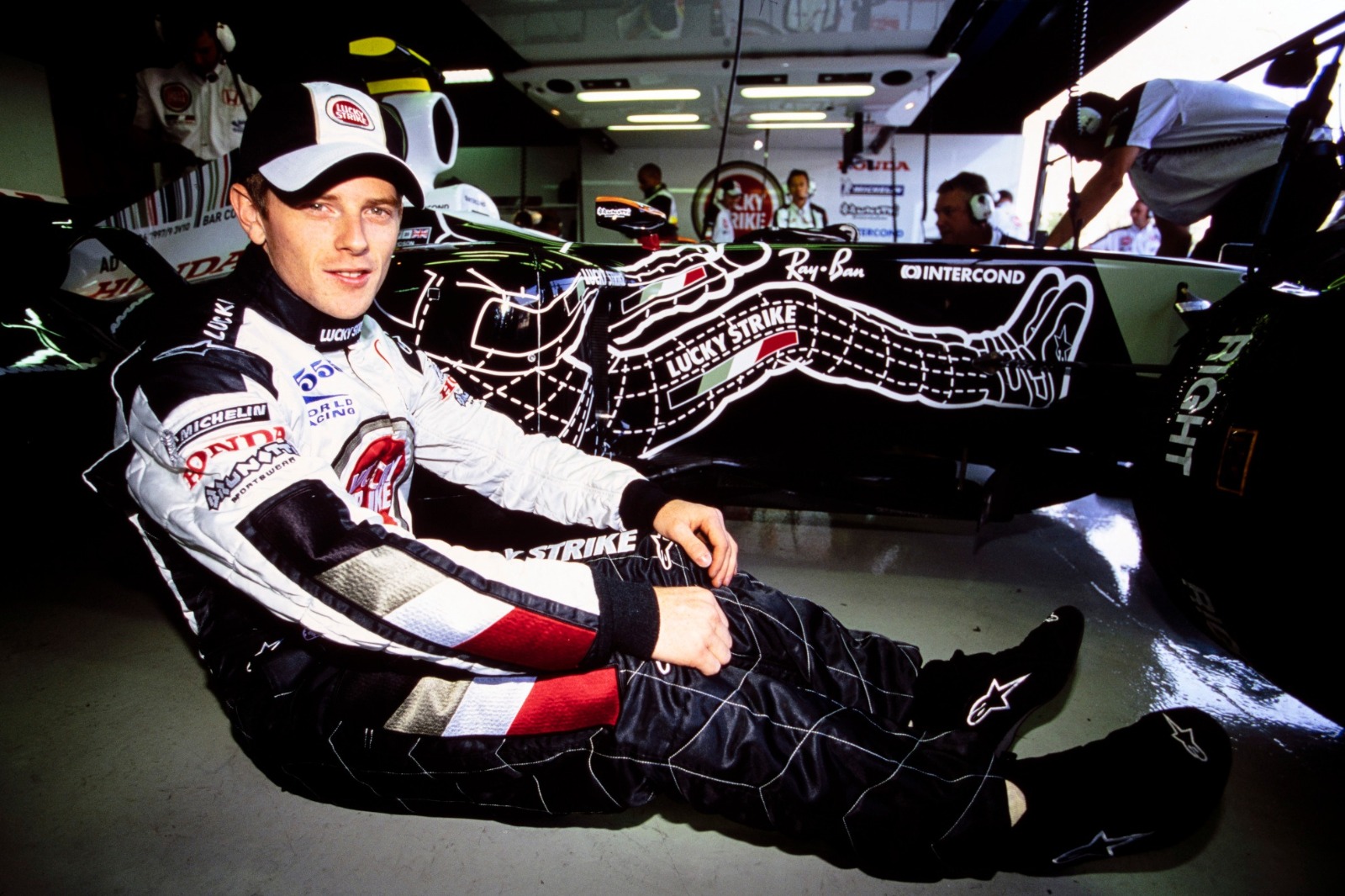
Davidson completed plenty of test miles for BAR, but race opportunities were limited. Today, he wishes he'd been more proactive seeking drives outside F1
Photo by: Motorsport Images
It was a reported at the time that BAR had put a block on Davidson taking part, though he doesn't remember it quite like that.
Archive: When Davidson was "too successful" to land an F1 seat
"BAR offered me a new deal to carry on that was really quite enticing," he recalls. "I got paid more money and I felt like the team was changing. Geoff [Willis, technical director] was having more of a say, and we got on really well.
"I'd done a good job on Fridays in 2004 and I felt there was more of a chance than ever of getting into a race seat. I didn't want to give that up for what was only a chance of getting one at Williams. It was a risk I wasn't prepared to take."
Davidson's disposition towards self-criticism explains his decision to call it quits now, after two and a bit seasons - and three WEC class victories - in LMP2 with the DragonSpeed and then Jota teams. He did have a plan to stop at the end of the 2019 when his final contract with Toyota finished, but his tenure of a race seat came to an early end after he was replaced by Fernando Alonso for the 2018/19 WEC superseason.
"I've been asking a lot of myself since I started racing in Cadet karting at the age of eight, so that's 34 years," says Davidson, who will continue his simulator role at Mercedes and F1 punditry with Sky Sports. "With a manufacturer team like Toyota that really does take its toll.
"Driver talent is a bit like a tube of toothpaste: as the tube gets older, the harder you have to squeeze. It's the same with driving. It gets more difficult over time to get the most out of yourself" Anthony Davidson
"I rediscovered my love of motorsport in the less pressured environment of LMP2, but it's still wearing. From almost as early as I can remember, I have been focusing on lap time and competition.
"I remember as a young driver reading a comment from Damon Hill when he retired or was close to retirement. He said that driver talent is a bit like a tube of toothpaste: as the tube gets older, the harder you have to squeeze. It's the same with driving. It gets more difficult over time to get the most out of yourself. It's a brilliant analogy.
"I know I'm still fast enough to get good results, to fight for wins and podiums. That's what I want to remember. I preferred to go now rather than hanging on a few years and slipping down the order. I've always been too hard on myself to let that happen."

Davidson maintains that he's picked the right time to step down
Photo by: JEP / Motorsport Images
The phone call that transformed Davidson's career
There was wasn't much on the horizon for Anthony Davidson during the winter of 2009/10. He'd been test and reserve driver for Brawn Grand Prix in 2009, but only ever got to drive the world championship-winning BGP 001 in a straight line and in some demo runs. He was, he says, at his "lowest-ever ebb". Then came a phone call out of a blue — and on Sunday — in early February.
"I was actually driving back from my brother's wedding and a call came in from a French number," he recalls. "I had a feeling I had to take it. There was a petrol station just coming up, so I swung in, pulled on the handbrake and answered."
The voice on the other end was Sven Smeets, Peugeot Sport's team manager. He asked whether Davidson would be able to meet him and racing boss Olivier Quesnel to talk about LMP1.
"I said where and whenever, I'll be there," Davidson continues. "A couple of days later I met them in Paris. I booked my own flight, flew over there and tried not to trouble them with anything. I thought 'right, you're going to show them commitment, commitment, commitment, and prove you're not a hassle to work with'.
"I told them how I loved LMP1, that my ambition was to win Le Mans and that I'd love to do it with them. We were talking about a deal centred on Le Mans and there were some good signs. Sven drove me to the factory to have a look around.
"Then they put me in a Peugeot shirt and did a head and shoulders press-type shot. They told me that it was just in case and made it clear that they were talking to other people. I couldn't quite work it all out.
"Driving home after the flight back to London, the phone rings again: 'Hi, Anthony, it's Sven. Listen, things have changed.' He said it in a kind of downbeat way. I thought, 'Oh no' and was ready to thump the steering wheel. There was a little pause, and he said, 'We want you to do everything'."
That meant a full programme in the build-up to Le Mans, including the Sebring 12 Hours just a few weeks later, and then two of the three rounds of the new Intercontinental Le Mans Cup.
"I remember putting the phone down and shouting, 'Yes, yes, yes,'" Davidson adds. "It was one of the most amazing days of my life."

Victory on Peugeot debut at Sebring in 2010 began successful prototype racing career
Photo by: Motorsport Images


Why Toyota’s 2026 WEC triumphs have put it into the all-time greatest endurance racing team debate

How Toyota destroyed the competition to seal the WEC crowns

When Can-Am made its controversial comeback

WEC Barcelona: Genesis secures maiden series pole from Toyota

How Ford is "hitting milestones" in preparation for WEC Hypercar assault

How Porsche Penske finally broke its Petit Le Mans duck

Why there’s no perfect solution to the WEC safety car conundrum

How an “informed gamble” enabled Toyota to beat Alpine in the Fuji 6 Hours

MotoGP "can’t just copy" F1’s Drive to Survive success – Chase Carey

Horner reveals Red Bull call to thank him for F1 engine project after maiden win

Autosport Business Exchange New York Examines the Forces Driving Racing’s Next Era of Growth in America

Why Hamilton’s return to form is not straightforward
Subscribe and access Autosport.com with your ad-blocker.
From Formula 1 to MotoGP we report straight from the paddock because we love our sport, just like you. In order to keep delivering our expert journalism, our website uses advertising. Still, we want to give you the opportunity to enjoy an ad-free and tracker-free website and to continue using your adblocker.


Top Comments