
The origin story of the Le Mans 24 Hours
A century ago, the Le Mans 24 Hours burst into life – even if it wasn’t actually meant to be a race...
The Grand Prix d’Endurance – now known as the Le Mans 24 Hours – was devised by the Automobile Club de l’Ouest as an endurance trial for production cars. That was never going to work…
Right from the start of the inaugural event – in cold, squally weather at 4pm on Saturday 26 May 1923 – it was clear that the frontrunners fundamentally disagreed with the ACO’s view that this was not a race. The drivers of the three fastest cars fought an intense, 19-hour battle for supremacy – despite the fact that there was literally nothing to be won.
All each entrant had to do in 1923 was to exceed a target distance in order to qualify for the second year of a multi-year competition; the margins by which the targets were exceeded were immaterial. But 12 manufacturers had deployed long-established racing departments to build and operate their cars, using professional drivers. It was inevitable that they would race each other.
The battle between two Chenard-Walckers and a Bentley only subsided when the latter was delayed, just before noon on the Sunday. At that juncture, all three were already at their target distances. For these teams (and many of those in the midfield), beating the opposition clearly offered much more exhilaration than qualifying for the actual competition.
The entrants also had the racing instinct. Chenard-Walcker lost no time in placing media advertisements declaring a ‘victory’ it had not actually achieved. Bentley in 1924, Lorraine-Dietrich in 1925-26 and Bentley again in 1927 also proclaimed illusory victories. There were only 22 starters in 1927, and the ACO – foiled by human nature! – knew the time was right to accept the de facto situation by offering a prize to the car completing the greatest distance. From 1928, then, this was officially a motor race, after all. Two years later, the cars were split into classes according to engine volumes: now there were several races in one.
It had turned out to be immensely difficult to build, equip, prepare and operate cars strong enough to endure 24 hours of hard driving, in both daytime and darkness and in variable weather, and fast enough to defeat rivals with similar resources. To win meant devising new equipment, techniques and strategies. The competitors had already fully understood the huge complexity of the challenge, which was what made it irresistibly attractive. It still does today.
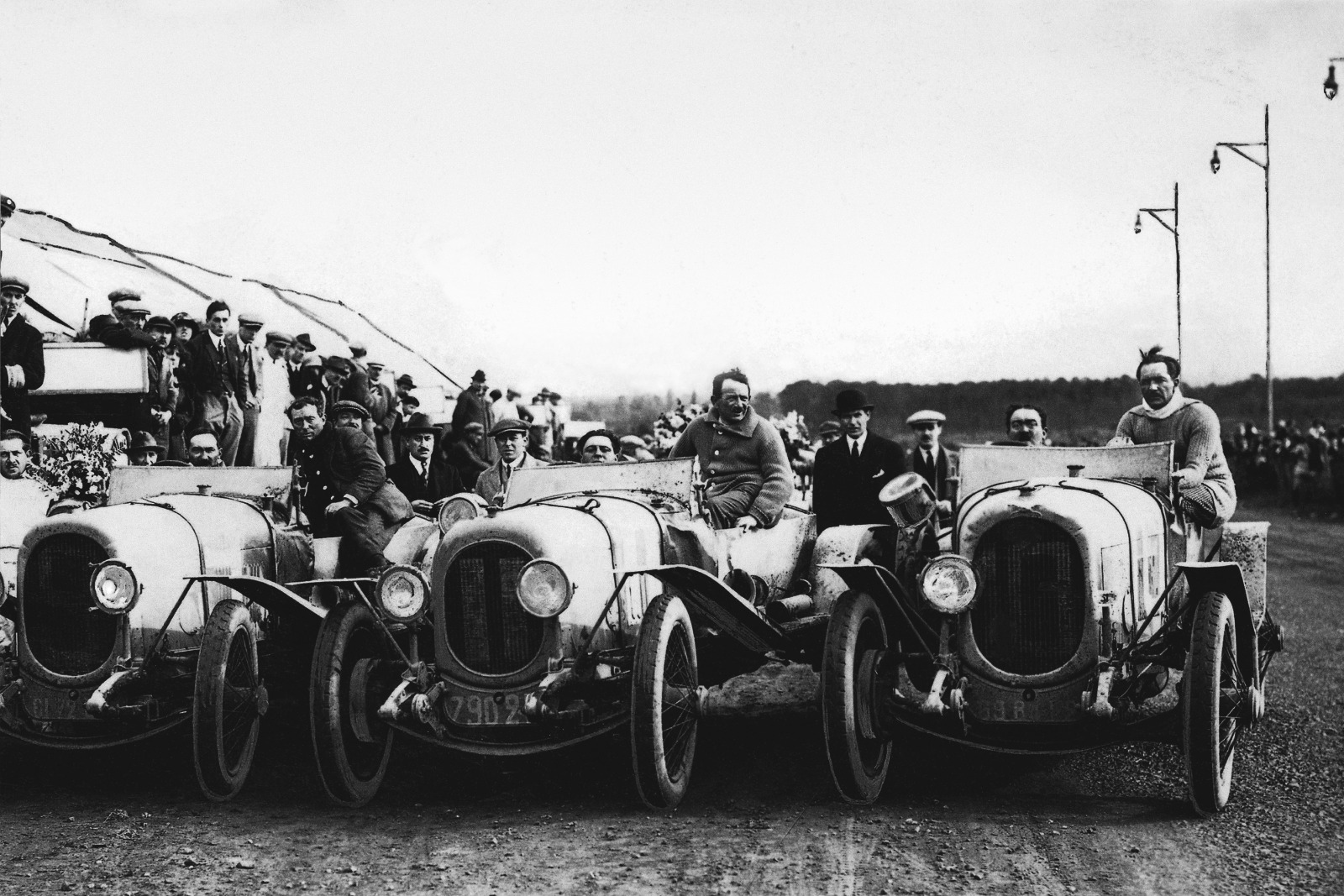
The first Le Mans 'winners' the Chenard-Walcker team line up at the 1923 event
Photo by: Motorsport Images
The event then staged a recovery in terms of numbers but, four months after the 1929 Le Mans, the world was changed by a few thousand complete and utter bankers on Wall Street. The 1930s was all about surviving the Great Depression, which led to the cancellation of the 1936 race due to crippling national strikes. Salvation came in 1937, when powerful new French cars, complying with regulations devised by the Automobile Club de France for its own Grand Prix, were also eligible for Le Mans. The decade ended on high notes, with big fields containing potent cars in numbers. Although road-legal in theory, the ACF formula cars were really the first full-on racing cars to contest the race.
Aspects of the original ‘endurance trial’ concept had already begun to fade away. But the ACO ensured three of its elements – the 24-hour duration, the provision of a harsh proving ground for innovative technologies that would transfer from circuit to road, and the encouragement of factory entries – were actively sustained. These remain three of the great strengths of the race. The others include a partnership with influential civic bodies, regulatory control (now facilitating the pursuit of ecologically sound solutions), and enduring spectator appeal.
Even in the 1920s, alongside countless advances in existing hardware, new technologies trialled and proved at Le Mans included aerodynamic bodies, air-cooled engines, foglamps, front-wheel drive, four-wheel hydraulic brakes, friction suspension dampers, stiff-walled tyres, all types of electrical components, control and supply systems, quick-fill replenishment devices, and many more. Later disc brakes, direct-injection fuel systems, radial tyres, and halogen, quartz-iodine and LED headlights were all developed by Le Mans teams.
Once the post-war recovery was under way, Le Mans scaled new heights. Active promotions of victories in the 1950s had measurable and startling impacts on road car sales for Ferrari and Jaguar, notably in the USA
From 1926, the ACO’s Biennial Cup was decided on the basis of an Index of Performance. This became a separate annual competition in 1938 and gradually gained more significance than the Biennial Cup, which was finally discontinued in 1960. Later, as energy efficiency became a motor industry priority, the Index competition spurred fuel-saving techniques long before the ACO inspired the introduction of the successful FIA Group C ‘fuel formula’ of the 1980s. Alternative fuels have been encouraged since the outset, leading, for example, to Audi’s successful programme to prove the potential of diesel in the 2000s. Since last year, all cars entered in the World Endurance Championship have been powered by a renewable fuel produced from waste from the wine industry, including the latest Hypercar electric hybrids.
In addition, the ACO has consistently encouraged entrants to trial radical solutions. This tradition is maintained in the ‘Garage 56’ initiative, first seen in 2012, and in the ACO’s commitment to the Mission H24 electric-hydrogen prototype project. It is not difficult to imagine manufacturers proving the technology by fielding works teams of such cars at Le Mans in the future.
The importance of Le Mans to car brands – and therefore its global significance – is well established. It skyrocketed in the 1950s. The revival of the race after the Second World War was delayed until 1949 because the venue had been devastated. The adjacent airfield had been a Luftwaffe base, and heavily bombed by the RAF. Part of the site had been used as a prison camp, and mined.
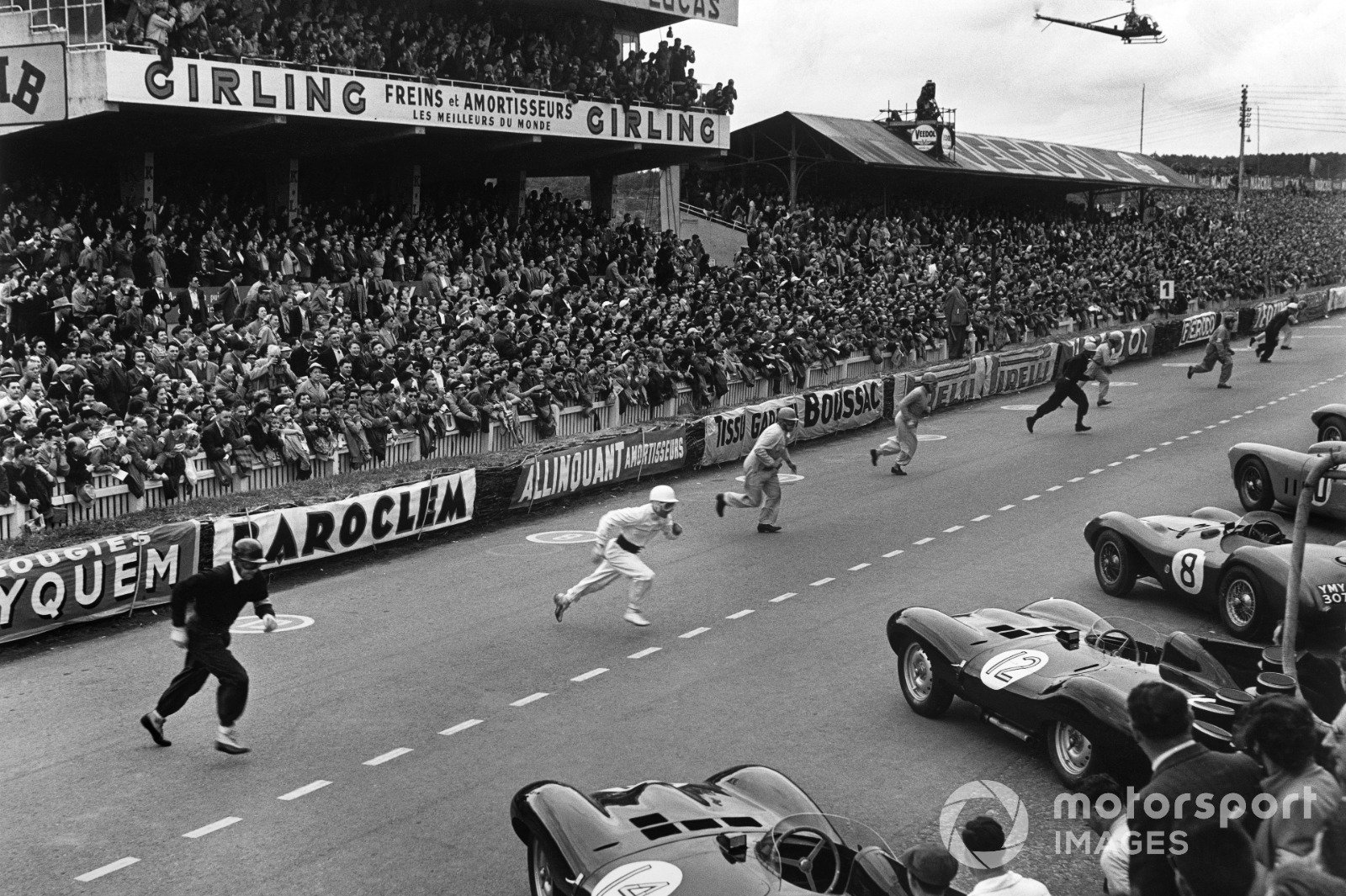
A post-war boom saw a surge in popularity from spectators and manufacturers
Photo by: Motorsport Images
Once the post-war recovery was under way, Le Mans scaled new heights. Active promotions of victories in the 1950s had measurable and startling impacts on road car sales for Ferrari and Jaguar, notably in the USA. Through the early 1960s, Ferrari burnished its brand with a string of Le Mans wins. From the late 1970s until the late 1980s, so did Porsche. Success at Le Mans had become a genuinely effective marketing tool.
The roll call of manufacturer winners has the names of Aston Martin, Audi, Bentley, BMW, Bugatti, Chenard-Walcker, Ferrari, Ford, Jaguar, Lagonda, Lorraine-Dietrich, Matra, Mazda, McLaren, Mercedes-Benz, Peugeot, Porsche, Renault and Toyota. This year, 20 cars will be operated by works teams representing eight brands.
The commitment of local and regional administrations has given this event real resilience in the face of adversity. Having noted the economic benefits from twice staging the Grand Prix de l’ACF, in 1906 and 1921, and several other major races before the Great War, Le Mans civic officials embraced the 24-hour event from the outset. In 1926, it was public money that built the first permanent buildings at the venue. The starkest example of this public commitment was a setback that would have destroyed a lesser event – the appalling accident in 1955, the worst in motor racing history, in which at least 80 spectators lost their lives.
Civic administrations actively resisted calls for the race to be banned, and facilitated loans to pay for alterations to the circuit layout at the scene, and a new pits complex. Always close, the collaboration was formalised in 1985 by the creation as the circuit owner of the Syndicat Mixte du Circuit des 24 Heures du Mans, in which the Departement de la Sarthe (with 50%), the Pays de la Loire (25%) and the Le Mans Metropole (25%) administrations are the current stakeholders. These days the estimated direct economic benefit to the city and region exceeds €100million annually.
The ACO has often been at loggerheads with the FIA over sportscar racing regulations, but no longer. Since 2012, the two have devised the WEC rules together and the ACO has handled promotion. It has also instigated the European Le Mans Series, the IMSA SportsCar Championship in the USA, and the Asian Le Mans Series. Regulatory control has secured the flagship event.
Very high speeds have attracted spectator interest since the late 1930s, when those ACF formula cars set the tone for future entries. For decades (although no longer), they were the fastest on the planet, reaching speeds as high as 250mph on the Mulsanne straight before it was chicaned in 1990. If a car was driven into Times Square 24 hours after leaving Le Mans, that is the approximate mileage of the record winning distance – 3362 miles at an average speed of 140mph (including all pitstops).
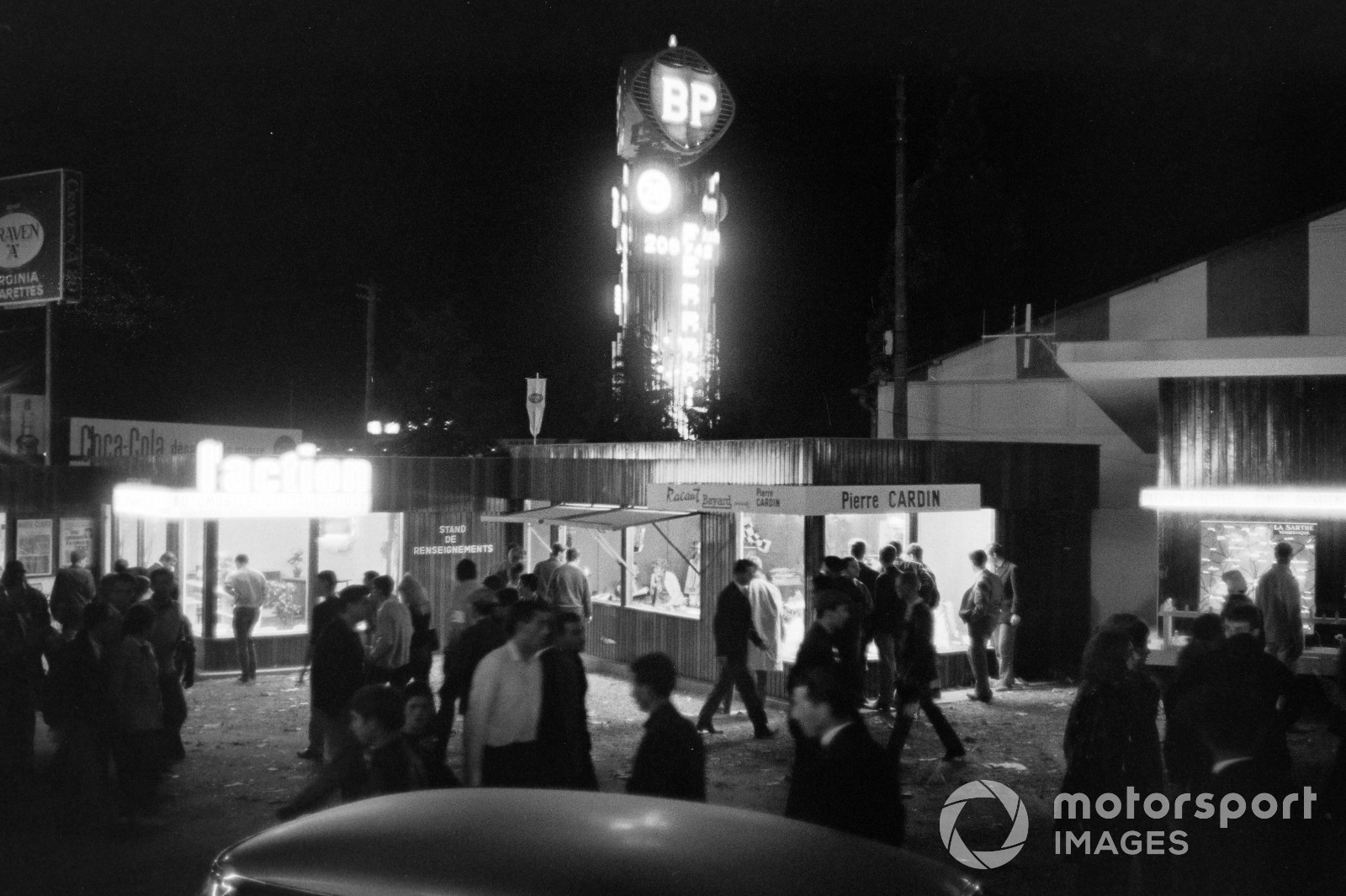
Attractions on and off the track have also kept fans coming back to Le Mans since its origins
Photo by: Motorsport Images
The ACO has always tried to give spectators a good time. Back in 1923, a row of cafes behind the grandstands, a pop-up cinema and an ‘American bar’ (with a stage for a jazz band and a dance floor) were provided, along with radio broadcasts of classical music from the Eiffel Tower in Paris. Today we have the ‘Le Mans Village’, while corporate guests are a feature dating right back to the 1920s.
The race gained enduring popularity among British spectators during and after Jaguar’s successes in the 1950s. It has not been uncommon for more than 50,000 fans to cross the Channel for the spectacle, the ambience and the fun. Last year, the trackside attendance was 244,200. The race was shown live on TV in 196 countries, and generated 3.5million page views on the ACO’s website. Tickets for this year’s centenary event sold out as early as January, and 300,000 people are expected.
Over a 100-year history, the culture of Le Mans has been incomparably enriched by countless compelling human stories, heroic deeds, triumphs and tragedies, and by dazzling achievements of engineering and racing expertise
The greatest race? Any such claim requires genuine heritage. Over a 100-year history, the culture of Le Mans has been incomparably enriched by countless compelling human stories, heroic deeds, triumphs and tragedies, and by dazzling achievements of engineering and racing expertise. Of the other traditional candidates, the Monaco Grand Prix remains special and yet, like that of other historic Formula 1 races, its status has been diluted by the recent escalation in the calendar. The Indianapolis 500 can no longer command worldwide attention, even though it remains the world’s biggest one-day sporting event in terms of attendance. National Geographic magazine put Le Mans at the top of a list of ‘must-see’ events that all sports enthusiasts should witness during their lifetimes, ahead even of the Olympic Games.
Last year, the cars competing in the 24 Hours covered a combined total of 173,631 racing miles, almost exactly 100,000 more than all the cars racing in the entire, 22-race Formula 1 World Championship (73,473).
Of course it is the greatest race. This is a wonderful centenary, to be cherished by motor racing people everywhere.

What memories and moments will the centenary Le Mans race provide?
Photo by: Christopher Lee / Motorsport Images
How it all began
What was known as the Grand Prix d’Endurance was conceived in the first week of October 1922 during the 17th annual Paris Salon de l’Auto, in the Grand Palais exhibition centre in the Champs-Elysees. The prime mover was Charles Faroux, editor of the magazine La Vie Automobile. Faroux was well versed in devising automobile events, having created the famous Coupe de L’Auto races before the First World War and, with the Automobile Club de l’Ouest, the Grands Prix de Consommation in 1920-21-22. Held on sections of the new Circuit de la Sarthe, to the south of Le Mans, these had been fuel economy runs for production cars, each being given a fuel allocation and a target average speed according to weight and engine volume. The three events attracted many French manufacturers, among which at least a dozen had fielded factory teams and professional drivers.
Faroux was in Paris to meet Emile Coquille, the French concessionaire for Rudge-Whitworth, the British motorcycle maker that also made automobile components. Coquille had told him a new, long-distance trial, designed to test and prove the latest components, would be welcomed by the industry.
Faroux had collaborated with Georges Durand, the ACO’s secretary-general, on the Consommation events. So he took Durand to meet Coquille on the Rudge-Whitworth stand in the Grand Palais. No fewer than 81 French car makers were exhibiting. In the booming post-war French economy, they were eager for new events.
Faroux and Coquille had envisaged an eight-hour event, four hours in daylight, four at night. By most accounts, it was the far-sighted Durand who suggested a 24-hour format. Coquille confirmed that, if such an event could be organised, he would offer title sponsorship. Durand asked Faroux to draft regulations for an inaugural 24-hour trial on the full Circuit de la Sarthe (with its 3.5-mile straight) the following summer. His companions doubted that he could obtain permits for public roads to be closed for such an extended period, but they misjudged the relevant civic officials, who had fresh memories of the boost to the local economy provided by staging the Grand Prix de l’ACF on the same circuit in 1921.
Faroux’s regulations specified all entries were to be filed by car makers, and to be ‘standard’ touring cars on public sale. To encourage future entries, he defined the trial as a multi-year competition. To put components under stress, all cars would be handed target distances, according to engine volumes, to be progressively increased year by year. Replacing components would not be permitted (unless the spares were carried on board). A curiosity is that, although it replaced the Consommation trials, there was no restriction on fuel. This was rectified the following year, with a minimum distance imposed between replenishments of any liquids (fuel, oil or water).
Faroux was the race director of the 24 Hours until 1956, the year before he died. He was also the race director of the Monaco Grand Prix from 1929 until 1955. A school near Le Mans, at Compiegne, bears the name of the great man.
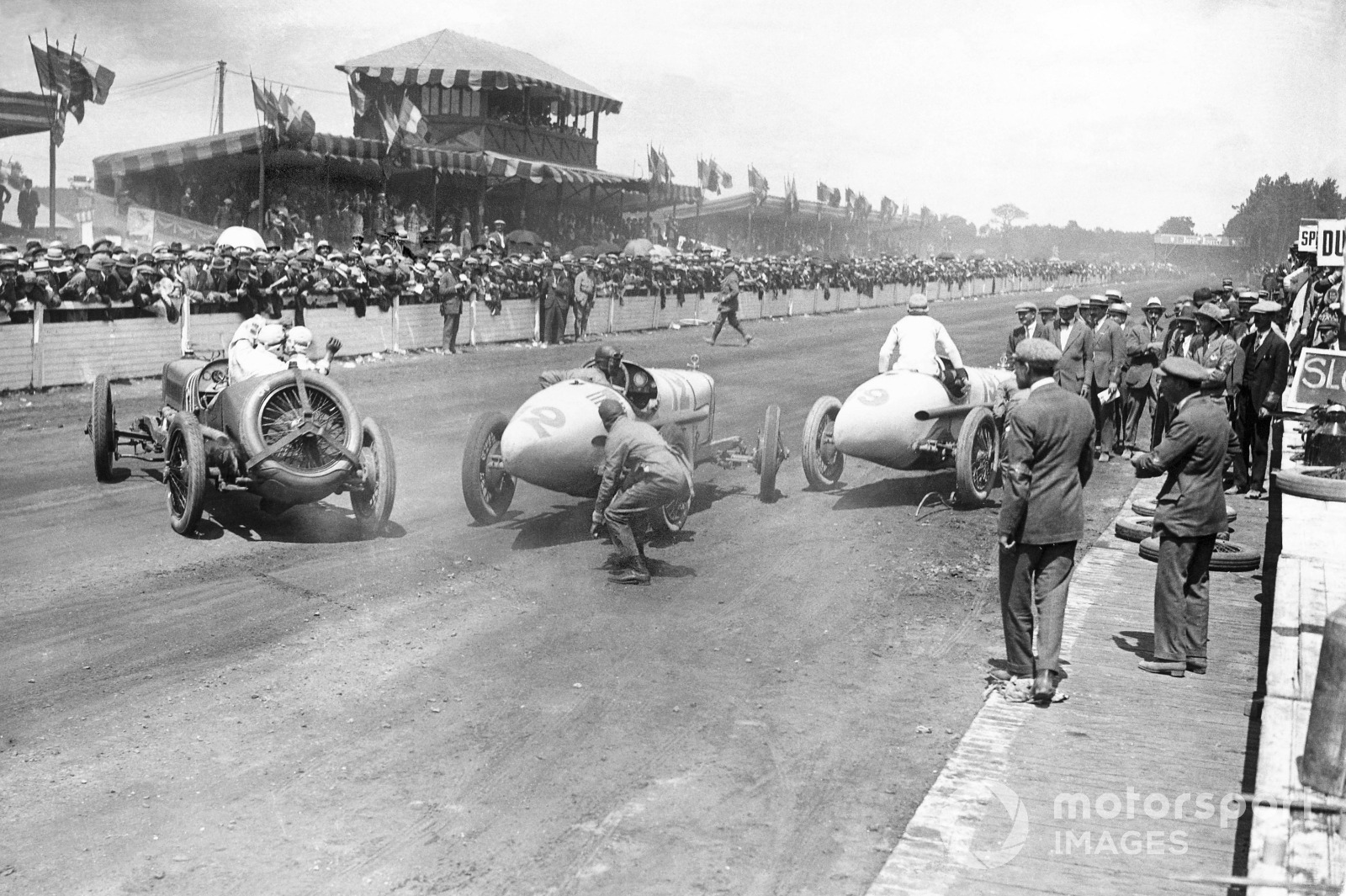
Where it all began... the start of the 1921 Grand Prix de l'ACF at Le Mans
Photo by: Motorsport Images

Norris frustrated after United States GP qualifying: "I did a very bad job"

F1 United States GP: Antonelli beats Verstappen to pole with Russell only sixth

F1 United States GP: Ferrari completes perfect practice record as Hamilton tops FP3

F1 United States GP live commentary and updates - Antonelli on pole
Subscribe and access Autosport.com with your ad-blocker.
From Formula 1 to MotoGP we report straight from the paddock because we love our sport, just like you. In order to keep delivering our expert journalism, our website uses advertising. Still, we want to give you the opportunity to enjoy an ad-free and tracker-free website and to continue using your adblocker.


Top Comments