
Peter Brock's '05' greatest motorsport moments
Twenty years ago motorsport lost Australian icon Peter Brock in a rallying accident. To remember “The Icon”, here are five of his greatest moments
Autosport Retro
Telling the forgotten stories and unearthing the hidden gems from years gone by.
On 8 September 2006, Australian motor racing experienced its ‘JFK Moment’.
On that Friday, in an otherwise low-profile rally event outside Perth in Western Australia, on a damp left-hand corner, a grey V8-powered Daytona Coupe flew off the road and struck a tree with sickening impact. There was no barrier to impede the car and it was clear immediately that it was a severe crash.
In the driver’s seat, Peter Brock was killed instantly. Alongside, his navigator and long-time friend Mick Hone, an experienced competitor, was badly injured. Officials were quickly upon the scene, but it was clear that there was nothing to that could be done to save Brock. At 61, Australia’s greatest and best-known racing driver was gone.
As the shocking news spread, the country literally went into mourning. Just days earlier Steve Irwin, the much-loved zookeeper, TV personality and environmentalist, had been killed in a similarly freakish and just as unexpected occurrence. Now, Brock was dead as well.
What followed was an outpouring of grief at all levels of Australian society. There was a state funeral in Melbourne, and numerous events to allow Brock’s family, friends and fans to share the loss of a man whose appeal reached far beyond the normal limits of sport. Australian motor racing, which is as tribal as sport gets, saw all sides unite to say farewell to the man who now, two decades after his loss, is still referred to many who knew and worked with him as “The Icon”.
To the public he was “Peter Perfect” or “Brocky”. He won the Australian Touring Car Championship three times and the Bathurst 500/1000 nine times, and the traditional Sandown 250/400/500 enduro nine times.
Among these successes there were many highlights but in honour of his famous racing number, we have selected the top 05 drives of Peter Brock’s brilliant career.
05. 1989 Oran Park ATCC
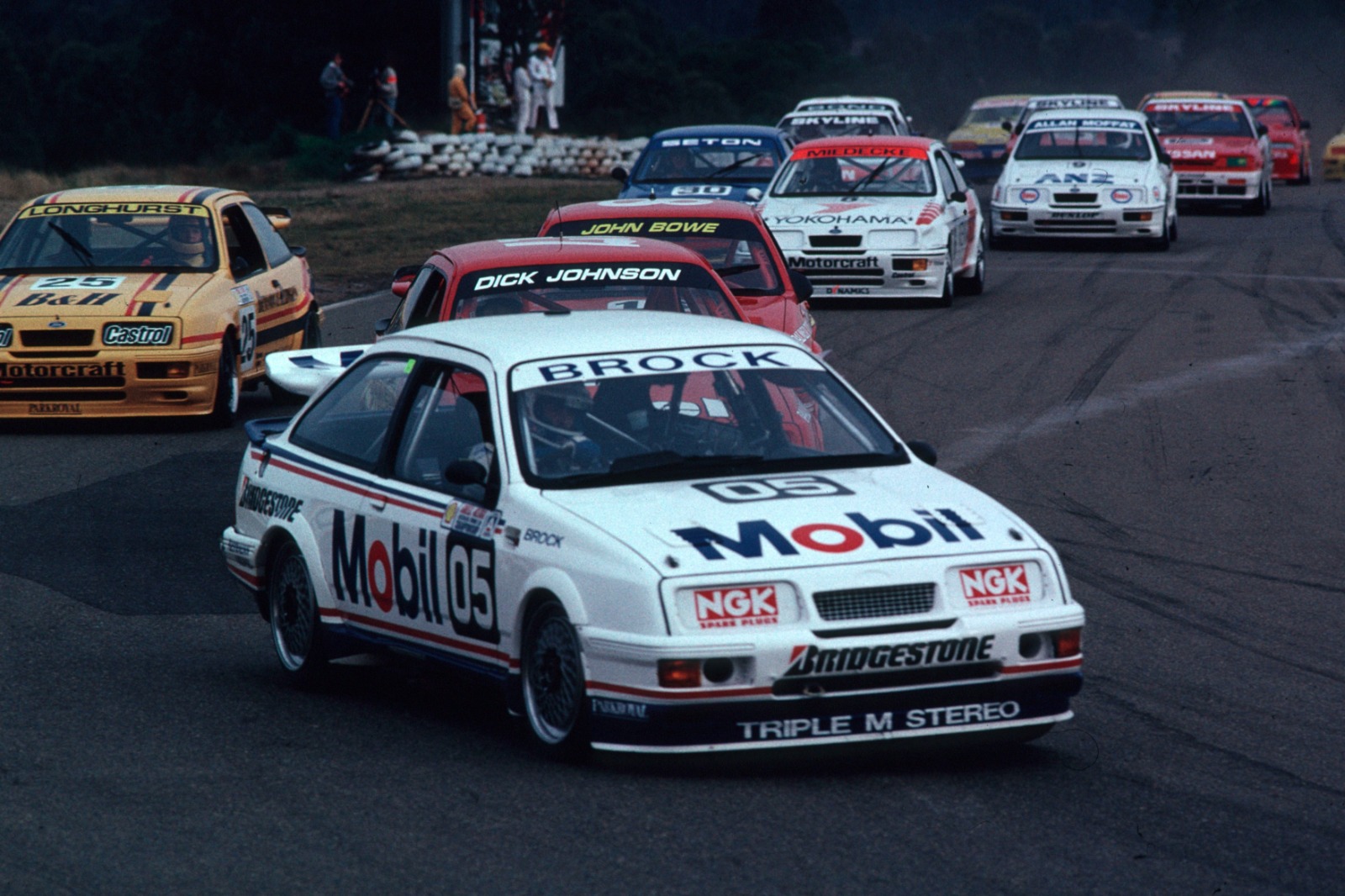
Brock won the start of the ATCC race at Oran Park in 1989, and led home the previously dominant Ford Sierras of Dick Johnson and John Bowe
9 July 1989
Qualified: 1st
Result: 1st
It was not so surprising that Brock would win an Australian Touring Car Championship race, from pole position. What was remarkable that on this day at Oran Park near Sydney, Brock did exactly that – in a Ford Sierra.
After his controversial split with Holden at the start of the 1987 season Brock raced a BMW M3 in 1988, finishing the ATCC in sixth overall, but with no wins or podium finishes. What his fans, his sponsors Mobil and Bridgestone and Brock himself expected was wins, so for 1989 that meant he needed to race a Ford Sierra RS500.
Brock and his manager Alan Gow (yes, that Alan Gow, who is now CEO of the BTCC) made a quick trip to the UK to do a deal with Andy Rouse Engineering, securing two RS500 Cosworths for Brock and team-mate Brad Jones. Throughout the season, while still acclimatising to the car Brock was quite competitive, with three second places in the opening seven rounds – but that maiden win was looking elusive.
That was down to Dick Johnson and John Bowe. Vastly experienced with developing and driving the turbocharged four-cylinder Sierra, the Dick Johnson Racing duo dominated the championship. Johnson had even spread his wings the year before, his Queensland team taking one of their locally developed cars to Silverstone for the Tourist Trophy, a 500km round of the European Touring Car Championship. Johnson had qualified on pole easily and he and Bowe ran away from the field, until a £2 water pump gasket failed. They’d demonstrated that the DJR Sierras were the fastest in the world.
On home soil in 1989, the duo dominated, winning every race except for a wet lottery at Winton Raceway. The red Sierras came to Oran Park’s series finale with the title secured. Brock was at his best. He took pole position, the 50th of his career, by a startling 0.31 seconds, temporarily abandoning his trademark glass-smooth style and admitting: “I literally threw the car around to do that lap time.”
Johnson took second and was relying on a good start, particularly after Brock inexplicably spun his car on the formation lap while trying to warm the tyres…
Brock won the start and Johnson, for once the pursuer, chased hard. But over the final 10 laps the white Sierra eased away from the red ones, Brock taking the win in the very car Rouse and Alain Ferte had driven to victory at Silverstone a year earlier.
Brock would only win once more in a Ford the following season. But he had proven he could do it, and in doing so, he had beaten the best in the business at his own game.
4. 1987 Bathurst 1000
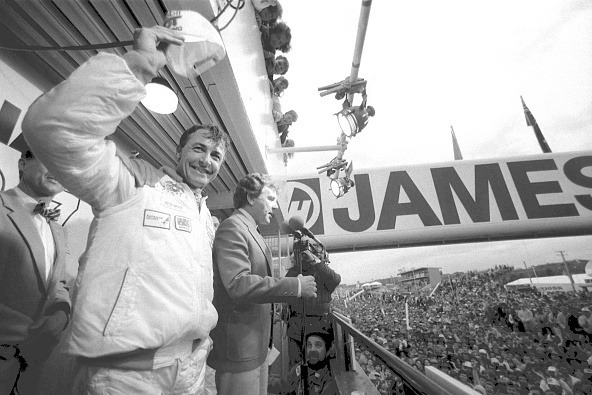
Brock’s popularity was clear to see on the podium - but better news was to come later on
4 October 1987
Qualified: 11th/20th*
Result: 3rd/1st**
*Brock qualified 11th in his own car
**The car that was qualified 20th by Peter McLeod
The world came to Bathurst in 1987, for the eighth round of the World Touring Car Championship. It would become a race of history, but not for the reasons many may have thought.
The WTCC was a great concept but, let’s say, it did not travel well. By the time October beckoned Australia’s touring car fans trekked to the Mountain to find a lot of things were different.
One of them was the status of Brock and his team. Holden had, effectively, dropped them. Brock had run a low-key single-car effort in the ATCC, with one podium finish on the way to seventh in the points standings. He did not much care for Australia’s recent move to Group A regulations, once comparing his newest Holden racer to the former Group C ‘big banger’ Commodore as “less power, less fun and only three times the cost”.
Nevertheless, needs must. Brock and his team pooled what assets they had to build a good race car for him and co-driver David Parsons, and another one for two pay-and-drive competitors in the other car.
It showed in qualifying. Brock could manage only 11th fastest, 5s slower than pole position, and in the ‘bitza’ Peter McLeod was only 20th, 3s further back – and that was after emerging unscathed from an incident that saw the brakeless car spear up an escape road and through an open gate at great speed.
The race started and Brock went about the business of chasing the all-dominant WTCC racers, led by the works Eggenberger Ford Sierras and the BMWs. But on lap 34, his Commodore’s engine expired and he retired the car.
Except, the team had thought to cross-enter all its four drivers. When McLeod brought the second Mobil Holden to the pitlane Brock leapt in, his co-driver Parsons was on standby.
No one within the team had any level of confidence that the car would make it to the finish but, when it rained, magic happened. Brock stayed on slicks and slithered around the circuit, much to the delight of his faithful fans, though much later he admitted to this writer that, had he thought he was in contention, he would have taken the conservative route and changed to wet tyres.
Lap after lap the ‘spare parts’ Commodore kept going, and Brock and Parsons kept it away from the trouble that claimed so many others. By the end of the race they were an astonishing third, and on the podium the dominant (and temporarily, victorious) Ford drivers came face to face with Brock’s level of popularity. But more was to come.
After the works Sierras survived the track and conditions, another team protested the legality of the cars, a soap opera started that, five months later, changed the outcome of the race. In the unlikeliest of results, Brock had won his ninth Bathurst crown, and perhaps the only one that came as a shock to the motor racing community.
3. 1972 Bathurst 500
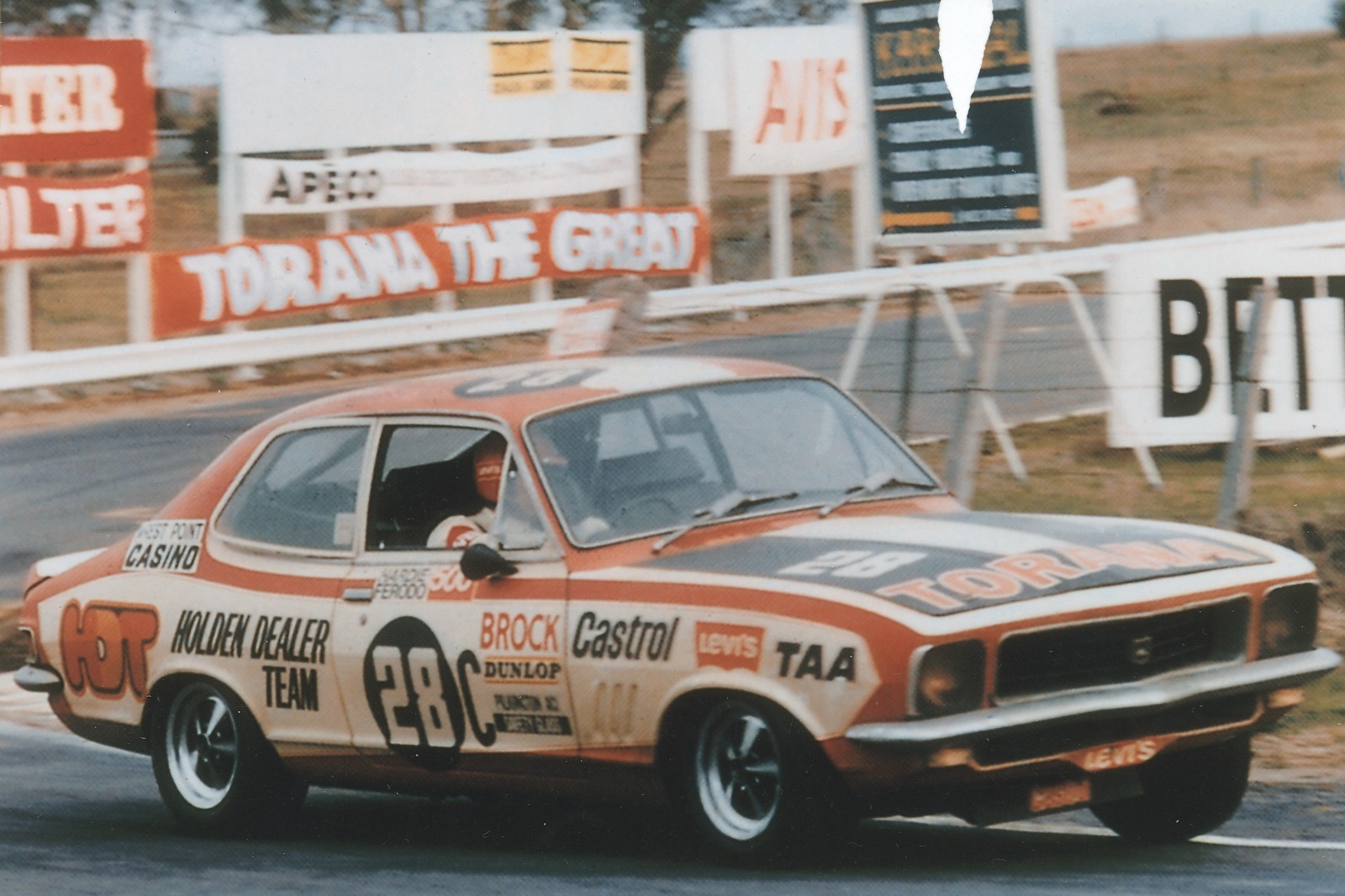
Brock took his place on the biggest stage in Australian motorsport at Bathurst, when he won the 1972 500-mile race in a Holden Torana XU-1
1 October 1972
Qualified: 5th
Result: 1st
Australian motorsport was changing. The 1972 Bathurst 500 would be the last for Production Cars, to be replaced by Improved Production – a new generation of cars modified for racing.
Ford went to Bathurst as defending champion, Allan Moffat looking for a three-peat in his factory-backed XY Falcon GT HO Phase III; then, and for some years after, the fastest four-door car in the world. Moffat and team-mate Fred Gibson, and two privateers, dominated qualifying.
The best of the Holden drivers was the brand’s rising star. Peter Brock was 27 and marking himself as a driver to watch. He qualified fifth fastest, 2.4s behind Moffat, in his Holden Dealer Team Torana XU-1. A small car based on what started life as a Vauxhall Viva/Open Kadett, it was fitted with a 3.3-litre six-cylinder motor, long before anyone in Munich thought of the BMW M3.
On paper Moffat was going to run away. Problem was, come Sunday morning the paper, like the race track, was soaking wet. Moffat took an early lead and, as the field slithered around in his wake, Brock was the one to move up through the field. On hand-cut Dunlop slicks, he was third after one lap and, when John French’s Ford went down the escape road, he moved onto the rear wing of the works Falcon. Though driving blind, Brock trusted Moffat enough to show him the way.
No such luck for the other HDT Torana. On lap three Colin Bond had speared off the road and into a tree, an occurrence virtually unknown at the time and, as it turns out, in the two decade career that followed. Then on lap 28 Moffat had a similar incident, at nearly the same place, but this time the car was dragged back onto the track and into the race.
From that point Brock just drove away from the field. He was not perfect; he restarted the engine too early during a pitstop, earning himself a 60s penalty but even so, he had the race well in hand, and won by a full lap.
Australian motorsport had its new star. Handsome, mediagenic and very fast, Brock’s win, the last for a solo driver before Bathurst evolved into a 1000km, two-driver race, set up the next decade that would move the sport forward.
Brock would go on to dominate the Mount Panorama track like no driver before or since. On that Sunday night, as darkness fell, motor racing down under had changed forever.
2. 1979 Round Australia Trial
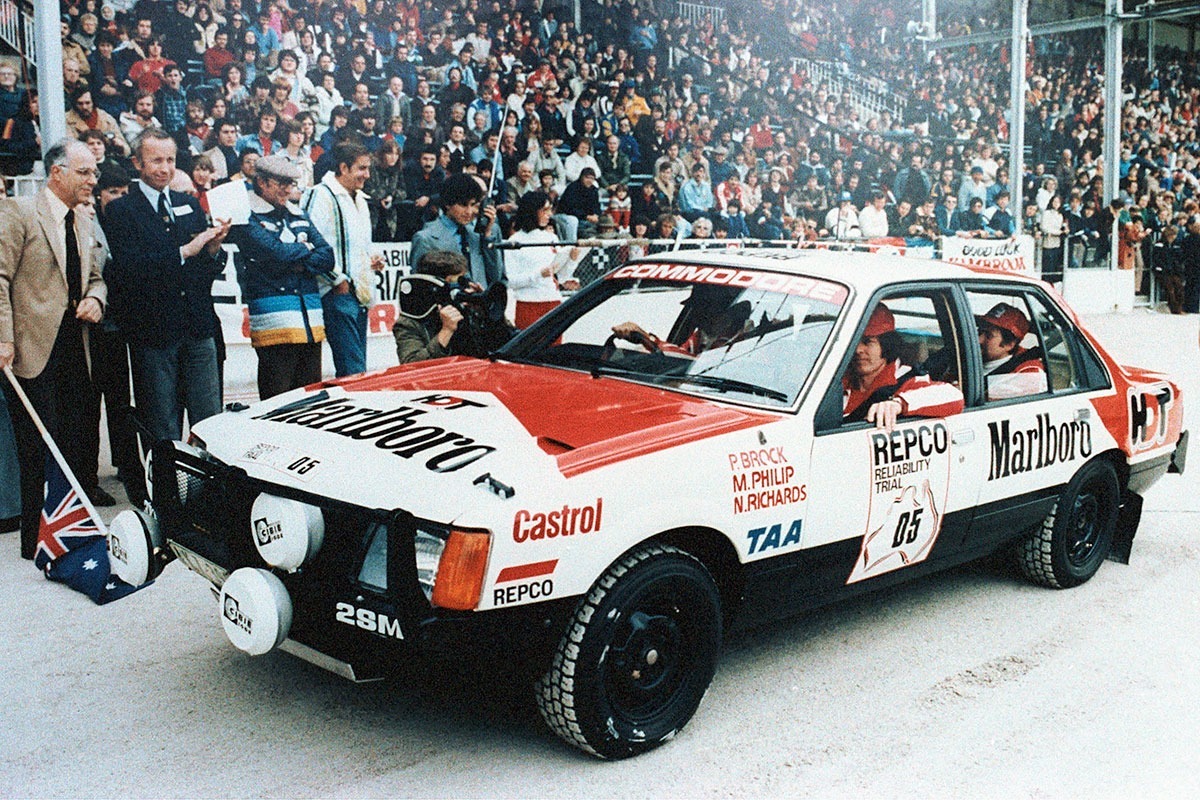
Brock, Matt Philip and Noel Richards led a controversial 1-2-3 finish in Holden’s new Commodore in the 1979 Repco Round Australia Trial
5-19 August 1979
Result: 1st
Brock himself rated his ‘fish out of water’ experience of competing in the Round Australia Trial as the best drive of his career.
He was entered in one of three Holden Commodores, the then-new six-cylinder family sedan that just superseded the brand’s larger sedans. He shared his car with experienced rally men Matt Philip and Noel Richards; the other Holden entries included experienced local and international rally drivers, including Rauno Aaltonen and Shekhar Mehta.
The event sent the competitors on a 19,000km loop of Australia, starting and finishing in Melbourne. It was soon obvious that it was no place for the faint-hearted as car after car crumbled with the challenge of racing more than 1000km a day on brutal tracks that barely qualified as ‘roads’.
Even in such unfamiliar surroundings Brock attacked from the start, taking on the event on his own terms. That nearly led to disaster; after a slow refuelling stop near Marree, in top gear, he misjudged a curve and hit a drain nose-first, the car skating 80 metres on its nose before coming to a halt. The crew emerged shaken but unhurt and found, much to their surprise, that the car was damaged but largely unbent. They remounted, Brock started the car and plucked first gear, then second and, content that the car was basically straight, carried on at full speed.
By the time the surviving teams were approaching Melbourne, the works Holdens were 1-2-3, with Barry Ferguson/Wayne Bell/Dave Boddy leading and Mehta/Aaltonen/Barry Lake second. Team boss George Shepheard gathered the squads together and called off any competition, ordering the drivers to hold position.
Brock must have missed that bit. He carried on at ten-tenths, to surge into the lead and take the win, in front of his disgruntled team-mates and a furious Shepheard. It came with a cost, Brock estimating that he slept a total of 30 hours in the two weeks, and losing as much as 6kg in weight.
“I’ve never done anything quite as challenging,” he said, “and I don’t know if I’d want to do it again.”
1. 1979 Bathurst 1000
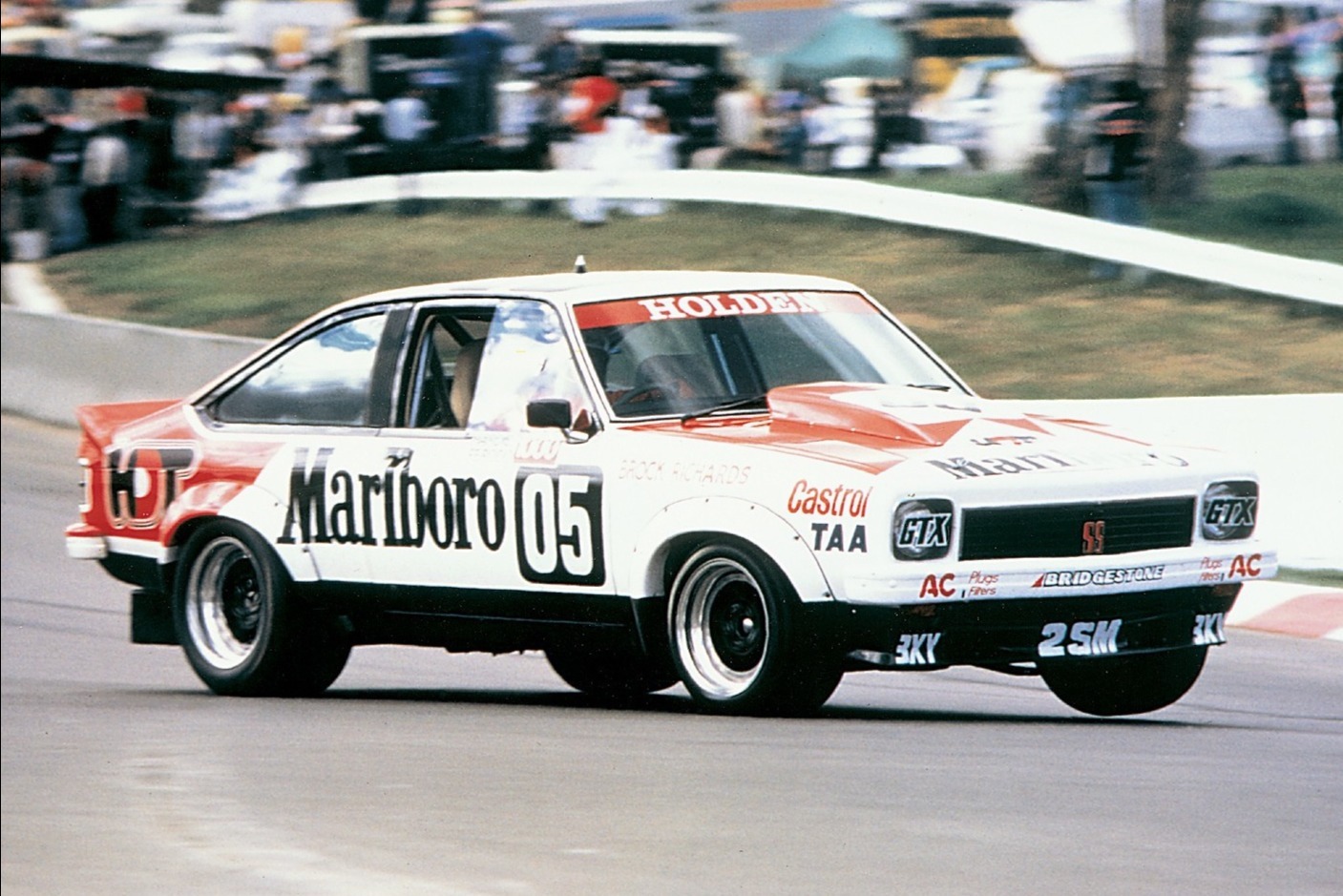
Brock and co-driver Jim Richards crushed the opposition at Bathurst in 1979, winning by six laps
30 September 1979
Qualified: 1st
Result: 1st
It was the end of the era. The Holden Torana V8, which had dominated Australian touring car racing in the mid- to late-1970s, would make its last start in the 1979 Bathurst 1000.
It had been a beast. Its ultimate variant, known as the A9X, was fast and pretty much bulletproof. With a five-litre V8 and a list of specialist motorsport fitments as standard, think of it as a ‘Holden Mustang Darkhorse’, 50 years ago.
So good was the car that Sydney driver Bob Morris had taken a privateer version to the Australian Touring Car title. So Brock arrived at Bathurst in a determined mood, having won the Repco Trial and the Sandown 400 Bathurst warm-up race in short order. He and co-driver Jim Richards were defending their 1000 win from a year earlier and went into race week as unbackable favourites.
In qualifying Brock was fastest. In the top 10 shootout, he was 1.966s faster than Morris in second. That was despite two problems; a driving error that saw the 05 Torana almost stop on the way up the Mountain, and then when an errant item fell out of his racesuit pocket while flat-out on Conrod Straight. Always a sponsor’s dream, Brock confided later that it was a packet of cigarettes.
After overnight rain, and on a slippery track, Brock took off at the start and was never seen again. Three seconds clear after a single lap. He and Richards maintained the lead which, by the time Brock came to start the final lap, had ballooned to six laps.
And then came the coup de grace. While the others plugged on at a steady pace to make the finish Brock drove virtually at qualifying pace, a 2m21.10s lap, just 0.6s away from his pole lap and a time that no other car in the race approached, even in qualifying. Later, when asked why he took such a risk on the final lap, he told this writer that he wanted to “send the Torana off in style”.
Perhaps another explanation is also relevant. Arch-rival (and lap record holder) Allan Moffat had long since retired his Ford Falcon with mechanical problems and was assisting with TV commentary. At that point Moffat could only sit and watch as Brock dismantled his mark corner by corner, in a crushing display of speed and superiority.
For all his positivity Brock showed the world, when it came to winning, in the Repco Trial and in the last hit-out for his beloved Toranas, beneath that friendly exterior beat the pitiless heart of a professional assassin. In his greatest race, that was clearly on show.

Brock remains an Australian motorsport legend

How last-lap heartbreak turned the Bathurst 1000 on its head

Supercars Bathurst 1000: Kostecki and Hazelwood win after leaders De Pasquale and Holdsworth run out of fuel

Supercars at The Bend: Mostert wins for Walkinshaw TWG Racing

Supercars Ipswich: Feeney takes second win to secure unlikely Sprint Cup title

Supercars Ipswich: Kostecki and Brown take a win each in hectic first day

Supercars, Triple Eight own up to “significant” error that has made Brown slower

Supercars Perth: Payne outduels Feeney for victory

Supercars Perth: Payne builds championship lead with near-perfect day

F1 United States GP: Leclerc beats Verstappen to top FP1 in upgraded Ferrari

MotoGP riders ask for guarantees to go and race in Qatar

IndyCar officially returns to Europe with Barcelona race in 2027

F1 United States GP live commentary and updates - Leclerc on top in FP1
Subscribe and access Autosport.com with your ad-blocker.
From Formula 1 to MotoGP we report straight from the paddock because we love our sport, just like you. In order to keep delivering our expert journalism, our website uses advertising. Still, we want to give you the opportunity to enjoy an ad-free and tracker-free website and to continue using your adblocker.


Top Comments