


The hidden backroom crew that helped Ducati Lenovo Team win the world title
Away from the glamour of the pitbox at the circuit, there’s a whole extra ‘garage’ making a difference for the factory Ducati team
Autosport Business
Covering industry news and insight into the business of motorsport
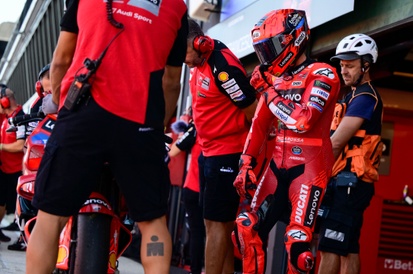
Only the eagle-eyed may spot it amid all the human drama in the factory Ducati team pit, but there’s a little technical ritual every time one of its MotoGP bikes returns to the garage. As quickly as possible after the rider dismounts, a cable hanging from the roof gets plugged into the thoroughbred GP25 in question.
It’s a tiny but critical piece of the jigsaw puzzle that made up the Ducati Lenovo Team’s latest successful MotoGP teams’ championship campaign, which was sealed in the sprint race in Indonesia last weekend. Because that modest-looking cable plugs that bike into a powerful support network – one that goes far beyond the confines of the pitbox.
A big part of that network, in fact, was on the other side of the world while MotoGP was doing its thing on Lombok. The reams of data that got downloaded from the bike after each run (F1-style live telemetry isn’t allowed in MotoGP) weren’t just for the several-strong team of engineers at the back of the garage and in the paddock offices.
They also got whizzed over to Italy, to the massive Ducati factory at Borgo Panigale outside Bologna, where both Ducati’s road and race bikes are built. There, the crew at the Ducati Lenovo Remote Garage was waiting to pounce.
And you can take ‘pounce’ almost literally. The crew at the factory, which has all the Lenovo computing power needed to process around a hundred gigabytes of data every race weekend, can make a contribution even before Marc Marquez or Francesco Bagnaia heads out for his next run.
“The Ducati Lenovo Remote Garage is a crucial point,” says David Attisano,
Ducati Corse’s head of data analysis – racing and R&D. “Because they are in a different environment. So the situation is more calm; it’s stable. You don’t have the noise of the bikes and so on. They can make some evaluations in a different way and from a different perspective.
“They also have the capability of all our infrastructure. They can run a lot of simulations on our High Performance Computing (HPC) to understand if there is a combination of parameters that could be better than the current one and that can improve the performance. And they can suggest some modifications to the engineers.”

Marc Marquez, Ducati Team
Photo by: Qian Jun / MB Media via Getty Images
The remarkable turnaround time cannot be emphasised enough, particularly given the frenetic nature of the modern MotoGP weekend format.
“The system helps us to have timely answers,” continues Attisano. “Because it is very difficult nowadays to give answers to the rider in good time. Because there are only a couple of minutes from when the rider comes and then goes out again.
“With the sprint race, the time to practice and do something that works better is very, very little. Friday Practice is really a qualification session, so we only have two real free practice sessions.”
It’s all about harnessing technology in a way that sends the team down the right path when there isn’t time to try them all.
“During the race weekend, because we have to have an immediate answer, the technology is so important,” adds Ducati Corse sporting director Mauro Grassilli.
“We have very fast communication between the box and the Ducati Lenovo Remote Garage. Because sometimes it’s not easy to have a fast answer to a question here. From a comfortable situation at the factory, it’s easier compared to here at the track.”
Launched during the pandemic in 2020 to allow engineers at HQ to work in real time alongside the crew at the track, the Remote Garage quickly became a key innovation in the Ducati Lenovo partnership. And it has evolved into a permanent hub for high-level technical support.

Mauro Grassilli, Ducati Corse sporting director
Photo by: Ducati Corse
Using Lenovo’s advanced computing, hardware and infrastructure, the Remote Garage enables split-second data analysis from the bikes, including engine performance, environmental parameters and electronics. It also runs complex aerodynamics simulations and scenario testing.
All of this capability doesn’t just mean finding ways to go faster. Word from the Remote Garage has, on at least one occasion this year, led to a late bike swap when a potential reliability problem was – rightly, as it turned out – detected back at base.
Like Grassilli, Attisano has been with Ducati since 2004, when a weekend’s worth of data was a measly 50 megabytes. Watching data and computing’s evolution since then, and particularly since Lenovo came on board as a partner in 2018, has given him a true appreciation of what it has meant to MotoGP’s champion squad.
“Technology has augmented our perspective,” concludes Attisano. “Because we are thinking things now that were impossible before.”

Share Or Save This Story

How Aprilia's world championship juggernaut hit its straps

The humble origin story of a MotoGP powerhouse

Rivals block KTM request to open MotoGP engines due to breakdowns

F1 champion Norris completes first full test in McLaren’s Le Mans Hypercar

How Solberg lit up WRC title fight in Chile

F2 adds extra Baku feature race and insists Qatar, Abu Dhabi still on – what does this mean for F1?

Healeys, MGBs and Lotus Elans top Castle Combe Autumn Classic
Subscribe and access Autosport.com with your ad-blocker.
From Formula 1 to MotoGP we report straight from the paddock because we love our sport, just like you. In order to keep delivering our expert journalism, our website uses advertising. Still, we want to give you the opportunity to enjoy an ad-free and tracker-free website and to continue using your adblocker.


Top Comments