
The unlikely series providing an open door to innovation
Regulations that permit a variety of propulsion methods make the European Truck Racing Championship attractive for investment. A prototype electric truck has been built, and plans are in motion to embrace hydrogen technology too

Engineering
Our experts' guide on how you can become a better racing driver
There are countless differences between the Formula 1 grid of 30 years ago and now, and one that has perhaps gone under the radar is the loss of engine variety. Ferrari’s screaming V12 was pitched against an array of V10 and V8 engines in 1994, when the Ford V8 powering Michael Schumacher’s Benetton’s B194 beat the Renault V10 in Damon Hill’s Williams FW16 to the title. Now all teams use 1.6-litre V6 turbo power units, and development is frozen until F1’s next major technical revamp in 2026.
It’s one thing to allow multiple engine configurations, as the World Endurance Championship does, but it’s quite another to welcome completely different methods of propulsion. Yet there are a few series that have left the door ajar. Take the FIA’s World Rally-Raid Championship, which contains provisions for hybrid, full-electric and hydrogen vehicles that have been on show this past week in the Dakar Rally. And there’s another, perhaps unlikely, avenue for technical freedom in circuit racing too.
The European Truck Racing Championship has for the past 12 months had a provision in its technical regulations allowing electric and hybrid race trucks to compete against combustion vehicles that since 2021 have run on sustainable HVO (hydrotreated vegetable oil) bio-diesel fuel from TotalEnergies. Hydrogen too is under discussion. The FIA hosted an ETRC-dedicated workshop last year to share its know-how with the key stakeholders of the truck racing industry, covering areas such as storage types, risk assessment, safety and relevant regulations.
Given the bulk of its machines, which have a minimum weight of 5300kg including the driver (around 6.6 times heavier than current F1 cars) that necessitates a 160km/h speed limit, the ETRC occupies its very own niche that means it has little in common with the rest of the motorsport world. But this is actually advantageous when it comes to facilitating different technologies, because it makes them more accommodating.
“The truck architecture allows more space so that you have more freedom to accommodate a different technology in the frame of the same vehicle,” explains FIA Senior Director of Circuit Sport Marek Nawarecki.
“Some challenges you have with the cars in terms of packaging or weight, that’s less of a problem for us,” agrees Georg Fuchs, managing director of ETRA Promotion. “That’s a very beneficial factor.”
But the ETRC’s openness isn’t simply born of a desire to attain its stated 2038 net zero target, having already decreed that emitting visible smoke – for so many years part and parcel of truck racing – is a punishable offence.
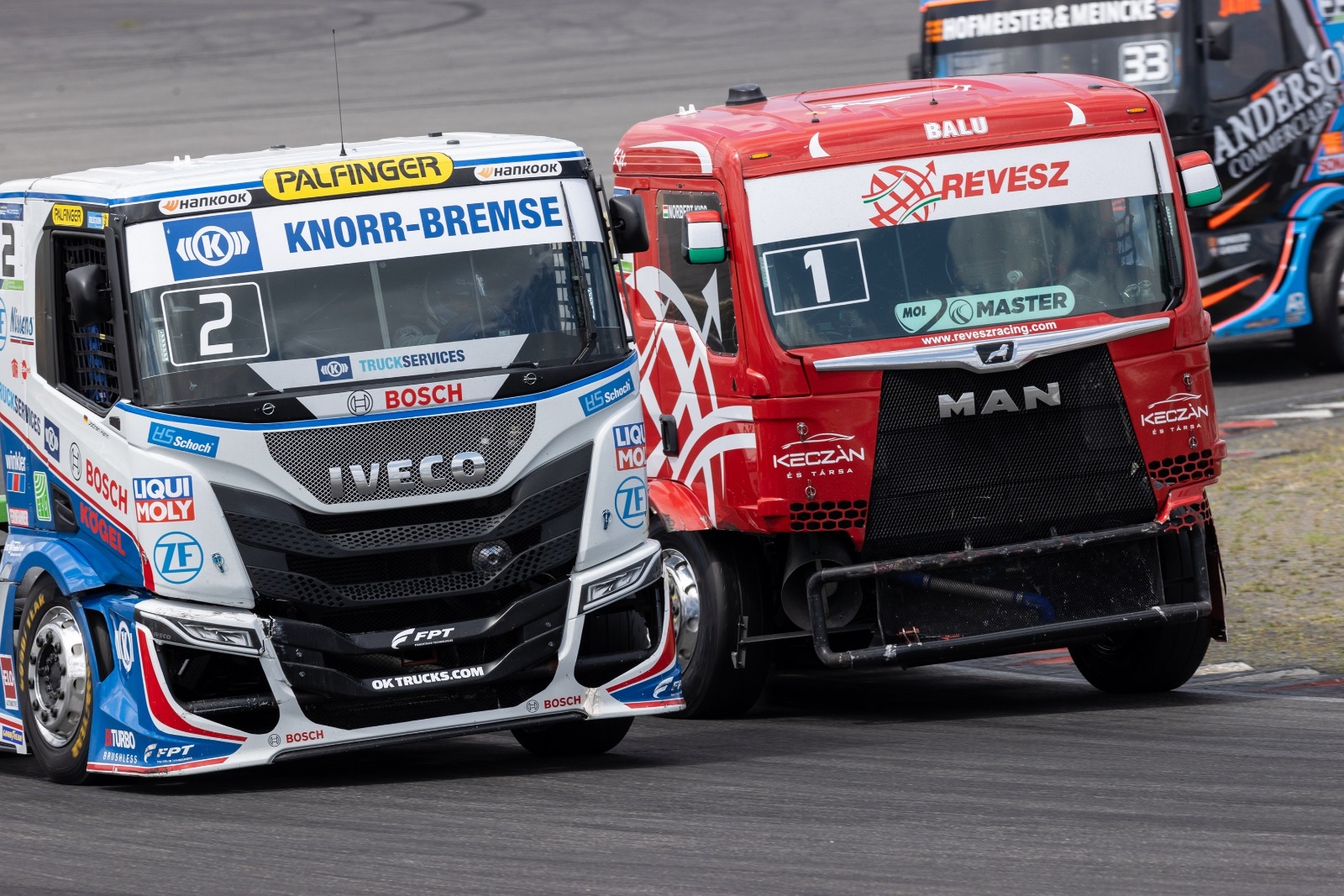
Photo by: Richard Kenberger
Due to the size and weight in the ETRC, it can be a hotbed of different technology competition
“With truck racing we’re not in an open space, we’re embedded in the industry,” asserts Fuchs. “We are a part of motorsport, but we’re also covering the industry segment of commercial vehicles. There’s still a big debate in the industry going on [regarding] what technology is useful for what application, and we’re responding to the characteristics of the industry. Even though we all know that we have to go down that route and it will happen, there is some reluctance to accept this. So our approach is also to lead as a best practice example and to raise the acceptance for this new technology.”
This clear effort to relate to trucks used by the majority of its fanbase are evident in regulations that, with lessons learned from the big-budget Super Race Truck boom-and-bust period, specify clear links between road-going homologated tractor units (to use their technical term) and their racing counterparts.
PLUS: The insane racing category that went off the rails
Engines must come from a range with a minimum quantity of 100 units, with modifications only permitted if using commercially available parts that don’t change the engine capacity. The gearbox, front and rear axles, steering box and braking components must also be road-based.
Realising the future vision
Any two-wheel-drive hybrid/electric trucks that are built must be subjected to approval by the FIA and granted a technical passport before being cleared to race. A maximum of four MGUs, which must be mechanically linked, are permitted, while the type and origin of the electric motors, inverters and energy recovery system is free. The FIA will apply its Equalisation of Technologies methodology - which Nawarecki is adamant should be considered as a different mechanism to Balance of Performance - to ensure parity when a truck with an alternative powertrain is readied to race, which may not be too far away.
"The first step will be that industry and manufacturers who are specialised in this kind of new technologies are guiding a race team, maybe supported as we see with Jochen Hahn, to establish a prototype and then in a second step it can be spread over to smaller teams" Georg Fuchs
The first electric racing truck built by six-time ETRC champion Jochen Hahn – the drivers’ representative on the FIA Truck Racing Commission – in partnership with IVECO was formally presented last July at the Nurburgring. Development is ongoing on the prototype, which has yet to be fully homologated. Fuchs says that it’s now allowed to run at 100km/h, with 160km/h the evident target.
“I’m sure it’s just a question of the time, if it will be [2024] or the year after,” says Fuchs on the matter of when it will race.
Although it will evidently take some time and considerable investment before an electric truck is able to take on and beat the established contenders, Fuchs acknowledges that there has been “a lot of reluctance for change – maybe some fear” within the paddock as well as in the fanbase. But he says positive industry feedback has given encouragement “that we are on the right way”, and there’s hope that momentum will continue to build behind the ETRC as a destination for innovation.
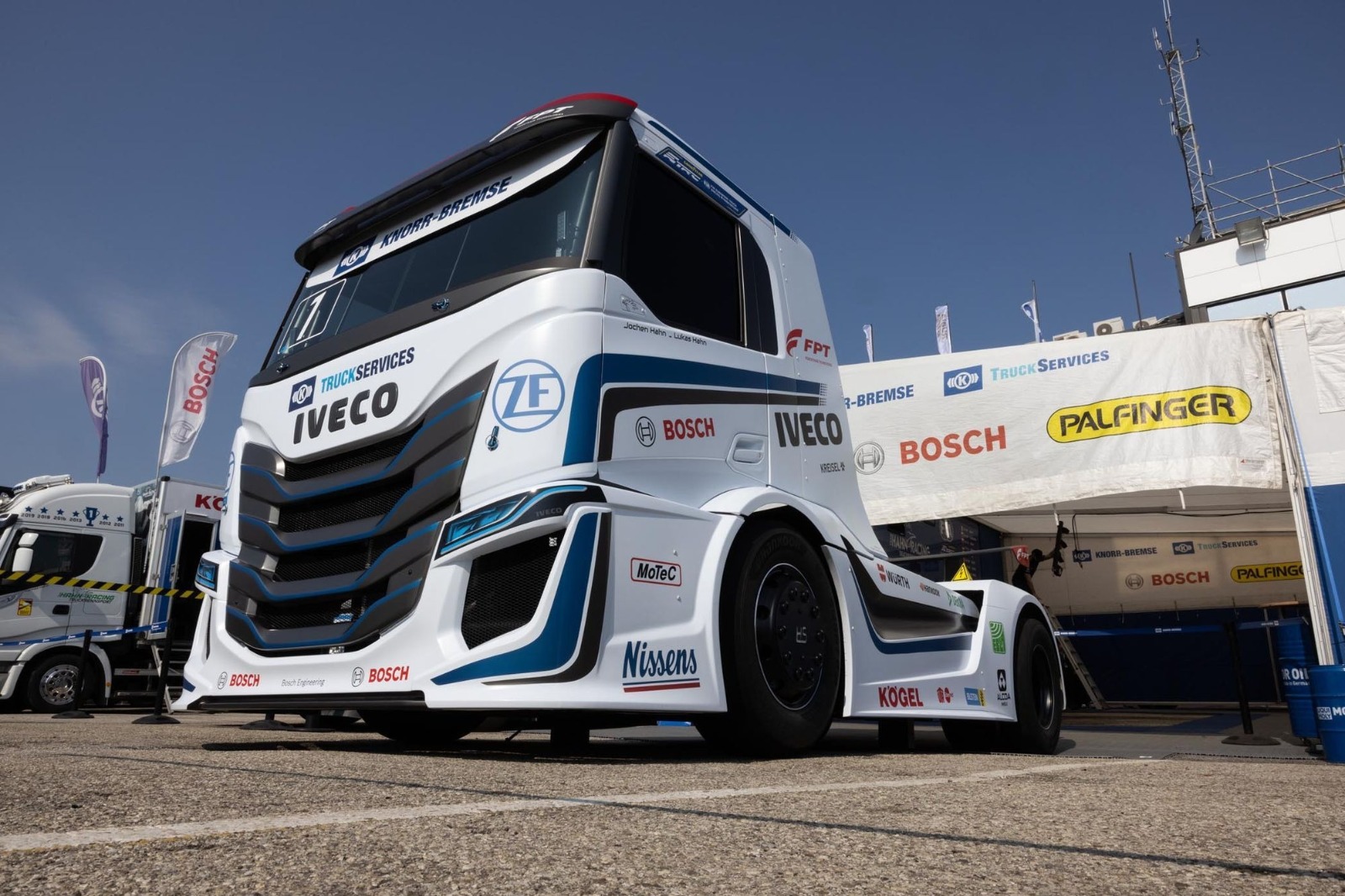
Hahn's electric truck prototype was presented at the Nurburgring last year
“The first step will be that industry and manufacturers who are specialised in this kind of new technologies are guiding a race team, maybe supported as we see with Jochen Hahn, to establish a prototype and then in a second step it can be spread over to smaller teams,” reasons Fuchs.
“The direction is not at all defined by the industry so you need to be an expert in different fields of the technology; from the delivery of the hydrogen, it can be gas, as a liquid, or it can be combustion engine or fuel cell and so on. Then once this technology is established, you can spread it out to more amateur teams, maybe in a guided way, maybe as a single supplier.
“It’s very exciting times, but also challenging times, because as you can imagine, from the side of the promoter but especially from the side of the FIA we need to be prepared.”
Fuchs hails the well-received hydrogen workshop as evidence of its efforts in this respect, although Nawarecki is clear that assessing hydrogen’s capabilities remains “a long and difficult process” for the regulatory body. He’s unwilling to give a robust timeframe for its adoption in truck racing because uptake will be determined by wider market forces but, as motorsport remains an attractive platform to showcase the performance, efficiency and safe application of new technologies, is convinced it is worth taking the time.
“The industry is looking for new solutions for transportation and we understood also that nothing is decided,” Nawarecki says. “Our role is to provide a very consistent regulatory framework to support the industry towards the development of new technologies. We try to bring everybody on the same level of understanding of how we should approach this topic.”
“We have to see how the industry is working towards one or the other direction,” adds Fuchs. “This is something the industry, together with the competitors and so on, have to sort out.”
A growing model?
An interesting case study for the ETRC will come courtesy of the World Rallycross Championship, which last month made the bold leap of announcing its so-called ‘Battle of Technologies’ concept. RX1 Supercars with internal combustion engines have been banished to the European championship for the past two seasons, but will now be allowed to compete against RX1e all-electric machines if powered by sustainable fuels.

Photo by: Red Bull Content Pool
Electric versus internal combustion is set to arrive in World Rallycross in 2024
At the time of writing, little is known about the promoter’s plans to equalise the two types of machine – the EVs are known to accelerate quicker, and won’t be hamstrung at higher-altitude tracks such as Montalegre – although recent series dominator Kristoffersson Motorsport has floated the possibility of entering two combustion cars alongside its trio of EVs.
Discussions on whether trucks with alternative power sources will be competing for outright wins in the ETRC or split into segregated classes remains “a little bit far off”, says Fuchs, although he insists that the idea of incentivising entrants with special prizes hasn’t been thought of. “We have been already on sustainable technologies for three years, it just hasn’t been that obvious than for example an electric vehicle,” he points out.
Nawarecki stresses that it’s not the FIA’s role to incentivise or promote one technology above another because “it’s up to different stakeholders, decision-makers to choose what will be the most relevant for the industry, what will be the most relevant in terms of economy”.
In demonstrating that all disciplines can contribute to making motorsport more sustainable and offering something that appeals to everyone, the ETRC’s bold philosophy shows how a middle ground can be occupied in conversations over the future of powertrains
Could this model of open technology be emulated more widely? It seems likely, despite the headaches for organisers presented by equalising differing densities of energy storage for fuel, hydrogen and batteries – the latter “far behind the two others”, says Nawarecki. But he notes that the FIA is determined to be “as inclusive as possible” in other disciplines too, and points to the WEC’s interest in embracing hydrogen as evidence that “probably this approach won’t be unique for truck racing”.
“From one discipline to another, the way that it will be applied, diversification will be different because of the size of the car, the racing format, the margin we have to adjust the performance in terms of parameters you can play with to find the right balance,” predicts Nawarecki.
Forming technical regulations that appeal to all comers isn’t a straightforward business. And Fuchs recognises that there is an important balancing act between welcoming new technologies and being incapable of taking decisions to guide the industry. “We can’t have everything open,” he says. “To keep this balance, I think that could be the factor of success.”
But in demonstrating that all disciplines can contribute to making motorsport more sustainable and offering something that appeals to everyone, the ETRC’s bold philosophy shows how a middle ground can be occupied in conversations over the future of powertrains. Variety is never a bad thing for improving a spectacle. Perhaps others could learn a lesson or two.
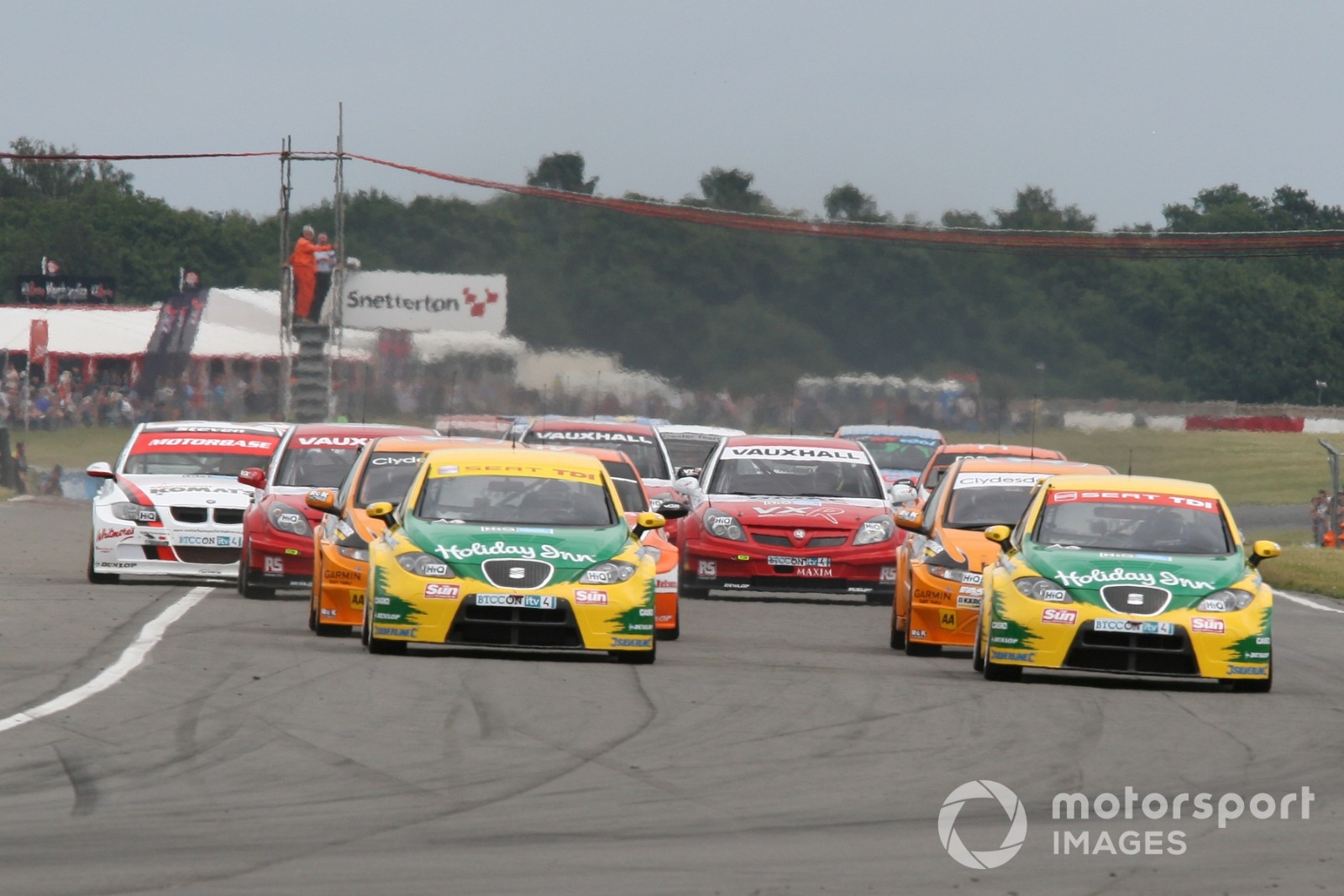
Photo by: Sutton Images
When the SEAT squad used turbodiesel engines in 2008 it created a headache for BTCC organisers
The BTCC’s ‘nightmare’ with turbodiesels and LPG
The British Touring Car Championship is well used to working with different bodyshapes and engine sizes. Series boss Alan Gow recalls that during the Super Touring years “we had four, five and six cylinders; four-wheel drive, front-wheel drive, rear-wheel drive” that all played into “a proud history of not saying no”. Today its regulations are consolidated around 2.0-litre turbocharged direct-injection engines, with common turbochargers and intercoolers to reduce costs.
“With our regulations, a privateer can come in and win the championship quite easily and compete on an equal basis,” says Gow. “It’s good for spectators because they understand that everyone’s equal, it’s easier for us to control, and it’s better for the teams because they know what they’ve got and they know what they’re racing against.”
That hasn’t always been the case in the past 20 years. LPG gas fuel was first used by privateer John George’s Honda Civic in 2004, although Gow admits this didn’t cause many concerns while he was towards the back of the grid. It was a different story in 2008 when the factory SEAT team adopted turbodiesel engines previously used in its World Touring Car Championship set-up. By season’s end, its Leons were the fastest cars in the series, but lead driver Jason Plato reckoned a lack of testing to iron out reliability niggles and understand how changes to weight distribution impacted the tyres proved costly.
Gow recalls: “That was always a constant battle through the year, trying to manage people’s expectations on how the SEAT performed against normal fuel cars. Having said that, our hands were tied anyway because we were running to FIA [Super 2000] regulations, so we had to accept it.”
Its problem was solved when SEAT withdrew at the end of the season, but LPG then became a race-winning force in the Arena-run Aon Ford Focuses in 2010.
“We were constantly adjusting because we were dealing with a complete unknown,” recalls Gow. “We were learning as we were going along, as were the team. We had no experience in LPG running at the front. It was a nightmare for all of us and perhaps in hindsight, perhaps we just should have said no. As it happened, LPG gas-powered cars became a bit of a cul-de-sac, so that didn’t go any further. But it was a complete nightmare.”

Photo by: JEP / Motorsport Images
LPG gas-powered cars eventually hit a development dead end

Archive: When Le Mans made its most controversial change

The man behind Japan's first Le Mans winner

Did Audi ‘give up’ on GT3 too soon?

Alex Zanardi’s top 10 moments

This retro-inspired Mercedes 190E racer is heading to the Nurburgring 24 Hours

Why Verstappen's Nordschleife approach is a win-win for motorsport

The new Mercedes star who had an unconventional route to success

Why Rast is leaving the DTM

Why F1's Madring debut was a wasted opportunity

Bruising F1 2026 will not be the end for Russell - Wolff

Haas confident of getting 2027 F1 budget closer to cap with new partner talks

Top 10 Can-Am drivers
Subscribe and access Autosport.com with your ad-blocker.
From Formula 1 to MotoGP we report straight from the paddock because we love our sport, just like you. In order to keep delivering our expert journalism, our website uses advertising. Still, we want to give you the opportunity to enjoy an ad-free and tracker-free website and to continue using your adblocker.


Top Comments