
How motorsport is embracing the opportunities of AI
As the role of artificial intelligence in modern life increases, motorsport isn’t being left behind. And it's not only Formula 1 teams who are seeking to capitalise on the latest technological revolution of modern times...

Engineering
Our experts' guide on how you can become a better racing driver
Backlash to the virtual female influencer introduced by Mahindra on the eve of the current Formula E season that resulted in it being swiftly scrapped showed how artificial intelligence in motorsport is a long way from gaining universal acceptance. Criticism directed at the short-lived PR campaign fronted by ‘Ava’, described as a ‘Sustainable Tech Queen & Racing Rebel Robot’, largely coalesced around the decision not to ‘employ’ a human for the role and ultimately rendered its continued existence untenable.
Team boss Frederic Bertrand explained that its intention was “just to add one tool to our toolbox for communication and to have one additional possibility for people to ask questions and get answers”. Its value, he added, was “as an addition to what we are doing and then it’s not replacing anyone”. But it was a point he acknowledged Mahindra “probably didn’t explain enough and that’s where we have failed”.
It’s arguable that however much it was explained, many would remain unconvinced. Concerns over the possibility that AI will replace creative jobs aren’t going away. As motorsport artist Jake Yorath puts it: “My job is always under threat because people want to do it for free, or really cheaply anyway. Now we can add in various apps that people use to make their postcards or posters. They’re fine, but it’s a classic ‘you get what you pay for’ situation.
“And with AI as well there’s going to be people wanting to use it to create ‘better’ or cheaper art. We saw McLaren do a livery [for the Formula E London E-Prix in 2023] that was part-designed by AI. I guarantee that there was still a lot of people on the back end of that making it fit the car. I don’t buy the ‘it democratises art’ argument, because artists have to work for years developing a style and learning their craft.”
But apprehension over the growth of large language models such as Chat GPT, the best-known generative AI tool, and the increasing influence of AI more widely in motorsport is not shared in the engineering sector. Machine learning – whereby software imitates decisions of humans using data, without explicit instructions – is instead viewed as a complementary tool.
World Endurance Championship squad Jota has been working with AI company Monolith since 2021, claiming the LMP2 title and Le Mans 24 Hours victory in 2022. Jota technical director Tomoki Takahashi says that when its partnership began, “it was ‘here’s a cool toy, go and play with it’ – it was brought in with open arms as opposed to, ‘I’ve found a computer programme to replace you’.”

McLaren's Formula E team raced with a livery in London last year that was largely produced by AI
Photo by: Nick Dungan / Motorsport Images
AI’s growing role
Problem-solving using computers is nothing new. Algorithmic approaches have been used to drive decision-making from data across all industries for many years. But improvements in computing power and the resultant possibility of processing significant quantities of data means that “the ability to access machine learning has become much more available”, according to Monolith’s head of automotive, defence and motorsport Sam Emeny-Smith.
“This is just a step on and allowing you to use a lot more data in smarter ways, and allowing experts to make the same decisions they would have been looking to make anyway, just faster and more informed,” he says.
When applied to a motorsport context, AI is being adopted to help engineers use their time more efficiently by focusing on their areas of specialism, accessing more insights and avoiding consuming brainpower where it doesn’t need to be. Formula 1 teams have been using machine learning for many years, but that is trickling down the ladder. As freelance race and data engineer Charlotte Phelps explained in a discussion panel at Autosport International’s business forum, “even from an F4 car, we get so much data you can’t deal with it all at once”.
Takahashi says that for Jota, as a privateer squad taking on fully fledged factory teams in the Hypercar class, “we’re trying to gain personnel via computing power”
“On a day-to-day basis, we do use a very minimal amount of data,” she said. “But the amount that’s available to us to help us in the wider season, we just can’t use without machine learning, but it’s there and ready to be used.”
As a result, there’s widespread expectation that AI will be a focus of significant resource in the future. “This is kind of the next frontier of where we’ll probably be going,” Alpine F1 head of vehicle performance Richard Frith said at ASI.
Takahashi says that for Jota, as a privateer squad taking on fully fledged factory teams in the Hypercar class, “we’re trying to gain personnel via computing power”. It has benefited from optimised wind tunnel runs and seven-post rig tests, while on-track tests have also been made more efficient. And Jota isn’t alone in finding gains through such partnerships – fellow WEC stalwart United Autosports is entering the third year of a relationship with Valkyrie AI that focuses on strategic insights and car maintenance.

Jota scored a podium in the first round of the WEC this season, and has reaped rewards from a partnership with AI company Monolith
Photo by: Shameem Fahath
“For a small team on a farmyard in Kent, you would like to think we were one of the first to try and embrace that kind of technology,” Takahashi says. “And it’s because we’re small that we’ve tried to do it.”
“Using an AI tool like Monolith means that you can quickly interpret data and you’re able to highlight the areas of interest within the data. In a seven-post scenario, we’ve made X change on the car and it has had an influence on this and you can see that within Monolith. It also has the capability to suggest the next test, but also you can go, ‘OK, that’s interesting so we’ll keep going in this direction’.
“That analysis previously would have taken a lot more time, and you would have to know what you were looking for. Whereas in this scenario, it’s kind of showing you a direction.”
That’s why BeyondMath co-founder Alan Patterson describes AI as “more of an assisted technology”. Speaking at ASI, he noted that it represents a trade-off of speed, accuracy and efficiency that enables engineers to “do their jobs better and actually focus on the stuff that they’re really good at”. As he put it: “We’re talking to people with a PhD in aerodynamics and they spend 95% of their time configuring the tools, and they should be spending 100% of their time on the aerodynamics.”
Aside from enhancing performance, AI is being used in battery modelling to speed up the deployment of electric vehicles and avoiding unreliability too. Phelps has considerable experience in implementing machine learning to predict when failures would happen from her time at Mercedes High Performance Powertrains working as a strategy engineer.
“You can use a lot of channels and trends to see when things will happen, but you can’t see that with your eye,” she said. “You have to look at months’ worth of data and watch the trends slowly change, and you will see the differences that can then help you predict something that you just can’t do with your eyes. You don’t have the time or the brain capacity to do it, especially if you’re also trying to run a car and a driver and a team of mechanics.”
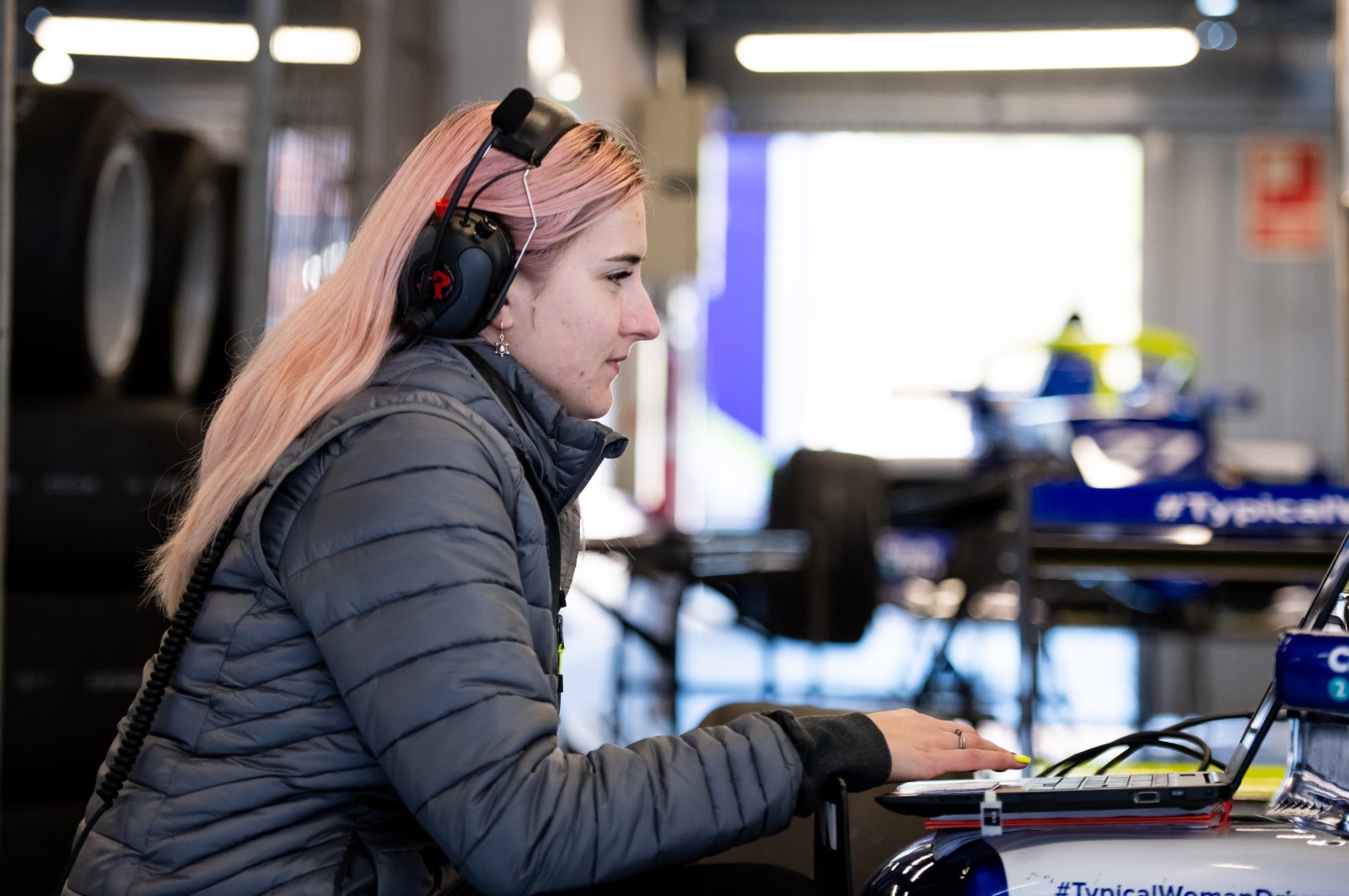
Phelps says even working with junior single-seaters the level of data available cannot be fully harnessed without using machine learning
Photo by: Lou Johnson
Tackling misconceptions, building trust
It’s fair to say that there remains a significant knowledge gap when it comes to artificial intelligence in wider society. That also applies to its best use cases, with Bertrand admitting he found it “a bit frustrating” that Mahindra was made to “look stupid on something where we thought we would maybe look smart”.
To Emeny-Smith, AI is at its most effective when there is “a problem or some margin of gain to make”, rather than treating it as “just a solution that’s going to make something generically better”.
“AI is a solution for a lot of very specific problems,” he explains. “What the wider industries and the wider general public are seeing is AI as a catch-all solution and it’s not. AI has meant many different things for years.
"It’s got to be fit for purpose. There’s no point trying to coordinate something that is going to cause negative impact, or even mistrust" Alan Patterson
“Like anything, you’re always going to build trust in something before you use it. There’s so many different areas that you can apply machine learning and AI to. But not everything is going to work.”
Building trust is a common theme whenever it comes up in discussion. “I’d be interested to see how long it will take for the AI to get to a place where everybody has confidence in it,” remarks 2009 Le Mans winner David Brabham, an interested observer at ASI’s Business Forum. “One day the driver turns up, he’s on it, the next time he’s not and that happens. So how does that AI understand that?”
At this juncture, it’s unclear how AI should be regulated in a way that avoids stifling innovation, and indeed whether enough knowledge exists to do so effectively. But a need for caution is recognised by Phelps, who said that its rollout “needs to be done on a small scale first and really proven, not just run away with things and surround us before we’re ready for it”.
Patterson agrees: “It’s got to be fit for purpose. There’s no point trying to coordinate something that is going to cause negative impact, or even mistrust. There’s a need to be able to trust the data, trust the system, trust those models to do what you want.”

Desire for trust meant Mahindra's AI influencer proved a misstep
Photo by: Mahindra Racing
Here to stay
There’s widespread confidence from industry experts that AI will go from strength to strength once it has earned the trust of users. The seminal moment from which there is no turning back is surely not far away, with the FIA also jumping on board to help staff with processing track limits violations.
“If AI is able to assist engineers and drivers with finding a quicker solution, you’re not going to stop them are you?” notes Brabham.
“We can all go back to pen and paper, but you quickly get beaten by someone using a laptop, right?” adds Takahashi. “This is effectively that next step.”
If, as expected, AI is here to stay, will increasingly developed machine learning only lead to a homogenised racing product that ceases to entertain, and inevitably results in a loss of interest?
“If there’s a ‘perfect’ solution, and AI is trained to find it, then everyone will find that solution,” Yorath asserts. “We live in a world that’s becoming more and more homogenous and AI is only going to hasten that.”
Whether he’s proven right will depend on how motorsport’s latest arms race plays out. Frith conceded that entirely replicating the human-machine interface in simulation is “far from a trivial task”. When it comes to modelling what a human would do, he said “there’s plenty of distance to go”.
Emeny-Smith agrees that “there’s a lot more to come” because AI is still “in its junior stages”. But while he doesn’t think engineers will be replaced by AI, he believes things are only going one way, and that engineers who don’t use the technology may in time be replaced by those who do.
“Motorsport is about innovating first and using that to your advantage,” he says. “And AI is being at the forefront of finding that at the moment.”

Accurately replicating the human-machine interface in simulation will take time
Photo by: Hitech Racing
What AI means for drivers
“It does everything else for us; it writes your social media posts, it does your emails, your photoshop images, but how do we make it applicable to us, to work in our industry? It’s fascinating and something that, because we don’t understand it, makes it more interesting.”
Tom Ingram’s presence among the audience at Autosport International’s Business Forum session on AI was notable as a sign that drivers are taking notice of its growing role in motorsport. In the case of the 2022 British Touring Car champion, machine learning isn’t just about improving performance – although that clearly is his biggest focus.
Ingram says that there’s a strong desire to “make it work for what we need to do with it, which fundamentally is how do we make the car go around a corner faster”, but also make the team work more effectively and improve his own driving.
"If we can start now to begin to work at it, then it means we can be a little bit ahead of the competition when it does come"
Tom Ingram
But knowing where to start isn’t easy. “How do we make everything work better and using lessons that are there, through technology, but not actually being put into action currently?” is the crux of what he wants to know.
Ingram says he’s not dissuaded by negative perceptions of AI “because we literally have zero use of it so far”. He reasons that if it has the potential to help him save money and go faster, it will be a worthwhile route to explore, because if he doesn’t jump on the bandwagon then others doing so may gain an edge.
“When it comes to being slightly easier to implement it, or more accessible or more cost-effective, if we’ve already done all of the behind-the-scenes work to make our data sets applicable to it, to make the data readable to the right people at the right times, we can then hit the ground running with it,” he says. “If we can start now to begin to work at it, then it means we can be a little bit ahead of the competition when it does come in a year, two years, 10 years or however long that may be.”

Ingram wants to explore how to make AI work for him both in and out of the car
Photo by: JEP / Motorsport Images
How A2RL is putting AI in action
“Over the past 12 months that Chat GPT has come out, people have put up their defences against AI,” said Dr Tom McCarthy on stage at ASI. The executive director of the ASPIRE company that is heading up the Abu Dhabi Autonomous Racing League views the grasp of generative AI as “one of humanity’s greatest challenges” in the coming years and hopes that his nascent racing series – known as A2RL – will “be able to make some minor contribution to bringing people along with understanding, while at the same time having a bit of fun”.
Driverless racing is nothing new, with the formative steps taken by the now dormant Roborace entity, followed up by the Indy Autonomous Challenge that has held events in North America and Europe using adapted Indy NXT cars. A2RL will go a step further by using Super Formula’s Dallara SF23, widely regarded as the closest performance level to Formula 1. McCarthy believes the choice of chassis “should be seen as epitomising our values” since it opens up opportunity for unfavourable comparison should the cars need to run significantly slower when operated autonomously.
The first race on 28 April will come just 15 months after McCarthy first met with Dallara.
“The world is about taking on almost impossible challenges and meeting them,” says McCarthy. “For any individual today, understanding what AI is and understanding what it can potentially mean in the future is a huge challenge, so we’ve got to say, ‘Hey, we’re not scared about these challenges.’”
McCarthy is clear that A2RL is “not trying to replace something like F1”, and believes there are significant safety improvements on the road that can result from a greater acceptance of AI “if they can sit alongside drivers comfortably and be adaptive”. He therefore welcomes the existence of other autonomous driving series on the market, and the possibility for more to follow, which he hopes will change consumer attitudes from pushing back against autonomous features to being more accepting of them.
“If nobody else was interested in doing this, I’d think I had a problem,” he adds.

McCarthy is full of optimism for the future of autonomous racing
Photo by: A2RL

Archive: When Le Mans made its most controversial change

The man behind Japan's first Le Mans winner

Did Audi ‘give up’ on GT3 too soon?

Alex Zanardi’s top 10 moments

This retro-inspired Mercedes 190E racer is heading to the Nurburgring 24 Hours

Why Verstappen's Nordschleife approach is a win-win for motorsport

The new Mercedes star who had an unconventional route to success

Why Rast is leaving the DTM

Evans: Late puncture was “harsh” but WRC title position is still "okay”

How Antonelli is proving unbeatable, even when he's beaten

F1 drivers push for Madring changes after "very poor" Spanish GP: "I almost fell asleep"

WRC Chile: Solberg seals victory as Toyota wraps up manufacturers’ crown
Subscribe and access Autosport.com with your ad-blocker.
From Formula 1 to MotoGP we report straight from the paddock because we love our sport, just like you. In order to keep delivering our expert journalism, our website uses advertising. Still, we want to give you the opportunity to enjoy an ad-free and tracker-free website and to continue using your adblocker.


Top Comments