
The merger that levels the junior single-seater playing field
The hideous chain of decisions that led to Formula Renault competing with Formula Regional for two years has been reversed. Now one massive grid of future stars is getting ready for F1 support action

It’s an outbreak of common sense. One team boss declares that “it’s more or less like the old Formula Opel Euroseries”. Another team manager enthuses that “it’s finally sorted that old crap out about the F1 superlicence points. It’s taken away a lot of confusion, given clarity and simplified it.” And a member of the combined series top brass says “there was a common will – it was obvious”.
This weekend, at the Emilia Romagna Grand Prix at Imola, there will be no FIA Formula 2 or F3. Instead, there will be the inaugural event for the newly merged, FIA-endorsed Formula Regional European Championship by Alpine. No fewer than 32 cars (at the time of writing) are expected on the grid. That’s a massive step forward from 2019-20, where the historic Formula Renault Eurocup and the ‘upstart’ Formula Regional European Championship sat uncomfortably alongside each other, using the same Tatuus Regional F3 chassis and diluting the marketplace.
In 2018, the FIA launched a tender process to operate its new-for-2019 Regional F3 series in Europe. Renault Sport had the history, the knowhow and the glamorous Monaco Grand Prix support date. Somehow, Italian body WSK, the promoter of Italian F4 and top-level karting, and with long support from the Ferrari Driver Academy, was given the nod. Spurned, Renault Sport decided to continue with its own renegade series anyway. The Renault Eurocup had the numbers, the quality of racing and more strength in depth, yet was always the poor relation when it came to the FIA’s F1 superlicence points.
“Even in 2019, I already started to discuss with my ex-boss, Cyril Abiteboul, if it was possible to merge the two championships, and we even started discussions – nothing really formal,” says Alpine Racing (formerly Renault Sport) commercial director Benoit Nogier. “After the COVID period in 2020 it became obvious to do it, and we started more advanced discussions with the ACI [the Italian federation under which WSK operates] to define whether we should do it.”
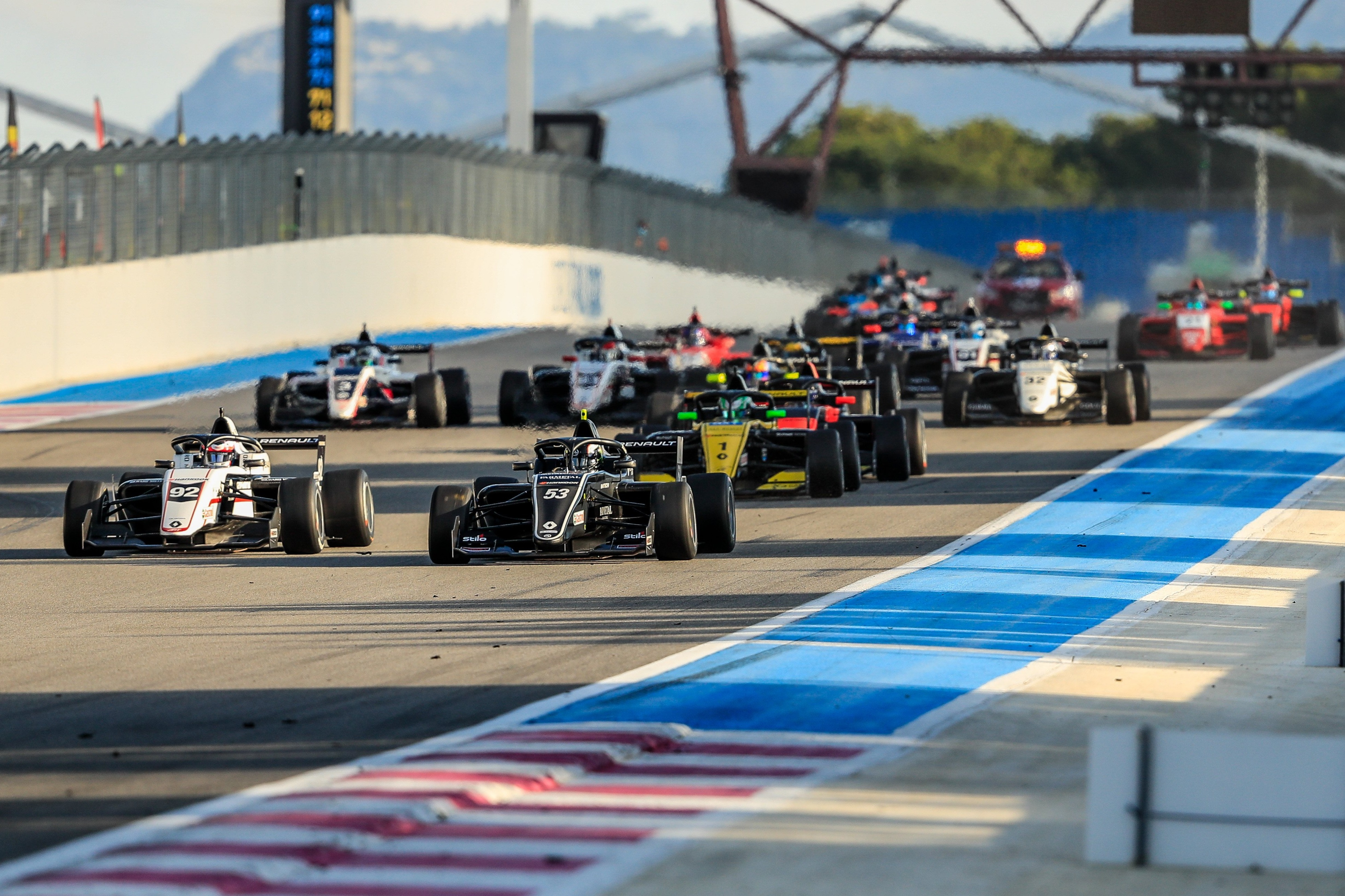
Formula Renault Eurocup 2020 Paul Ricard start
Photo by: Renault Sport
The upshot is that the Regional teams ditch their Autotecnica-built Alfa Romeo turbo engines for the Renault Megane RS unit; the Renault teams swap their old Hankook tyres for the Regional Pirellis. And it operates under the Alpine name in line with Renault’s rebranding of its sporting activities from F1 down. The advantages are obvious, continues Nogier.
“It’s definitely to have a foot in the FIA system,” he explains. “It’s a long story between the FIA and Renault regarding the single-seater championships. Renault always had its own system and the FIA created something else, and I think it was time to stop this two-part world and to work together in the same world. It’s a definite advantage for us to merge the two championships, to be an official series of the FIA, to work together with the FIA and not against.”
Not only is the grid huge, but the calibre is high too. Of those 30-plus drivers, 22 of them have scored a combined total of 114 race wins in FIA-approved F4 competition. On the teams side, it brings yet another face-off between Prema Powerteam (the FRegional dominator) and ART Grand Prix (which carried Victor Martins to the Renault crown last year, its first back in the series).
Add in strong Renault regulars in the forms of R-ace GP, Arden International, MP Motorsport and JD Motorsport, and occasional Prema beaters Van Amersfoort Racing, KIC Motorsport and DR Formula from Regional. And the first three rounds support F1 grands prix: after Imola come Barcelona and Monaco. No wonder VAR boss Frits van Amersfoort made that Formula Opel remark, referring to the old F1-supporting series in which his team came to prominence when it ran Jos Verstappen in 1992.
"Personally, I can’t see how it can go on being run as a joint venture. You know what happens in all these sorts of situations – eventually one will end up running the whole lot. I just hope it’s the Renault side" Ben Salter
The manufacturer support is critical. Over the past 50 years, no car maker has done more to support young talent than Renault. Arden team manager Ben Salter, who has worked in FRenault since 2012, initially with Fortec Motorsport, hopes that can continue.
“They’ve done a fantastic job for young drivers,” he asserts. “You’ve only got to look at them now – they’ve got Collet, Piastri, Zhou, Lundgaard, Martins [in their academy]. That’s five drivers in F3 and F2.”
Oscar Piastri and Martins were both promoted to the Renault (now Alpine) F1 academy thanks to success in the manufacturer’s Eurocup and, says Nogier, that will continue into the new era.
PLUS: Why Alpine faces the same junior problem as Ferrari
“We kept it exactly the same,” he says. “The winner of the championship will have the opportunity to enter the academy and, if he decides to go with the Alpine academy, we will support him financially a bit more than if he chooses to go alone.”
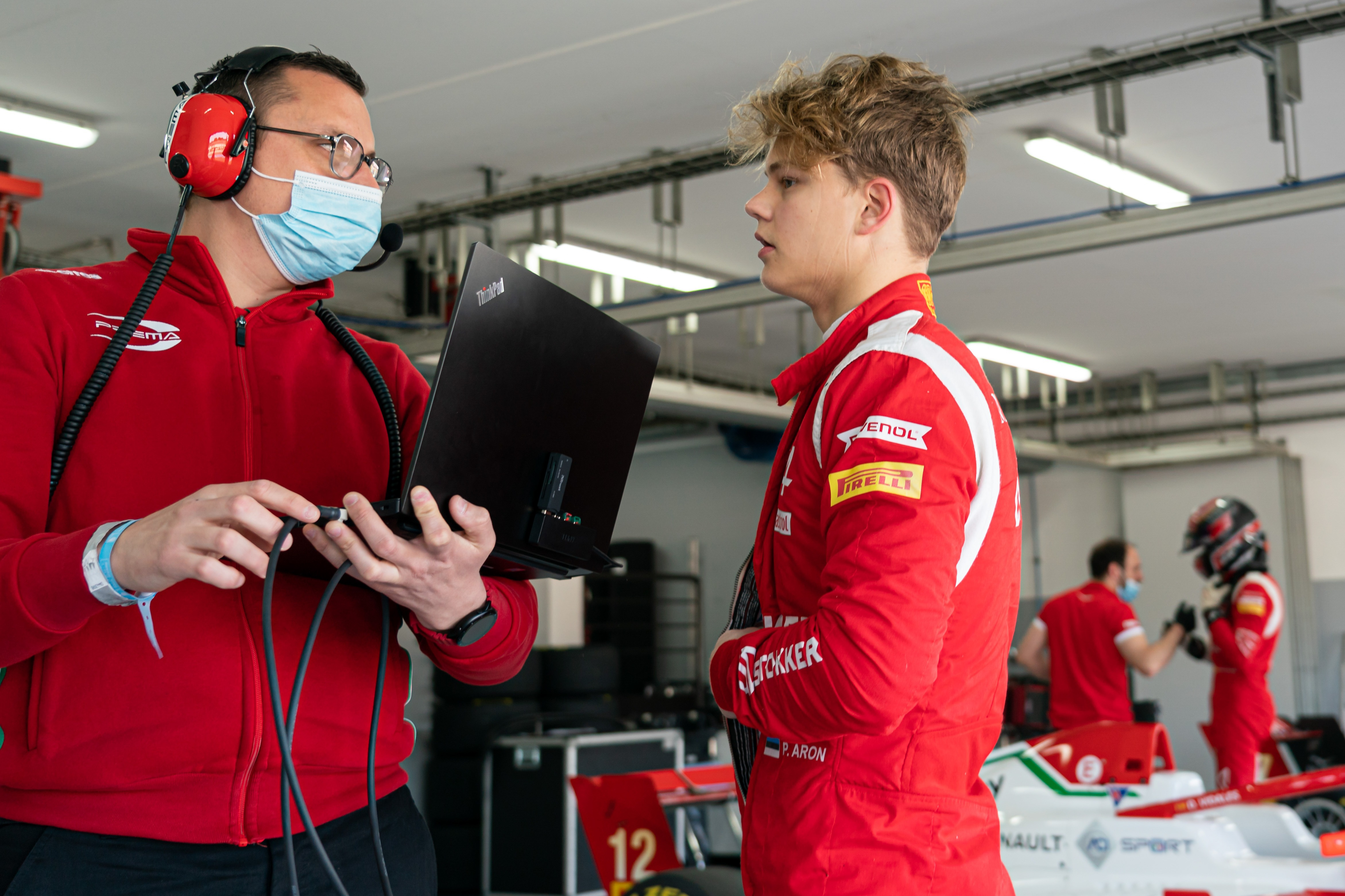
Paul Aron, Prema
Photo by: Formula Regional by Alpine
The organisation of the championship is a direct fifty-fifty split, with former Renault Eurocup coordinator Pascal Eyraud continuing in the role alongside his opposite Regional number, Valerio Iachizzi.
“Valerio and Pascal are in contact with the teams, and they work really close together,” says Nogier. “After that, regarding the different responsibilities, I would say the regulations and communications are from the ACI side, and logically we are in charge of the technical aspect, and providing the parts for the cars and the service.”
Such a compromise can bring concerns, with Salter pointing out: “I think at the moment everybody’s finding their feet with it all. Personally, I can’t see how it can go on being run as a joint venture. You know what happens in all these sorts of situations – eventually one will end up running the whole lot. I just hope it’s the Renault side.”
Van Amersfoort, whose team spent the first decade of the 2000s under the Renault umbrella in the Dutch championship and then the Northern European Cup, says: “Pascal and Valerio do a very good job. Sometimes you nearly switch off your app, because they keep sending information left and right! I must say it’s really fantastically organised.”
The merger hasn’t been without teething problems. One was born out of the 2020 FRegional season finishing three weeks after FRenault.
“The whole transfer went a bit awkward,” reveals van Amersfoort, who is running three rookie graduates from F4 this season. “They knew it was going to change, but they still had a rookie test [a tradition in FRenault Eurocup] at Paul Ricard where we were not invited, which was for us not a problem, but they didn’t run the Hankook anymore [instead running the Pirelli tyres], so they ran the cars in the spec that we are running in now, and it felt a bit like a knife in the back.
“These guys were testing new guys, juniors for the next year, and we can’t test because we still have an event to go. That felt really a bit shitty, but now it’s all done and we shouldn’t complain, but at the time we felt we were the second fiddle.
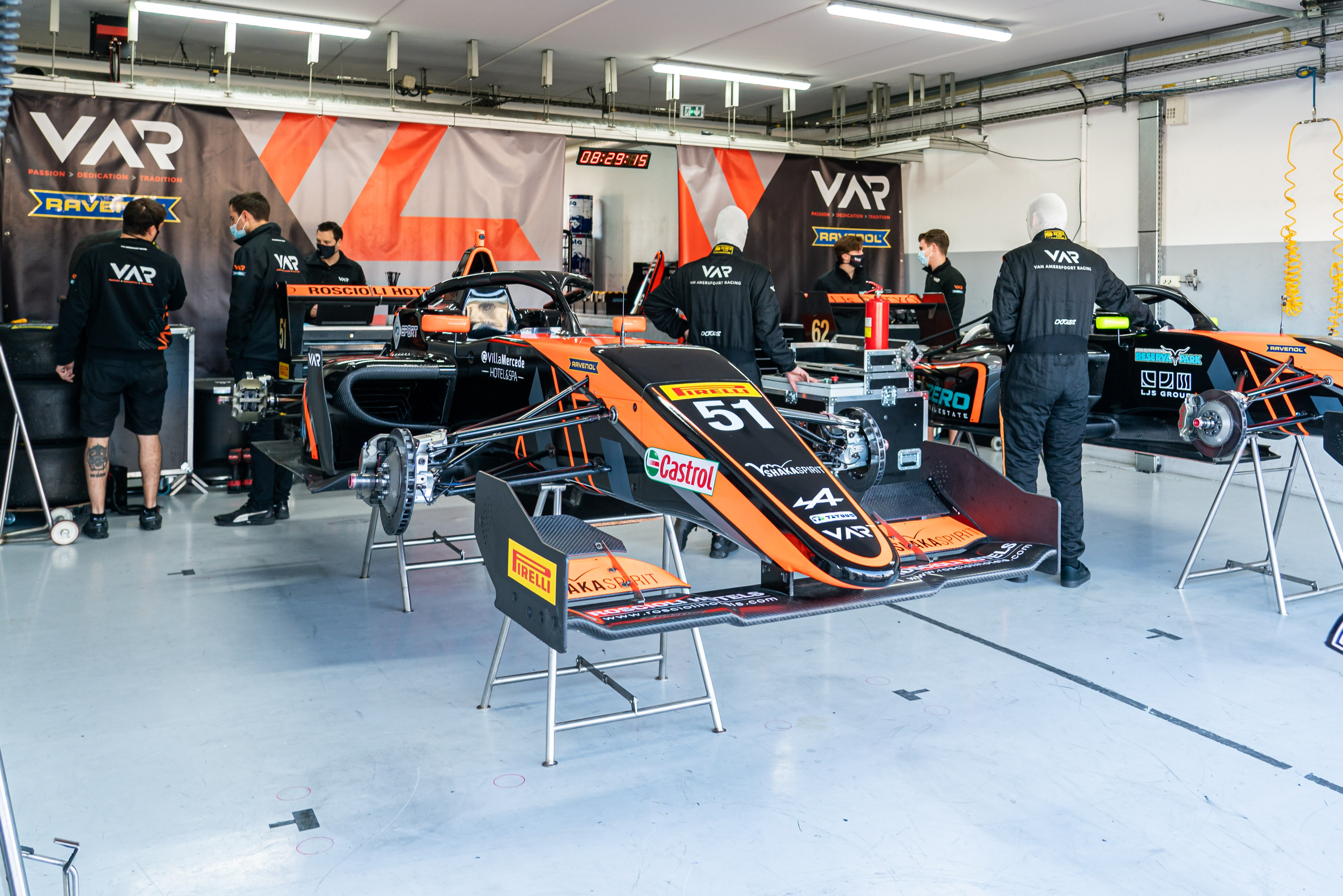
Van Amersfoort Racing garage
Photo by: Formula Regional by Alpine
“And then, after the season, we wanted to test too, but there was no time to change the car to the Renault engine, so we had to do our winter testing with the Alfa. Of course that felt a bit funny, because we saw all the other teams running their Renault-spec cars with the Pirelli tyres, and we were still on the Alfa. And then we also had some trouble in getting tyres, because the Renault teams had ended their season earlier, so they ordered a lot of tyres and when we wanted to order they were out [of stock].”
Those Renault teams will claim they needed that extra time to adapt to the characteristics of the Pirelli. Unlike the F1/F2/F3 tyres produced by the Italian firm, the Regional rubber is, says Salter, “more like the old Michelins we used to race on [in Renault’s pre-2019 era]. You’d get a good peak out of them for qualifying, and it was important to get on the tyre at the peak, and then it stays relatively consistent over a race distance. The Hankook was almost too durable, but the Pirelli seems a good tyre.
“The Regional teams switching to the Renault engine and the Renault teams switching to the Pirelli tyre has been the compromise in it all, if you like. But I think learning the tyre is everything – there’s more work in that than there is in learning the engine, that’s for sure. At the end of the day, the engine is the engine. You stick it in the back, work out where the power is, and you change gear at that point and off you go. But obviously with tyres you’ve got camber, pressures, springs, there’s a lot more going on with it.”
"We had regular electronic problems with the Alfa. There seems to be less with the Renault. But the Alfa engine looks much sexier than the Renault" Frits van Amersfoort
Van Amersfoort is happy that the Renault engine is a more solid piece of hardware than the Alfa the Regional teams are waving goodbye to.
“The good thing is that it seems the electronics of the Renault engine are stronger than the electronics of the Alfa, and I think that’s a little bit of an advantage,” he says. “With the Alfa engine, and this had nothing to do with Autotecnica [which also builds the Abarth powerplants used in German, Italian and Spanish F4], it was just the complete package and we had regular electronic problems with the Alfa. There seems to be less with the Renault. But the Alfa engine looks much sexier than the Renault. The Renault engine looks terrible, because it’s cast iron, and the Alfa engine had a nice red camshaft cover.”
Neither the Renault nor Regional series were polluted by reversed grids, and the very pure Renault sporting format of two races per weekend, with a qualifying session for each, has been retained going into the new era. Two sets of Pirelli tyres are available to each car once qualifying begins on a race weekend, so the usual strategy will be one set for first qualifying/first race on Saturdays, and the other for the second qualifying/second race on Sundays, with the proviso that the format is tweaked a little at the F1 supports due to timetable constraints.
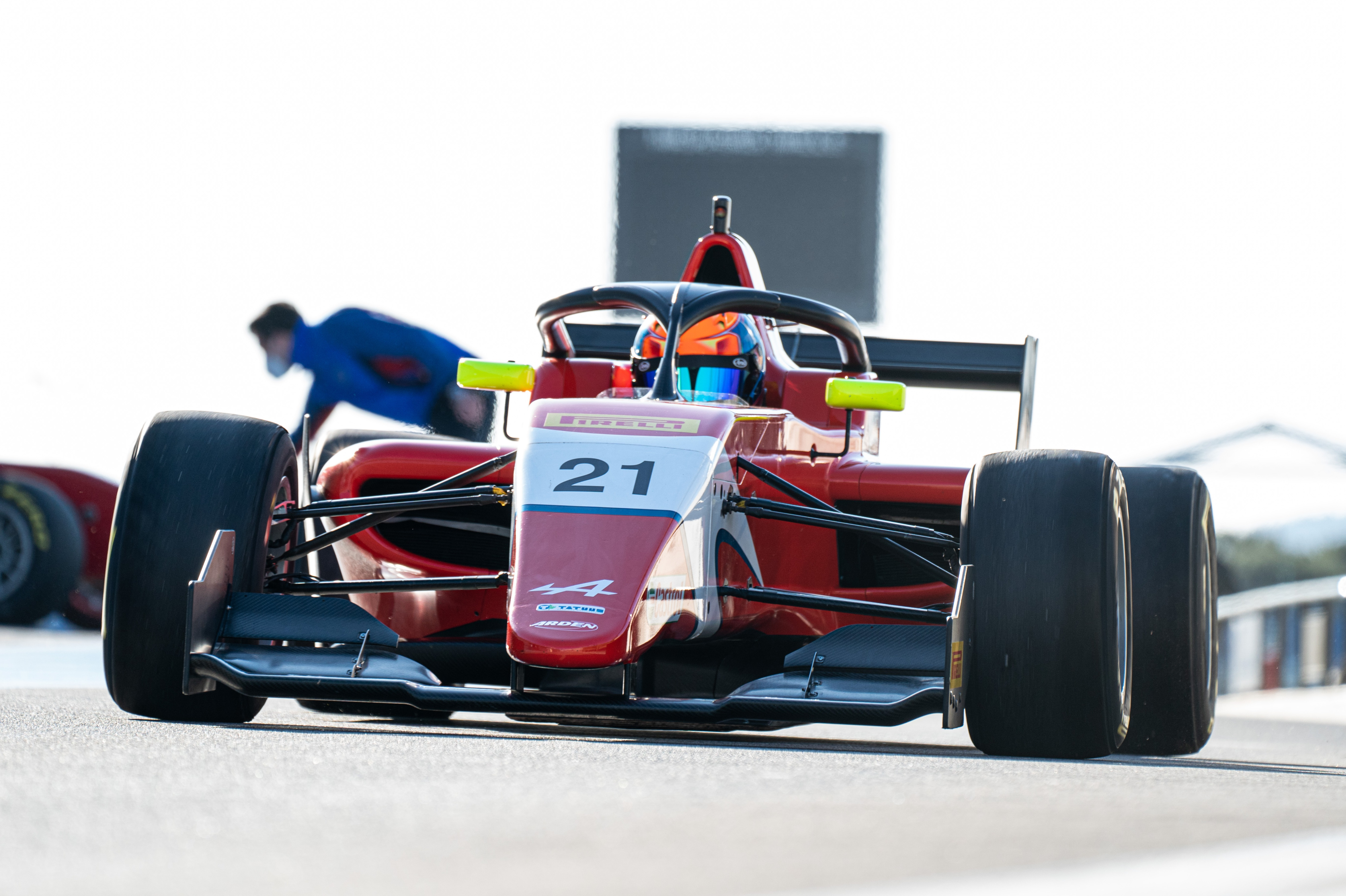
Alex Quinn, Arden
Photo by: Formula Regional by Alpine
“If you qualify bad on Saturday and race bad, you can then reset, refresh and go again on the Sunday,” says Salter, who will oversee leading second-year Renault racers Alex Quinn and William Alatalo at Arden.
“Generally we qualify-race, qualify-race. For a junior-level young driver that helps with the learning. Certainly, when you get to F3, if you have a bad qualifying that’s the weekend dead. At least with us, if you have one bad qualifying you can reset and go again. Even at Imola [this weekend], where we’ve got qualifying-qualifying, race-race, you’ve still got the opportunity to do another qualifying. In F3 and F2, you can have a problem outside of anybody’s control – the driver’s and team’s – and it screws the weekend.”
Once the F1 supports are out of the way, it’s off to Paul Ricard, Zandvoort, Nurburgring, Spa (probably), Red Bull Ring, Mugello and Monza, sharing the card with a smorgasbord of GT championships in a very attractive calendar. It’s been a huge draw for drivers, and that’s vital for the teams that have businesses to run, and their staff who have mortgages to pay.
“Basically it was a nightmare for two years,” says van Amersfoort of the old FRegional. “We lost a lot of money on that championship. The first year Prema was driving circles around us, and the races looked really terrible. Last year it was a bit better. We contracted Pierre-Louis Chovet for it, and in the end we put Dennis Hauger in to bring some extra competitiveness to the team. That paid off, but it wasn’t a successful two years. We never felt that the championship came alive. But I’m happy now to have three drivers, all rookies. So it will be a hard season with 32 cars, but we love to see that because we all love racing.”
“It’s fantastic,” echoes Salter. “We kick the season off at Imola with the only support race; Barcelona we’ll be there with F3; and for the other F1 support race at Monaco we’ll be there with F2. For the drivers it gives them a bit of an insight into the next step, and how F1 teams are. It’s a real shot in the arm for the championship and the drivers.”
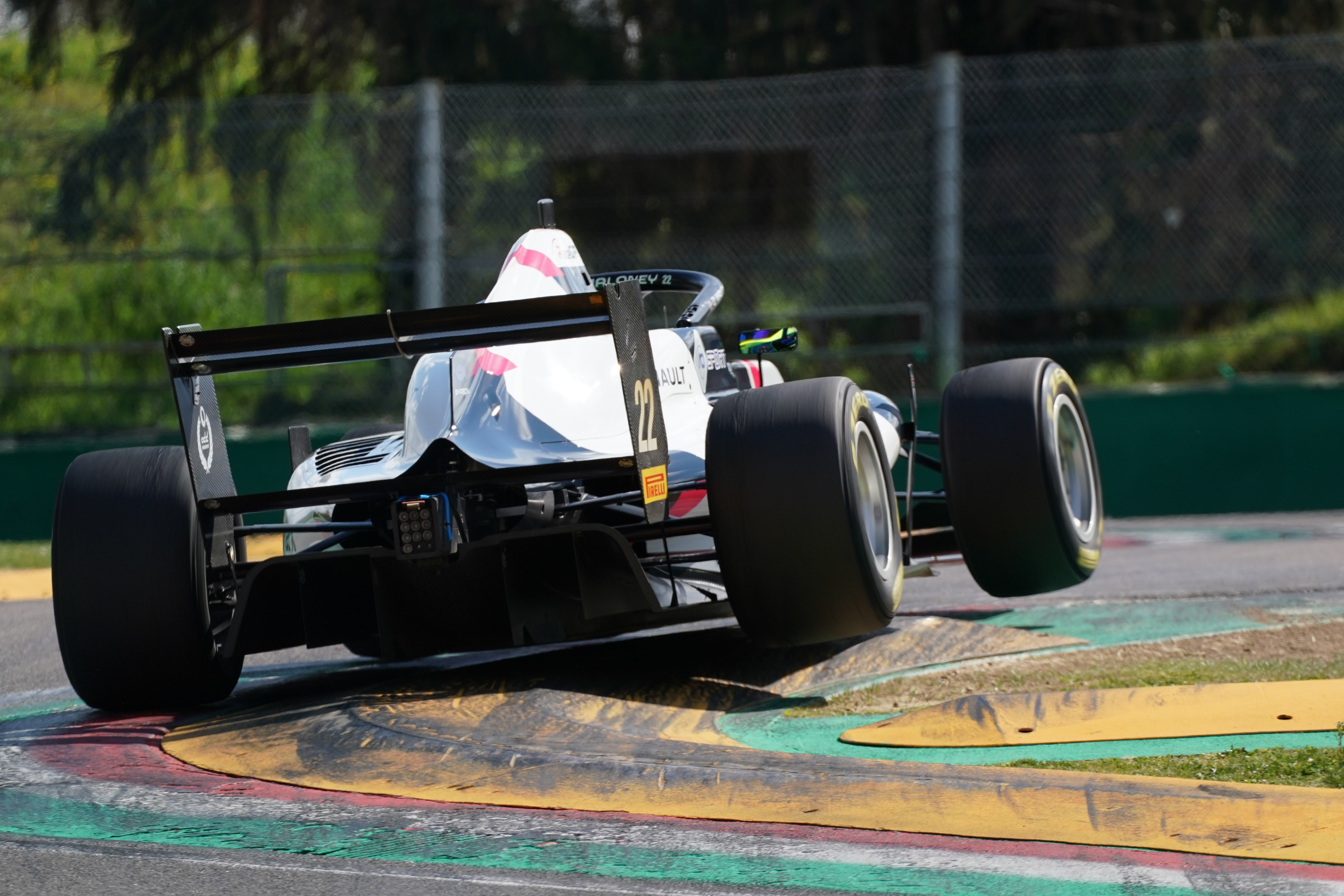
Zane Maloney, R-ace GP
Photo by: Formula Regional by Alpine


Kay keeps two-wins advantage with Elan spirit in Autosport National Rankings

Why the contentious regulations were a talking point again in BTCC's visit to Thruxton

How Sutton scorched rivals to extend BTCC lead at Thruxton

BTCC Thruxton: Ingram wins race three despite penalty to cut into Sutton’s lead

BTCC Thruxton: Sutton takes victory in race two after investigation

BTCC Thruxton: Cook holds off Sutton for opener win

BTCC Thruxton: Cook rustles up a tasty qualifying race win

BTCC Thruxton: Proctor substitutes for unwell Osborne, Smiley tops practice

MotoGP plans Austin showcase during F1 US GP

The shocking aspect to Antonelli's rapid F1 title-contending transformation

Kay keeps two-wins advantage with Elan spirit in Autosport National Rankings

"We don't want to put tape on anyone's mouth" – F1 boss reacts to driver criticism of 2026 rules
Subscribe and access Autosport.com with your ad-blocker.
From Formula 1 to MotoGP we report straight from the paddock because we love our sport, just like you. In order to keep delivering our expert journalism, our website uses advertising. Still, we want to give you the opportunity to enjoy an ad-free and tracker-free website and to continue using your adblocker.


Top Comments