
The Monaco win that started another triple crown
30 years ago, victory in the Monaco Grand Prix-supporting Formula 3 race – then a showpiece invitational event – began a young Jorg Muller’s pursuit of a unique set of street circuit wins that he’d later complete at Macau and Pau

Despite Fernando Alonso’s best efforts to crack the Indianapolis 500 in recent years, Graham Hill remains the only driver ever to have completed motorsport’s official triple crown. Known as Mr Monaco, Hill claimed no fewer than five Grand Prix victories in the principality between 1963 and 1969, added the Indy 500 at his first attempt in 1966 before completing the set with glory in the 1972 Le Mans 24 Hours.
But while it may not be the best-known, there is another triple crown which has a similarly exclusive membership club of one. Made up of the big three street circuit races below Formula 1 – the Macau and Pau Grands Prix, plus Monaco (which held an invitational Grand Prix for Formula 3 cars between 1964 and 1997) – an illustrious list of drivers have won two out of three.
Patrick Depailler, Jacques Laffite, Bruno Giacomelli and Yannick Dalmas each won the hallowed streets of Monaco and Pau on their rise through the ranks (of the quartet, only Dalmas raced at Macau, which didn’t become an F3 grand slam until 1983). Geoff Lees (twice) and Roberto Moreno claimed honours in Macau during its spell as a race for Formula Pacific before winning at Pau - an event for Formula 2/Formula 3000 machines in all but four years between 1957 and 1998 when it staged non-championship F1 races. In 1988, Enrico Bertaggia conquered both the Monaco and Macau invitationals, but could never reach those heights at Pau in F3000.
When Jorg Muller made his bow at Monaco in 1990, he didn’t appear a likely candidate to even enter the discussion, let alone become the first man to win all three. In sodden conditions that allowed poleman Laurent Aiello to streak clear of the field and get acquainted with champagne, the 1989 German Opel Lotus champion’s Bongers Reynard was busy getting acquainted with the barriers.
“Jorg Muller was on the warpath,” reported Autosport. “After three laps, he had elevated himself from 20th to seventh. A lap later, he was sixth. Then he sailed off at Mirabeau, and reduced his chances further with a rearwards collision at Piscine on his recovery.”
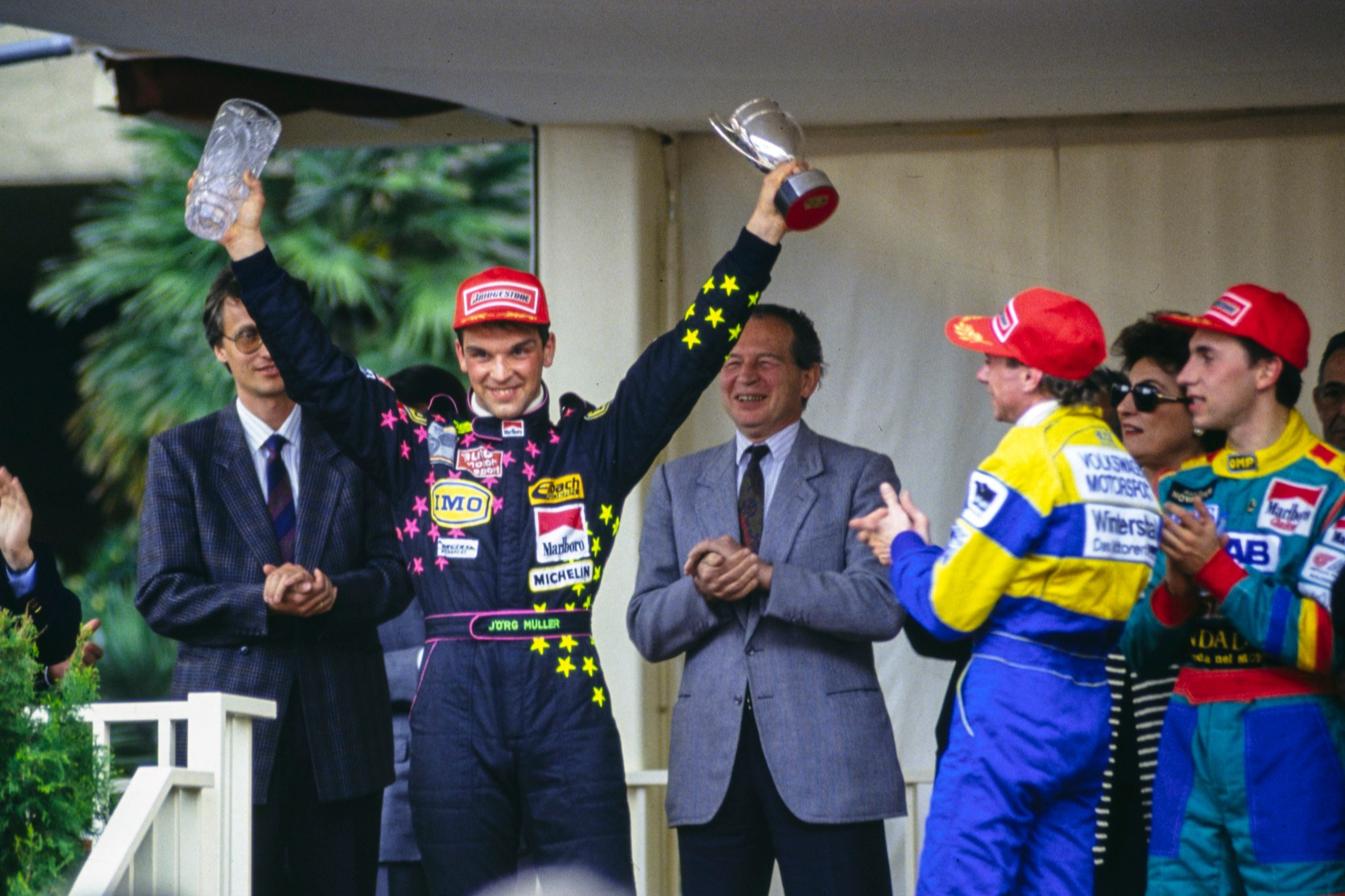
Jorg Muller celebrates victory in the 1991 Monaco F3 GP support race
Photo by: Motorsport Images
Yet the following year he triumphed by a whopping 23 seconds and began a remarkable quest that he’d follow by winning the 1993 Macau Grand Prix, and the 1996 Pau F3000 race – both with Helmut Marko’s RSM team – on his way to that year’s title. So what was it like to complete the set?
“The most surprising definitely was Monaco,” says Muller, “the biggest in my heart is Macau and the hardest was Pau!”
Street circuits are the ultimate test of a driver’s speed and accuracy, and in this area Muller excelled - a point he underlined by winning twice more at Macau in touring cars with BMW after spells as an F1 test driver with Arrows and Sauber, then as the test hack for BMW’s engine programme with Williams.
“I love street circuits because you’ve got to be very precise and you’ve got to understand your car and that’s something which fell into my hands all the time,” he says.
"We put our standard rain tyres on it, I pushed like hell and I was fourth on the grid. All of a sudden all of the tyre manufacturers were in our tent and wanted to give us tyres!" Jorg Muller
At the behest of his main backer, the ONS – now the DMSB, Germany’s motorsport authority, which before him had supported Michael Schumacher and Heinz-Harald Frentzen – Muller had been placed at Bongers for the 1990 German F3 championship. But as the only driver for the team which had only been a sporadic winner since delivering the 1984 German F3 crown for Kurt Thiim, Muller found the going tough and reckons success on the streets first time out was never a realistic possibility.
But 1991 was a different story - despite the fact he had still yet to win a German F3 race - due to a turn in the weather that allowed him to exhibit “his unusual flair and undoubted bravery”, as Autosport’s report noted.
Teams were permitted a free tyre choice for Monaco, where the major suppliers brought special rubber to the event, but not everybody had access to them. Among the ‘have nots’ was Muller, one of only four Reynards in a field of Ralt and Dallara machines, who turned up with the same Michelins used by Bongers in the German championship after a late decision to accept his invitation.
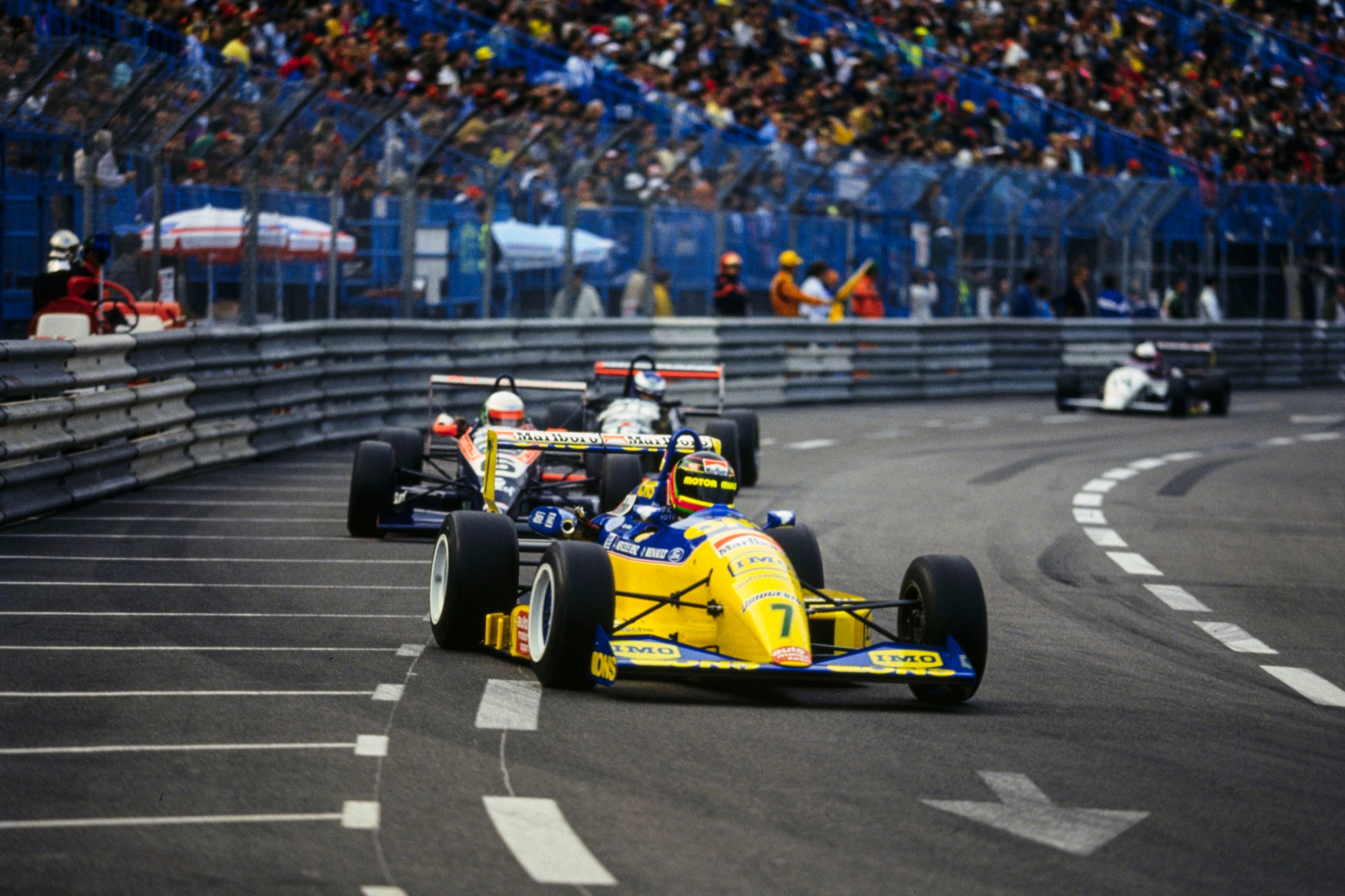
Jorg Muller, 1991 Monaco F3 GP
Photo by: Motorsport Images
“We weren’t really sure if we should go there because we didn’t have the big budget to do it,” he recalls, “but somehow we found the budget and all of a sudden the qualifying went great.
“It was damp, so it was more like a driver’s situation. We put our standard rain tyres on it, I pushed like hell and I was fourth on the grid. All of a sudden all of the tyre manufacturers were in our tent and wanted to give us tyres!”
His father had known Bridgestone motorsport bigwig Kees Van der Grint since the karting days, which explains Muller’s decision to go with the Japanese rubber for the race.
“We took out the standard Reynard set-up sheet, set-up our car on these Bridgestone tyres and off we went,” Muller continues. “I was flying. It was a good, fun race, I tell you.”
He made a good start to pass Jacques Villeneuve into third at Mirabeau, then took Max Angelelli for second at the chicane. He chased after poleman Klaus Panchryz in the factory VW Ralt and once through, ran away and hid.
“It was not a classic race. Yet it will be remembered as the day on which Jorg Muller turned from a flawed gem into a real shining light,” wrote Autosport.
Graciously, Muller says the tyres were the key factor in the outcome.
“It was the tyre, definitely,” he says. “In Germany we had a lot of races where the Ralt won, I thought always that was the better chassis for slower speed stuff. But Bridgestone had the best tyre at the time. To win a race with nearly all the cars the same like Formula 3 and pull away by 23 seconds, I think I’m a talent but I think I’m not that talented! This is something which is impossible to be honest, so it must have been the material.”
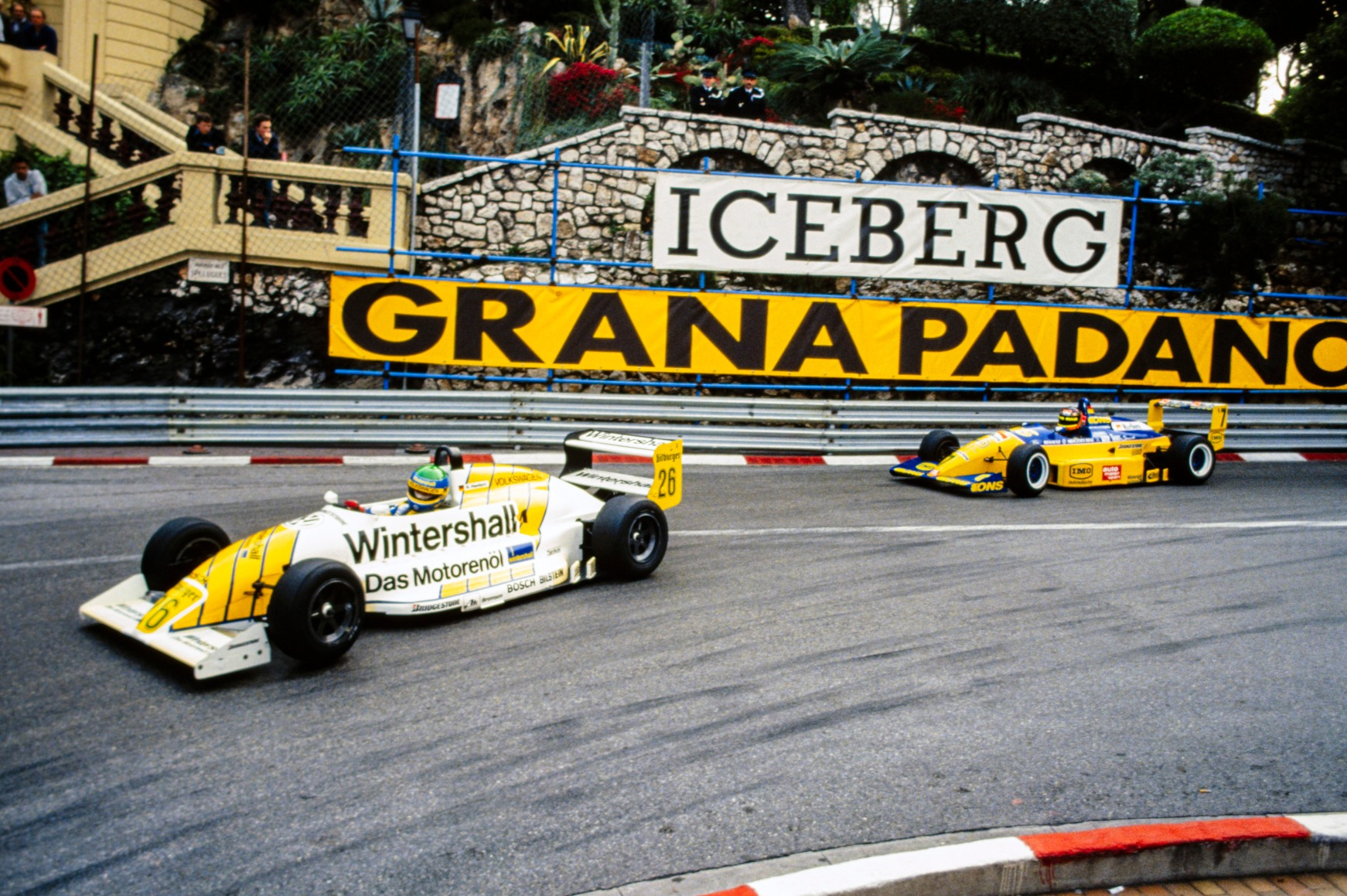
Jorg Muller chases after Klaus Panchryz in the early stages of the 1991 Monaco F3 GP
Photo by: Motorsport Images
Muller recalls being approached after the race by 1982 world champion Keke Rosberg to join him on his boat that evening - “I don’t know what about, probably he wanted to have a management thing, and I decided to stay with the team and drink beers”.
He relished the atmosphere in Malte Bongers’ team that he describes as “like my second family” and after making his Macau debut at the end of 1991 - hampered by a tangle with Masami Kageyama, he finished 13th - stayed for a third year in 1992.
But with hindsight, this was a mistake. Having finished fifth in the 1990 German F3 standings and improved to fourth in 1991, he slid to seventh in 1992 and even failed to qualify at Monaco, which he puts down to “a combination of lots of things”.
“I loved my team manager, I loved the mechanics and I really enjoyed the time with them,” says Muller. “But at that time I should have looked at, ‘Where is the best performance?’ As I just enjoyed driving and I always saw motorsport as my hobby, I stayed with the team. I did a few mistakes in my career and that was probably one. I should have changed the team really.”
At the start of 1993, Muller was out of a drive and working as a mechanic for Bongers, but found a lifeline in Marko, whose team had run Karl Wendlinger to the 1989 German F3 title. A mid-season return to F3 yielded a win at Diepholz, but gave little indication of the manner in which he’d dominate at Macau – having dropped out the previous year with throttle cable problems.
"We didn’t change anything on the car the whole weekend because it was like we were welded together, the car and me were one piece. I didn’t have to think about one thing of when to shift or whatever, I just had to concentrate on the circuit" Jorg Muller
Annexing pole position, he was never headed in either of the heats, with Sascha Maassen the only man who could live with him in race one, before making a mistake trying to keep up in race two. As Autosport put it: “Muller won this race in the first two laps. On cold tyres he was sensational”.
“We were fine-tuning the car like you wouldn’t believe, we put such a lot of effort into it,” says Muller, who reckons this gave him a psychological edge. “It was like I got to Macau and ‘I have the best car in the world, no-one can beat me’.
“We didn’t change anything on the car the whole weekend because it was like we were welded together, the car and me were one piece. I didn’t have to think about one thing of when to shift or whatever, I just had to concentrate on the circuit.”
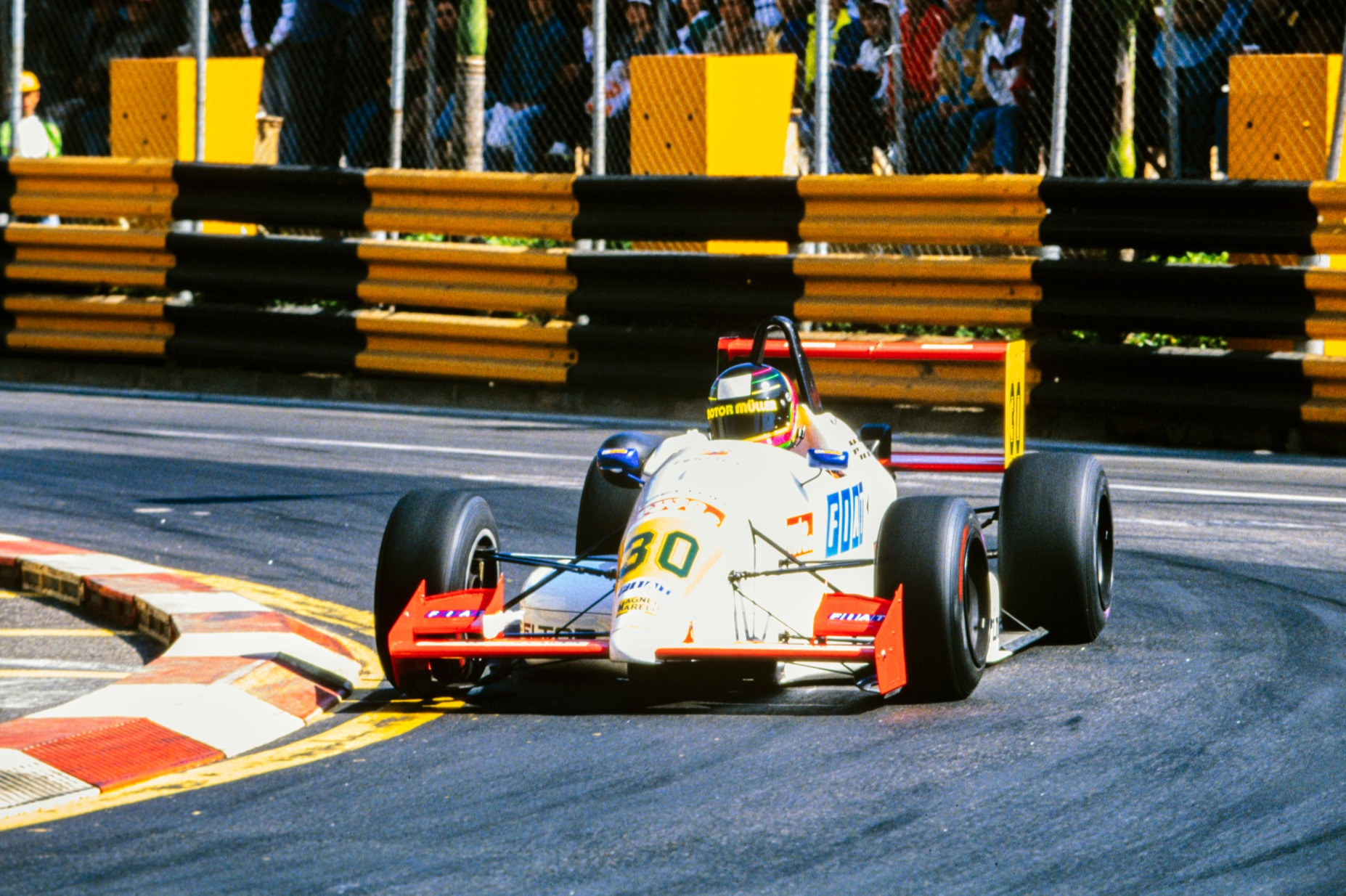
Jorg Muller 1993 Macau GP
Photo by: Motorsport Images
Muller made his experience count and won the German F3 title at a canter in 1994, and almost claimed a second Monaco win – having been forced to skip the 1993 event. Running second for most of the race behind Giancarlo Fisichella, Muller “had this place where I was sure I could take him two laps before the end” – but reckoned without Maassen ambushing him at Mirabeau to thwart any hope of victory.
“I was so pissed off!” says Muller, who then punted Maassen into a half-spin at the Rascasse to reclaim the place on the final lap, prompting afters from his rivals on the slowing down lap. “I think I could have won it a second time, but that’s racing.”
His F3 career ended in disappointment when engine woes struck at Macau, allowing Maassen to claim victory – despite not winning either heat due to the aggregate format of the day – as race one winner Fisichella crashed out trying to pass Kelvin Burt. Jan Magnussen crowned a memorable comeback from 18th on the grid for race one by charging to heat two victory.
Then followed a career sidestep, as Muller spent 1995 in the employ of BMW doing the German Super Touring championship (STW), having decided together with Marko to defer their entry to F3000 by a year until the formula’s new spec car was introduced for 1996.
The decision paid off handsomely and he found the more powerful Lola immediately to his liking. After placing second behind expected title favourite Kenny Brack’s Super Nova machine at the Nurburgring, Muller’s almost completely white Lola was in prime position to capitalise at Pau when poleman Tom Kristensen was caught out by the lights sequence.
Despite pressure all the way from Brack, Muller was unwavering and together they lapped the entire field, including third-placed Ricardo Zonta. The watching David Sears was moved to remark that the rest “must have been out for a Sunday drive”, not that it mattered much to Muller.
“It was tough,” he recalls. “I mean, 200kms, no fuel stop, in this big heavy car flying through the armcos in Pau – I was completely done after that!”
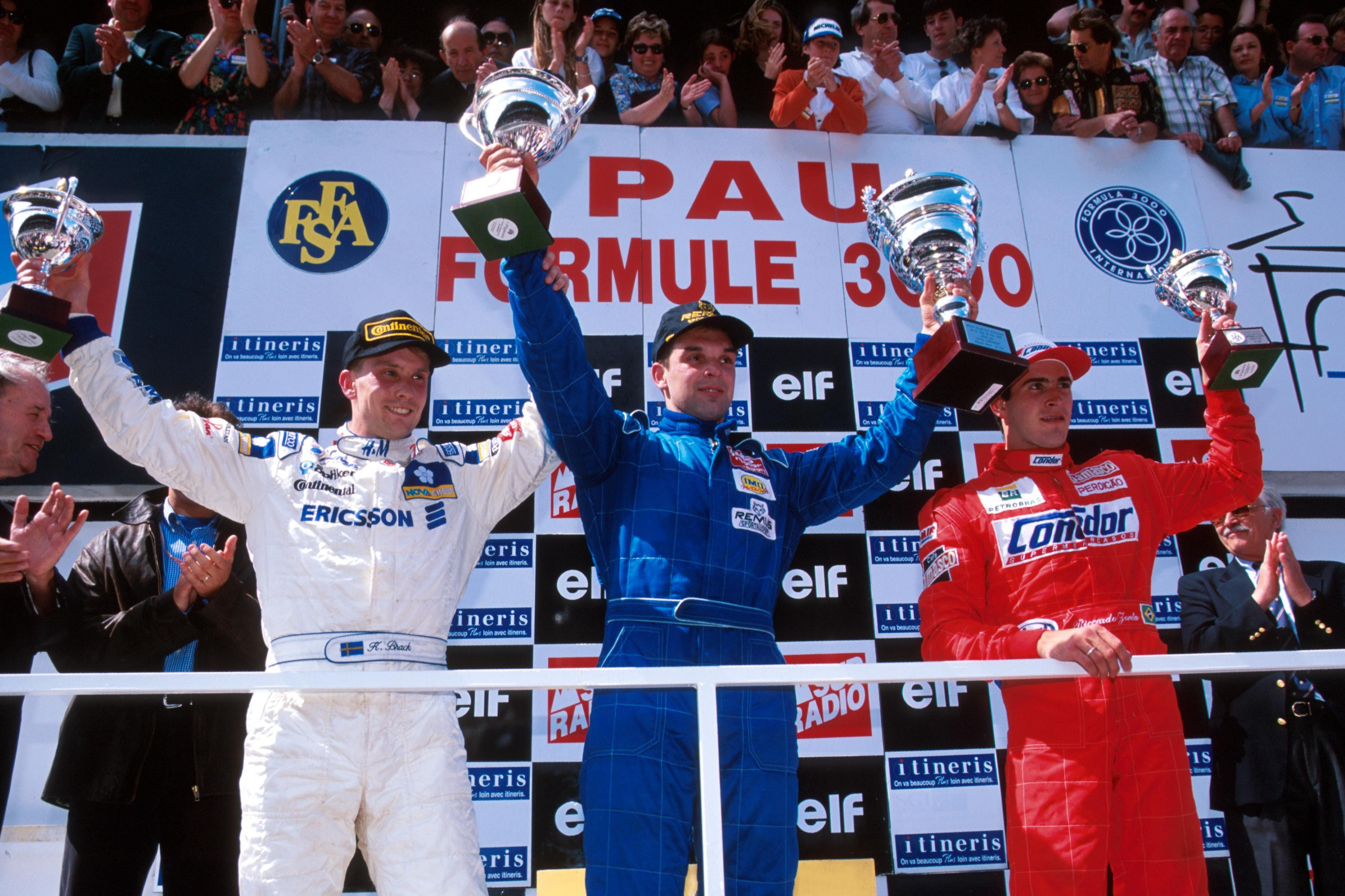
Jorg Muller flanked on the podium after winning the 1996 Pau F3000 race by Kenny Brack and Ricardo Zonta
Photo by: Motorsport Images
Muller reckons that Pau being part of the poorly-promoted F3000 championship, rather than a standalone event like Monaco and Macau, means it’s rarely remembered in the same breath.
“But I was happy to go there because I loved street circuits and it was the team I did Formula 3 with,” he says. “A circuit which I love which has a lot of armcos, who could beat me?”
After Pau became an F3 race in 1999, Nicolas Lapierre and Felix Rosenqvist managed Macau/Pau doubles, while Lewis Hamilton won Pau and Monaco when both formed rounds of the F3 Euroseries in 2005.
But unless Macau makes a surprise appearance on the F1 calendar before Hamilton calls it a day, it doesn’t appear likely that Muller’s exclusive feat will be matched any time soon...
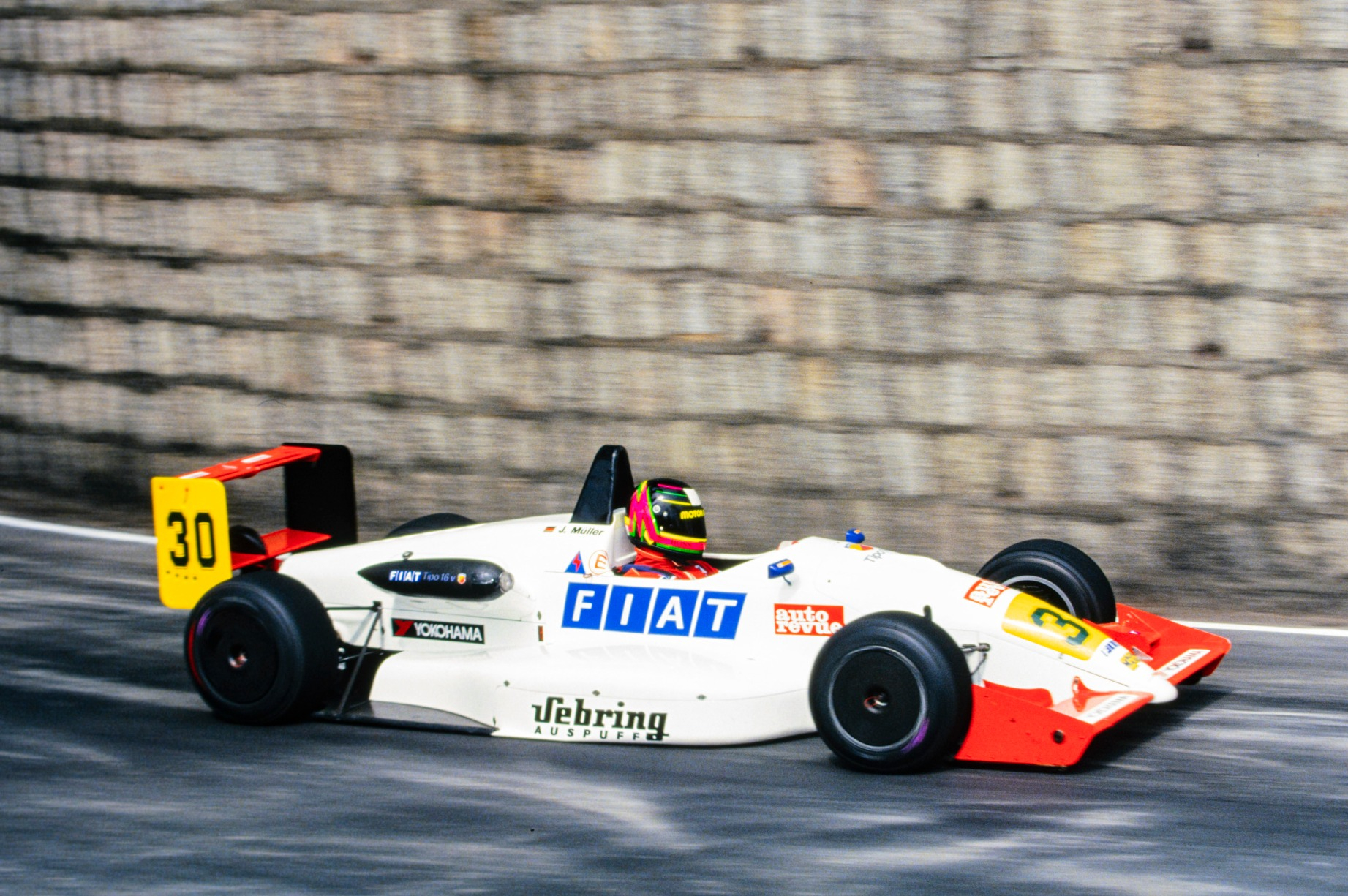
Jorg Muller 1993 Macau GP
Photo by: Motorsport Images

Archive: When Le Mans made its most controversial change

The man behind Japan's first Le Mans winner

Did Audi ‘give up’ on GT3 too soon?

Alex Zanardi’s top 10 moments

This retro-inspired Mercedes 190E racer is heading to the Nurburgring 24 Hours

Why Verstappen's Nordschleife approach is a win-win for motorsport

The new Mercedes star who had an unconventional route to success

Why Rast is leaving the DTM

WRC Acropolis Rally Greece: Neuville has “no choice” but to take more risks to win

Red Bull apologises to Max Verstappen after technical issue caused F1 qualifying crash

WRC Acropolis Rally Greece: Neuville and Ogier set for Sunday showdown

Why Antonelli aborted his fastest lap in Austrian GP qualifying
Subscribe and access Autosport.com with your ad-blocker.
From Formula 1 to MotoGP we report straight from the paddock because we love our sport, just like you. In order to keep delivering our expert journalism, our website uses advertising. Still, we want to give you the opportunity to enjoy an ad-free and tracker-free website and to continue using your adblocker.


Top Comments