


Why the FIA must not bury its head in the sand over Abu Dhabi F1 fallout
Despite the controversial end to 2021's Formula 1 season finale in Abu Dhabi, the FIA backed race director Michael Masi's actions - which ultimately yielded a first world title for Max Verstappen. However, with even Red Bull upset about stewarding inconsistencies, the FIA must be proactive and improve how it runs races

While Formula 1 race director Michael Masi’s decision to clear the lapped cars and hurry the safety car restart in Abu Dhabi was key to helping Max Verstappen win the title in Abu Dhabi, it was quite telling that even Red Bull has joined the voices calling for changes to be made in the way grand prix races are run.
While suggestions of manipulation to favour one team over another are nonsense – with both Mercedes and Red Bull feeling hard done by at various points this season – what is of concern is that there are more and more apparent inconsistencies with the way decisions are made.
The controversies that F1 has faced over track limits, and the recent confusion over racing rules and driving etiquette, meant that the U-turn about what lapped cars could do on Sunday, plus the ultimate overriding of F1’s safety car rules, took on much greater significance.
As Red Bull motorsport advisor Helmut Marko left the Yas Marina paddock late on Sunday night, with the FIA stewards having rejected Mercedes’ protests over the safety car restart, his message was clear.
"The whole system needs to be rethought,” he said. “There needs to be consistency. Decisions cannot be interpreted once this way and once that way. The rules must be simplified. The premise must be: let's race!”
Indeed, while the final safety car restart call went the perfect way for Verstappen and Red Bull – in clearing the backmarkers and giving the Dutchman one lap to surge past Lewis Hamilton – it wasn’t lost on the Milton Keynes-based team that it had been unhappy a few hours before about a first lap call.
Recent confusion about what is and is not allowed in battle, which has existed since the FIA chose not to investigate the Verstappen/Hamilton Turn 4 incident in Brazil, continued as Masi rebuffed Red Bull’s complaints about the Mercedes driver having gained an unfair advantage in the way he cut across the run off at the Turn 6/7 chicane.
That decision ultimately paled into insignificance compared to the safety car restart choices, but it proved once again how F1 teams and drivers have been left as confused as fans about what is and isn’t allowed in battle.

Verstappen and Hamilton's Abu Dhabi first-lap controversy paled into insignificance compared to safety car decision
Photo by: Simon Galloway / Motorsport Images
PLUS: The call Masi should have made to ensure the 2021 finale had the integrity F1 deserved
Masi may frequently say that every incident is judged on its own merits, and no two situations are identical. But there has to be some very basic guidelines to help everyone understand what criteria are taken into consideration when coming to conclusions.
While the FIA stewards backed Masi to the hilt on Sunday night – insisting that his authority in dealing with the safety car is absolute, and that F1’s rulebook allowed what happened with some regulations superseding others – that decision has simply fuelled talk that things are not sitting right if the championship’s own regulators are having to interpret their own rules in a manner that only teams normally do.
A classic example was Masi’s almost unprecedented decision to only allow the backmarkers sitting between Hamilton and Verstappen through. This seemed to mark a complete U-turn from his approach to dealing with matters at the 2020 Eifel Grand Prix.
Back then, there were complaints about the length of time that the safety car was kept out after Lando Norris’s stricken McLaren had been cleared away.
"The whole system needs to be rethought. There needs to be consistency. Decisions cannot be interpreted once this way and once that way. The rules must be simplified. The premise must be: let's race!” Helmut Marko
Speaking afterwards about it, Masi said: “Quite simply that one was the fact that we had to: there’s a requirement in the sporting regulations, to wave all lapped cars past.
“So I think from that point, it was position six onwards that was still running. So 10, 11 cars, that had to unlap themselves, and therefore the safety car period was a bit longer than what we would have normally expected.”
Equally, the FIA’s arguments on Sunday about certain regulations being chosen to supersede others, appears to be in contrast to the governing body’s argument earlier this year regarding Kimi Raikkonen’s penalty at the Emilia Romagna Grand Prix.
Alfa Romeo was unhappy about the Finn being handed a 30-second penalty for having not overtaken cars ahead of a red flag restart – even though rules regarding red flag and safety car restarts appeared to contradict themselves over what he should do.

Kimi Raikkonen was giving confusing penalty earlier this year as rules weren't clear
Photo by: Mark Sutton / Motorsport Images
The team’s argument, that a rule confirming Raikkonen did the right thing by not passing cars and starting on track, was rejected because this could not overrule another regulation that meant he had to start from the pitlane.
The FIA suggested that if there was scope for one rule to take precedent over another that contradicted it, this would be made explicit.
A stewards doc at the time said: “Read in sequence, the stewards find that the regulation is intended to instruct the drivers when they are permitted to resume racing passes and it therefore does not supersede the regulations that permit passing to regain the restart order. Further, and most simply, as written, there is nothing explicit in Art 42.12 that states that it supersedes Art 42.6.”
This suggests therefore that if some rules are written with the possibility of superseding others – as happened on Sunday with regards to the timing of the safety car restart – then that would be made clear.
Judging by the reaction from fans and media after the Abu Dhabi GP, it is clear that the unease over the execution of events in the closing laps is not something that can be brushed under the carpet.
And that’s especially true considering there is an awful lot about what happened in 2021 that doesn’t sit especially comfortably.
On the one hand, the FIA was absolutely rigid with its regulations when it came to being forced to hand out points for the non-race at the Belgian Grand Prix.
And there was also no leeway for Mercedes’ rear wing gap being 0.2mm too wide after qualifying in Brazil – even though the problem had been caused by some loose screws.

FIA has stuck rigidly to rules at times this year but seemingly didn't with Abu Dhabi safety car procedure
Photo by: Sam Bloxham / Motorsport Images
But then suddenly, even though the rules are explicit about when a safety car restart can take place once backmarkers have been shuffled out of the way, that can suddenly be ignored in favour of a catch-all regulation that gives the F1 race director complete control over things.
As one paddock insider questioned, if the catch-all Article 15.3 is intended to deliver Masi complete freedom over what he can do with the safety car, then why does the rulebook need to have any further regulation governing its use?
For the FIA, the hope may be that Mercedes elects to drop its appeal against the safety car restart and that, once Verstappen is formally crowned champion in Paris this week, the criticisms over Abu Dhabi will fade away over the Christmas period and be forgotten by the time F1 2022 starts revving up.
But to bury its head in the sand in such a way, and feel that its execution of the Abu Dhabi race was spot on, would be to risk further embellishing the critics who suggest that under Liberty Media F1 is moving away from being a pure sport and is instead becoming overly obsessed with the show.
While some have suggested that F1 should move Masi aside, there are others who believe that actually what is needed is more support for him in his role
Indeed, we have seen the FIA make reference to a desire to ‘play on’, like in football, when it came to incidents like the Verstappen and Hamilton clash at Turn 4 of the Brazilian Grand Prix.
Furthermore, there has appeared to be a desire to stop yellow flags interrupting the end of qualifying sessions as much as possible when cars run off track in critical Q3 moments.
The way F1 is run is under the spotlight like never before after what happened in Abu Dhabi, and it is clear that the scale of the backlash about events means changes need to be made – and the arrival of a new FIA president on Friday could be the catalyst for this.
As Marko said about whether this should go as far as personnel tweaks: “That in itself is not our task, but after so many mistakes and questionable decisions were made, there is certainly a great need for action. A new president is coming, so he will want to start here first. And the stewards should definitely be questioned.”

Michael Masi has been a divisive figure in F1 this year
Photo by: Erik Junius
While some have suggested that F1 should sack Masi, there are others who believe that actually what is needed is more support for the Australian in his role – both in terms of the personnel put around him as well as an infrastructure that means he does not face as much political pressure from outside as happens now.
It was well known that former F1 race director Charlie Whiting had a strong crew behind him, with his long-time ally Herbie Blash having proved rock solid in acting as an experienced deputy race director as they spent decades on the road together.
Masi has not had that level of experience permanently alongside him, and is perhaps trying to do too much himself rather than building up the kind of support team he needs to do his job effectively.
He was certainly not helped after this year’s Monaco Grand Prix when he lost from race control the vastly experienced race control systems manager Colin Haywood, who stepped down after a 17-year tenure at the FIA.
From next year the plan is for DTM race director Niels Wittich to step up as Masi’s deputy race director, and that should at least give him someone permanent to help alleviate some of the pressure and responsibilities he faces.
There appears to be some changes in the FIA’s F1 structures too. There is talk that Peter Bayer, the FIA’s secretary general for motorsport, will be appointed to a new senior F1 role to help oversee the governing body’s key figures of Masi, Nikolas Tombazis and Jo Bauer.
It will also be interesting to see how the incoming FIA president – whether it is Graham Stoker or Mohammed Ben Sulayem – chooses to respond to the criticisms that F1 is facing when they take over later this week. Their first days in office could be the perfect opportunity to make a big change.

Mercedes representatives including Ron Meadows, Sporting Director, Mercedes AMG, visit the FIA stewards
Photo by: Andy Hone / Motorsport Images
The FIA also needs a complete reworking of the way that radio communications are handled between teams and race control: for the pressures being put on Masi by lobbying from the teams have gone beyond what should be accepted for an independent referee.
First of all, broadcasting messages from the teams to Masi is already something that has been questioned, as it can lead to showboating from the squads in pushing for decisions to be made.
PLUS: The lessons F1 can learn from the Masi "souk" deal criticisms
But, ultimately, perhaps all two-way radio chatter should be halted, and the only communications that can be made are those that Masi chooses.
Red Bull boss Christian Horner and Mercedes chief Toto Wolff should never have been allowed to try to push Masi to make a call on safety matters with regards to the timing of the safety car at the end of Abu Dhabi.
There is much that can be done to ensure there is no repeat controversy in the future. And for that, the FIA needs to put its hand up, admit its error and make positive changes
It was a call for Masi to make alone based on the considerations of restarting when it was safe to do so.
Sure, if teams have some form of complaint, or want to point out potential rules indiscretions, they could still have a point of contact with someone specific in race control, but F1’s race director should be allowed to get on and do his job without outside pressures or interference.
His focus should not be on pleasing teams or winning arguments with them over the radio, it should be about executing the running of a grand prix that upholds the rulebook and sporting fairness.
The winter should also be used as an opportunity for the FIA to come up with some proper guidelines for stewards (and therefore drivers) about the racing rules so we avoid the concerns about a lack of consistency in F1 this year.
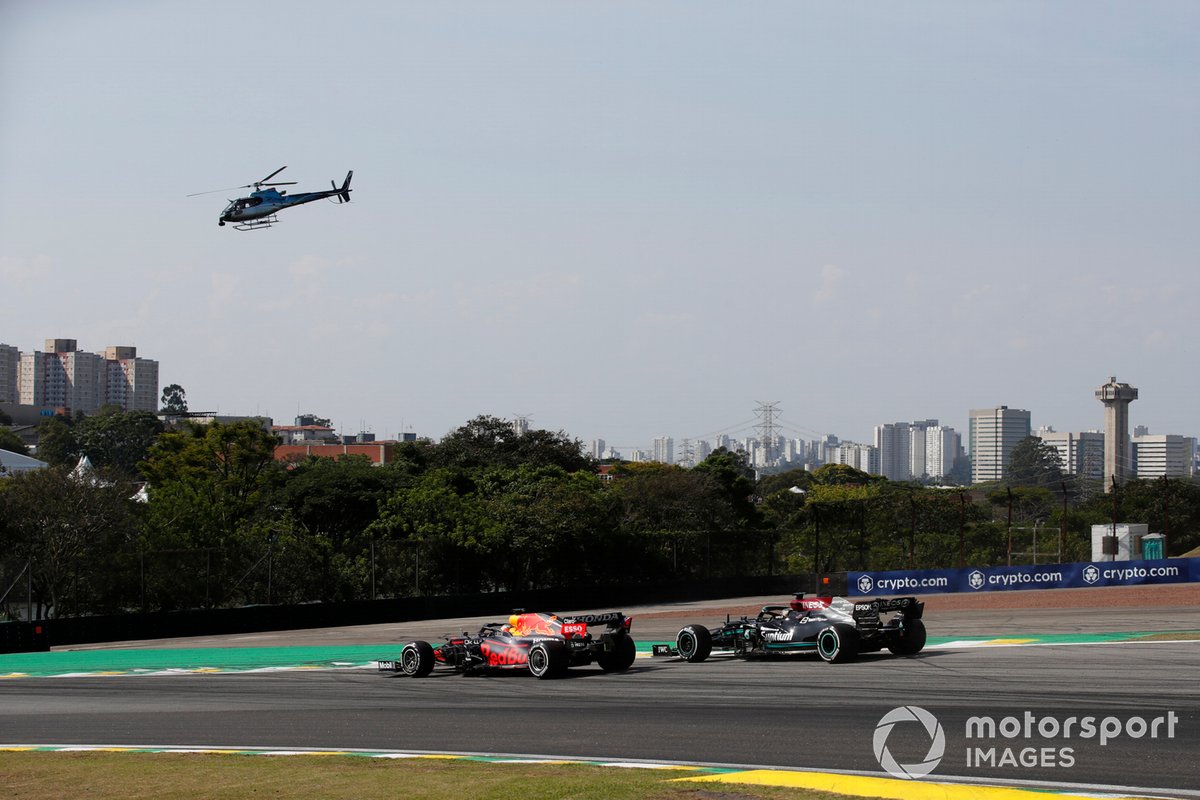
Brazil Turn 4 incident raised questions about rules being applied consistently
Photo by: Charles Coates / Motorsport Images
An agreed stance on the rules of engagement – and especially the confusion there is about leaving racing room for a rival on the exit of corners, and running wide – would be a major step forward in helping everyone understand and appreciate things better.
The FIA will have Horner on hand for next year’s annual stewards’ seminar, as part of his punishment for blaming the ‘rogue’ marshal at the Qatar Grand Prix.
His presence (even if it will only be via Zoom) should not be wasted in helping the FIA better appreciate what the teams are after from the FIA, and how decisions can be made much more consistently through a campaign.
What happened at the end of the Abu Dhabi Grand Prix is done now, and the clock cannot be turned back on the mistakes that were made.
But there is much that can be done to ensure there is no repeat controversy in the future. And for that, the FIA needs to put its hand up, admit its error and make positive changes.
The very worst thing it could do is say that everything went to plan, bunker down against the criticisms and simply hope it all just blows over.

Is it time for FIA to admit it made mistakes in the way it handled the Abu Dhabi GP?
Photo by: Charles Coates / Motorsport Images


Brundle awarded OBE in King’s New Year’s honours

The new rules dilemma that will define the 2025 F1 season

Verstappen issues Red Bull title warning in push for RB21 progress

Mercedes opens up on the factors that hurt Hamilton with the W15

How McLaren faced up to the misinformation, noise and distractions of being an F1 title challenger

Why Bottas is not letting the “worst-case scenario” end his F1 career

Jon Noble: An unfair perception or a genuine concern? Lifting the lid on Red Bull’s Tsunoda scepticism

Binotto on Audi's F1 reality check after finding team "frozen" with no plans

Acosta's long road to his maiden MotoGP win

MotoGP Austrian GP: Acosta finally claims maiden win

Great debate: Which circuit should host the F1 2026 finale if the calendar has to change?

Live: MotoGP Austrian Grand Prix updates as it happens
Subscribe and access Autosport.com with your ad-blocker.
From Formula 1 to MotoGP we report straight from the paddock because we love our sport, just like you. In order to keep delivering our expert journalism, our website uses advertising. Still, we want to give you the opportunity to enjoy an ad-free and tracker-free website and to continue using your adblocker.


Top Comments