


Why Ferrari's F1 team boss must learn to live under fire
Frederic Vasseur cut an embattled figure during the Canadian Grand Prix weekend as reports emerged in Italy that the knives are out for him. Welcome to life as Ferrari team principal…

“To be the team principal, I knew when I took the position that you are exposed,” said Ferrari Formula 1 boss Frederic Vasseur during an extraordinary rant ahead of last weekend’s Canadian Grand Prix. “This is quite easy to manage. It's more for the people of the team. They are working very hard.
“To decide one day 'this one will be replaced, this one is useless'. Honestly, it's very harsh. These journalists need to consider these people have family. This is completely disrespectful.”
Vasseur was responding to claims in two influential Italian newspapers that he has lost the confidence of the drivers and senior management. There was criticism, too, of specific staff.

Hence Vasseur’s stance that he knew he was letting himself in for personal attacks when he took the job, but he draws the line at speculation over his staff – in this case chassis technical director Loic Serra, who joined from Mercedes last October. He also referred to “the case last year with the chief of aero”, a brouhaha in which La Gazzetta dello Sport announced that Ferrari had poached Red Bull aero chief Enrico Balbo, then had a second bite of the cherry, subsequently claiming Balbo had been approached but declined to leave.
Vasseur pointed out that the Ferrari situation stands in contrast to those of other F1 teams, where those in charge are permitted to get on with their jobs without being subject to constant questioning. But it was ever thus at Ferrari – the swirling culture of politics, backbiting and blame isn’t just a product of the Scuderia being akin to a second religion in Italy, it was set in motion by the founder.
Long before the first grand prix in the ‘world championship for drivers’, Enzo Ferrari had ceased to attend races in person, preferring to attend to his role as self-proclaimed “agitator of men” back at the factory. He believed in creative tension and cultivated an enjoyment at being the spider at the centre of a web of intrigue, informed by trusted lieutenants.
As such, Scuderia Ferrari and rancour have proceeded hand in hand. There was the famous instance of mercurial driver Jean Behra punching team manager Romolo Tavoni in the face after the French Grand Prix at Reims; Tavoni had been relaying Enzo’s displeasure at Behra criticising his car in the pages of L’Equipe.

Ferrari has always had an intense relationship with the media over the internal politics of the team
Photo by: Rainer W. Schlegelmilch / Motorsport Images
Tavoni had no background in management or engineering – he had worked in a bank before becoming Enzo’s secretary, so his role in the team was to be the eyes and ears. It didn’t last long because he was among those to depart in the great purge of October 1961, alongside key engineers Giotto Bizzarrini and Carlo Chiti.
His replacement, Eugenio Dragoni, relished his power to selectively feedback information to HQ and was cited by Phil Hill and John Surtees, world champions both, as reasons for leaving. Even Mauro Forghieri, the great engineer personally promoted as a young man by Enzo, finally left after falling out of favour yet again in the late 1980s.
The man elevated in Forghieri’s place, British engineer Harvey Postlethwaite, would later regale dinner guests with how his coping mechanism for Ferrari’s internal politics was to close his eyes and visualise his salary as a wardrobe full of cash.
Intrigue was so baked into the structure that it survived Enzo’s death – only months after ousting team principal Cesare Fiorio, Alain Prost was himself given the boot late in 1991 – but there was a brief ceasefire during the renaissance presided over by Luca di Montezemolo and Jean Todt in the late 1990s and early 2000s.
Like Todt, Vasseur is French and this seems to be a point of contention for some of those criticising him. The claim is that he neither speaks Italian nor has a grasp of ‘how things are done’ at Maranello
But while we look back at this now through the prism of recalling Michael Schumacher’s five consecutive world championships in rosso corsa, it’s easy to forget that the arrival of Todt – an outsider – wasn’t uniformly popular. He would recall that during the early months of his tenure, as he fought to make changes within the organisation, he came home to find it had been burgled – and a pair of scissors left at the end of his bed.
Like Todt, Vasseur is French and this seems to be a point of contention for some of those criticising him. The claim is that he neither speaks Italian nor has a grasp of ‘how things are done’ at Maranello.
When Vasseur joined Ferrari to replace Mattia Binotto at the beginning of 2023, he did so with a three-year contract which therefore runs to the end of this year. It’s not unknown for certain media outlets to take extrapolative leaps based on contractual terms – seasoned readers will recall the many times the late Niki Lauda was said to be leaving Mercedes – and, equally, Binotto was given three years in charge before being escorted from the office.

When Vasseur took over from Binotto, he was seen as an outsider set to refresh Ferrari
Photo by: Mark Sutton / Motorsport Images
But this being Ferrari, should an employee neglect to flush the toilet after attending to their daily ablutions, this development will be reported in the sports papers.
What’s interesting is that while there was some overlap between the stories in La Gazzetta dello Sport and Corriere della Sera, the latter was far more detailed. Gazzetta’s key claim was that the outcome of the Canadian, Austrian and British Grands Prix will be crucial to the level of pressure exerted internally on Vasseur, the likelihood being that he will be invited to clear his desk if the trend line of performance doesn’t pick up during the second half of the season.
Given Ferrari’s history, this could easily be filed under the principle of a stopped clock telling the correct time twice a day. But there were also allusions to dissatisfaction with the culture promoted under Vasseur’s regime – that he puts off “acceptance of difficulties” and demonstrates excessive optimism about the performance gap between Ferrari and its rivals, and the timeline for closing it up.
This is interesting since the source is evidently further up the food chain from Vasseur, suggesting a level of impatience – either at boardroom level or somewhere between it and the Gestione Sportiva in Maranello. And herein lies the challenge for senior managers such as Vasseur: they exist at the junction between the areas of the business populated by the people who actually do the work, and those who pass their days in the boardroom playing toy soldiers and acting out petty intrigues against one another.
One does not have to be an expert in the science of management to be aware of the colloquialism 'shit rolls downhill'. It is the choice of someone in Vasseur’s role to either deflect it from those they manage – thereby risking full impact from the ordure – or step aside and permit it to gather momentum on its way to striking those below.
Vasseur is trying to foster a culture of responsibility rather than blame inside the Scuderia, which is why his instinct is to protect those who report to him. But whoever is briefing the Italian papers clearly belongs to the old school, whereby a human sacrifice is required when a project is deemed to be struggling.

It is fair to say the honeymoon period for Vasseur at Ferrari is over
Photo by: Steven Tee / Motorsport Images
That is certainly the way to read the Corriere della Sera reportage, which contained yet more detailed criticism of Vasseur’s regime, including a claim explicitly sourced to Charles Leclerc’s camp that Leclerc has lost faith and wants to go. There was also suggestions that questions were being raised about the high-profile hiring of Lewis Hamilton.
This is particularly rich since chairman John Elkann, a scion of the Agnelli dynasty, was both the originator of the move to recruit Hamilton, and the energy behind making it happen at great cost. Vasseur was involved in the mechanics of the transfer (and, as Hamilton’s team boss during his GP2 championship year, among the attractions of joining Ferrari) but wasn’t responsible for signing the cheques.
Then again, those readers versed in the machinations of the corporate world will no doubt have witnessed the speed and brazen cravenness with which senior execs will disavow a trophy hire when things go south.
Brawn thought his staff wasted too much time worrying what the papers said about them – and banned said newspapers from the technical office
The Corriere della Sera says Antonello Coletta, who runs Ferrari’s successful endurance racing project, is one potential replacement. It’s understood he has been approached before and turned the job down, but may reconsider given that his stock has increased further after another Le Mans win for Ferrari’s Hypercar.
For now, Vasseur remains in place, and he now knows the knives are out for him. Will he continue to protect his staff? Indubitably.
That is what Todt did, with great results – albeit after several years of rebuilding. Perhaps Fred could take a tip from Ross Brawn, whom Todt recruited as technical director. Brawn thought his staff wasted too much time worrying what the papers said about them – and banned said newspapers from the technical office.
If only there were a contemporary equivalent of this now the coverage has shifted online.
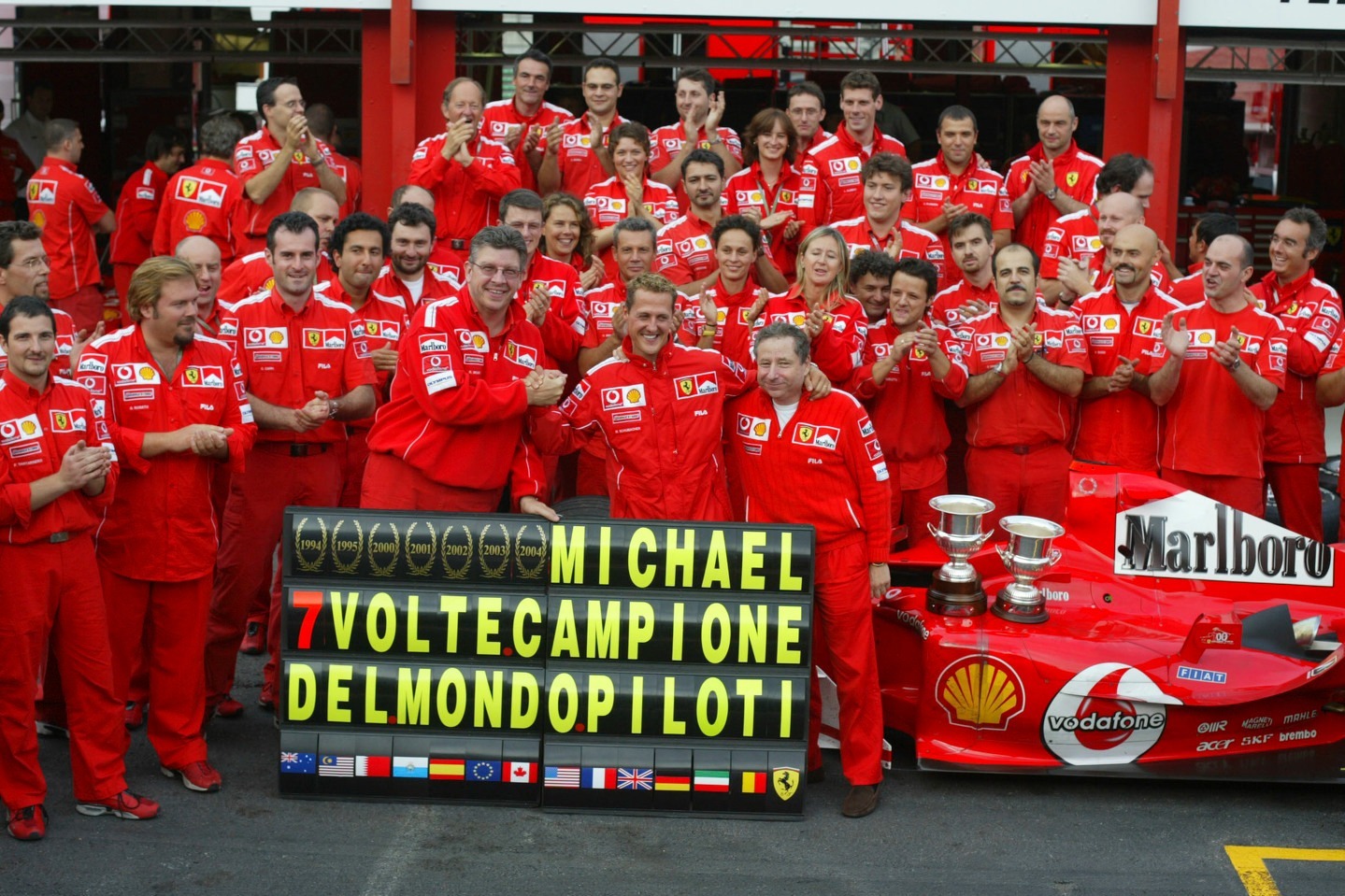
Perhaps Vasseur can take a lesson from Todt and Brawn over Ferrari management by blocking out the noise
Photo by: Motorsport Images


'Senior moment' or breakdown of trust? The implications of Hamilton's Singapore GP meltdown

Why Verstappen's dominance left rivals scrabbling for alternatives in Singapore

A "better job" or more engine power? Verstappen's Singapore pole unpicked

FIA reveals "human error" caused latest software glitch in Singapore sprint qualifying

F1 Singapore GP live commentary and updates - Verstappen takes sprint pole

F1 Singapore GP live commentary and updates - Verstappen wins sprint while McLarens collide

F1 Singapore GP live commentary and updates - Verstappen on pole

LIVE: F1 Singapore GP - Verstappen dominates to victory from Leclerc, nightmare for Hamilton

Five key takeaways from F1's big African Grand Prix reveal in Rwanda

IndyCar driver Harvey announces cancer diagnosis

Why McLaren cannot fix its F1 car handling until 2027

MotoGP riders could get what they want, and fast, if only they would stand together
Subscribe and access Autosport.com with your ad-blocker.
From Formula 1 to MotoGP we report straight from the paddock because we love our sport, just like you. In order to keep delivering our expert journalism, our website uses advertising. Still, we want to give you the opportunity to enjoy an ad-free and tracker-free website and to continue using your adblocker.


Top Comments