


Why Ferrari's 2026 F1 car is both innovative and brave
The unveiling of Ferrari's SF-26 was quickly followed by its Fiorano shakedown, confirming a number of novel design solutions. Ferrari, if it is to dispel a dismal 2025, needs them to work if it's to hit the ground running

Autosport Explains
Our experts decode the most important stories in motorsport.
Ferrari had to contend with two conflicting emotions across 2025, albeit one a direct result of the other. First came the hype and expectation, that associated with Lewis Hamilton's move to the team from Mercedes. After a tricky Melbourne in rain-affected conditions, the expectation built after Hamilton's sprint race win in China from pole position.
It was a story that wrote itself - at least, for a couple of months, as the fairy-tale plot was left decidedly unfinished. With instructions unclear, Hansel and Gretel were roasted in the oven, rather than the witch. Following the hype, disappointment became the defining factor of Ferrari's year. Hamilton's struggles intensified as it became apparent that he wasn't gelling with the car. Charles Leclerc's face of despondence became increasingly prevalent, too; his mantra of wanting to win the title as a Ferrari driver sounded increasingly unconvincing, and flashes of performance later were often met with surprise.
Beyond the sour notes of Hamilton's season, further disappointment was accrued as its change in suspension concept had little in the way of pay-off. Changing layout with just one season of the 2022-generation ruleset left was a risk, one that offered Ferrari a chastening experience as it was unable to reliably get its car in 'the window'.
Ferrari has the chance to start fresh, and it has apparently seized upon that opportunity. Visually, the Prancing Horse has taken an aggressive canter down an interesting avenue of development, one it hopes that can allow it to open 2026 in a similar manner to its rambunctious start to the previous regulations in 2022.
But first, the white bits. It's very difficult to make the HP logo fit into Ferrari's 'visual identity', and the American brand does not seem entirely keen on having its roundel logo rendered in white to make it fit. It feels marginally cleaner than last year's fit on the engine cover, although the bordered stickers on the wings look a little bit out of place. But you're not here for livery design reviews - you want some details.
Last year, Ferrari took the punt on switching its front suspension to a pull-rod layout, having felt that it had taken the push-rod design to the end of its performance curve. This yielded a double pull-rod arrangement, having stuck to its guns (albeit with some suspension link changes to improve rear end performance) with the same layout at the rear. Evidently, Ferrari has not found this a worthwhile pursuit with the 2026 rules, resorting to the double push-rod hinted at by the reveal of Haas' 2026 car.
It's also interesting to see the front-end treatment, and leaked videos of Ferrari's Fiorano test demonstrated the application of the active aerodynamics on the front wing - where the upper two elements fold back like a sprung trap door. It looks silly, but I suppose DRS did when we first encountered it. Ferrari has also bracketed its top two rear wing elements together and this will essentially lift up in a similar manner to DRS - but it means that those elements have to work together in both straight and corner modes.
There's a touch of the 412 T1 about Ferrari's nose - the Scuderia's 1994 car - albeit more drooping and chiselled than its 32-year-old counterpart. The nose mounts, or pylons, sit quite high up the nosecone as it has presumably identified this area as the best position to set up the airflow ahead of the suspension components. The active aero actuator sits in the middle of the three-piece front wing, which has a gradual spoon shape in its central section.
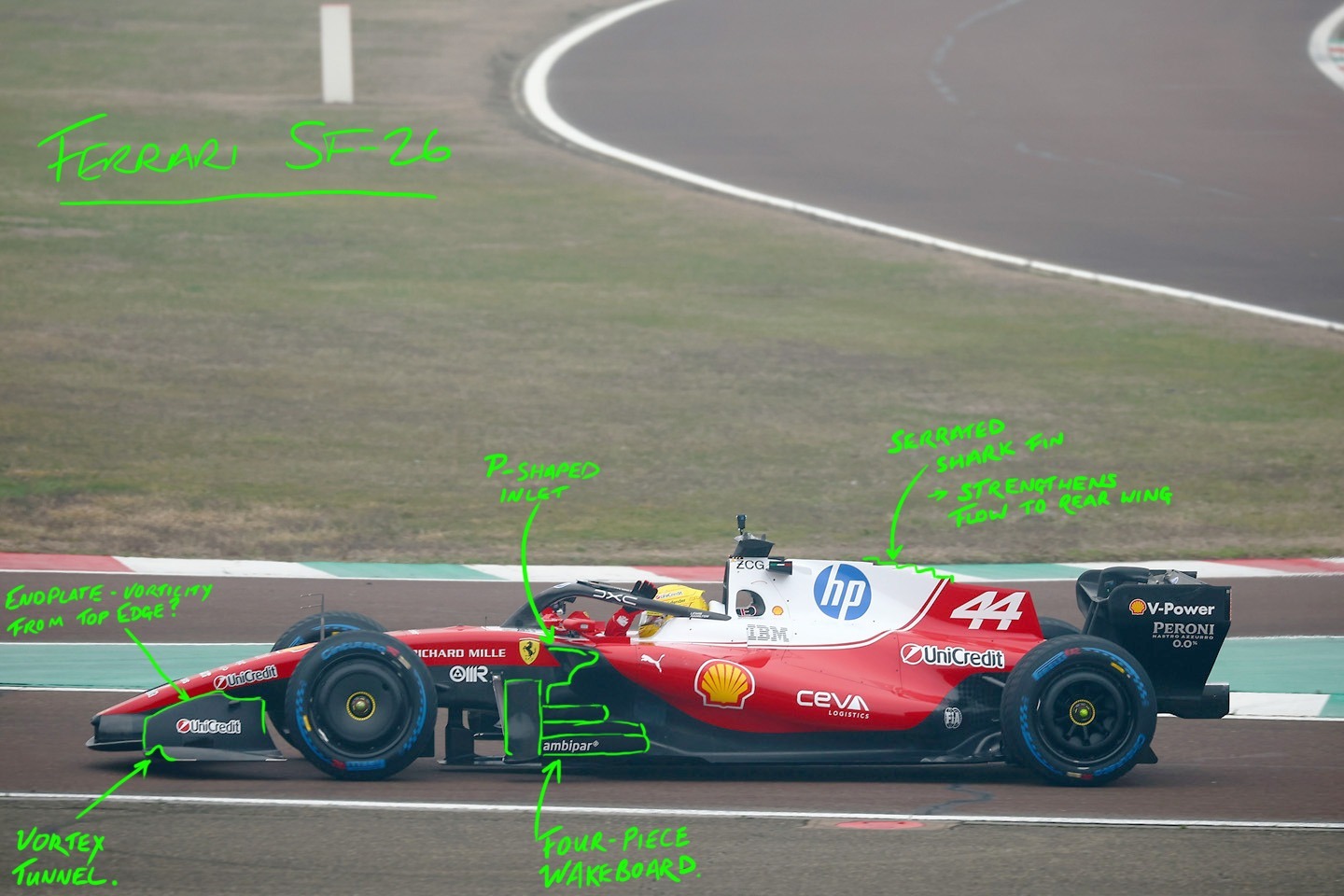
Ferrari has chosen to take an interesting route with the front wing endplates; it has opted for no additional wing flap, instead using the space for a tyre temperature sensor, and a footplate below with a vortex tunnel designed to push airflow outwards quite early on. While this handles the tyre wake management with outwash, the top edge of the endplate appears to assist with powering up the inwash. The cut-out in the top should be able generate a tip vortex, which can be folded between the front wheels and the chassis, improving the energy of the flow in this region.
Behind the front wheels, the wakeboard is made up of four elements - as seen across most of the other launch imagery thus far - but is supported by a diagonal leg from the chassis to the floor edge. Behind this, P-shaped inlets (with the opening of the inlet running parallel to the chassis flanks) give way to pill-shaped sidepods with a noticeable undercut, something we'd seen on the Mercedes in its shakedown form, rather than the render imagery. This is a way to help merge the undercut and over-top flows around the sidepods, wrapping them together before sending the air through the suspension components.
Both Ferrari and Mercedes share a common packaging trait, in that both have chosen to reduce the components lodged within the airbox/engine cover area and move them into the sidepods. While this means that neither team can shrink the trailing edge of the sidepods as much as they would like, it at least keeps the flow to the rear wing relatively clean.
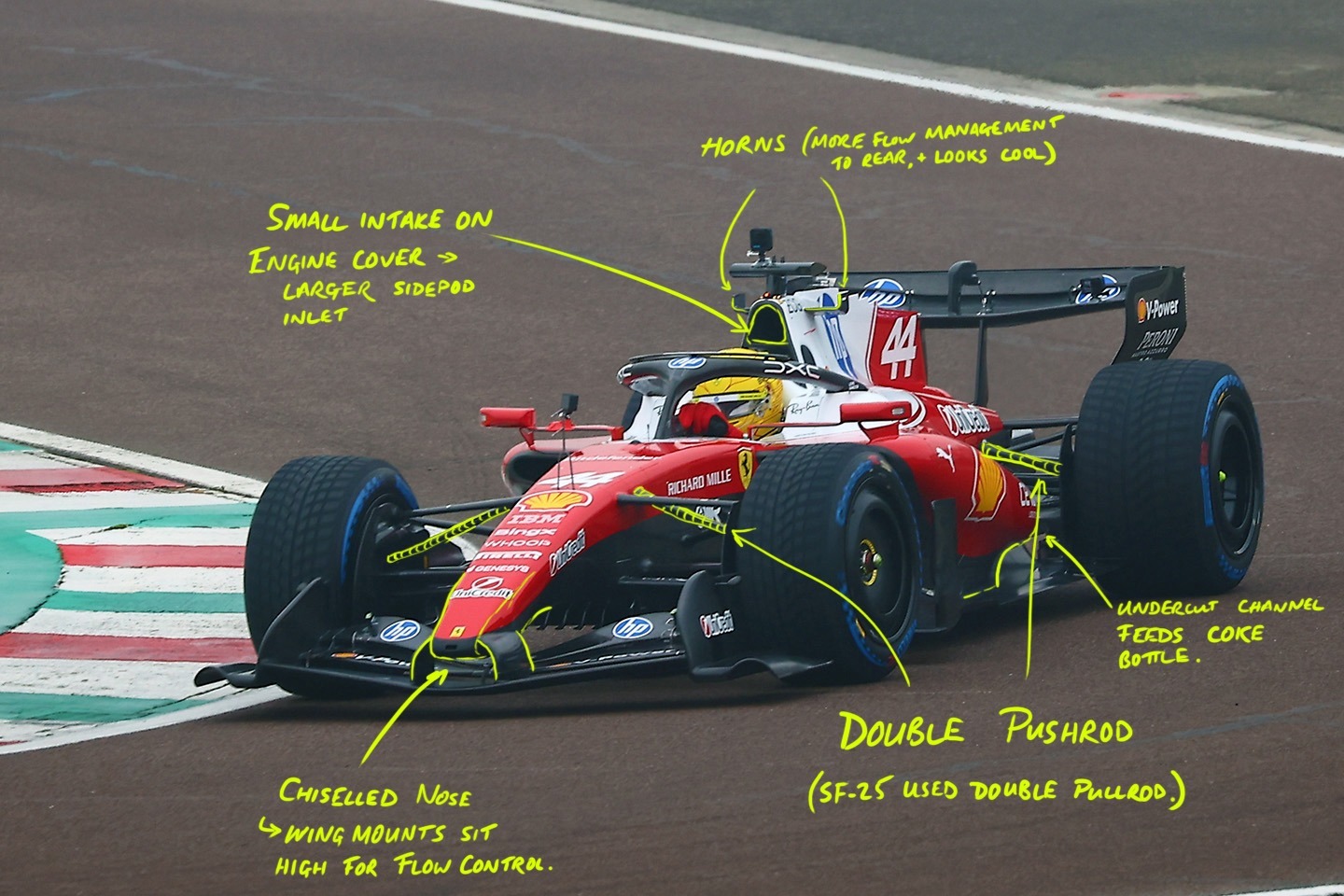
Ferrari appears to have given a lot of credence to this area. The engine cover's flaring has been kept as low as possible, ensuring that the bodywork around the rollhoop is kept reasonably tight. To strengthen to the flow to the rear wing even further, Ferrari has implemented a series of jagged edges onto its shark-fin, which should help to energise the air in this area. If that wasn't enough, Ferrari has attached a pair of horns to the rollhoop.
The tips will produce vortices, giving the rear wing a supply of higher-energy, low pressure air. The inboard part induces a small amount of local lift, but should wash the vortices towards the underside of the rear wing to maximise the low-pressure nature of the underside to get the wing working harder.
There's a lot of brave design choices here. Perhaps other teams had elected to hold their own braver elements back, but Ferrari certainly seems to have pushed the boat out to find success in the first year of this rule-set. And, for Ferrari's sake, these need to work and hit the ground running - and that's only the start of it. It won't be difficult for the other teams to observe those solutions and try them for size in the wind tunnel, thus ingenuity cannot be in short supply.
Much of it depends on the powerplant, and whether it can overcome the alleged performance difference produced by the apparent compression ratio shenanigans. The rest will be down to the drivers; Leclerc can be counted on to deliver if the car works as it should, and Hamilton has to put his faith in a new race engineer (identity to be defined) as Ricciardo Adami moves into a new role.
But, if nothing else, at least the car looks nice...


Photo by: Federico Basile | AG Photo


FIA expects F1 races in Qatar and Abu Dhabi to run as planned

Why Piastri has struggled to show his best with this year's McLaren MCL40

Lights, Camara, action: How Haas picked F1's latest rookie for 2027

Horner's inside story of how Red Bull built its own F1 engine

Why Mercedes' latest 2026 F1 update is no downgrade

Singapore Grand Prix Driver Ratings 2026

What we learned from the 2026 F1 Singapore GP sprint race and qualifying

The political minefield set out by F1’s recent cost-cap grievances

FIA expects F1 races in Qatar and Abu Dhabi to run as planned

Top five roles on Motorsport Jobs this week

Champions crowned at incident-filled Donington Park 750 Motor Club meeting

Why Toyota’s 2026 WEC triumphs have put it into the all-time greatest endurance racing team debate
Subscribe and access Autosport.com with your ad-blocker.
From Formula 1 to MotoGP we report straight from the paddock because we love our sport, just like you. In order to keep delivering our expert journalism, our website uses advertising. Still, we want to give you the opportunity to enjoy an ad-free and tracker-free website and to continue using your adblocker.


Top Comments