


Why F1's racing guidelines will never be perfect – and why that is also fine
No set of guidelines will ever be a panacea for F1 racing – but that’s no reason not to have them, argues Oleg Karpov

There was a lot of chatter late in the season about the so-called racing guidelines in the Formula 1 paddock before the conversation inevitably shifted to more exciting talking points – like the title fight and that other set of ‘not regulations’, called the Papaya rules.
The drivers held a lengthy meeting with the FIA in Qatar which, although annual and pre-planned, still felt like a crunch moment given their comments in the weeks leading up to it. Those remarks suggested there was something to fix. Yet, as outrageous as it may sound, there is a valid argument that many of the drivers actually share: there’s nothing fundamentally wrong with the guidelines themselves. Drivers were involved in developing them, after all. What F1 – drivers and FIA included – needs is a better understanding of what those guidelines actually represent.
There is essentially one major issue: the guidelines, which were never intended to be binding rules, are sometimes treated as ultimate truth. Drivers sense this – and seize every opportunity to play strictly ‘by the book’, including the now-famous tactic of ‘racing to the apex even if that means pushing the other guy off the track’.
All that really means is that the dialogue must continue. The guidelines appeared precisely because drivers complained for years about inconsistent decisions in similar situations – and, to a degree, they have delivered more consistency. It’s worth noting that during the meeting in Qatar, the discussion revolved essentially around just three incidents (across 22 races) where the guidelines presumably won the battle over common sense. That’s out of 509 incidents reported to the stewards overall (albeit including matters unrelated to the guidelines). That’s a remarkably low percentage.

The next step seems obvious: reinforce the understanding that stewards should not treat the guidelines as strict rules. Yet that immediately creates another problem: there will always be incidents that split opinion – including among the drivers themselves.

Davidson, along with Chandhok and Palmer, have been credited by Sainz for getting more decisions right than the stewards
Photo by: Sky Sports
Common sense, despite the name, is rarely common. So F1, like every other sport, will always need humans to make judgement calls – at least until someone invents the ultimate AI tool capable of pleasing everyone.
Racing also has a unique complication. You can’t just blow a whistle, pause the action, and check whether everyone kept their hands away from the ball by watching endless replays. F1 is dynamic – and without a mechanism to freeze the field, decisions will always feel late to someone.
What is worth exploring, though, is the evergreen topic of permanent F1 stewards. Carlos Sainz recently suggested that TV pundits such as Karun Chandhok, Jolyon Palmer and Anthony Davidson get most of their analysis spot-on – and might even do a decent job inside race control. It’s hard not to see that as a dig at the current batch of driver stewards, but Sainz has a point: for Chandhok and co, analysing racing action is their job. They are paid to study those incidents constantly, whereas the current stewarding pool consists largely of people who have other priorities in their professional lives.
The scrutiny of the guidelines is another step in that process. But it’s equally important to remember that no number of steps will ever make racing stewarding a flawless process
The FIA, for its part, notes that the permanent stewarding panel already comprises only 12 people – and the federation’s president has made clear that he isn’t opposed to full-time stewards. The question is simply, who pays for them? And the world has stumbled across far bigger problems than ‘fixing’ F1.
But none of this means F1 isn’t moving forward. The scrutiny of the guidelines is another step in that process. But it’s equally important to remember that no number of steps will ever make racing stewarding a flawless process. And that’s something to note for the fans, too.
This article is one of many in the monthly Autosport magazine. For more premium content, take a look at the January 2026 issue and subscribe today.
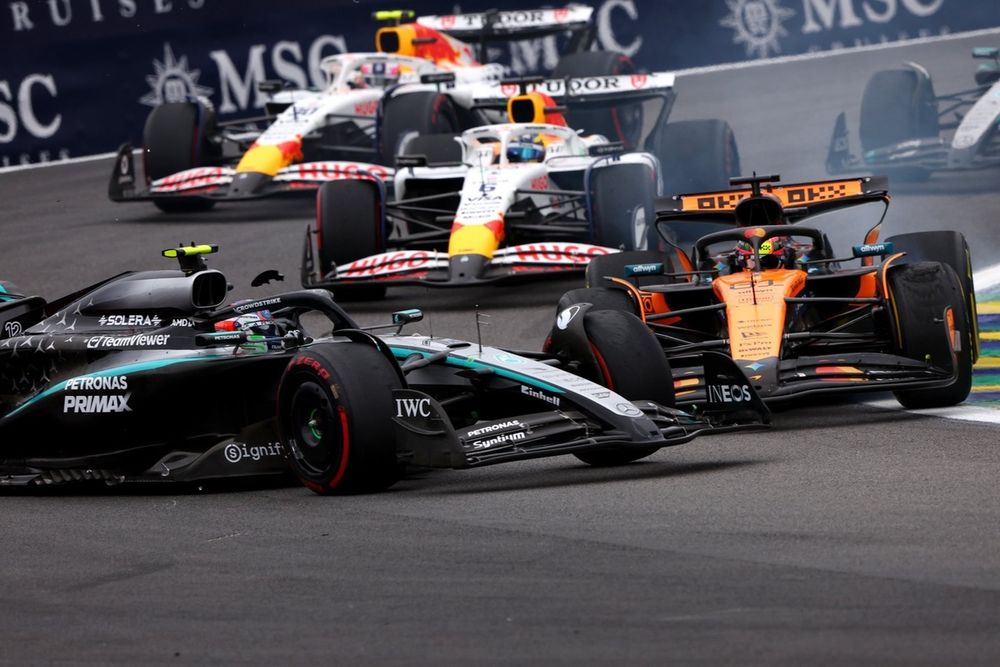
Piastri's clash with Antonelli and Leclerc in Brazil was judged by the racing guidelines - but many felt the decision was wrong
Photo by: Andy Hone/ LAT Images via Getty Images


Red Bull defends decision to force Verstappen to give back two positions

Why Mercedes didn't pit Russell under virtual safety car in Italian GP

How Piastri's Q3 mistake denied Norris "half a second" in Italian GP qualifying

Piastri hit with three-place Italian GP grid penalty for impeding Lawson

Why Hamilton shouldn't regret his Ferrari radio rant - but why he was right to apologise

Grading the class of F1 2026 so far

Why F1 shouldn’t be hiding its most interesting characters

Why Sainz only got a five-second penalty for Hungarian GP clash with Piastri

How Antonelli levelled up his character to be F1 2026's world champion-elect

FIA set to close F1 cost cap loophole with new rules

Norris promises to make "better decisions" following fresh talks over Singapore GP clash

FIA expects F1 races in Qatar and Abu Dhabi to run as planned
Subscribe and access Autosport.com with your ad-blocker.
From Formula 1 to MotoGP we report straight from the paddock because we love our sport, just like you. In order to keep delivering our expert journalism, our website uses advertising. Still, we want to give you the opportunity to enjoy an ad-free and tracker-free website and to continue using your adblocker.


Top Comments