


Why F1’s latest battleground offers unlimited opportunities
As Formula 1's push to bring costs down is limiting how much teams can use their state-of-the-art windtunnel facilities, the advancement in simulation technology and its limitless possibilities could soon be the determining factor in a team's success

There was a time when the fight between Formula 1 teams to have the best facilities revolved around windtunnels. Rivals would throw vast resources at creating bigger and better tunnels in the hope that they could help unlock the aerodynamic gains to give the winning edge on track.
But, as part of F1’s push to bring costs down and stop the big budget outfits from going over the top with ever-more expensive designs, there have been more and more restrictions on their usage in recent years. Sure, there is still a benefit to be had from having as best facility as you can – which is why McLaren and Aston Martin are both building their own new bespoke tunnels right now – but it’s no longer become such a big battleground of innovation.
PLUS: Why the end is nigh for F1’s most dependable design tool
Ultimately the windtunnel rule restrictions have put a cap on the kind of advantage a team can get, so it’s a law of diminishing returns when it comes to teams throwing too much resource towards them. Plus, the benefits will be further pulled back from 2022 when F1’s new generation of cars – which impose much stricter limits on the freedoms that teams get to develop aerodynamics – leave hands further tied when it comes to generating lap time.
But, as often happens in F1, as one area closes off, that just opens up another battleground and there now seems a trend to chase the next big thing: third generation simulators.
F1 team simulators are nothing new, having been used for many, many years. But what has been happening over the past two years has been a realisation that the rampant march of computer brain power and technology has been a game changer.

Dynisma DMG-1 motion simulator
Photo by: Dynisma
Now it is no longer about just having a simulator. You need a third generation that is best in class if you really wanted to maximise the returns. Last year, McLaren technical chief James Key said the latest generation of simulators had become a goldmine for engineers in helping them unlock car performance – free from the stringent testing restriction.
“The thing with the car is it's multidimensional,” he said. “An aero map - there used to be a set of curves and it was a surface, now it's loads of surfaces that all somehow interact. The same with tyres. Same with certain aspects of the engine, and it's certainly the same aspects of suspension as well.
"And the more processing power you get, the more you're able to combine those effects and better replicate what the car does. So, as that's increased over the years, you just have to put more maths into it and get a more representative model out.”
"In the last 12 months, we are putting a lot of effort on all simulations, not only with the new simulator that we hope to be able to use towards the end of this year, but precisely in all our environments and simulation tools" Mattia Binotto
Simulators are no longer really about helping a driver to better unlock a set-up they are happy with. Simulators are now increasingly more being used as a tool for teams and their engineers to understand better car behaviour and – more especially – tyres. As the value of getting tyres into the right operating window remains absolutely critical to success, it is obvious to state that the team that can best understand what’s needed and what works will be at an advantage.
PLUS: Why simulation is an ever-evolving battleground
It was fascinating to hear from Ferrari team principal Mattia Binotto last week about the value his team is putting on its simulator and simulations as it plots its path back to the front of the grid.
There is a very real sense that it sees an opportunity in getting on top of F1’s new 18-inch tyres before anyone else, which is why it’s both helping out so much with Pirelli’s development work on track but also being so aggressive with its own sim development off it.
Ferrari has recently completed construction of an all-new simulator at Maranello, which is now in a commissioning process that will take two to three months to go through. It wants to have the facility on tap for Carlos Sainz Jr and Charles Leclerc by the end of the season, so that it is then flat-out on the 2022 project.

Carlos Sainz Jr., Ferrari SF21
Photo by: Dom Romney / Motorsport Images
“We believe that having a good simulator is very important,” said Binotto. “If we look at the tyre wear [problem] we had in France, you need to manage, understand and react to those issues. If you've got a good simulator, which is somehow good in terms of response or correlation with the race track, the exercise will be certainly more accurate.
“That's why I think that the current [old] one we've got is not the best in class, if we look at our competitors. That's why, for us, it was important to make an upgrade. That's why we believe the new one can put us in a good position for the future.”
But it is the depth of what a current state-of-the-art simulator can offer that really exposes the benefits that teams see from them.
“The correlation between the models we use in the simulator and the real behaviour on the track is the most important part, so you can then understand and manage them in some way,” explained Binotto. "For our part, in the last 12 months, we are putting a lot of effort on all simulations, not only with the new simulator that we hope to be able to use towards the end of this year, but precisely in all our environments and simulation tools.
“This involves trying to create models that replicate the physical behaviour of the tyres, aerodynamics, the car and so on. The key element is if you can model it, you can understand it. And if you can figure it out, you understand how it works too. We are making great strides in this direction.
“The same thing must be done with next year's tyre. If you have the correct model, you can sooner understand their behaviour. Models are built in many ways, through a good definition of geometry, its structure, compound, chemical and physical parts.
"There are many elements, and artificial intelligence is increasingly present in these simulations to try to replicate behaviours. Even without having a physical model, you can map what is seen on track and bring it back.

Carlos Sainz Jr., Ferrari with 2022 18-inch Pirelli Zero
Photo by: Pirelli
“That’s why we are working on the tests with the 18-inch tyres Pirelli makes available. We are the team that is doing the most of all, because we are the team that has made itself available to do so and we are doing it precisely for this. Our intention is not only to participate in the development of the new tyres, but to try to build as much information as possible to have models ready as soon as possible as early as next year.”
How soon before the race drivers are flown back after sessions to help deliver their input? Or how long before teams can create portable facilities that can be flown to races for race drivers and engineers to decamp to?
Beyond the remarkable opportunities that teams are now seeing from latest generation simulators, what will be intriguing to see is whether or not the FIA steps in and tries to limit their usage. When Lewis Hamilton spent the morning before first practice for the British Grand Prix on the Mercedes simulator running through the day’s programme, it certainly prompted some mutterings about whether things could get out of control.
With teams already running through the nights with sim drivers on grand prix weekends to rattle through programmes, how soon before the race drivers are flown back after sessions to help deliver their input? Or how long before teams can create portable facilities that can be flown to races – even to a location outside the paddock – for race drivers and engineers to decamp to?
For now it seems far fetched to think that in the cost cap era, the gains will be worth the expense of doing so. But in the world of F1, never say never when there is lap time to be had.
Watch this space.
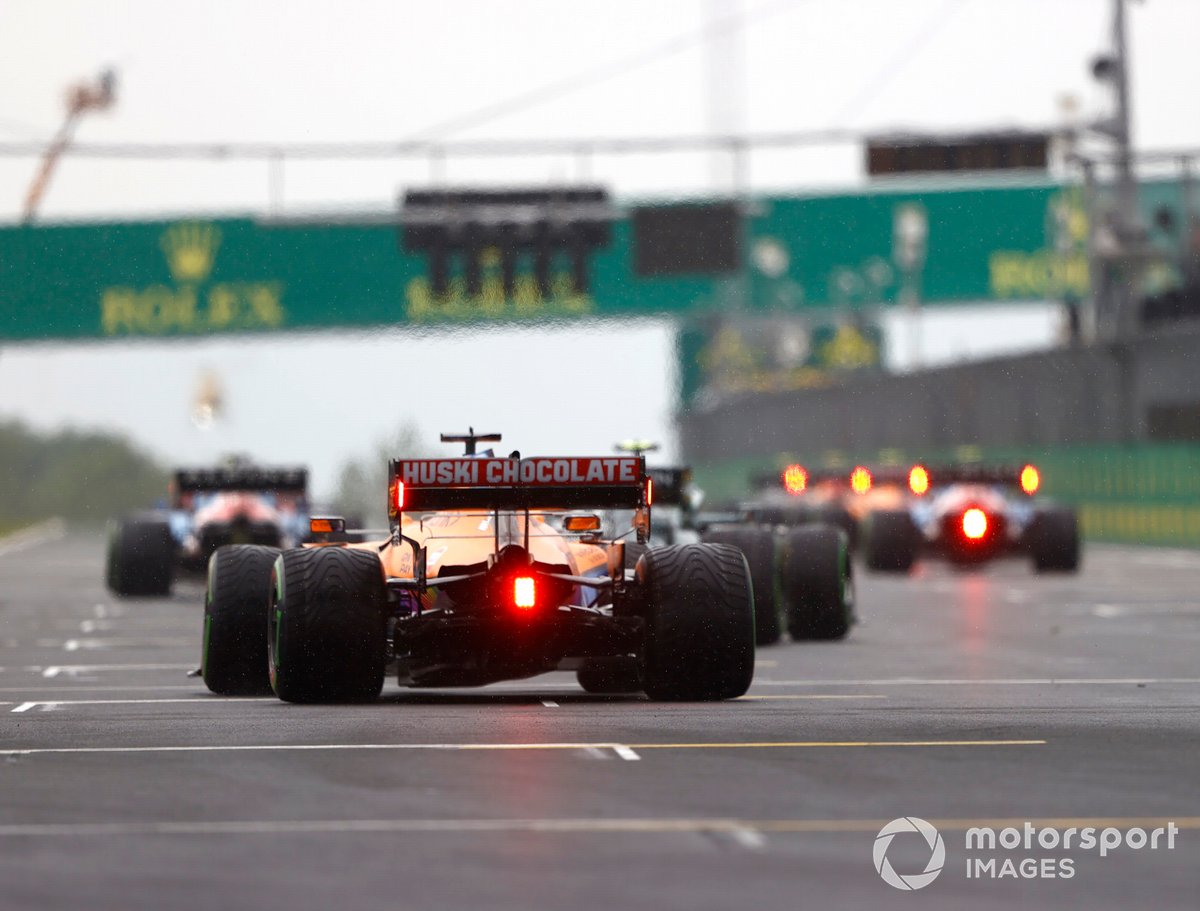
Daniel Ricciardo, McLaren MCL35M, takes his grid position for the start
Photo by: Andy Hone / Motorsport Images


Brundle awarded OBE in King’s New Year’s honours

The new rules dilemma that will define the 2025 F1 season

Verstappen issues Red Bull title warning in push for RB21 progress

Mercedes opens up on the factors that hurt Hamilton with the W15

How McLaren faced up to the misinformation, noise and distractions of being an F1 title challenger

Why Bottas is not letting the “worst-case scenario” end his F1 career

Jon Noble: An unfair perception or a genuine concern? Lifting the lid on Red Bull’s Tsunoda scepticism

Binotto on Audi's F1 reality check after finding team "frozen" with no plans

Could Rally Chile offer Fourmaux the best chance at elusive WRC win?

McLaren drops H-wing concept for F1 Spanish GP

Audi commits to appeal against Tsunoda's Italian GP result

Why new Madrid F1 circuit will be a "challenging" test of cars and engines
Subscribe and access Autosport.com with your ad-blocker.
From Formula 1 to MotoGP we report straight from the paddock because we love our sport, just like you. In order to keep delivering our expert journalism, our website uses advertising. Still, we want to give you the opportunity to enjoy an ad-free and tracker-free website and to continue using your adblocker.


Top Comments