


Why a departing stalwart was perfectly suited to F1's most pragmatic team
He was tasked by Red Bull founder Dietrich Mateschitz with developing young talent. Eighteen years, five grand prix winners and two world champions later, the man usually first in and last out of AlphaTauri’s factory every day is stepping aside. But, as OLEG KARPOV found out, if there’s one thing this loyal team man doesn’t like, it’s talking about himself…
A long, rose-tinted farewell interview? No way, he’s not going to do it. A sentimental rewind through 18 years at the helm of Red Bull’s junior team, a key role in developing young talent into grand prix winners and world champions, memories of his own racing career… Franz Tost is not available for any of this. He still has a job to do before he clocks out and melts away from Formula 1 into a quiet retirement in the Austrian Alps.
“He will refuse to talk about himself.” Fabiana Valenti, AlphaTauri’s communications director, has been with the team since its Minardi days and well knows how its boss rolls. He might make an exception for us, though, because we’re friends, she says. But only if we want to talk about the team. After all, representing it is part of his job.
So our request is amended. And it is approved. Dare we push our luck a little bit on the day? Well, it would be remiss of GP Racing to let someone who has quietly contributed so much to F1 slip away unacknowledged…
GP Racing: Franz, let’s start with a rather difficult subject. In the spring, the floods in the Emilia Romagna region affected many of your colleagues. How are they doing now?
Franz Tost: "It was a big shock for the whole team. Because 23 of our employees lost almost everything. I’ve never seen so much water – some houses were flooded up to the first floor. And I think it will take at least two years for everything to be rebuilt in an acceptable way. I was talking to one of our guys last week who lost his house. And he was waiting for the building authorities to come and see if the house could be renovated or if he’d have to tear it down because there’s nothing to hold on to. It was a huge shock for all of us."
GPR: Is it under your personal control now?
FT: "It’s under the control of the team. Fortunately, people worked very closely together, they helped each other. I must say that our HR department did a fantastic job. Because we immediately took care of the families, organised hotel rooms, apartments, clothes, money, all those things."

Photo by: Mark Sutton / Motorsport Images
Many AlphaTauri mechanics and staff were directly impacted by the floods in the Emilia Romagna region
GPR: You’ve been with the team for 18 years now. You know the date by heart, 8 November 2005. What do you remember about that day?
FT: "It was a beautiful autumn day. And that day I went to Italy, to Faenza. That was the day I started working at what was then Scuderia Toro Rosso. It was a good day and I enjoyed it. I remember talking to my wife and she said, 'Well, Italy, how long do you think we’ll be there?' And I said, 'Maybe three years. Four years maximum.' And now it’s 18 years and I have to say it’s been a fantastic time. I met fantastic people. Emilia Romagna is a very nice area to live. Warm, beautiful weather, great landscape, vineyards. You can’t find a bad restaurant there. And the people are very friendly."
"He was very easy to work with. There was no contract, just a handshake. And whatever he said, he stood by his word" Franz Tost on Dietrich Mateschitz
GPR: You said that in 2005 you found 85 people at Minardi who had a lot of passion but not much else – no money, no infrastructure. Laurent Mekies was one of them, aged 28 at the time. And soon, after a few years at Ferrari, he’ll replace you as team principal. Are you happy to hand over to him?
FT: "Laurent joined us as a young engineer and has done a very good job. He’s a very smart guy. And so he moved up and became chief race engineer. And I remember joking with him at the time, saying, 'You should go to another team now, learn something new, get more experience and then come back to us.' But now that’s exactly what has happened. And it’s good because he knows the team very well, some of the people he worked with are still there. And that, of course, is a good starting point because the trust is there."
Tost was brought in by fellow Austrian Dietrich Mateschitz who, after buying Jaguar and renaming it Red Bull Racing, also rescued the moribund Minardi, to form a team to develop young drivers. The principle was for both teams to share a common chassis, as regulations allowed at the time, so Tost’s job was initially just to run a racing team, with the chassis designed and built in Milton Keynes. Before that, he had spent a few years as BMW Motorsport’s track operations manager and Ralf Schumacher’s personal supervisor during the German's junior career. So he knew how to run a team and handle young, talented drivers.
But, after Sebastian Vettel’s victory at Monza in 2008, Toro Rosso became a victim of its own success. ‘Customer cars’ were banned, Mateschitz’s one chassis, two teams concept was no longer viable and Tost suddenly found himself building a brand new factory in Faenza, which opened in 2012 and continues to expand.
GPR: Dietrich Mateschitz. How different was this image of a great businessman and entrepreneur from the person you met?
FT: "I met Dietrich Mateschitz for the first time, I think it was 1993, at the Nurburgring, and I immediately had a very good impression. And then, in 2005, he said to me: 'Franz, you go to Italy now to build the team, use the synergies with Red Bull Technology and train young drivers.' And we did that. He was very easy to work with. There was no contract, just a handshake. And whatever he said, he stood by his word. If I needed something, I called him and he said 'yes' or 'no'. The decision was made in five seconds. He was a visionary. But being a visionary is just one thing. He also made all the projects he had a success. You will never find another person like Dietrich Mateschitz."

Photo by: Glenn Dunbar / Motorsport Images
Vettel put himself and Toro Rosso on the map with win in the wet at 2008 Italian Grand Prix
GPR: From the very beginning, he said the team should develop young drivers, which meant there was never a goal to win races and championships. Have you ever tried to change that?
FT: "No, it was very clear. He said: 'Look, the philosophy of the team is firstly to use the synergies with Red Bull Technology and secondly to develop young drivers. And that is your goal.' It was clearly defined and I never tried to change it, no. Because I think it’s a clear vision.
"And it worked well. Too well, in fact, because we won in Monza. And, you know, there are two sides to every medal. One side is that we won, fantastic. But the other side is they changed the regulations. That had a big impact on our team because we didn’t have the infrastructure, but suddenly we had to design and produce the monocoque ourselves, the nose, front wing, floor, diffuser, rear wing and bodywork.
"First of all, we had to find workspaces for the people. I remember we got the containers from Red Bull to accommodate the engineers. Then we had to set up a design group, find people for production and for the aerodynamics department. All at the same time. I have to say it was a tough, demanding time. People had to work a lot of hours because otherwise we wouldn’t have had cars to put on the grid... It was tough. But looking back now, it was also fun! The team has got better and stronger."
GPR: Mateschitz had to sign it off, right? He had to invest. How did he feel about it? Because, at first, the concept was different...
FT: "Yes, he understood. Because Bernie [Ecclestone] explained it to him. Max Mosley also talked to him about it. Of course, he wasn’t happy because it wasn’t the philosophy he had in mind.
"Fortunately, Red Bull was dramatically increasing the number of cans they sold year on year. That meant the cashflow was there. So we got the money. There was no negativity. It was always easy with him. I think I can only remember one time he got upset with me."
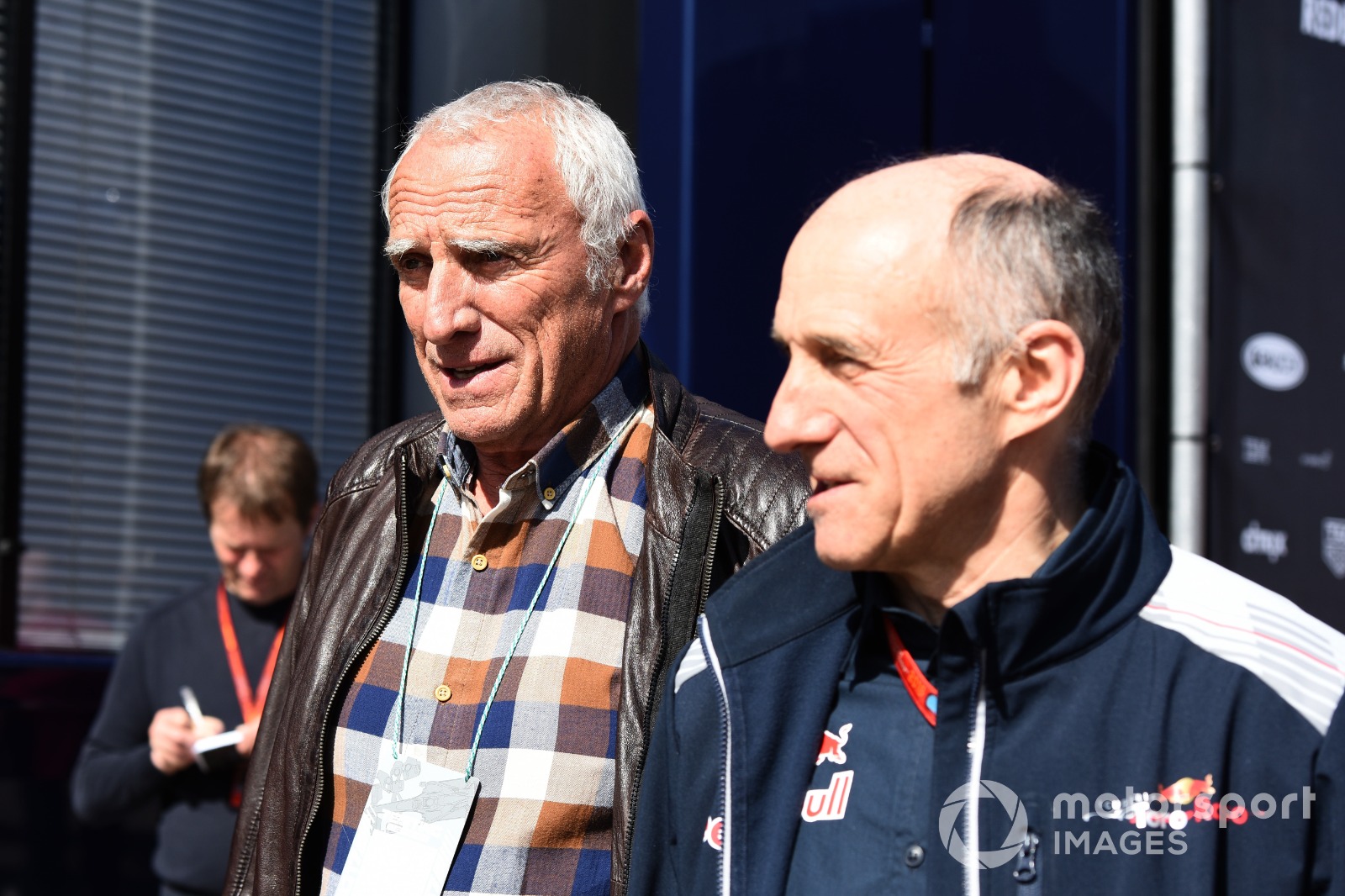
Photo by: Motorsport Images
Mateschitz and Tost enjoyed a good working relationship, aside from the matter of cutting down trees...
GPR: Why was that?
FT: "Because I made a decision to cut down a tree. There was a park and there was this big old tree and... I needed more working spaces. So we cut it down. But he loved trees. He said, 'Why, Franz? Why did you cut down this fantastic tree?' I said I needed working spaces, not trees. And he got upset. But that was the only time he ever got upset with me."
"When I was at BMW, sometimes after a race we would fly back to Munich and just go to the next gate to catch a flight to Jerez or Barcelona" Franz Tost
GPR: It is still difficult to recruit staff, isn’t it? Your technical director, Jody Egginton, spends four days a week in Faenza and then flies home for the weekend. How many people on the team do that?
FT: "Yes, much more now than in the early days. When I started, I wanted all the people to be in Faenza, with their families and so on. The experienced engineers are about 35-40 years old. Most of them are English and have families. And, when you ask them at the beginning, 'Do you want to come to Italy?' they’re all happy because they like Italy, but they have an image of holidays.
"After two or three months, the holiday atmosphere flies away. I observed, for example, that the wives always had to stay at home and look after the children. And then, after six months, a year at the latest, the problems began. And when I saw that, I changed my mind. Now, if we take an engineer from England, I prefer he has maybe Friday and Monday off, that he stays longer in England and then comes to Faenza from Tuesday to Thursday. And only if necessary. Nowadays, with all the communication tools we have, they don’t necessarily have to come every week.
"I’ve seen during these years that, if people want to work together, they can work together, even if they’re 2000km apart. If people don’t want to work together, they can sit next to each other and just exchange emails, but they don’t talk to each other. At the moment I think we have that under control because we also have a base in Bicester. We now say, OK, the engineers from England don’t need to come to Faenza every week because they can work from Bicester. And they just communicate via Zoom or whatever. It works."
GPR: So the plan for the future is to expand the UK base...
FT: "Of course, it’s much easier to find engineers in England than in Italy. But Faenza will always remain the centre of the team. However, with Bicester, and in the future with Milton Keynes – because Bicester is getting too small now and the team is building a new facility – we will have space to have more people in England."

Photo by: Simon Galloway / Motorsport Images
AlphaTauri has grown under Tost's leadership
When Tost says “people had to work a lot of hours” during the team’s transformation, the implication is those staff spent very little time at home during that period. He often comes across as being uncompromising, perhaps a little unreconstructed, with his half-joking remarks about his staff’s families being his “biggest problem” and that “people should be happy to work in F1” rather than complaining about calendar expansion. But, ask anyone at AlphaTauri and ‘demanding’ won’t be the first word they use to describe him. He is a caring, considerate and even kind boss.
But, as someone who is usually the first to turn on the lights at the Faenza factory in the morning, he does sometimes find it hard to understand why people don’t want to spend all their time building cars and going to races.
GPR: Is your wife interested in motorsport, Franz?
FT: "My wife... she watches the start of the race and then the chequered flag, because she wants to see the results to know if I get the bonus or not. That’s the only thing she’s interested in when it comes to motorsport."
GPR: But does she read the motorsport press? It’s interesting to know what she makes of your comments about every weekend away from the track being a waste of a weekend...
FT: "No, no, there’s no problem with that. I told her that from the very beginning. When we met – I was studying in Vienna and she was studying there too – I said, 'Look, I’m going to work in motorsport, I’m not going to be at home at weekends.' I told her right away that I didn’t want to have children because I wouldn’t have time for them. I said, 'I’m just telling you now so you know.' And fortunately she didn’t want children either. So that was easy. And the rest was no problem because she has her own business and when I’m not there she takes care of it. So it’s all good. We have a very, very good relationship. Also because I’m not at home all the time."
GPR: That probably makes the relationship stronger, right?
FT: "Exactly. It’s much better! But I spend a lot more time at home now than I did. When I was at BMW, sometimes after a race we would fly back to Munich and just go to the next gate to catch a flight to Jerez or Barcelona. We didn’t come home. Not just me, but other engineers too. It was normal."

Photo by: Steven Tee / Motorsport Images
Tost has worked with young talent including Verstappen, Vettel and Ricciardo
GPR: So all this talk about 24 races...
FT: "It’s a joke. Because, you know, nowadays at the track, I wouldn’t say it’s anything like a holiday. But... There’s a curfew. And the mechanics can go to the hotel at 9 or 10 o’clock, it depends. Hey, in the old days, for example, at BMW we changed an engine every day. On Friday we had the Friday engine, then we had the qualifying engine, then we had the race engine. And we never came back to the hotel before one or two in the morning. That was normal. And then at six or seven in the morning we had to get up and go to the track. Nobody complained.
"I said when I was younger that I wasn’t going to glue myself to the seat and I wasn’t going to wait for them to take me out" Franz Tost
GPR: No burnouts.
FT: "People didn’t know what it was. The real people still don’t know what it is. Burnout is for lazy people. The real people who like to work don’t have it. But I would say now 23, 24 races is kind of a limit. When I look at the schedule now, we go from Austin to Mexico, from Mexico to Sao Paulo – that means the team is away for about four weeks... For me, that’s absolutely no problem. But there are others. The mechanics have days off after the race weekend, but the engineers have less leisure time – because they come back after the race, then analyse everything, then they prepare everything for the next race. And if you have a family at home, it’s a different story."
GPR: Why don’t you want to stay in a consultancy role?
FT: "It’s not decided yet. We’re still discussing it. I don’t want to be a consultant and have more work than I have now. We’ll see. I’ll definitely not come to all the races. I’ll not be at the side of Peter [Bayer] and Laurent telling them to do this and that. No. They’re smart enough and experienced enough. And they have to do it on their own, because otherwise everything would continue in the same way and that should not be the case. They should come up with new ideas."
GPR: You once said that when you took this job you promised yourself not to forget to recognise the day when it’s time to step down. But that’s not easy. And how can you be sure the moment is right?
FT: "I told Dietrich Mateschitz two, three years ago that we had to find someone to succeed me because I wasn’t going to stand on the pitwall at the age of 70. And he said, 'Stay with us for another two or three years.' That time is over now. And you’re right, I said when I was younger that I wasn’t going to glue myself to the seat and I wasn’t going to wait for them to take me out with it or throw me through the window with it. And I think the team needs new leadership now.
"There will be a new regulation in 2026. All the work for this change has already started. And you can’t be team principal until the last moment and then, five minutes before the new regulations come into force, say, 'OK, now someone else should take over.' No, it has to be prepared well in advance.
"That’s why I decided two years ago I was going to stop. And that is now the case."

Photo by: Mark Sutton / Motorsport Images
After 18 years at the helm, Tost will say goodbye to F1

How Ratzenberger beat the odds to realise his cruelly short-lived F1 dream

F1 uncovered: A weekend behind the scenes with a chief mechanic

When McLaren was pipped by Red Bull in a modern F1 classic

The big opportunity Sainz’s Williams switch affords to F1’s latest centurion

Inside the science of F1 fuel

How F1’s plan for rotating races could look in practice

The early decisions that set Sauber’s rookie for success

How F1 media coverage has evolved in line with its subject

Evans: Late puncture was “harsh” but WRC title position is still "okay”

How Antonelli is proving unbeatable, even when he's beaten

F1 drivers push for Madring changes after "very poor" Spanish GP: "I almost fell asleep"

WRC Chile: Solberg seals victory as Toyota wraps up manufacturers’ crown
Subscribe and access Autosport.com with your ad-blocker.
From Formula 1 to MotoGP we report straight from the paddock because we love our sport, just like you. In order to keep delivering our expert journalism, our website uses advertising. Still, we want to give you the opportunity to enjoy an ad-free and tracker-free website and to continue using your adblocker.


Top Comments