


What we learned on day one of the second 2022 F1 test
With the second Formula 1 test of 2022 underway in Bahrain, the rivalry between Red Bull and Mercedes has once again been reignited. Matt Kew looks at the latest episode in their fierce fight, this time centring around Mercedes' radical new sidepod design

If there’s a perfect snapshot of the mentality that Red Bull harbours towards Mercedes - and Mercedes possesses regarding Red Bull - then oddly, it’s to be found in the lyrics of a classic show tune. ‘Anything you can do I can do better. I can do anything better than you’. So far in 2022, that involves scrapping for sidepod supremacy.
Wind back 15 days to the first morning of the 2022 Formula 1 pre-season ‘shakedown’ at Barcelona and the artistry of the aerodynamics team led by Adrian Newey was the talk of the town. Even in the context of the new rules unexpectedly paving the way for greater design differentiation between teams, the RB18 looked radically different to its rivals.
It doesn’t take an engineering degree to appreciate where Red Bull had been far more savage. Diminutive inlets appear to have been milled at right angles by a meat cleaver. The top of the sidepods seem to float in line with Max Verstappen and Sergio Perez’s shoulders rather than flow down into pronounced hips as per convention.
Not to be out done, Mercedes has fought back with its own sidepod showstopper a fortnight later. Come Thursday, the first day of the official pre-season test at Bahrain, heavily revised bodywork adorning the W13 broke cover.
The notion of a reworked car hadn’t arrived out of the blue. In the immediate aftermath of running at Barcelona, when Lewis Hamilton pipped new team-mate George Russell to the top of the times by a tenth of a second, with Perez another 0.3s in arrears, rumour was rife that Mercedes hadn’t shown its true hand. Following the precedent set in 2019, there was a growing expectation the three-pointed star would turn up at the next test with a heavily revised package. Mercedes hasn’t disappointed.
Overall fastest times on day one
| POS | DRIVER | TEAM | TIME | LAPS | TYRE |
| 1 | Gasly | AlphaTauri | 1m33.902s | 103 | C5 |
| 2 | Sainz | Ferrari | 1m34.359s | 52 | C3 |
| 3 | Leclerc | Ferrari | 1m34.531s | 64 | C3 |
| 4 | Stroll | Aston Martin | 1m34.736s | 50 | C5 |
| 5 | Albon | Williams | 1m35.070s | 104 | C4 |
| 6 | Norris | McLaren | 1m35.356s | 50 | C2 |
| 7 | Bottas | Alfa Romeo | 1m35.495s | 66 | C3 |
| 8 | Vettel | Aston Martin | 1m35.706s | 39 | C3 |
| 9 | Russell | Mercedes | 1m35.941s | 60 | C3 |
| 10 | Perez | Red Bull | 1m35.977s | 138 | C2 |
| 11 | Hamilton | Mercedes | 1m36.365s | 62 | C3 |
| 12 | Alonso | Alpine | 1m36.745s | 24 | C3 |
| 13 | Ocon | Alpine | 1m36.768s | 42 | C2 |
| 14 | Zhou | Alfa Romeo | 1m37.164s | 54 | C3 |
| 15 | Fittipaldi | Haas | 1m37.422s | 47 | C2 prototype |

Lewis Hamilton, Mercedes W13
Photo by: Mark Sutton / Motorsport Images
By using the spec Side Impact Structures (SIS) as separate fins, Mercedes has been able to shrink its sidepod design wildly with only a vertical letterbox to denote the traditional sidepod inlet. Thanks also to the reappearance of vents first trialled in Spain to extract heat, Mercedes can keep its 1.6-litre V6 turbo hybrid engine cool while heading in an extremely compact direction.
With the W13 looking not unlike the Lamborghini 291 challenger from 1991, the idea is that the smaller cross-sectional area cuts drag and to give the floor a boost. That arrives with the trade-off that Mercedes loses the interaction between the corner of the sidepod working with the tyre wake.
"I'm proud to be part of a team that's pushing innovation and all this hard work - blood, sweat and tears" George Russell
Given porpoising was the hot topic in Spain, perhaps it wasn’t too much of a surprise that another maritime metaphor came to mind when Autosport ventured trackside at Turn 10 in Bahrain to watch Lewis Hamilton get to grips with his facelifted motor in the morning.
As a result of the heavier cars that the new rules have mandated, none of the machines look especially lithe through the downhill, cambered left-hander. Lock ups are just as frequent as apexes. But the slower speeds as Hamilton exits the corner gives plenty of time to take in the rear three-quarter angle of the W13.
Where the narrow sidepods seem to melt completely into the floor, which in turn ripples around the edges to exploit ground effects to the maximum, the Mercedes looks not unlike a cuttlefish.
Russell made of the aesthetic: “I guess it looks interesting, but it's not about how it looks. It's about how fast it goes. It obviously caught quite a few people's eyes this morning. I'm proud to be part of a team that's pushing innovation and all this hard work - blood, sweat and tears. Seeing something pretty spectacular being pulled off is pretty incredible.”

Sergio Perez, Red Bull Racing RB18
Photo by: Carl Bingham / Motorsport Images
It soon became clear the profound changes to the W13 had caught rivals and legislators a touch off-guard. Respected German publication Auto Motor und Sport soon quoted Red Bull team principal Christian Horner as having questioned the legality of the design and the spirit in which it was conceived. The team’s communications department then moved to deny Horner had spoken to any media, or if he had, it wasn’t for public consumption…
Later, F1 managing director Ross Brawn admitted that when the somewhat prescriptive new rulebook was written, the minimalist Mercedes layout had not been foreseen. In addition to doffing his cap to the “impressive” innovation, Brawn added: “There's no doubt that the Mercedes concept we didn't anticipate. It's a very extreme interpretation of the regulations.
"And I think inevitably, there's going be a lot of debate about their interpretation. That's what happens with new regulations. However hard you try to close off all the options, and believe me, we closed off hundreds of them, as I say, the innovation in Formula 1, it's always extreme.”
The current unknown, though, is just quite where the W13 sits by the letter of the law. Brawn, speaking on behalf of the championship, continued: “From our perspective, it's largely about ‘does it affect the objective of the regulations?’. From the teams’ perspective, they want to be sure that no one's taken an interpretation that they don't feel is correct. I think there's going to be a lot of debate in the next few days.”
A revised system of governance for 2022 ensures that if the Mercedes design was to be protested, and subsequent amendments forced through, this would now only need to be backed up by an 80% supermajority from fellow teams, plus the approval of the FIA and F1. Previously, the process was less fleet of foot as unanimous support was required in the paddock.
Brawn added: “You have to be fair. When a team comes up with an idea, with innovation, with novelty, you shouldn't penalise it straight away. [The FIA] are OK with it so far. But of course, a team may come in and raise an objection that the FIA hadn't considered. Then you have a problem.
“I'm sure there's going to be a lot of discussion about it. But it's impressive for a set of rules, which everybody said were too prescriptive. We're seeing all these solutions."

Christian Horner, Team Principal, Red Bull Racing, Helmut Marko, Consultant, Red Bull Racing
Photo by: Carl Bingham / Motorsport Images
In the current context, perhaps it wasn’t too surprising to hear Mercedes motorsport boss Toto Wolff express his preference for the old, more unified method of governance. But the Austrian stressed there had been communication with the FIA and an exchange of CAD data to ensure transparency should the governing body have wanted to prevent the shrinking sidepods sooner.
Wolff continued: "The car, we are really proud of what we have achieved in terms of concept. But now we need to make it go fast. It's a development direction that we like and it's about feeling the car and so we are experimenting a lot with what we've done during the day and approaching it with curiosity.
“It's clear that sometimes when you come with an innovation, it creates the kind of debate that we're having here… You possibly can't take it off the car if it's compliant with the regulations. We were keen in not running around, or not running alone, being in touch with the FIA. That's why I think it will be OK.”
"It's clear that sometimes when you come with an innovation, it creates the kind of debate that we're having here" Toto Wolff
With the risk that the shrink-wrapped sidepods will spawn protests and bitter debate, in the first instance there should be an appreciation that the two likely title contenders in Red Bull and Mercedes have found such visually different ways to skin their respective cats.
The shift to ground effects initially, at least, has introduced diversity before an inevitable convergence around the optimum solution. Factor in the Ferrari ‘bathtubs’, the elongated Aston Martin design and more, it’s quite clear that one size does not fit all in 2022.
While the Brackley and Milton Keynes design departments have devised drastically different sidepods, they can still find common ground in that they remain afflicted by porpoising. It still seems as though it’s the McLaren MCL36 that has navigated the 1980s phenomenon best of all. There was no trace of the jumping while Lando Norris was at the wheel for 50 laps in and around morning brake issues.

Lando Norris, McLaren MCL36
Photo by: Mark Sutton / Motorsport Images
Team lap chart on day one
| POS | TEAM | LAPS |
| 1 | Red Bull | 138 |
| 2 | Mercedes | 122 |
| 3 | Alfa Romeo | 120 |
| 4 | Ferrari | 116 |
| 5 | Williams | 104 |
| 6 | AlphaTauri | 103 |
| 7 | Aston Martin | 89 |
| 8 | Alpine | 66 |
| 9 | McLaren | 50 |
| 10 | Haas | 47 |
In their bids to combat the ground-effect side-effect, Mercedes, Alfa Romeo, and Ferrari all turned up in Bahrain with carbon rods poking out from the base of the engine cover that attach to the floor to minimise flex in a bid to ward off the stalling air.
But not only did the oscillating persist, with Mercedes and Alpine – the latter now running with DRS - seemingly hurt most of all as per Spain, but the move to Sakhir meant drivers could now experience the nauseating rocking motion through the medium-to-high-speed corners that are missing from the Barcelona lap.
Where porpoising could be spotted quite clearly from behind the barriers, there is still much to be learned about the obscured leaderboard. Pierre Gasly set the pace as dusk set in over the gusty Gulf circuit, the AlphaTauri pilot flashing the line at 1m33.902s. However, that arrived on the softest C5 Pirelli tyres, to place him an unlikely six tenths clear of the C3-shod Ferraris of Carlos Sainz Sr and morning pacesetter Charles Leclerc.
And just for good measure, when Gasly had bolted to the top with 25 minutes to go to potentially tee up the testing equivalent of a sprint finish, the session came to an abrupt halt. With eight minutes of the four-hour afternoon session left on the clock, Perez backed the RB18 into the gravel at Turn 8 while cruising under practice virtual safety car conditions and brought out the red flag to deny any late charges.
Against its benchmarks, the best of Gasly’s 103 laps put him 1.9s down on the fastest lap recorded in the 2021 Bahrain Grand Prix, as set by former Mercedes driver Valtteri Bottas. Verstappen’s pole time the previous day has been a substantially quicker 1m28.997s.
However, there must be the usual testing considerations that engine modes and fuel loads weren’t divulged, so times are expected to fall over the remaining two days as a captive F1 audience waits patiently to see which one of Milton Keynes or Brackley has done it better.
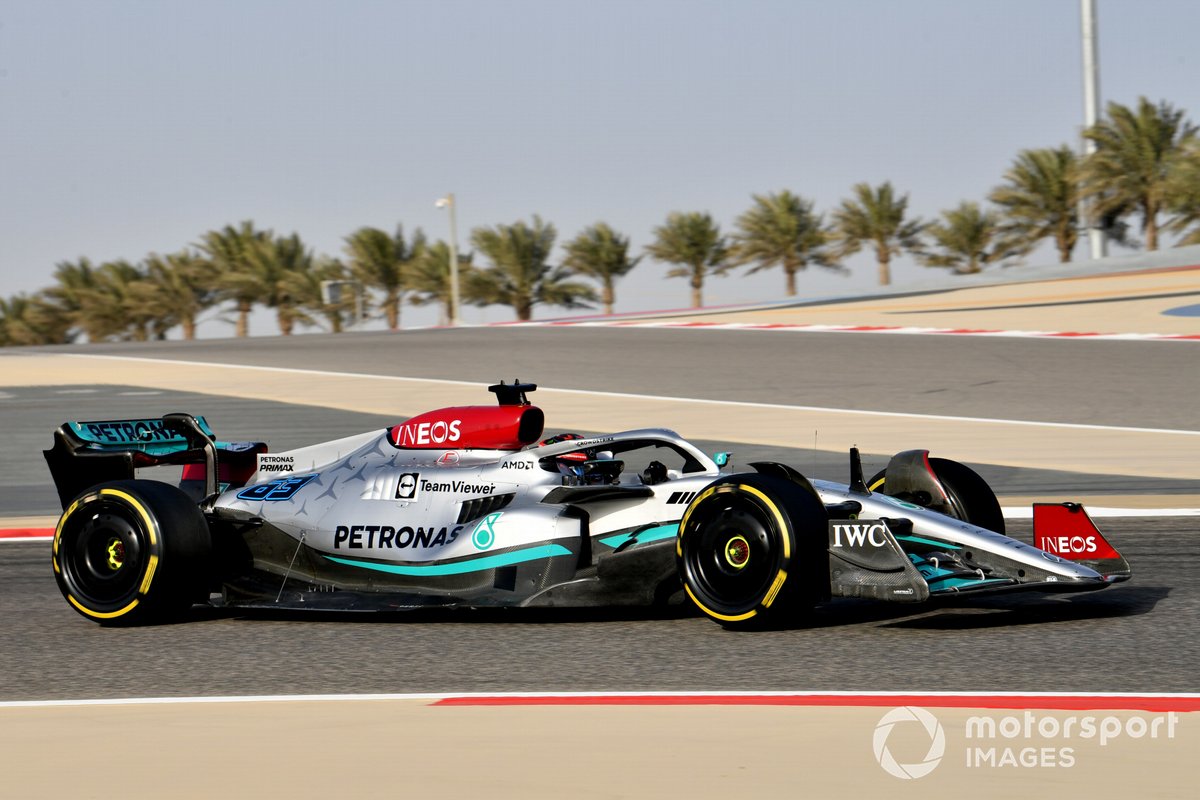
George Russell, Mercedes W13
Photo by: Mark Sutton / Motorsport Images


Marko: Perez improved F1 form because 2025 contract talks are at stake

Russell explains how low-fuel runs expose Mercedes F1 inconsistency

Leclerc: No answer for "once in a season" Japan F1 qualifying struggle

Sainz: Now time to "speed up" talks to find 2025 F1 seat

Hamilton: Vettel an "amazing option" as Mercedes F1 replacement

Sargeant to race repaired F1 car in Suzuka; no spare Williams until Miami

Pirro leaves role as McLaren F1 academy chief

The impatient pair who’d hoped to be a thorn in Red Bull’s side again

WEC Barcelona: Genesis secures maiden series pole from Toyota
What drives Bortoleto as his junior rivals hit new heights in F1

How the M8B became the most dominant car in McLaren’s history

What Verstappen knew about Red Bull’s big upgrade when he signed his new F1 deal
Subscribe and access Autosport.com with your ad-blocker.
From Formula 1 to MotoGP we report straight from the paddock because we love our sport, just like you. In order to keep delivering our expert journalism, our website uses advertising. Still, we want to give you the opportunity to enjoy an ad-free and tracker-free website and to continue using your adblocker.


Top Comments