


What we learned from the Chinese GP sprint race and qualifying
With Formula 1’s sprint race format getting a first outing this year, it set teams a harder task of banking valuable data and tyre information for Sunday’s Chinese GP. The schedule also left all teams blind on what is set to be the most important tyre compound of the entire race weekend

A literal take on a well-known idiom might be the only opportunity to secure victory at this year's Chinese Grand Prix. Given the profusion of worn tyres and decreasing grip over the course of the 19-lap sprint race, the solution to overcoming that is hidden in the following phase: go against the grain.
Graining, the phenomenon where the surface of the tyre rubber overheats and starts to form ripples in the surface, is nothing new in Formula 1 - particularly when it comes to the Shanghai circuit. Long radius corners and its front-limited nature tend to create sliding around the front axle if the drivers fail to minimise slip angles, which scuffs at the tyre surface and creates unevenness on the contact patch. At that point, the tyres struggle to cling on - particularly in another car's wake - and start to slide more, upgrading the graining into an accelerated phase of degradation. As is natural for a clockwise circuit, the left front was taking most of the pain.
A driver can circumvent this, but it requires a tacit acceptance of short-term pain. By backing off and surrendering a few seconds to the car in front, sensible inputs at the wheel can bring the tyres back into the frame and clear up the graining pattern from the surface. The thing is, there might be a faster driver behind that isn't struggling quite so much - and any attempt to race them prematurely as they come into view can very easily force a graining relapse.
Oscar Piastri, so long as he retains his lead into the first corner, will have the easiest job in doing so. It's fair to say that McLaren struggled with graining during the sprint race, and team principal Andrea Stella reckoned that the mechanisms it had in place to overcome it were not quite up to par. Yet, green shoots were visible when the tyre fog cleared up enough for Lando Norris to displace Lance Stroll for eighth and get onto Andrea Kimi Antonelli's tail. And, with the benefit of post-sprint tinkering in the garages, most of the teams will have combed through the data to implement some fixes for how the front tyres are used.
Thing is, there's still going to be plenty of jostling into the long first corner and into the Turn 3 transition - the bottleneck at which the side-by-side positional play will eventually be forced through the mangle into single file. With the notion of clean air being the carrot on the stick, there's a lot riding on the opening carousel of corners.
Graining and degradation on medium tyres
Since the sprint race neatly acts as a race simulation for a given stint, it's possible to draw a few conclusions from the overall race pace from the top four teams. And there's a few similarities; for one, the effect of graining starting to strike at around laps seven and eight, as lap times dropped off. It was here that, after Max Verstappen began to harry Lewis Hamilton in his bid to take control of the 19-lap race, he began to feel the effect of the Ferrari's turbulent air.
At this point, it's a cycle: spend too long in the dirty air, lose front-end performance, the front tyres start to slide, they grain, and then the lap time starts to distend to a point at which a driver needs to recover it. That's the point at which a driver chooses to either back off and try again later in the hope that the driver ahead is over-pushing, or keep going in the hope of forcing an error at the risk of losing the tyres completely.
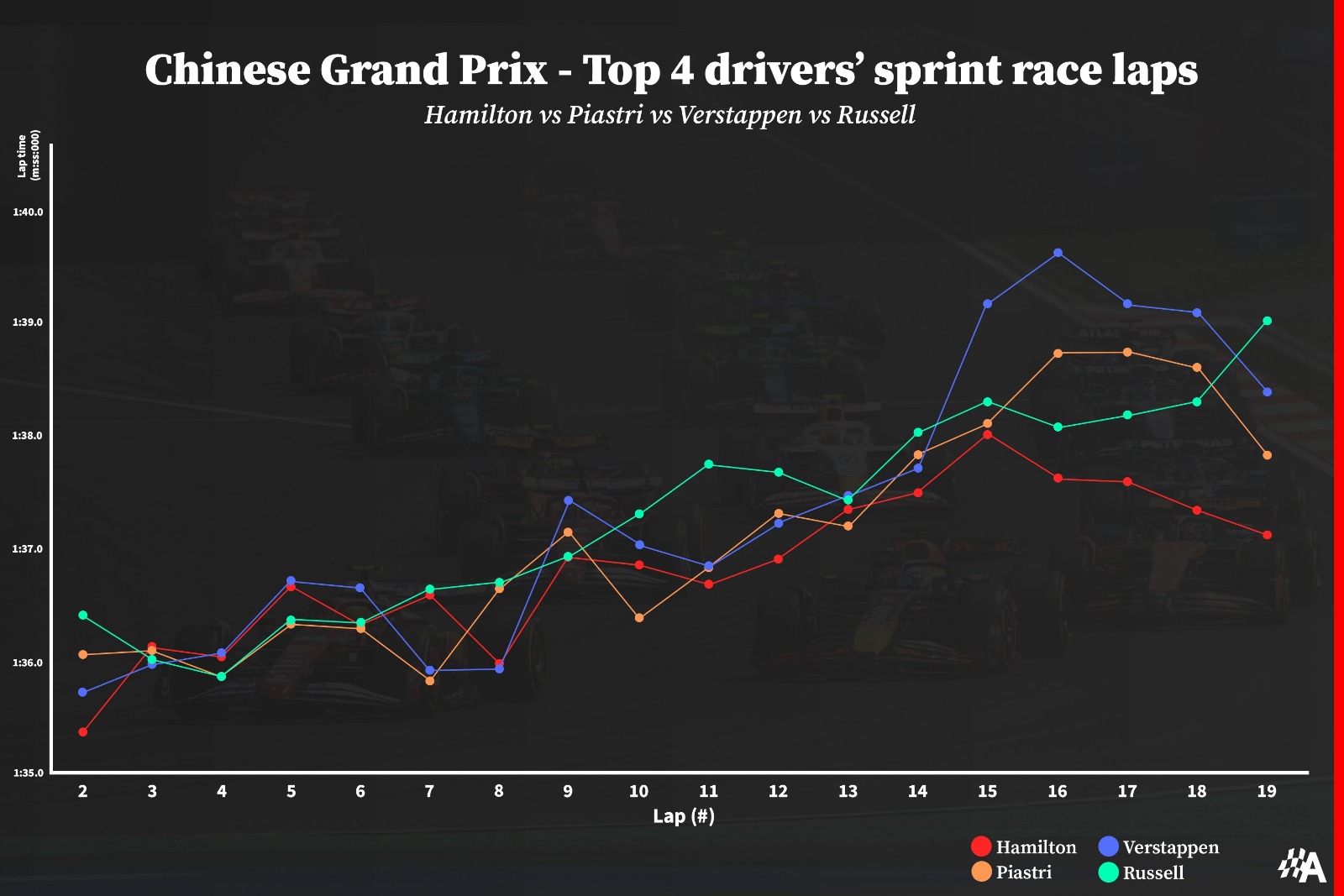
The top four teams' race pace in the Chinese GP sprint
Photo by: Autosport
Verstappen did the latter, and you see the effects of that circa lap 14. This allowed Piastri to make his play, relegating the Dutchman to third.
Piastri was also fighting the effects of graining-turned-degradation, but the drop in performance was not nearly as precipitous as Verstappen's at this phase. He was still ensconced within the 1m38s, while Verstappen had fallen into the 1m39s and risked becoming prey to an incoming George Russell if he could not stabilise his pace. Ultimately, he managed to do so, as Russell seemed to have hit the end of his medium tyres' tenure by the final lap.
It wasn't that Russell had been completely profligate with his tyre life in the opening stages of the race, although his pace between the third and sixth laps had matched the cars ahead. This might have exacerbated some of the graining, which seemed to bite in the subsequent six tours, before it evened out and he started to outpace the McLaren and Red Bull ahead. But Russell was forced onto the defensive on the final lap as Charles Leclerc started to probe for overtaking opportunities, the Ferrari looking in a marginally brighter spot with its tyres.
Hamilton resisted the temptation to break beyond the DRS's one-second grace delta, as he made sure he was not burning out his own chances to clinch his first win of any kind for Ferrari
Hamilton had the best place to slowly bring his tyres into the race and, despite Verstappen's occasional challenges, benefitted from it. The clean air in front was doing its bit to help the tyres and ensured that, amid the degradation, the Ferrari driver could maintain a flatter pace trace throughout the stint and minimise the depreciation of lap time at the end. That Hamilton resisted the temptation to try and build a break beyond the DRS's one-second grace delta was also vital, as he made sure he was not burning out his own chances to clinch his first win of any kind for Ferrari.
Hard tyre a complete unknown, two-stopper expected
Given the tight turnarounds of a sprint race weekend, nobody dared venture onto the hard tyre in the sole free practice session available. As such, allied to the effect of the new track surface, nobody has any data for the C2 Pirelli compound - and yet, it'll likely be the tyre that'll be used most on Sunday.
Pirelli motorsport chief Mario Isola believes that it'll be a two-stop strategy, given the high levels of graining and wear experienced within the sprint; the 19-lap stint might have even been too long for the medium to cope with.

Teams will be concerned about having no information on the hard tyres
Photo by: Greg Baker - AFP - Getty Images
"The wear of the medium with 19 laps is quite high and, for some teams it was at the limit," Isola explained. "That means that for tomorrow it is confirmed that we believe it's a two-stop strategy, medium-hard-hard. Nobody has information or data on the hard, but this is probably the only option.
"I heard someone talking about a three stop - to be honest, I don't think it's a three stop, but it's feasible managing the tyres considering the track evolution for tomorrow, considering that we don't have rain, so the track is improving and the graining is going to be less tomorrow, so a two stop is feasible.
"If you start from the back of the grid, the option is also to start on the hard and try something different or keep the medium for the last stint. That means, with a lighter car, you generate less graining, you can attack a bit more."
With no hard tyre data, the lap-time delta and wear forecasts are simply predictions. Selecting that crossover point between the medium and hard between the first two stints will prove an important battleground, and the prospect of a two-stopper should offer a bit of variation.
Consider the two Williams drivers, as Carlos Sainz made a mid-race stop for mediums in the sprint while Alex Albon stayed on the same set; at the start of Sainz's second stint, he was three seconds per lap up on Albon, with a little convergence towards the end (ignoring the final lap, as Sainz encountered the clash between Jack Doohan and Gabriel Bortoleto). Isola estimates that you lose about 23 seconds for a pitstop and, assuming the hard tyre is anywhere between 0.5s-1s slower than the medium at peak performance, that kind of delta between similar machinery on different tyres would be a helpful marker for other teams should anyone make an early call.
Could someone short-stint the mediums back-to-back, and transition to a three-stopper with two sets of hards at the end? Isola doesn't seem to think so, but the gamble is there to take.

Sainz pitted during the sprint race, raising the prospect of a three-stopper for the grand prix
Photo by: Sam Bloxham / Motorsport Images
Any indications of change from qualifying?
Compared to the sprint, the overall grand prix qualifying times suggest that McLaren and Mercedes have made a successful effort to get ahead of Ferrari. And, although Hamilton thrived in the clear air at the front of the sprint race, Leclerc found a much more arduous task to battle tyre wear while racing within the pack. Even if Ferrari makes a step forward with its race pace, it'll be a difficult task to follow up the sprint with another race win.
Norris looked a little more at home with the McLaren in qualifying, although was perhaps guilty of overdoing it on his final lap; Stella suggested that the Briton is much more potent when driving at 99%, rather than reaching for the golden 100. Staving off Verstappen at the start and dispatching Russell in short order will be his mandate for the opening laps, lest he become stuck behind them and suffer a repeat of his sprint race struggles with graining.
Seeing off Verstappen should be doable, as Red Bull continued to struggle with higher tyre degradation. Russell has a chance of keeping Norris behind if Mercedes has found a bit more race pace during the sprint-to-qualifying interregnum, but McLaren does have an advantage overall. Per Isola's assertion that graining should have reduced by the time we reach Sunday's race, then McLaren has a scenario that plays into its hands.

McLaren is still the favourite, but can it keep clear of the chasing pack?
Photo by: Zak Mauger / Motorsport Images


What caused Mercedes' pace deficit at Sepang despite upgraded W17?

Three kings: F1's generational stars shone at Sepang

Bahrain Grand Prix in Malaysia Driver Ratings 2026

The slick tyre gamble that hurt McLaren and Ferrari's chances in Bahrain GP in Malaysia

The wide world of strategy options expected in F1's Bahrain GP in Malaysia

McLaren explains recurring Norris straightline speed issue after Bahrain GP qualifying

How drivers waiting in the wings can still make their presence count in F1

What we learned from Friday practice at the 2026 Bahrain GP in Malaysia

A story of persistence as Evans' long wait for WRC glory finally ends

What caused Mercedes' pace deficit at Sepang despite upgraded W17?

The contrasting tactics used by Ducati and Aprilia in MotoGP 2026 title fight

Three kings: F1's generational stars shone at Sepang
Subscribe and access Autosport.com with your ad-blocker.
From Formula 1 to MotoGP we report straight from the paddock because we love our sport, just like you. In order to keep delivering our expert journalism, our website uses advertising. Still, we want to give you the opportunity to enjoy an ad-free and tracker-free website and to continue using your adblocker.


Top Comments