


What we learned from the 2025 F1 Brazil GP sprint race and qualifying
Overnight rain and gusty conditions created a tricky sprint race and a surprising qualifying result in Saturday's sessions in Sao Paulo. But the fun should continue into Sunday's Brazil Grand Prix - and here's why

A sense of deja vu permeated the Interlagos paddock amid the pings of storm warnings, disseminated into the home screens of the myriad phones lain on hospitality tables. The worry was that, for the second year in a row, Saturday's running would be affected to the point where qualifying may have bled over into the Sunday morning schedule; those working at Brazil's Formula 1 proceedings last year were dreading the potential 4am wake-up call...
As it happened, the storm - scheduled for the hours of 6am-9am - arrived early, leaving its liquid droppings on Sao Paulo overnight. A damp and breezy morning emerged from the cackle of thunder, thankfully with little interruption to the day's schedule. However, the overnight downpour had washed away any of the meaningful grip generated through Friday's sessions, transplanting another variable into the equation for the sprint and for qualifying.
Since surface grip was at a premium, reinforced by the inconsistent distribution of wet patches around the track, there was a split in compounds; those comfortable with their tyre preparation on the formation lap opted for the medium, while others opted to take some margin with the conditions and applied the softs. Polesitter Lando Norris opted for a fleet-footed formation lap to inject some extra temperature into his medium tyres, largely to cover off fellow front-row starter Andrea Kimi Antonelli - who began the race on softs.
The sprint demonstrated - twice - that the medium tyre was the one to be on. Norris resisted any early assaults from Antonelli and began to build an early sprint-race break, at least until Oscar Piastri wrapped his own McLaren in the wall at Turn 3.
Although the circuit was drying, the kerbs were still imbued with a smattering of puddles. As confidence grew, the drivers began to attack the inside kerb at the Curva do Sol; Piastri arguably squared up to it too much, and paid the price as the rear end kicked out. Nico Hulkenberg and Franco Colapinto did likewise, although the Sauber driver managed to untangle himself from the accident.

Sao Paulo's sprint race produced three separate Turn 3 incidents - all on lap six
Photo by: Kym Illman / Getty Images
The circuit dried a little more during the intervening red flag, creating a starker demonstration of the difference between the softs and mediums. Norris, now equipped with softs, broke ahead of Antonelli (who switched to mediums) with a 1.4-second lead on the restart - but this was as good as it got. Indeed, Antonelli stabilised and began to put Norris under pressure in the final part of the race as the softs were starting to find life difficult.
Pirelli's estimates suggested a delta of between 0.2-0.3 seconds between the soft and the medium, but the low-grip track surface generated a considerable quantity of rear-end sliding. As such, the medium held up more as the surface of the softs was much more prone to overheating, particularly at the rear. With no running on a circuit that was essentially green, the teams had no idea that the softs would be so capricious. Changing winds did not help the situation either, with grip levels different from lap to lap.
Antonelli looked incredibly lively over the sprint race, and the reproduction of the same front row for the grand prix suggests that the Italian will attempt to put Norris under a bit more scrutiny on Sunday
This explains Norris' loss of pace towards the end of the sprint, and also that of Fernando Alonso - who had similarly switched to softs for the sprint's second act, challenged Max Verstappen for two laps, and then fell behind Charles Leclerc. It was difficult to keep the C4s in the window, while the C3 seemed to cope a little bit better with the situation.
Will the GP bring McLaren vs Mercedes, round two?
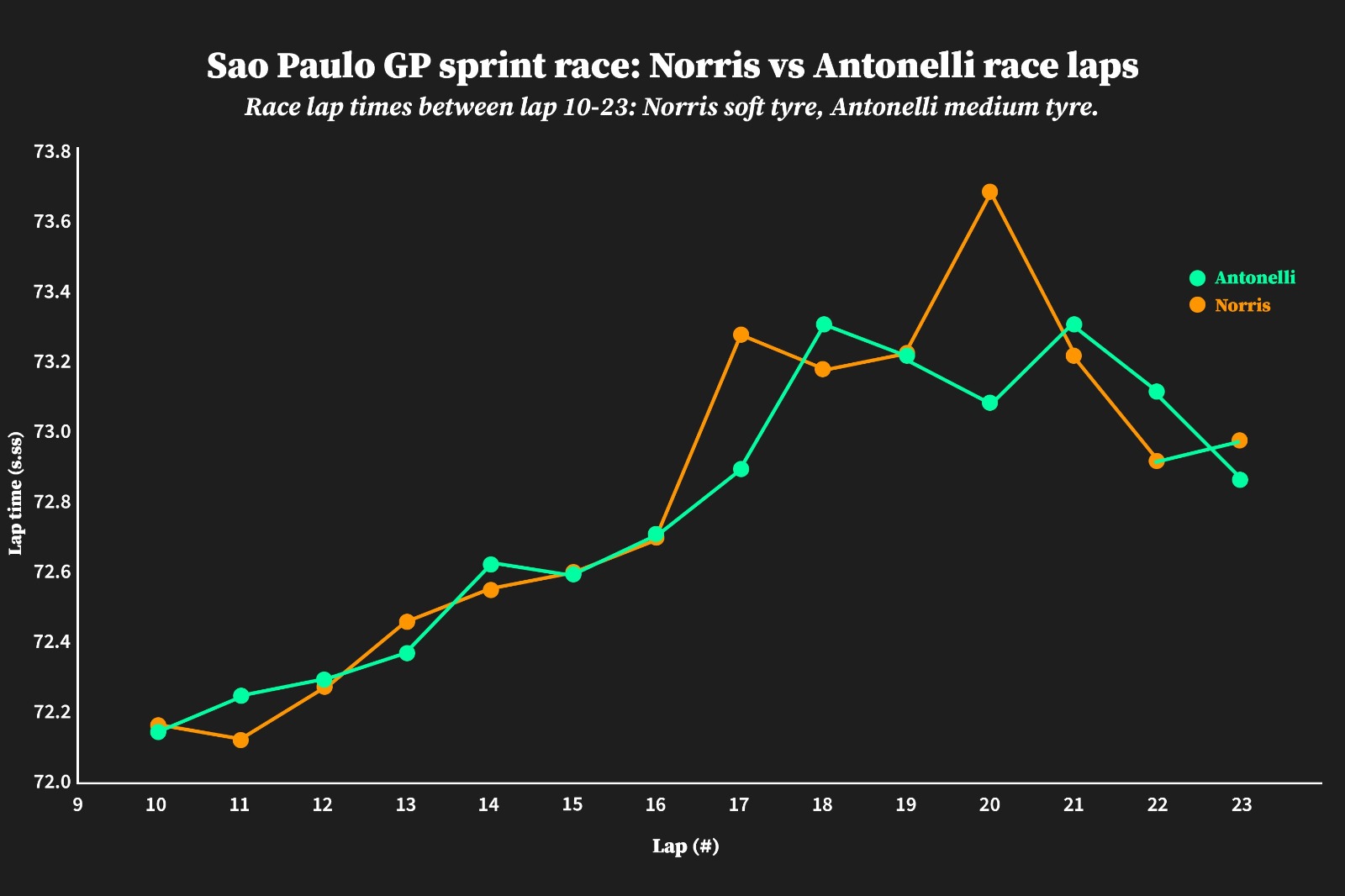
When plotting Norris' sprint race laps on softs versus those of Antonelli on mediums, a more gradual lap time curve can be observed from Antonelli's side before he starts to have his own pace affected by the car ahead.
Norris had to contend with a couple of peaks in his overall lap times, although the ultimate slower pace of his lap 20 (a 1m13.689s) versus Antonelli's (a 1m13.082s) perhaps helped him to bleed some of the heat out of his rear tyres and maintain enough of an edge over the Italian teen over the final three tours.
"It's fair that we were a bit concerned after the sprint in terms of the run on consecutive laps," Andrea Stella admitted following Saturday's sessions. "Because we saw that Mercedes was very fast. There was a difference of tyres, I think we have seen which tyre is the most competitive; due to the red flag there was a swap, like those who started on soft went on medium, and vice versa, and I think now everyone understands which tyres are the best.
"Independently of the tyres, I think Mercedes is very, very close, as we see also in qualifying. In terms of what we learned from the sprint, there's a few things that we could change to make the car faster, but there's a few things that we also needed to take into account to consider that the race is three times longer than a sprint; it's three times more laps that your car is going to contact the ground, so you have to take this into account.
"This is not going to make the car faster for the race, because you need to play slightly more conservative."
Antonelli looked incredibly lively over the sprint race, and the reproduction of the same front row for the grand prix suggests that the Italian will attempt to put Norris under a bit more scrutiny on Sunday. Of course, Antonelli has nothing to lose; there's one car between him and the chance of a first Formula 1 win, and it just so happens to be the championship leader.
He's planned ahead for this. Mercedes chose to give George Russell the medium tyre for his final Q3 run, as the Briton was not finding a particularly good groove with the soft compound - even over just one lap. Antonelli considered a similar route, but thought it was best to keep the sole set of mediums unadulterated from an experimental qualifying lap.
"The grip [on the medium] just felt better, the tyre felt more robust, especially throughout the whole lap," Antonelli explained. "So definitely, we had a thought about it because we thought that there was not much of a gap. But I thought as well that, because I felt good on the soft, I thought it would be better to keep it for tomorrow. We have new tyres, so that’s good, especially for the start. I think that was the right choice in the end."
"Anomalous" midfield could bring some drama

Gasly impressed in qualifying, despite the limitations of his Alpine machinery
Photo by: Sam Bloxham / LAT Images via Getty Images
Stella termed the mix of midfielders behind the McLaren-Mercedes-Ferrari top three as "anomalous", thanks to the Q3-interloping performances of the Racing Bulls, Haas, and Alpine cars, while both Red Bulls dropped out in Q1 for the first time since the 2006 Japanese Grand Prix.
Throughout the year, there's been an ebb and flow of the midfield teams, and it's understood that this relates to ride-height sensitivity; raising the ride heights post-sprint will be one of the key changes made around the grid, as the reduced floor wear in the sprint (owing to the shorter race distance) prompts teams to be more aggressive. They can't do that for the grand prix, and thus will have to be more conservative.
Owing to the bumpiness, teams will take even more margin with ride heights. This is suspected to be one of the reasons why Red Bull fell so dramatically out of the window; Verstappen reported that the car bounced less during qualifying, but had no grip across his qualifying laps.
It's likely that Red Bull will trade in Verstappen's lowly 16th on the grid for an engine penalty and perhaps tinker with the set-up to rescue something from the race; otherwise, the Dutchman might be in for a very long afternoon
Those are clues that point to the ride heights being much lower for the sprint events, provoking bouncing over the bumps as the floor strikes the ground, and the lack of downforce at the rear for grand prix qualifying suggests that the team has had to jack the car up more.
Those teams who performed uncharacteristically well in qualifying are likely those who enjoy the higher ride height conditions, as they've been designed around a more balanced concept that doesn't quite generate the peaks involved with lower heights. It's likely that Red Bull will trade in Verstappen's lowly 16th on the grid for an engine penalty and perhaps tinker with the set-up to rescue something from the race; otherwise, the Dutchman might be in for a very long afternoon. Without rain, producing a recovery drive akin to 2024's Brazil race would be a tough ask; breaking parc ferme might give him a fighting chance.


Verstappen may start Sunday's race from the pitlane - and if he does, can he turn in a recovery masterclass again?
Photo by: Mark Thompson - Getty Images


Mission control: Inside the FIA and F1's latest answer to football's VAR

FIA expects F1 races in Qatar and Abu Dhabi to run as planned

Why Piastri has struggled to show his best with this year's McLaren MCL40

Lights, Camara, action: How Haas picked F1's latest rookie for 2027

Horner's inside story of how Red Bull built its own F1 engine

Why Mercedes' latest 2026 F1 update is no downgrade

Singapore Grand Prix Driver Ratings 2026

What we learned from the 2026 F1 Singapore GP sprint race and qualifying

How Antonelli will manage the pressure as F1 coronation looms

Verstappen warns COTA bumps are “unacceptable” and “out of control”

Why Colapinto spoke out against abuse targeting his own F1 team

Sainz yet to be "convinced" that F1 2026 will finish in the Middle East
Subscribe and access Autosport.com with your ad-blocker.
From Formula 1 to MotoGP we report straight from the paddock because we love our sport, just like you. In order to keep delivering our expert journalism, our website uses advertising. Still, we want to give you the opportunity to enjoy an ad-free and tracker-free website and to continue using your adblocker.


Top Comments