


What makes Hamilton's 'barn find' Ferrari F40 so important
More than a fashion accessory, the F40 is a historically significant car which ties Hamilton in to past Ferrari legends

Autosport Business
Covering industry news and insight into the business of motorsport
"I'm more into art nowadays," said Lewis Hamilton a year ago when he revealed he had divested himself of his entire car collection. But he admitted he still hankered after an F40, on account that it was "a piece of art".
His dramatic arrival at Monza this weekend in a recently restored F40 was a grand, ostentatious gesture – typically of Hamilton, carefully curated right down to the details of his garb. But the F40 is more than just a fashion statement. Hamilton himself has admitted that while first he merely wanted to possess it, he quickly found himself wanting to drive it.
The F40 occupies a fascinating niche in Ferrari history and there is more to its story than you'll find in the endless YouTube videos and search-engine-optimised articles which essentially rehash the same Wiki-factoids from each other. Like anything bearing the fingerprints of marque founder Enzo Ferrari, there is a fuzziness around the edges befitting a man who delighted in being the centrepiece of his own myth.
When Ferrari sold a majority stake in his company to Fiat in 1969, he ceded control of the road car division while racing remained his bailiwick. Fiat's ownership hastened the end of the company's old model of artisan construction, shifting towards more conventional mass-production methods – and, it must be said, a more conservative approach to the product itself.
“The sign-off of the F40 was, for me, one of the last decisions taken directly by Enzo Ferrari,” said project leader Nicola Materazzi in an interview shortly before his death in 2022.
As his health failed in the late 1980s Ferrari was fully aware of his own impending mortality and, it's said, wanted to celebrate 40 years of car manufacture with as outrageous a machine as possible. He was emboldened in this by the success of the seminal 288 GTO, a limited edition built to satisfy the FIA's homologation requirements for Group B racing.

Hamilton made a grand entrance at Monza with his 'barn find' F40
Photo by: Getty Images
In keeping with the principle of the F40 being a figurative vaffanculo to the Fiat suits and their stifling policy of adequacy in all things, development proceeded in secret. Much of the design and production work would be outsourced to long-standing partners and allies rather than taking place within the mainstream Ferrari set-up.
Materazzi was a multi-disciplined engineer who had joined Ferrari in 1979 from Lancia, via Osella, with a mandate to rescue the F1 team's troubled turbo engine project. His personal interest in aero engines and experience on the Giro d'Italia-winning Group 5 Lancia Stratos HF turbo gave him specific expertise in solving the problems of premature ignition arising at high compression ratios.
Ferrari had embraced turbocharging in F1 with enormous reluctance, and only when ground-effect aerodynamics made its long-serving flat-12's mechanical layout disadvantageous. The early turbo prototypes blew up regularly but, with Materazzi's input, Ferrari achieved competitive power outputs remarkably quickly, along with a greater degree of reliability. He was also involved with innovations such as the technically interesting collaboration with Agip, Ferrari's fuel supplier, to combat pre-ignition by emulsifying tiny droplets of water in the mix.
The F40's 2.9-litre twin-turbocharged V8 therefore represented the quintessence of technology transfer from F1 in period, producing 160bhp per litre, and featuring what was then cutting-edge engine management electronics to adjust the fuel mixture dynamically as revs and boost pressures rose.
To preserve the secrecy, much of the detail work was entrusted to the specialist engineering company Michelotto, as a reward for productive collaborations with Ferrari and Materazzi in other projects including the 288 GTO. Indeed, a pair of 288 GTO Evoluzione prototypes acted as test beds for the F40's mechanicals as the project took shape over a 13-month period.
Pininfarina's soon-to-retire chief stylist Aldo Brovarone oversaw Pietro Camardella's work on the body styling, and he is credited with adding the F40's signature right-angled rear wing. When Michelotto made a number of changes to this after wind tunnel testing, it was interpreted as such a slight – Brovarone had styled many influential Ferraris including the Superamerica and Dino 246 GT – that Pininfarina briefly demanded its name be taken off the project.
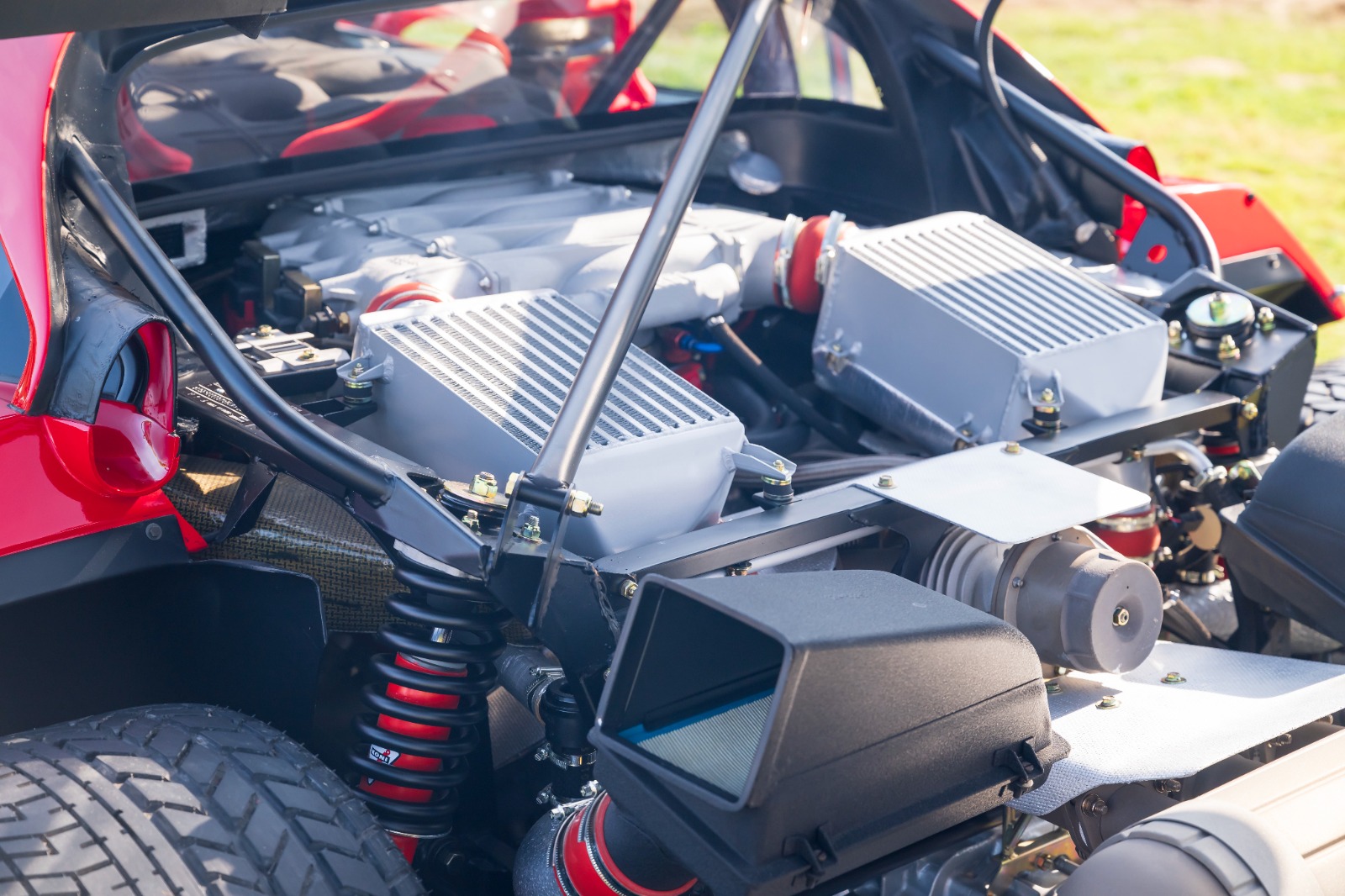
Mid-mounted twin-turbo V8 produced 160bhp per litre – a remarkable output
Photo by: Getty Images
Only the final assembly was undertaken at Maranello. The subcontractors were a veritable Who's Who of Ferrari suppliers from the golden age of artisan manufacture: Vaccari of Modena provided the tubular steel spaceframe; Scaglietti bonded in the composite reinforcing sections; and Dino Cognolato, a neighbour of Michelotto, manufactured the composite bodyshell itself.
As a race car for the road, the F40 made a virtue of various weight-saving measures. The paint was applied so thinly that the carbon fibre weave is visible at certain angles (indeed, a heavy-handed respray is a surefire way of knocking value off a second-hand F40). There was not even wiring for a radio, and the door pulls were fabric loops rather than moulded handles. On early models the plexiglass side windows were fixed, with a small inset sliding panel, but this was dropped when those owners who wanted to drive their cars complained of inconvenience when trying to pay Autostrada tolls.
Having planned to build only 400, Ferrari responded to demand by building over three times that amount. Any reservations the Fiat bureaucracy might have had about this special project were quashed by its effects on the bottom line.
This being Ferrari in the 1980s, the paperwork from the era is inexact. It's understood between 1311 and 1315 F40s were built, the disparity partially accounted for by a handful of right-hand-drive examples believed to have been made at Pininfarina's works for the Sultan of Brunei.
Many of the cars vanished into private collections; this car, as much as any in its genre, set the template for rarefied 'less is more' specials designed to appeal to high-net-worth individuals. Hamilton's F40 was among those which essayed just one journey from the factory.
"I wanted to find the most authentic one," he said, "and managed to come across this one that the owner had bought it, drove it from Maranello to his home, 69 kilometres, and then parked it and never started it again.
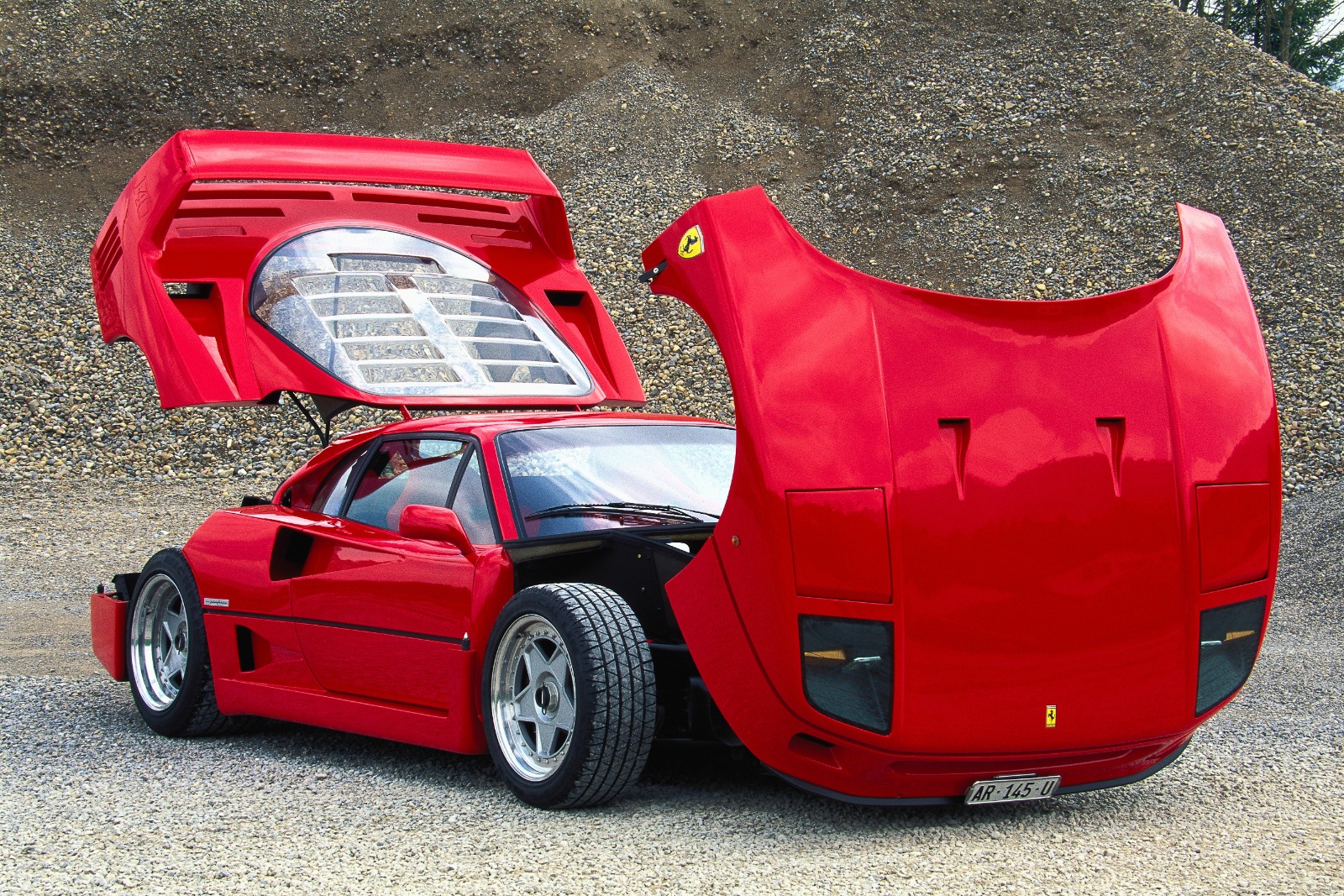
Spaceframe chassis meant the bodywork didn't have to be structural. This is a later model where wind-down windows made a concession to practicality
Photo by: Getty Images
"The passenger door had never been opened. It just had this cover on it and all this dust. Then the decision was kind of, 'What do you do? Do you keep it as an art piece, keep it all dusty, or do you have them clean it up?' So that took me a while to decide, and then I had them redo it because I wanted to drive it.
"Because I realised, what's kind of crazy is, I might be wrong, but I'm pretty sure none of the Ferrari drivers in history have ever arrived in the coolest cars that they have. These iconic ones, the [250] GTO or the F40. And I was like: 'It has to be done.'"
There are several interesting points to unpick here. While recent Ferrari F1 drivers have appeared in road-going Ferraris near the top of the range, it's open to question whether they actually paid for them or whether the cars were on loan.
Famously, Enzo Ferrari declined to give cars away to his drivers. John Surtees, for instance, arrived in Maranello driving the BMW 507 which Count Agusta had partly paid for as a gift to Surtees for winning the motorcycling world championship. Enzo rather curtly said he ought to be driving a Ferrari – but declined to even loan him one.
The best deal Ferrari would countenance was for Surtees to pay cost price. And although it's widely reported that Ferrari eventually gifted Surtees a 330GT 2+2 for winning the world championship, there is some doubt over this claim since that car was exchanged for the one he had originally bought.
This author has seen at least six 330GTs claimed by their owners to be one of the ex-Surtees cars, but Ferrari Classiche – the division which now restores and certifies historic models – has only recently made a definitive call on the identity of chassis 6981GT, the second car. Its current owner has carefully restored the mechanicals to original specification so it is driveable, but has preserved the patina of faded paint and cosmetic rust on the exterior to emphasise its originality.
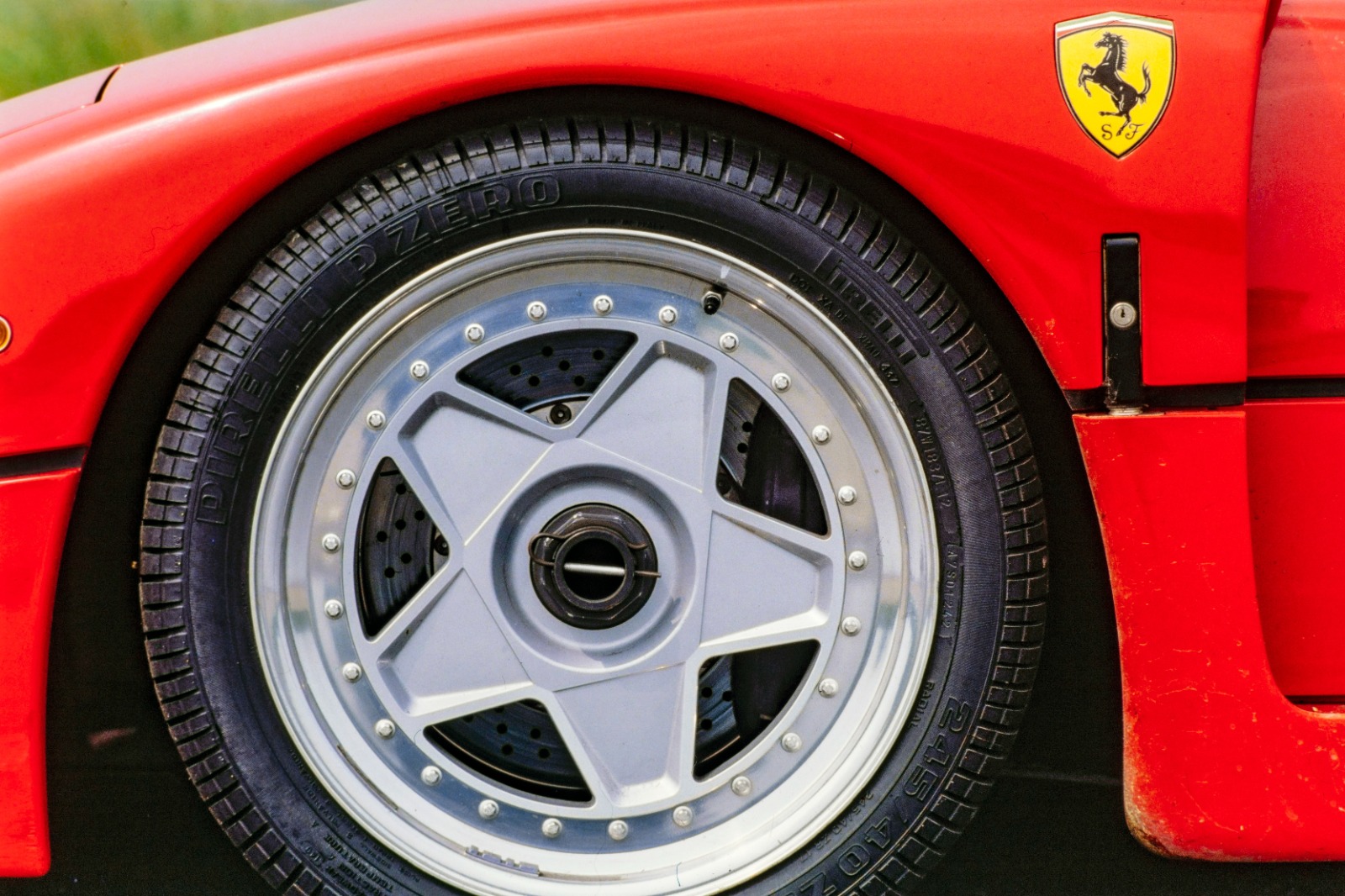
F1-style double-wishbone suspension enabled the wheelarches to be almost flush with the upper wing face
Photo by: Getty Images
As with Hamilton, owners of classic machines face a difficult decision: restore it and use it, or keep it as you found it? This is an even tricker proposition with cars built extensively from composites, like the F40, since while carbon fibre resists the passage of time, the resin used to bond it does not.
Still, for Hamilton there was an irresistible detail: the engine's serial number, he claims, matches his race number.
"What was also crazy is when they were taking the car apart to check it, firstly, it stood the test of time," he said. "Everything was working. Hardly anything had to be changed.
"And when they took the engine out, they found out the engine's number 44. It's got stamped on the engine number 44. I couldn't believe it. I was like: 'Did you know? You've got to be lying.'
"So, it feels very much like fate. And I thought it was a real opportunity to kind of highlight the history of Ferrari in their home country, at their race, and when am I ever going to get to do that again?"
Lewis may have put a few more miles on the clock, but this F40's value just went up.


'Senior moment' or breakdown of trust? The implications of Hamilton's Singapore GP meltdown

Why Verstappen's dominance left rivals scrabbling for alternatives in Singapore
A "better job" or more engine power? Verstappen's Singapore pole unpicked

FIA reveals "human error" caused latest software glitch in Singapore sprint qualifying

F1 Singapore GP live commentary and updates - Verstappen takes sprint pole

F1 Singapore GP live commentary and updates - Verstappen wins sprint while McLarens collide

F1 Singapore GP live commentary and updates - Verstappen on pole

LIVE: F1 Singapore GP - Verstappen dominates to victory from Leclerc, nightmare for Hamilton

How Antonelli levelled up his character to be F1 2026's world champion-elect

FIA set to close F1 cost cap loophole with new rules

Norris promises to make "better decisions" following fresh talks over Singapore GP clash

FIA expects F1 races in Qatar and Abu Dhabi to run as planned
Subscribe and access Autosport.com with your ad-blocker.
From Formula 1 to MotoGP we report straight from the paddock because we love our sport, just like you. In order to keep delivering our expert journalism, our website uses advertising. Still, we want to give you the opportunity to enjoy an ad-free and tracker-free website and to continue using your adblocker.


Top Comments