


The unexpected benefit of F1’s sprint race repeat
OPINION: Formula 1's sprint race trial at Silverstone drew mixed feedback on Saturday, but there remained the true test of how it would impact Sunday's Grand Prix. While fans were busy marvelling at Fernando Alonso's progress, a key lesson was being learned that would directly contribute to the dramatic lap one clash at Copse the following day

Formula 1’s inaugural sprint race experiment had appeared to tick an awful lot of boxes by the time the cars headed back to the garages after Saturday’s 17-lap encounter.
A much better Friday of action, and a Saturday qualifying race that delivered enough thrills - courtesy of Fernando Alonso - and spills - courtesy of the Haas drivers and Sergio Perez - to delight fans were exactly what F1 had hoped for when the idea was first proposed.
Sure there remained some aspects of the weekend that needed tweaking – like the awarding of ‘pole’, the needless obsession with not calling the sprint a ‘race’, and how to stop Saturday mornings being a bit of an empty spectacle. But these are all detail changes that can be sorted out in 10 minutes. Give the historic pole to the fastest man on Friday, accept Saturday is a sprint ‘race’, and rename Saturday’s morning’s session as a warm-up. Job done.
Yet the biggest concern of all, and the one aspect that had perhaps been much harder to predict before the real life experiment, was what impact would Saturday’s race have on Sunday’s official grand prix.
OPINION: The successes and warning signs from F1’s first sprint race
The fears, of course, were that it would make it a much less spectacular affair. From drivers having been able to push almost flat out for 17-laps in the sprint race, unleashed from concerns about saving tyres and managing fuel, when it came to having to think once again about strategy on Sunday and the long game, things would not be quite as exciting. Almost certainly the kind of gamble that Alonso and Alpine took in Saturday’s sprint race, of going for a soft tyre that the outfit thought might just work, was not something that would be so typical in the grand prix itself.
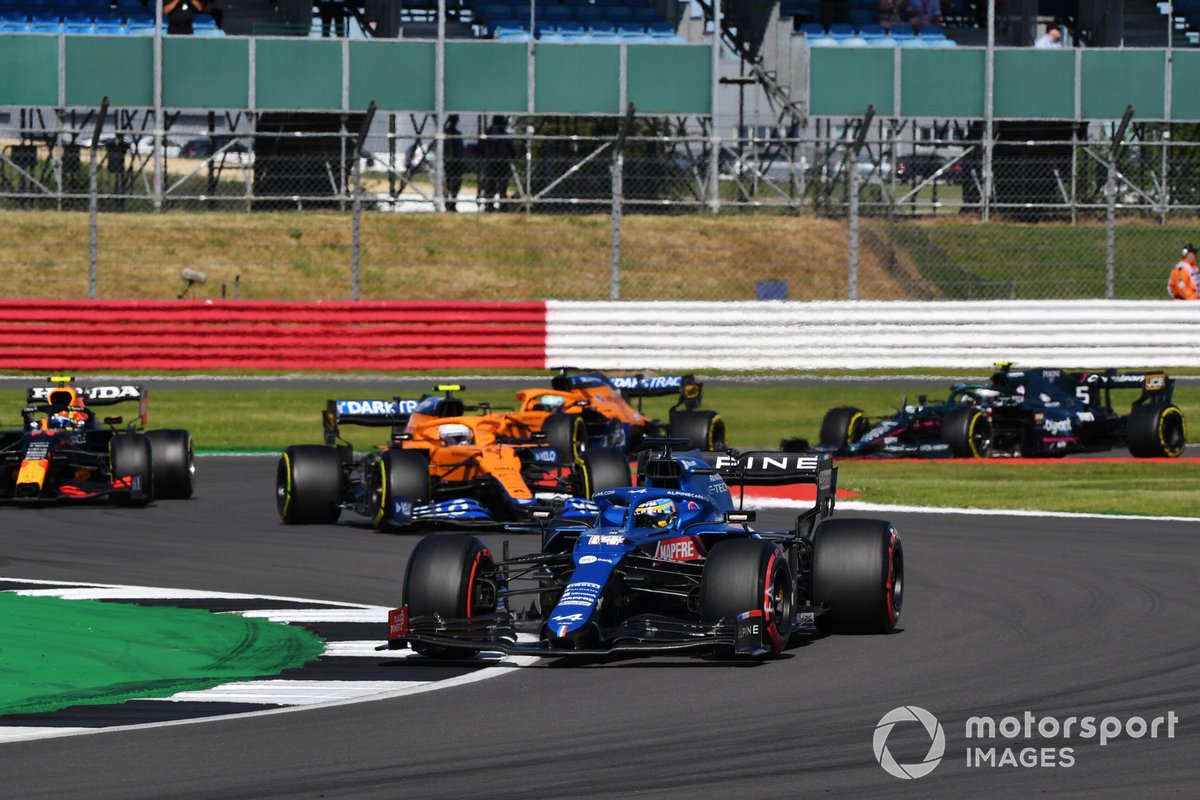
Fernando Alonso vaulted up the grid on lap one of the sprint thanks to his soft tyres
Photo by: Mark Sutton / Motorsport Images
And in terms of the wider spectacle, there was that niggling feeling that Saturday had already taken away much of the guess work about how the cars were going to perform in the main event. Cars that had already been lined up once in their speed order over a single lap, were now being lined up for a second time in the order of competitiveness they had shown over a short race distance. What reason was there to believe that the end result of Sunday would be any different to what we had seen on Saturday?
But what no one knew in the build up to the race was the very fact that we had seen a snapshot of car performance – and the strengths and weaknesses of the packages – was actually a factor in upping the stakes on Sunday. As opposed to the times when F1 has raced back-to-back on the same circuit, most recently at the Red Bull Ring, what added a unique twist to the Silverstone affair was that car set-ups were locked in.
With F1 chiefs eager for teams not to construct qualifying cars for Friday and then switch to a race-spec for Saturday and beyond, parc ferme restrictions had been imposed from when the cars left the pits at the start of Q1. It meant that unlike between the Styrian and Austrian Grands Prix, when teams were able to change set-ups and adapt their cars for race two based on lessons from race one, there was no such option this time around.
Rather than F1’s sprint race ruining the Sunday spectacle, the first trial has perhaps shown us how it can serve to improve it and actually ramp up the intrigue and efforts to turn things around
This, in effect, took the power and responsibility away from the teams to make things better, and put it firmly in the hands of the drivers. For it was simply down to those in the cockpit to adapt and improve with the same tools. And it was exactly that factor that triggered the incredibly intense duel between Max Verstappen and Lewis Hamilton on the opening lap of the grand prix.
Both men well knew the strengths and weaknesses of their package. Verstappen had the confidence to know that he had a very good race car underneath him, but knew that the higher downforce configuration his team had been locked into since Friday left him exposed on the straights.
From Hamilton’s perspective, he was well aware of the straightline speed advantage his lower drag solution gave him – but fully knew, based on what he had seen on Saturday, that if he had not got past the Red Bull by the time that cars were heading into the Becketts complex then there was going to be very little chance of overcoming his title rival.
It was that mindset which meant Hamilton was not just going to sit back and let the race settle down over the opening lap. He needed to make his move. That is what triggered the aggressive efforts at the first complex, the wheel-to-wheel run into Brooklands before he got squeezed out, and it especially led to his choice of line in to Copse.
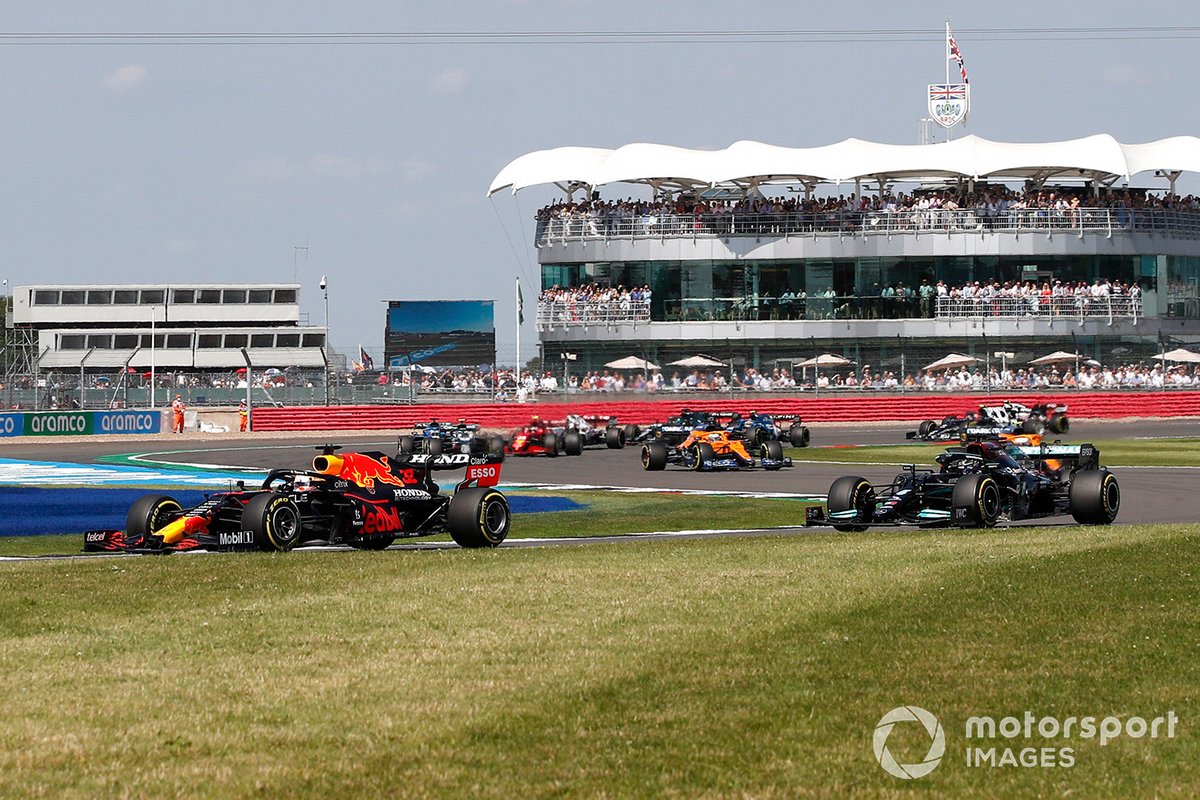
Max Verstappen, Red Bull Racing RB16B, Lewis Hamilton Mercedes W12
Photo by: Zak Mauger / Motorsport Images
On Saturday, he had got an identical run on Verstappen out of Luffield but had opted to try to go around the outside. But on that occasion, Verstappen held the advantageous line and was able to keep in front. That was enough for him to get enough clear through Becketts and Chapel with his higher-downforce spec, to be gone once they blasted their way down the Hangar Straight.
Having taken on board the lessons of the day before, it was obvious Hamilton was not going to make the same mistake again. As he reflected after the race: “Yesterday I went down the left-hand side and I really regretted not going for the gap that was down the right-hand side. So I dummied him, moved to the left and then moved to the right for that gap.”
Red Bull boss Christian Horner was equally convinced that it was the very lessons from the sprint race, that if he wasn’t ahead by Becketts it was game over, that triggered what we saw on lap one.
“I think he knew exactly that,” he said. “I think he was wound up after yesterday's result and he knew that was his only opportunity I think. He knew had Max come through that corner, he might not have seen him again for the afternoon…”
So rather than F1’s sprint race ruining the Sunday spectacle, the first trial has perhaps shown us how it can serve to improve it and actually ramp up the intrigue and efforts to turn things around. It’s a consequence that few truly expected when the idea first came about.

Lewis Hamilton, Mercedes, 1st position, celebrates on the podium
Photo by: Glenn Dunbar / Motorsport Images


Brundle awarded OBE in King’s New Year’s honours

The new rules dilemma that will define the 2025 F1 season

Verstappen issues Red Bull title warning in push for RB21 progress

Mercedes opens up on the factors that hurt Hamilton with the W15

How McLaren faced up to the misinformation, noise and distractions of being an F1 title challenger

Why Bottas is not letting the “worst-case scenario” end his F1 career

Jon Noble: An unfair perception or a genuine concern? Lifting the lid on Red Bull’s Tsunoda scepticism

Binotto on Audi's F1 reality check after finding team "frozen" with no plans

Why being "very adaptive" gave Norris the edge over Piastri at US GP

Smyth makes Formula Ford Festival history as he wins despite clash with team-mate Murray

Taken for a ride? The less heralded flaw of the 2026 F1 regulations

Sainz set for Rally1 outing in latest gen WRC car
Subscribe and access Autosport.com with your ad-blocker.
From Formula 1 to MotoGP we report straight from the paddock because we love our sport, just like you. In order to keep delivering our expert journalism, our website uses advertising. Still, we want to give you the opportunity to enjoy an ad-free and tracker-free website and to continue using your adblocker.


Top Comments