


The underdog F1 squad that thrust Senna into the limelight
The Toleman TG184 was the car that could, according to legend, have given Ayrton Senna his first F1 win but for Alain Prost and Jacky Ickx at Monaco in 1984. That could be stretching the boundaries of the truth a little, but as STUART CODLING explains, the team's greatest legacy was in giving the Brazilian prodigy passed over by bigger outfits an opportunity
“Start small, think big,” runs a quote popularly attributed to technology entrepreneur Steve Jobs. In January 1984 Jobs, whose company had begun operating from a suburban garage in Los Altos, California, unveiled the first Mac computer in a revolutionary blaze of hype, setting Apple Computer Inc on the path to becoming one of the biggest companies in the world. Four months later and thousands of miles away, a group of unproven individuals destined for greatness in Formula 1 narrowly missed out on achieving one of the greatest upsets in the history of motor racing.
Monaco 1984 is F1’s great shoulda-woulda-coulda moment, an event still hotly debated. The narrative is stuffed with Hollywood tropes: a struggling, underdog team; a new car created by a who-are-you-anyway designer; a driver talented enough to have caught the eyes of top teams, but not so much that they wanted to employ him straight away; a surreal race flagged before the finish and the win awarded to a driver who had already been overtaken; and the long-tail intrigue of whether the car which crossed the line first, only to be denied a sensational victory, would have made it to the chequered flag if the race hadn’t been stopped early. And most of it is true.
Indubitably Toleman was not a team of which grand prix greatness was expected. South African-born businessman Ted Toleman’s father and brother were keen racers, and the family company revolved around the motor trade – delivering Fords to dealerships – so it was a natural fit as a sponsor. But when Bob Toleman suffered fatal injuries in a Formula Ford 2000 race in 1976, it would have been understandable if the family interest in motor racing had evaporated. Instead, driven largely by the energy of Toleman employee and race team manager Alex Hawkridge, it set its sights higher – to Formula 2.
Toleman Group Motorsport entered F2 in 1978 running a BMW-engined March chassis engineered by former Royale designer Rory Byrne for ex-Royale works driver Rad Dougall, both also South African. The operation was based in a corner of Tom Walkinshaw’s workshop at Kidlington, near what is now called London Oxford Airport. After finishing third in the season opener at Thruxton, Dougall’s results petered out and the team began a works association with Ron Tauranac’s Ralt company for 1979, but the car was overweight and late arriving.
For 1980 Toleman and Hawkridge signed off on an in-house chassis designed by Byrne and John Gentry, using new Pirelli radial tyres. The car was built in new premises in Witney, just west of Oxford. British F3 champion Derek Warwick joined, bringing BP sponsorship, while the promising Stephen South was sacked in favour of Brian Henton after sneaking off to test an F1 McLaren. Henton won three rounds and took six other podiums in the Hart-engined TG280, bloodying the nose of Ron Dennis’s Project 4 team.

Toleman powered to the 1980 Formula 2 title with Brian Henton, pictured here at Pau following team-mate Derek Warwick
Photo by: Ercole Colombo
In late 1980 Toleman announced its graduation to F1, using the same personnel and suppliers – why disrupt a successful operation? Pirelli wanted to expand into F1 and Hawkridge, despite Bernie Ecclestone’s advice to run Cosworth DFVs, saw turbos as the future: “Only an idiot would have gone with a naturally aspirated engine,” he said.
But Toleman’s first three seasons in the top flight were borderline catastrophic. Henton and Warwick qualified the bulky TG181 just once each in the 1981 season, and Warwick managed just two classified finishes in its b- and c-spec versions the following year, though he and new team-mate Teo Fabi made the qualifying cut more often. Warwick cuttingly nicknamed the car ‘General Belgrano’ after the Argentine warship sunk during the Falklands War in early 1982.
Flat floors, mandated to reduce ground effect, entailed a last-minute chassis redesign. Byrne’s solution was to fit double rear wings, and relocate the radiators to the front in a large wing assembly which featured venturi tunnels to achieve ground effect
This was a time of rapid technological advance and political ferment. For Byrne and Gentry there was much to learn about ‘ground effect’ aerodynamics and the structures required to contain them at this level, as well as packaging a turbo engine and its plumbing. Pirelli was new to F1. Engine tuner Brian Hart also faced a huge learning curve, for all his previous successes in fields as diverse as F2 and the World Rally Championship. Creating a new engine wouldn’t be as simple as sleeving down the Ford-based 420R to 1.5 litres and adding a turbo.
When Renault’s Jean Sage, keen to align Toleman on the grandee teams’ side of the brewing FISA-FOCA war, invited a delegation from Toleman into his garage at the 1980 Italian Grand Prix, Hart ran his eye over the twin-turbo V6 and the enormity of the task hit home.
“I thought, ‘My God, what the hell are we doing here? This is what we’ll be up against.’”
Hart’s first iteration of the 415T engine, with a single Garrett turbo, suffered huge lag – typical of the era – and lacked top-end power compared with Renault, Ferrari and, latterly, BMW. It was prone to bursting head gaskets too. The team’s issues provoked tensions between Hart and Byrne, but Hawkridge was too invested in the engine project to contemplate an alternative, even if one existed, so Toleman continued to underwrite development. Hart revised the straight-four so it was cast as a monobloc – no head gasket to blow – and reckoned this single development yielded 130bhp.

A late run of points for Warwick in the final four grands prix of 1983 rescued what had been a tough season for Toleman
Photo by: Motorsport Images
Allied to Byrne’s new carbonfibre TG183 chassis, introduced for the last two races of 1982, the redeveloped Hart engine brought an improvement in performance, only for the whole project to be almost scuppered by the regulatory rug-pull which came in early 1983. Flat floors, mandated to reduce ground effect, entailed a last-minute chassis redesign.
Byrne’s solution was to fit double rear wings, and relocate the radiators to the front in a large wing assembly which featured venturi tunnels to achieve ground effect. Warwick amassed nine of the team’s 10 points in a late-season surge.
The TG183B would soldier on into 1984, but change was brewing. Hart had radical developments planned in the form of a bespoke twin-spark electronic engine management system created by ex-Lucas engineers Bill Gibson and Bill Mason, who had recently co-founded Zytek. Byrne had a new chassis in the works with more conventional wings and plumbing, having found the front venturi setup too pitch-sensitive.
The new car was being designed with Michelin rubber in mind, and with the French tyre company’s data, as Toleman manoeuvred to extricate itself from its Pirelli contract. And Hawkridge had snapped up a promising driver who leading teams had tested but decided to leave on the shelf while he gained experience elsewhere: 1983 British F3 champion Ayrton Senna.
Pat Symonds, now chief technical officer at F1 and GP Racing’s tech columnist, was then a young race engineer at Toleman and found Senna an immediate upgrade on Bruno Giacomelli.
“Until a driver gets to F1 you cannot know how good a driver he really is,” Pat recalled in a round-table interview in 2014. “I knew he was good, but he hadn’t dominated in F3, he was pretty level with Martin [Brundle, Senna’s title rival], very similar.
“Some drivers you think they’re average before they get to F1 and they end up doing very well. Others you think they’re brilliant and they end up doing not very well. So you never quite know. But as soon as I started working with Ayrton I knew he was very capable.”

Senna's season didn't get off to the best of starts with a DNQ at Imola
Photo by: Rainer W. Schlegelmilch / Motorsport Images
And Senna was hungry for success. When a blown turbo caused his retirement from the 1984 season opener, his home grand prix in Brazil, his response to Hawkridge was unequivocal: “What are you going to do about it?”
It’s a mark of how powerful an impact Senna made at this early stage that his demand was acted upon immediately. Hart cast around for an alternative and alighted on Holset, better known for supplying truck manufacturers. The company was at first surprised, then delighted, and its products proved more robust – although Toleman was still down on power compared with rivals.
Matters with Pirelli came to a head at San Marino. A dispute caused the team to skip Friday’s running entirely. The drivers were set to run until a fax arrived from Toleman HQ telling them not to go out… Saturday started wet, but Senna suffered a fuel-pressure problem which marooned him out on track when conditions were at their best. The result was his first and only DNQ in F1.
Come race day Senna was in his element as pendulous grey clouds deposited heavy rain and chaos ensued. For once he was equipped with 1984-spec tyres, for Michelin had no old wet-weather tyres available, and on this level playing field Senna duly excelled
Toleman was then able to obtain Michelins – but only last year’s compounds, at the insistence of McLaren boss Ron Dennis. Hawkridge always maintained this was sheer pettiness motivated by their previous rivalry in F2.
“You can’t compare the handling of this car with the previous one,” said Senna when he first drove the TG184, during the French GP weekend. “I feel I can take time off anyone in the corners.”
Though based on the TG183 monocoque and suspension layout, the TG184 had entirely different bodywork, shaped in the Ministry of Defence windtunnel at Shrivenham. It elevated Toleman to the midfield, though Senna’s last turbo failure of the year eliminated him in France. It was the next round, in Monaco, in which he would begin to establish his legend.
Now carrying Candy sponsorship, Senna’s TG184 seemed to be trundling languidly around the perilous street circuit as the Brazilian essayed his first-ever laps there in Thursday practice. The atmosphere on the pitwall grew tense as the engineers and team management wondered what their new star was up to.

Senna was on top form at Monaco and might even have won had the race not been red-flagged early in one of F1's enduring what-ifs
Photo by: Motorsport Images
“This went on for a few laps,” Hawkridge would later recall. “Him going round at a snail’s pace and then – bang – he went straight to the top of the timesheets from the bottom. We thought, ‘bloody hell – how do you do that?’
“I said to him afterwards, ‘What were you doing?’ He said, ‘I was looking at where the manhole covers were, where the camber changed, where the gutters ran down, where the crown of the road is.’ I said, ‘But you can’t learn Monaco in five laps.’
“He said, ‘Oh, you can.’”
Senna qualified 13th after a final session in which he left absolutely nothing on the table. Every wheel rim bore the scrapes of repeated kisses of the barriers. Come race day Senna was in his element as pendulous grey clouds deposited heavy rain and chaos ensued. For once he was equipped with 1984-spec tyres, for Michelin had no old wet-weather tyres available, and on this level playing field Senna duly excelled.
The race got under way 45 minutes late after a fire truck was deployed – at the drivers’ insistence – to wet the surface in the tunnel under the Loews’ hotel. A first-corner shunt eliminated both Renaults, then Nigel Mansell seized the lead for Lotus, only to spin off. McLaren’s Niki Lauda also gyrated, and Nelson Piquet’s Brabham succumbed to an electrical problem… but Senna required no further assistance.
The rest of the attrition occurred far behind on the timesheets as Senna ascended to second and homed in on the McLaren of race leader Alain Prost. Symonds counted the laps by, noted down the margins by which his man was gaining: 1.5s one lap, 4.4s the next. The fact that Stefan Bellof’s third-placed Tyrrell was gradually catching too meant nothing. Toleman’s man was going to win.
Only he didn’t. On laps 29 and 31 Prost gesticulated wildly as he passed the finishing line, demanding the race be stopped. Clerk of the course Jacky Ickx concurred and signalled for the red flags. Next time around Prost pulled to a halt at the line and Senna went by, believing himself to be the victor – but, since the results are taken from the lap before any red-flag stoppage, Prost was declared the winner.
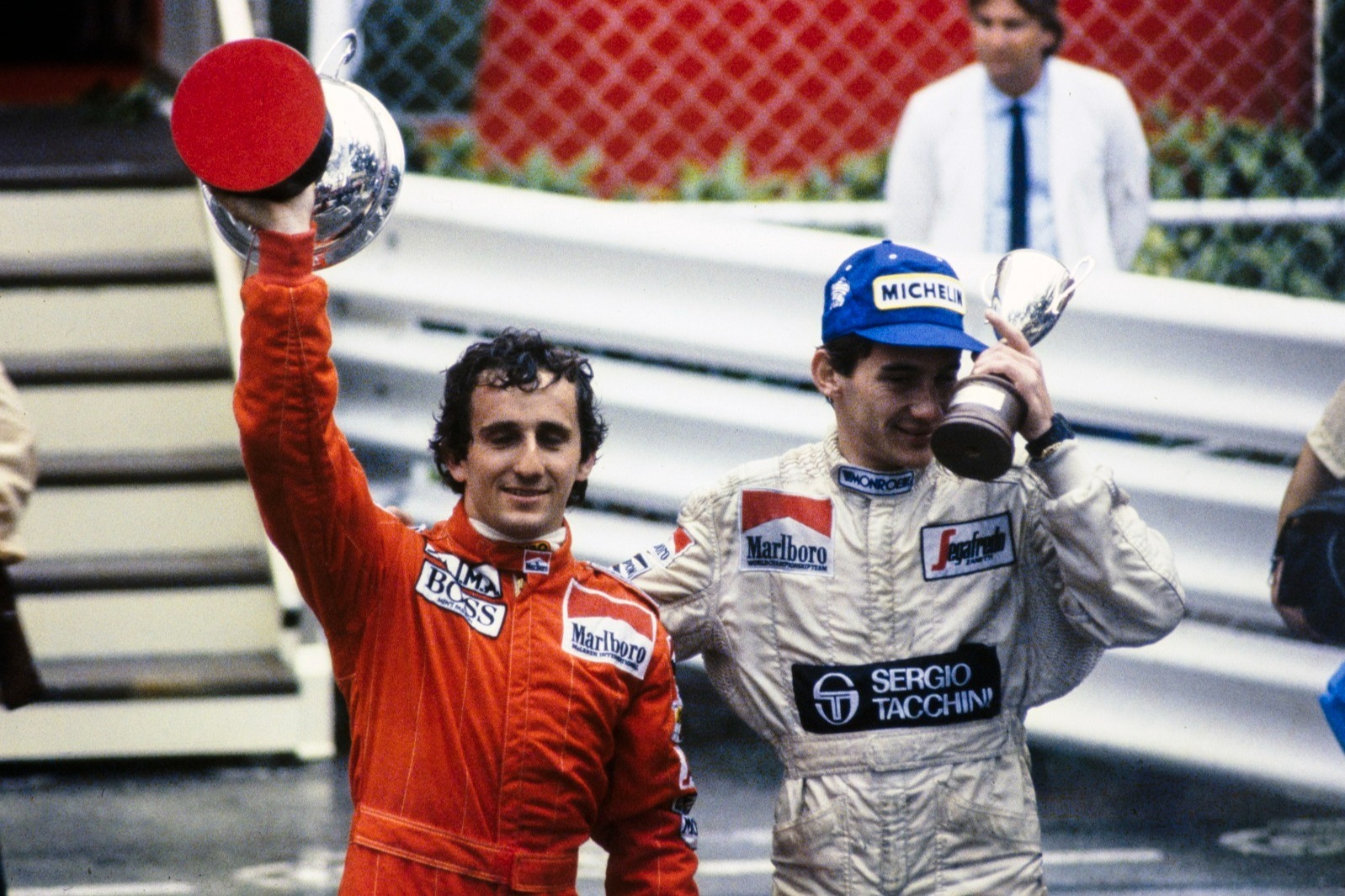
Prost and Senna shared a podium for the first of many occasions on that day
Photo by: Ercole Colombo
Would Senna have won had the race not been stopped? Possibly. One of the front suspension rockers was damaged, but perhaps not enough to have forced Senna to park the car.
“One of the front rockers was cracked,” said Symonds. “And we believed that happened on a trip over the kerbs at the chicane. But no-one will ever know whether the car would have finished. In my view, it was a serious crack but it wasn’t just about to fail. No-one will ever know.”
Now the big teams were properly interested in Senna. Lotus custodian Peter Warr swooped during a period of three DNFs – Germany, Austria and the Dutch GP – on the bounce for Senna to tempt him into black-and-gold for 1985; a furious Hawkridge responded by suspending Senna from the Italian Grand Prix. At the end of the year, they parted ways – Senna to a maiden grand prix win with Lotus before properly establishing himself as one of the all-time greats with McLaren.
Would Senna have won had the race not been stopped? Possibly. One of the front suspension rockers was damaged, but perhaps not enough to have forced Senna to park the car
As Ted Toleman’s interest pivoted towards powerboats his team was sold to Benetton, and in that and various other incarnations it has won four drivers’ championships and three constructors’ titles. Two of those championship-winning cars were drawn by Rory Byrne before he moved to Ferrari and even greater glory during Michael Schumacher’s pomp.
Big achievements from small starts…

Senna was sent on his way by the efforts of the Toleman team, which later became Benetton
Photo by: James Mann

How Ratzenberger beat the odds to realise his cruelly short-lived F1 dream

F1 uncovered: A weekend behind the scenes with a chief mechanic

When McLaren was pipped by Red Bull in a modern F1 classic

The big opportunity Sainz’s Williams switch affords to F1’s latest centurion

Inside the science of F1 fuel

How F1’s plan for rotating races could look in practice

The early decisions that set Sauber’s rookie for success

How F1 media coverage has evolved in line with its subject

The not-so-obvious chance Leclerc missed to usurp Verstappen

Cheshire cats de la Roche and Musgrave grin after Silverstone Historic F3 thrillers

Dramatic Mini fight goes to the wire as Ovenden wins title by a point at Brands Hatch

How Ingram made his mark on the 2026 BTCC campaign – before going out with a bang
Subscribe and access Autosport.com with your ad-blocker.
From Formula 1 to MotoGP we report straight from the paddock because we love our sport, just like you. In order to keep delivering our expert journalism, our website uses advertising. Still, we want to give you the opportunity to enjoy an ad-free and tracker-free website and to continue using your adblocker.


Top Comments