


The top 10 Ferrari F1 rookies
After Ollie Bearman’s surprise debut for Ferrari in Saudi Arabia, it’s time to pick out the best F1 newcomers who first appeared in red
Ollie Bearman became the 33rd driver to make their world championship debut in Ferrari machinery at the Saudi Arabian Grand Prix earlier this month. The 18-year-old Briton impressed on his way to seventh, but how does his performance stack up to those of his predecessors?
For this list, we’ve excluded the earliest Ferrari ‘rookies’, such as Alberto Ascari at the 1950 Monaco GP (where he finished second), because they were already GP drivers who were active prior to the inauguration of the world championship.
10. Andrea de Adamich
Qualifying ahead of team-mates Ickx and Amon sadly didn't result in greater things to come for de Adamich
Photo by: LAT Photographic
1968 South African GP
Started 7th | Result Retired
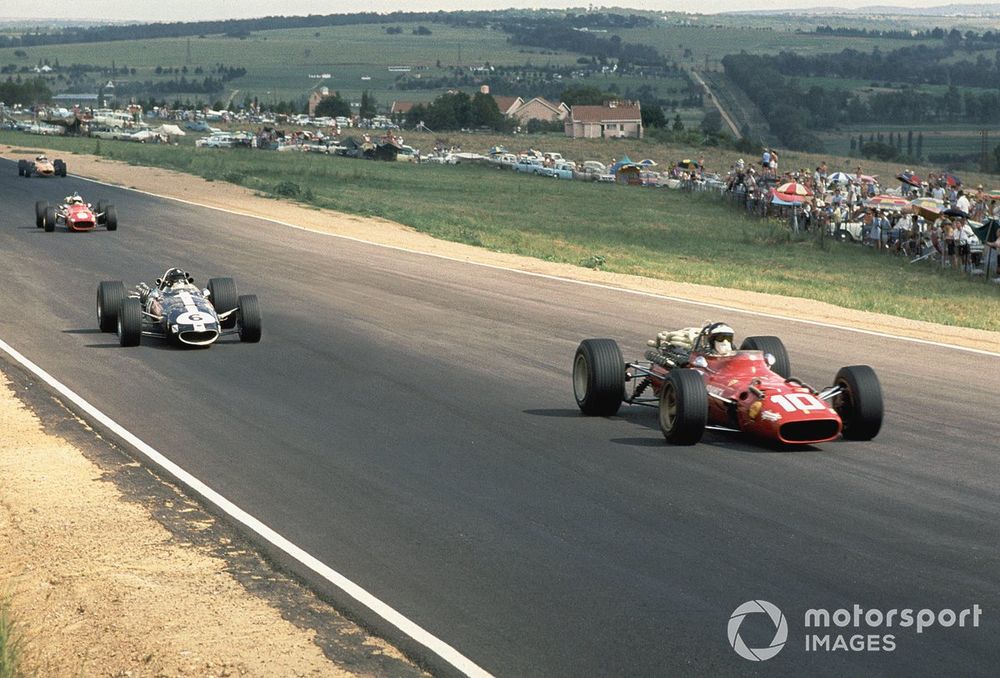
The bespectacled 26-year-old from Trieste had won the 1966 European Touring Car title with Alfa Romeo and made his F1 debut for Ferrari in the non-championship 1967 Spanish GP before heading to Kyalami for his first points-paying grand prix on New Year’s Day in 1968.
The new boy was part of a three-car team from Maranello, and was assigned a 312 that was 36lb heavier than the machines prepped for Chris Amon and the exciting young Jacky Ickx. The heat in practice forced teams into some on-the-spot solutions, with Autosport describing the misfiring Ferraris as having “flexible piping rigged up to direct cooling air on the fuel metering pumps, and the Ferrari mechanics had made an outrigger oil cooler on the left hand side of Ickx’s car”.
The Belgian tried all three cars in practice, but neither he nor Amon could match the hugely impressive de Adamich, who qualified seventh, 0.2 seconds quicker than eighth-placed Amon and 1.3s clear of Ickx in 11th.
The race was less to write home about. Ludovico Scarfiotti had just crashed his Cooper-Maserati and sustained burns from the escaping oil and water when de Adamich lost control on the oil at Clubhouse Bend and hit the barriers, damaging his suspension and forcing him to walk back to the pits.
De Adamich never drove another world championship GP for Ferrari, and in fact his next start was not until 1970 with McLaren. His final F1 race, with Brabham, ended with injuries when he was caught in the pile-up at the 1973 British GP at Silverstone, but he enjoyed plenty of success with Alfa in his parallel sportscar career. MS
9. Bob Bondurant

Bondurant got his chance standing in for the injured Surtees
Photo by: Motorsport Images
1965 United States GP
Started 14th | Result 9th
Bondurant is better known for his eponymous driving school and his sportscar successes, which included ending Ferrari’s reign in the GT class at Le Mans in 1964 sharing a Shelby Daytona Coupe with Dan Gurney. But it was with the Prancing Horse that the then 32-year-old got his F1 chance.
Ferrari’s team leader, John Surtees, was out of action following a serious sportscar crash at Mosport Park. That meant team regular Lorenzo Bandini was joined at the 1965 United States GP by Pedro Rodriguez and Bondurant, both racing under the North American Racing Team banner. Bandini and Rodriguez drove the flat-12-engined 1512, with Bondurant in the less powerful but arguably more nimble V8 158.
Bondurant got faster and faster in practice at Watkins Glen and, although he was only 14th, outqualified Rodriguez. He was 1.65s off Graham Hill’s pole mark and just 0.12s slower than the best lap by Surtees in the V8 car the year before.
Both Bondurant and Rodriguez moved forward early in the GP and were part of a scrap that involved Jo Bonnier, Bruce McLaren, Jochen Rindt and Jo Siffert – all past or future GP winners.
As others hit trouble, notably Jim Clark’s Lotus and the Cooper of McLaren, the Mexican and the American moved up. Rodriguez made the most progress, breaking away from the battle and eventually finishing fifth, a spot behind Bandini.
A rain shower made things harder and Rindt took advantage of the “wretched” conditions, as Autosport described them, to make ground as Bondurant dropped down the order. But he kept the 158 out of trouble to finish ninth, which was then outside the points. “Bob Bondurant put up an excellent show in his first F1 race,” reckoned Autosport.
Bondurant would go on to start eight more world championship GPs, in Lotus, BRM and Eagle machinery, taking a best finish of fourth in the 1966 Monaco GP. KT
8. Richie Ginther

Ginther scored a point on debut and became a well respected test driver
Photo by: Motorsport Images
1960 Monaco GP
Started 9th | Result 6th
Like several Ferrari F1 drivers of the period, Ginther had already tasted sportscar success before getting his world championship debut. Despite Ferrari’s focus on front-engined cars, British constructors Cooper and Lotus had shown that a mid-engined approach was the way to go, and the Italian team did start to experiment. Ginther, who would become a respected test driver, was entrusted with Ferrari’s 246P for the 1960 Monaco GP.
The mid-engined machine was initially off the pace in practice, but things improved and what Autosport described as a “wonderful effort” got Ginther onto the 16-car grid in ninth, as eight cars failed to qualify. He was 2.3s off pole. If that sounds a lot, it should be pointed out that gaps were often bigger then – Stirling Moss’s Lotus was on pole by 1s – and Ginther was only 0.3s behind fastest Ferrari qualifier Wolfgang von Trips.
Ginther fell back early on, but kept plugging away, “going far better than had been anticipated”, according to Autosport’s Gregor Grant. Things were made even harder around the tight street circuit when rain arrived just before one-third distance. While others, including reigning world champion Jack Brabham, slid off in the tricky conditions, Ginther gradually climbed up the field.
When Graham Hill’s BRM crashed out at two-thirds distance, the American moved into fifth. Transmission failure finally put the Ferrari out with 30 of the 100 laps to go, but Ginther was still classified sixth, meaning his efforts were rewarded with a world championship point. “A really outstanding performance,” reckoned Autosport.
Ginther would reap the rewards of his development work with a seat in the pacesetting 156 Sharknose for 1961. Though never quite a top-liner, he finished second at the 1961 Monaco GP to one of Moss’s greatest drives on his way to fifth in the standings. His best championship finish was third for BRM in 1963, and Ginther finally took his first and only GP win for Honda in Mexico in 1965. KT
7. Arturo Merzario

Another injury stand-in, it led Merzario to a full-time Ferrari drive in 1973
Photo by: David Phipps
1972 British GP
Started 9th | Result 6th
Ferrari’s call-up of Merzario at Brands Hatch is a little akin to a similar summoning of Alessandro Pier Guidi for an F1 debut today. The diminutive Italian was a leading light in the Prancing Horse’s world sportscar team, and had already taken victories in 1972 at the Spa 1000Km and the Targa Florio. With Clay Regazzoni suffering an injured wrist from a footballing shunt while playing with the Ferrari mechanics, and favoured supersub Mario Andretti on Indycar duty at the Michigan 200, Merzario got his chance.
The stereotyping (well, this was the 1970s…) was in full flow as Autosport described Merzario’s qualifying performance: “Little Arturo Merzario showed a fine display of Italian temperament and achieved an untidy 1m23.7s. He knocked off a front wing on the first day of practice and was actually stopped practising by the team on the second day.”
But Merzario put in a rock-solid race. While Ferrari team-mate Jacky Ickx led under pressure from Jackie Stewart and eventual winner Emerson Fittipaldi before retiring, the 29-year-old from Como ran in the midfield.
He needed a mid-race pitstop for new tyres, but towards the end was hunting down the fifth-place battle between Chris Amon (forced into the older, heavier Matra after crashing the newer one in practice) and Denny Hulme (the McLaren star struggling with injuries from a Can-Am accident). A late crash for the March of Ronnie Peterson elevated Merzario to sixth, and a debut point. He also set fourth fastest lap and, after a further outing, replaced BRM-bound Regazzoni full-time for 1973.
Merzario was also awarded the inaugural Prix Rouge et Blanc Joseph Siffert – Marlboro’s new ‘star driver’ award to commemorate the popular Swiss killed at Brands in 1971. He drove in F1 throughout the 1970s, in the latter years with his own unsuccessful team. MS
6. Clay Regazzoni

Regazzoni enjoyed a Ferrari F1 debut and sealing the F2 title in 1970... not a bad omen for Bearman
Photo by: Motorsport Images
1970 Dutch GP
Started 6th | Result 4th
The 30-year-old ticinese was regarded as a promising talent, albeit carrying a reputation for rough driving tactics. Regazzoni’s priority in 1970 was with Tecno in winning the European Formula 2 title, which he achieved, hopefully a good omen for Bearman… And he got his F1 opportunity with Ferrari at Zandvoort, the race after Ignazio Giunti’s debut.
Regazzoni, already regarded as being quick at the Dutch track, did a fine job to qualify sixth, with team leader Jacky Ickx third. But he lost ground at the start when the clutch failed on the March of Chris Amon, immediately ahead of him on the grid, delaying the car behind.
Regazzoni got his head down and, wrote Autosport’s Paddy McNally, “moved ahead of [Jean-Pierre] Beltoise in a heart-stopping manoeuvre on the straight, and tried unsuccessfully to take [Piers] Courage and [John] Miles at the same time”. Before long he was sixth, then leapfrogged to fourth thanks to trouble for the BRMs of Jackie Oliver and Pedro Rodriguez.
The race continued under a cloud after Courage fatally crashed his Williams-run De Tomaso. The cussed side of Regazzoni was revealed when race winner Jochen Rindt lapped him, and “the Ferrari chopped right across his bows and nearly had him off the road”. Regazzoni got up to third briefly, when Ickx pitted due to a puncture, but the Belgian was soon back in front.
Giunti drove the following race in France, but Regazzoni contested the final seven GPs and claimed third in the championship – and his maiden win, at Monza. An impressive haul to add to his F2 crown. The debut itself perhaps wasn’t quite as impressive as Giunti’s, but overall he had earned his full-time F1 break. Regazzoni went on to win a total of four grands prix for Ferrari and another for Williams, before his career ended when he suffered life-changing injuries in a Long Beach crash in 1980 with Ensign. MS
5. Ollie Bearman

Bearman became the first driver to make their F1 debut for Ferrari since Merzario in 1972
Photo by: Mark Sutton / Motorsport Images
2024 Saudi Arabian GP
Started 11th | Result 7th
Like Regazzoni 54 years earlier, Bearman was chasing a Formula 2 title when he was called up to make his F1 debut for Ferrari.
But ironically, his season with Prema Racing had kicked off in disastrous fashion the previous weekend with an uncompetitive outing in Bahrain.
Things had already taken an upturn in Jeddah, with Bearman earning F2 pole position in Thursday qualifying. The Ferrari Driver Academy protege woke up on Friday expecting to apply himself to the prospect of the reversed-grid F2 race, before the call came to tell him that he was instead replacing the indisposed Carlos Sainz.
He would be the first driver to make his F1 debut for Ferrari since Merzario in 1972. Bearman, just 18 years old, qualified a fine 11th – he was pipped to the Q3 shootout by just 0.036s at the hands of 2025 Ferrari signing Lewis Hamilton, and was half a second away from the leading red car of acknowledged qualifying maestro Charles Leclerc. That drew plaudits from many of the leading names in F1, and so did his race performance.
At times, unsurprisingly, Bearman had looked ragged in his qualifying efforts – he had missed out on two of the three practice sessions, after all. But he settled in nicely in the race, battled back past some of the midfielders after making an early pitstop under the safety car, and then leapfrogged to seventh when Hamilton and Lando Norris made their own stops for soft tyres. It was the pace he showed to prevent these two Brits catching him that was the icing on the cake. Bearman was already being tipped for a full-time F1 seat in 2025 – Haas is running him six times in FP1 this season – and the clamour will now only grow stronger. MS
4. Ignazio Giunti

Giunti looked a strong prospect for Ferrari before his untimely death in 1971
Photo by: Rainer W. Schlegelmilch / Motorsport Images
1970 Belgian GP
Started 8th | Result 4th
The Roman had no single-seater background to speak of and was a talent of Alfa Romeo’s sportscar and tin-top teams. But, when he starred in a test of the Ferrari 512, he was snapped up by the Prancing Horse for 1970. Not only would he race in sportscars, but he would get his opportunity in F1, alternating races with fellow comingman Regazzoni alongside established top dog Jacky Ickx as the team tried out talent for the future.
Giunti got his first opportunity on the old Spa road course for the Belgian GP. On such a dangerous circuit it was wise to be cautious, and Giunti played himself in carefully. The heat helped – as the Ford Cosworth-engined runners wilted with various ailments, the 12-cylinder cars proved more robust. Giunti had qualified eighth, officially just 1.7s slower than Ickx (although the heat was also affecting the timekeepers and the Belgian was thought to have gone quicker). He slipped back early in the race, but began to rise up the order, mostly as others hit trouble. Autosport wrote that Giunti “had been driving a most sensible race”.
Eventually Giunti finished fourth, lapping 2s faster than in qualifying – and quicker than Ickx, who admittedly was suffering severe pain from fuel leaking into his cockpit. Giunti’s only dramas were a spin on oil dropped by the BRM of Jackie Oliver; and a quick pitstop because officials were convinced that the oil was coming from his Ferrari. That dropped him behind Rolf Stommelen and he ran fifth late on, before passing the Brabham with two laps to go.
Giunti drove three more GPs in 1970 and was supposed to alternate with Mario Andretti in Ferrari’s third F1 car in 1971, only to be killed in a horrific sportscar accident in the Buenos Aires 1000Km. MS
3. Ricardo Rodriguez

At the time Rodriguez was the youngest driver to start a grand prix
Photo by: David Phipps
1961 Italian GP
Started 2nd | Result Retired
A precocious talent who had already starred at Le Mans alongside older brother Pedro, 19-year-old Rodriguez was a sensation on his debut, on the extended banked layout at Monza. With guidance from five-time world champion Juan Manuel Fangio, the younger Rodriguez qualified second, just 0.1s behind points leader Wolfgang von Trips and ahead of Richie Ginther and Phil Hill in a Ferrari 1-2-3-4. That was despite the Mexican running the old 65-degree V6 engine, which gave away around 10bhp to the 120-degree versions in his team-mates’ cars.
At the time, Rodriguez was the youngest driver to start a world championship GP. The other Ferraris were slow away and Jim Clark thrust his less-powerful Lotus into the lead fight. Rodriguez completed the first lap in third, behind Hill and Ginther, which meant he was ahead of the lap-two crash between Clark and von Trips that claimed the life of the German and 15 spectators.
As was the norm back then, the race continued. Rodriguez battled with Hill, Ginther, Jack Brabham (Cooper) and Giancarlo Baghetti (Ferrari) for the lead until being forced to retire after just 13 of the 43 laps. The official reason was fuel pump failure, though there was strong suggestion of an engine issue.
It had been a short debut, but the “incredible” Rodriguez had matched Hill, who clinched the drivers’ title that day, and his future looked bright. Sadly, Rodriguez would be killed during qualifying for the non-championship 1962 Mexican GP at the circuit that now bears his (and Pedro’s) name. He was just 20. KT
2. Mike Parkes

Could Parkes have won on his debut with better Ferrari teamwork?
Photo by: David Phipps
1966 French GP
Started 3rd | Result 2nd
Ferrari’s 312 could, perhaps should, have won the 1966 world championship in the first season of the new three-litre regulations. Team leader John Surtees had won round two, the Belgian GP, but walked away after a fallout at Le Mans. Ferrari’s line-up for round three in France was therefore Lorenzo Bandini and British engineer Parkes, a fine test and sportscar driver who had failed to qualify the obscure F2 Fry at the 1959 British GP. Ferrari even built a longer chassis to accommodate the Briton’s lanky frame!
Bandini took pole at the high-speed Reims circuit, ahead of Surtees – now in a Cooper-Maserati. Parkes was 1.3s slower, but that was still good enough for third, ahead of Jack Brabham’s eponymous Repco-engined machine.
Surtees’s Cooper failed almost immediately, leaving Bandini to lead Brabham and Parkes. While Brabham worked hard to stay in Bandini’s slipstream, Parkes had to fend off Graham Hill. When the BRM’s two-litre engine failed, Parkes was left clear of Denny Hulme’s Brabham, albeit well behind the leading duo.
Bandini’s throttle cable broke on lap 32 of 48, leaving Parkes trailing Brabham by 52s. Ferrari now hung out ‘faster’ signals to Parkes, who upped his pace and recorded his best lap on the 35th tour.
His car repaired, Bandini returned to the track to give Parkes a tow. The gap came down but Parkes fell 9.5s short of Brabham, who would win the next three GPs on his way to a third world title.
Autosport felt Parkes could have won had Ferrari played a better team game before Bandini’s problem. “This race showed bad tactics by Ferrari, in letting Bandini and Parkes become separated by such a margin,” wrote Gregor Grant. “When the former broke down, Parkes had all his work cut out to try and get anywhere near the Brabham.”
Parkes wouldn’t complete a full season, but did finish second at the Italian GP and took two non-points victories the following year before a crash at the Belgian GP left his world championship starts at just six. KT
1. Giancarlo Baghetti

Baghetti defeated Gurney in a sensational battle at Reims
Photo by: David Phipps
1961 French GP
Started 12th | Result 1st
Non-championship F1 races used to provide another arena for drivers to gain some experience. And armed with Ferrari’s 156 Sharknose, Baghetti won the Syracuse and Naples GPs before making his world championship debut at the 1961 French GP. A race in Modena being cancelled and a reversal of the suggestion that Baghetti was supposedly not permitted to run ‘Formula races’ outside of Italy meant he joined the entry list.
Although the fast Reims circuit played to the strengths of the powerful V6, Baghetti was limited to the older-specification unit. He qualified 12th, while Phil Hill, Wolfgang von Trips and Richie Ginther locked out the top three with the newer powerplant.
Baghetti lost a spot on the opening lap but the Italian made swift progress thereafter. After 10 of the 52 tours, Baghetti was fifth, behind Hill, von Trips, Ginther and Stirling Moss’s Lotus. Now at the front of a gaggle of cars, Baghetti soon hauled in Moss and made it a Ferrari 1-2-3-4.
Then the Sharknose effort started to crack. Von Trips retired with a holed radiator, Hill spun out of the lead, and Ginther ran out of oil.
Baghetti thus hit the front for the first time on lap 41. Many of the British frontrunners had also wilted in the blistering heat, leaving the Ferrari to fight the Porsches of Dan Gurney and Jo Bonnier. And they slipstreamed past each other constantly.
Autosport likened the contest to the epic 1953 French GP encounter: “A battle reminiscent of the unforgettable Hawthorn v Fangio duel. For lap after lap they swapped places, often travelling abreast.
“No one could possibly have blamed the young Italian for making an error, but he drove an inspired race, countering every move of the Porsche pilots.”
Bonnier hit engine problems in the closing stages, and Baghetti outdragged Gurney’s Porsche on the run to the line to win by 0.1s in a “truly magnificent finish”.
“Bravo, Baghetti!” shouted Autosport’s headline, but it would be as good as Baghetti’s career would get. He would never again stand on a world championship podium, despite Ferrari outings in 1962, and his switch to the breakaway ATS team in 1963 took the sting out of much of the potential his career might still have had. KT

A win on debut was as good as it got for Baghetti
Photo by: Motorsport Images


Antrobus and Kay close to Autosport National Rankings table-topper

The weekend the BTCC said goodbye to its showman character

How sensational Sutton closed in on the BTCC title

BTCC Croft: Doble clear of drama in Croft crashfest

BTCC Croft: Sublime Sutton wins on hard tyres

BTCC Croft: Cook wins wet-weather thriller from Sutton

BTCC Croft: Cook dominates qualifying race

BTCC Croft: Mercedes on top again with Rowbottom

WRC Chile: Solberg saves best until last to pull away from Evans

How Norris unfurled a surprising - and "unrepeatable" - Spanish GP pole lap

F1 drivers criticise Madrid circuit, Verstappen laughs: "I'll sort it out"

WRC Chile: Solberg maintains lead as Neuville and Armstrong suffer rolls
Subscribe and access Autosport.com with your ad-blocker.
From Formula 1 to MotoGP we report straight from the paddock because we love our sport, just like you. In order to keep delivering our expert journalism, our website uses advertising. Still, we want to give you the opportunity to enjoy an ad-free and tracker-free website and to continue using your adblocker.


Top Comments