


The subtle but significant changes McLaren will make for its 2027 F1 car
While some teams plan to carry over their chassis to contain costs, McLaren aims for something "quite different" next season to address a fundamental limitation
It has taken the team which won the last two constructors' championships half a season under Formula 1's new technical regulations to get back to where it feels it ought to be. Lack of efficient downforce relative to the other frontrunners, along with insufficient understanding of how to run the complex new power units, were the key factors holding McLaren back.
One limiting factor in terms of finding that aerodynamic load is baked into the MCL40's design and is one of the elements the team plans to change next year.
The 2026 technical rules mandated shorter, narrower, lighter cars: maximum wheelbase was cut from 3,600mm to 3,400mm; width was reduced from 2,000mm to 1,900mm; and minimum weight came down from 800kg to 768kg. Anticipating difficulties in hitting that weight limit, McLaren alighted on an even shorter wheelbase, understood to be 3,250mm.
That created a lot of challenges in terms of packaging wiring, cooling and other ancillary systems, and has proved to be a limiting factor as the team tried to add efficient downforce because there is less floor area available.
"We put a shorter car together because it's lighter, and we knew that the regulations on weight were going to be a big, big challenge," Neil Houldey, McLaren's technical director – engineering, told select media including Autosport.
"So that gave us a nice head start, and it allowed us to put performance in different areas. Performance often adds a little bit of weight here and there, and it allowed us to put a little bit performance because we'd save that mass up front.
"As we've developed the car, we've taken a little bit more weight out of it. For next year we'll end up with a longer car because aerodynamically you give yourself a little bit more plan area on the floor, and as we've developed the floor more and more, it seems like we can manage that.
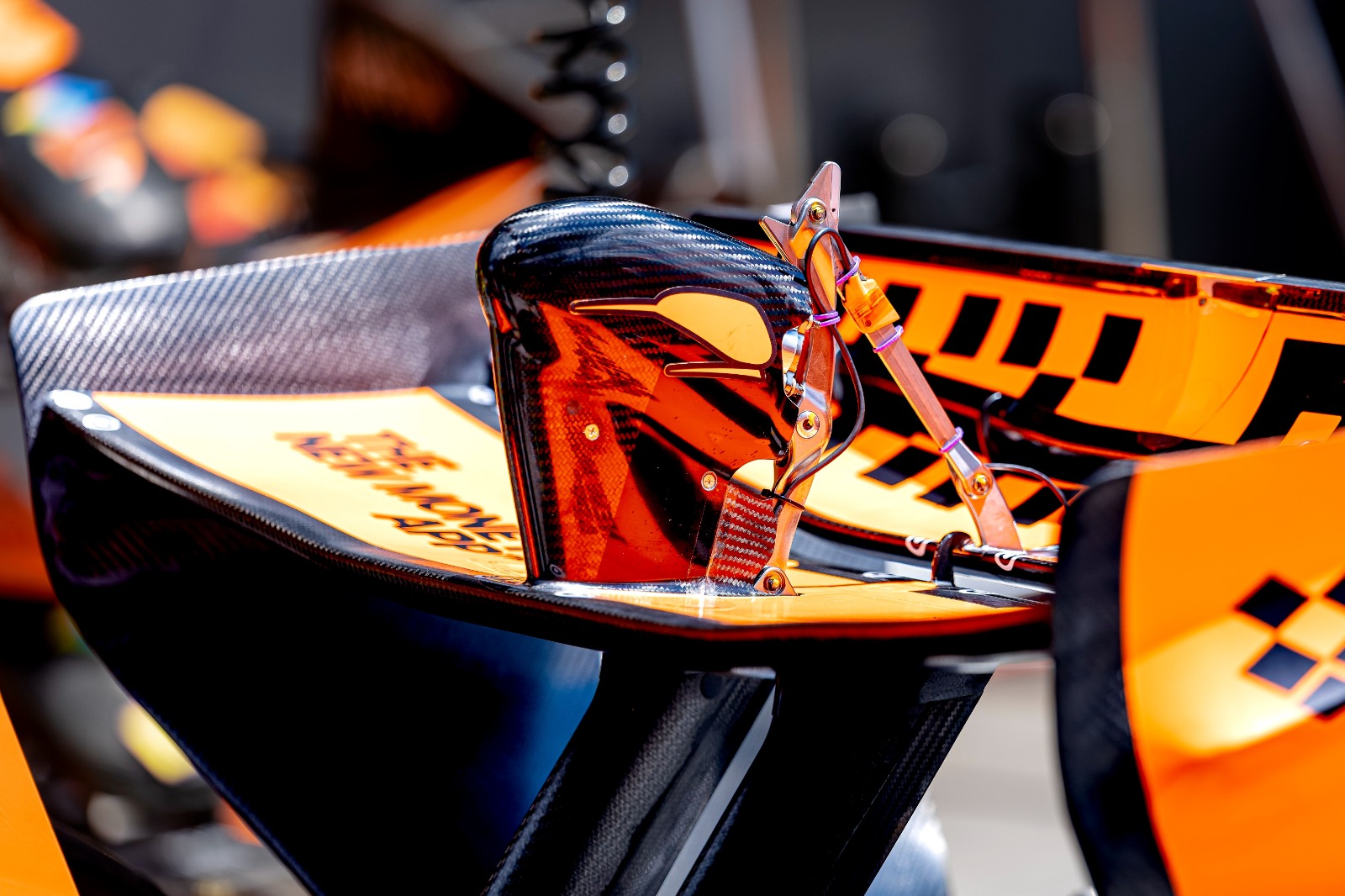
In Hungary McLaren began evaluating its own version of the pivoting rear wing pioneered by Ferrari and Red Bull
Photo by: Getty Images
"Initially it looked like actually it wasn't much of a lap time penalty to shorten the car. Do we think the wheelbase is a game changer? Absolutely not. It's small stuff, but when you're looking for small stuff everywhere, you take it.
"Beyond that, we're looking at everything on our car. Obviously we're looking at everything on everyone else's cars and taking inspiration from that. But really, we'll end up with a car I think that will be quite different to the one that we've got at the moment in terms of how we laid it out.
"But nothing groundbreaking. Just finding performance as you normally do through the year, through trying different things."
Another reason to embrace change is the package of rule tweaks coming for 2027, through which the FIA aims to rein in some of the unexpectedly large gains some teams have found, as well as closing various loopholes. Particularly around the diffuser area, many teams have been highly creative in deploying aerodynamic geometries purporting to be floor stays.
The rear wings will also be shallower by 20mm or so, while the rectangular extensions many teams have been adding to achieve a similar effect to a Gurney flap will be outlawed. Known to the teams as ‘hanger flaps', these exploit the wording of the present regulations which allow up to three ‘rotation brackets' outside the standard reference area to facilitate the movement of the rear wing's upper element in and out of Straight Line Mode.
The exhaust-mounted winglets, used most effectively by Ferrari, will also go as part of a wider tidy-up around the diffuser area, while at the front of the floor the number of permitted flow conditioners will be reduced from five to three. Also in this area, the length of the ‘plank' which contains the skid blocks will be reduced from 900mm to 600mm. This will all come off the front, the area known as the ‘bib' which protrudes from under the nose cone and plays a role in influencing the underbody airflow.
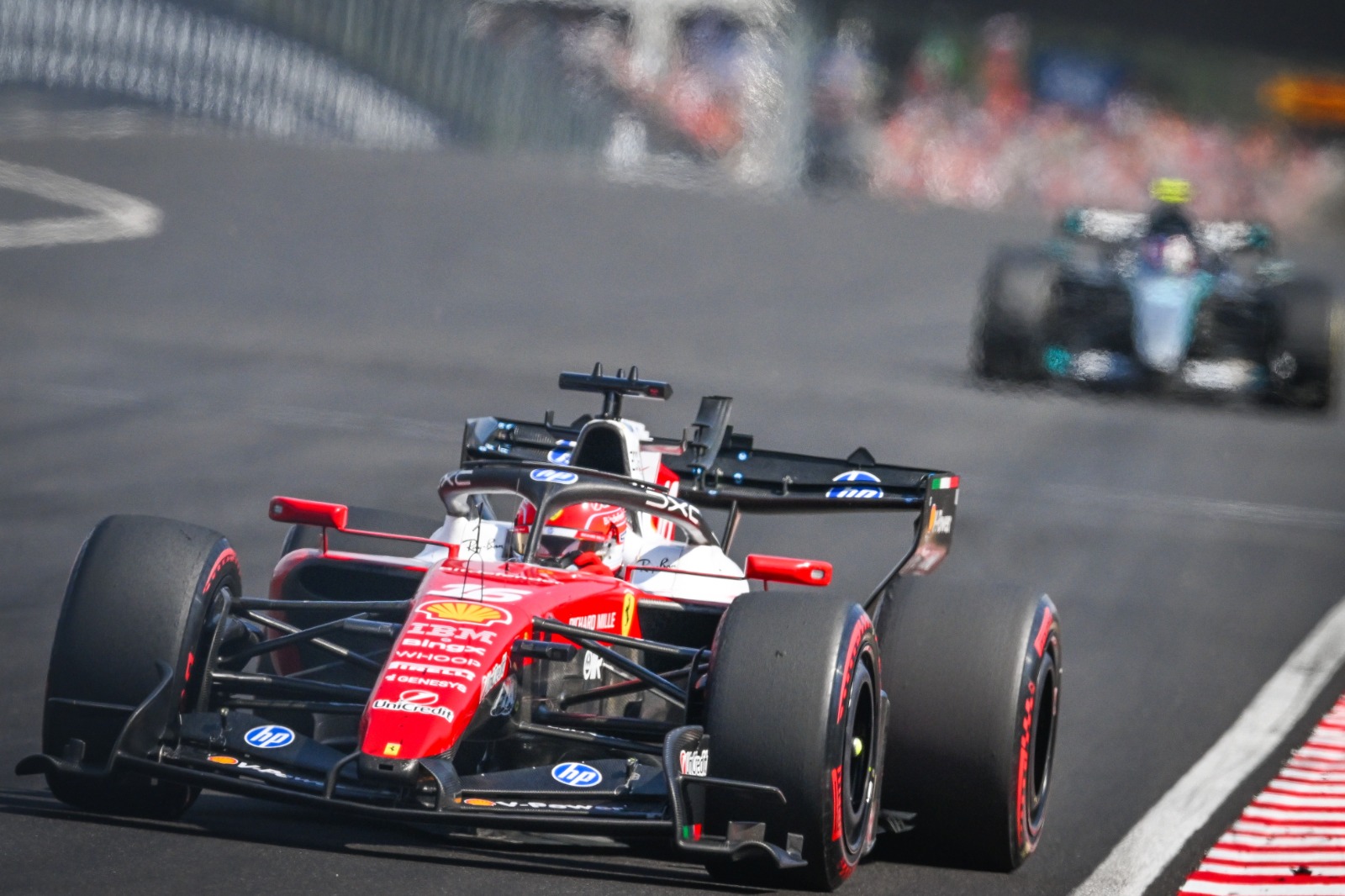
Ferrari has been one of several teams to add so-called 'hanger flaps' to its upper rear wing element
Photo by: Getty Images
While the visual differences won't be immediately obvious to the layperson, these subtle-sounding changes will have a significant effect on aerodynamic development because they open up different ways of running the car. The plank in effect dictates the car's overall ride height – too low and it will wear excessively as the car bottoms out, triggering disqualification (like McLaren suffered with both its cars in Las Vegas last year).
Shortening the bib therefore makes a lower front ride height theoretically possible, which has implications beyond optimising for a higher rake angle. Broadly speaking, the lower the front wing is to the ground, the more powerful the low-pressure area generated beneath it.
"Of course, we want to run as low as we can at the front," said Houldey. "Generally, we're still in that position, and you're either skid wear-limited or you might be bottoming-limited around some circuits. So that's what's setting your front ride height.
"Now that the bib shortens, potentially front ride heights can drop a little bit, puts the front wing closer to the ground. So that might affect how stiff you need to make your front wing – one from a contact perspective, but two whether the load requirements change, air elastic load requirements change.
"And then how do we manage that bib structure? Now it's right close to the front of the chassis, so it's not as easy to get the legal compliance in that you want [the bib is subjected to various deflection tests].
"So all of those things are just layout challenges to understand how we re-optimise and maximise the performance opportunity – effectively ride height, bottoming skid wear with a skid pack, front end of that bib that's harder to package than it is at the moment.
"Have we done a lot of work on it yet? No, it's still there on the job list to get into very soon."


Why Mercedes is still quicker than McLaren

Why "dangerous" Hamilton-Lawson incident in Azerbaijan GP practice hasn't led to change

Will the "big swing" Williams F1 car upgrade be a hit or a miss?

Russell's theory on his big hope for F1 2027 – and Antonelli's reply

What’s behind the delay in cancelling the Qatar and Abu Dhabi GPs?

What were Leclerc's "other opportunities" before signing new Ferrari deal?

Italy’s next F1 world champion?

Why Norris doesn’t buy Russell’s driving style theory

British GT Brands Hatch: Orange/Clutton take shock title as Collard spins

BTCC Silverstone: Record-breaker Sutton wins fifth title in style

Alpine condemns abuse again following Colapinto's Azerbaijan GP crash

BTCC Silvestone: Moffat wins after penalty overturned, Sutton made to wait for title
Subscribe and access Autosport.com with your ad-blocker.
From Formula 1 to MotoGP we report straight from the paddock because we love our sport, just like you. In order to keep delivering our expert journalism, our website uses advertising. Still, we want to give you the opportunity to enjoy an ad-free and tracker-free website and to continue using your adblocker.


Top Comments