


The science F1 must defy to prevent Spa shambles repeat
In one of the most exciting, closely contested F1 seasons for years, the 2021 Belgian Grand Prix stood out as an ugly exception. PAT SYMONDS explains what is being done to avoid wet weather wreaking similar disruption in the future
As we look back at what was an extremely exciting 2021 Formula 1 season involving the closest inter-team competition that we have seen for many years, several events will stand out. Most of these will be positive as even the circuits that normally struggle to produce good racing seemed to throw off the mantle of dullness. Unfortunately, the one negative that will be discussed for some time to come is the events that occurred at Spa.
The circuit is renowned for wet weather, with prevailing westerly winds picking up moisture as they transit the sea and then meeting the hills of the Ardennes, causing them to drop that moisture as rain. We have raced at Spa for years and always dealt with it, but last year the sheer intensity caused the race to be effectively abandoned.
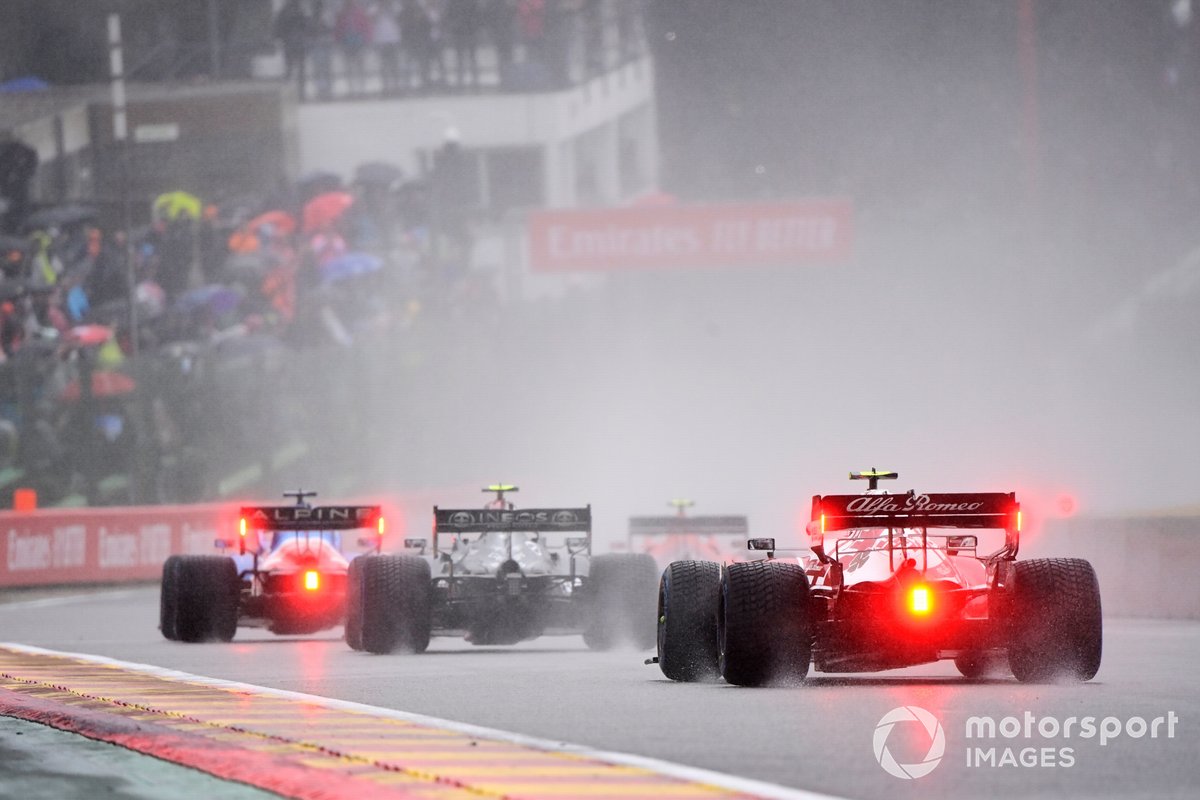
So what are the complexities of racing in the rain? It comes down to two things: aquaplaning and visibility. Grip is reduced considerably, but this in itself is not a problem. The drivers adjust and it actually increases the differentiation between the very best drivers and the rest of the field.
PLUS: Ranking F1's 10 greatest wet-weather drives
Drivers dread aquaplaning as they have no control over it. For a given tyre it is a function of speed and depth of water. Below a critical speed, a tyre will clear water and above it the tyre will ride up on a wedge of water causing a total loss of grip. Tread design is secondary to these other factors in determining the propensity to aquaplaning.
Visibility is a much more complex problem, as it involves not just the tyre but also the aerodynamics of the car. Like aquaplaning, it is really only something of concern when on the full wet tyre. The intermediate tyre, by definition, is dealing with much less severe conditions and not ones that generally concern the drivers.
A full wet tyre displaces an enormous amount of water. At 155mph, a front tyre displaces 50,000cc of water per second; a rear tyre displaces 70,000cc per second when running through water 2.5mm deep. To put that into context, an average bath is filled to around 100 litres, so the four tyres on an F1 car displace enough water to fill that bath in well under half a second.

Poor visibility resulting from wet weather racing is a serious problem for F1 to tackle
Photo by: Erik Junius
As a tyre rolls over the water on a track, there are several mechanisms of fluid flow in place. In front of the tyre, a proportion of the water is expelled forward of the tyre contact patch in the form of a bow wave. Side waves are also formed by the water that is squeezed out sideways from the tyre.
The side wave is a plume of water that encounters a wall of water at the edge of the contact patch which absorbs some of its energy but also changes its direction, throwing it upwards. The wall of water that is outside the area of the contact patch has now had this energy imparted to it and undergoes the same process.
The result is that the apparent displacement of water is actually much wider than the tyre footprint itself. Both the bow and the side waves start off with relatively large droplets, maybe 3-5mm in diameter, but when they interact they are broken into a fine mist that is carried aloft as spray. Spray droplets are typically well below 1mm in diameter and hence are more easily moved by the airflow around the car.
It may be that the 2022 cars, with reduced outwash, perform slightly better for following car visibility, but until we understand and can replicate the physics of this complex subject it is difficult to be sure
A further amount of water is actually picked up by the tread and ejected behind the tyre at an angle of around 30 degrees. The final contributor to the spray is a film of water that adheres to the tyre by capillary adhesion and is stripped from the tyre by the airflow as a very fine aerosol.
With an F1 car it is not just the tyres that are contributing to the spray. At a certain speed, the low pressure generated under the car by the floor and diffuser will be enough to overcome the surface tension that is holding the water on to the track and will suck it up into the rooster tail.
PLUS: What F1 must do for Belgian GP fans after Spa farce
We can understand that an enormous amount of water is lifted off the surface by the car, and what goes up must come down. Luckily a combination of crosswinds and natural outwash of flow from the cars will displace an amount of water sideways, leading to the racing line drying out – but the water will still be held off line and, if there is any banking on the track, can continue to flow into the path of the cars.
Aerodynamic pressures, in addition to tyres, also contribute to creating the spray effect
Photo by: Mark Sutton / Motorsport Images
At F1 we are undertaking some fundamental research into the formation and dispersion of spray in wet weather. It is a complex subject involving the simulation of what are termed ‘multi-phase’ flows – that is flows that have both a liquid and a gas component.
Fernando Alonso has told me his experience of LMP1 cars in the wet is much better and so I am sure, even without enclosing the wheels as is done in sportscars, we can do things to mitigate the visibility problem that exists in F1 today.
Our research will not be the matter of a moment, as some new techniques need to be evolved, but similar approaches have been employed in other industries. For example, it is important that an aircraft engine running on a wet runway does not ingest too much water and this is investigated by modelling as well as practical tests.
It may be that the 2022 cars, with reduced outwash, perform slightly better for following car visibility, but until we understand and can replicate the physics of this complex subject it is difficult to be sure. What I am sure of is that there is an answer to the problem and we will eventually make F1 considerably safer in the rain.

F1 is working on solutions to make wet races safer in future
Photo by: Mark Sutton / Motorsport Images

How Ratzenberger beat the odds to realise his cruelly short-lived F1 dream

F1 uncovered: A weekend behind the scenes with a chief mechanic

When McLaren was pipped by Red Bull in a modern F1 classic

The big opportunity Sainz’s Williams switch affords to F1’s latest centurion

Inside the science of F1 fuel

How F1’s plan for rotating races could look in practice

The early decisions that set Sauber’s rookie for success

How F1 media coverage has evolved in line with its subject

How Antonelli levelled up his character to be F1 2026's world champion-elect

FIA set to close F1 cost cap loophole with new rules

Norris promises to make "better decisions" following fresh talks over Singapore GP clash

FIA expects F1 races in Qatar and Abu Dhabi to run as planned
Subscribe and access Autosport.com with your ad-blocker.
From Formula 1 to MotoGP we report straight from the paddock because we love our sport, just like you. In order to keep delivering our expert journalism, our website uses advertising. Still, we want to give you the opportunity to enjoy an ad-free and tracker-free website and to continue using your adblocker.


Top Comments