


The rise of a new F1 superpower
Benetton may be best remembered for its successes, controversies and colourful liveries, but former engineering chief Pat Symonds argues that 1993's B193 is a forgotten gem that preceded title glory in the following years
Nearly – but not quite. That sums up Benetton in the early 1990s. The close-knit team based in a patchwork of industrial units in Witney was established as Ford’s factory-powered squad and through Flavio Briatore’s marketing hustle from 1989 boasted a decent budget, with limited but consistent support from the Italian ‘woolly jumper company’ that owned it.
Yet it always seemed to be a pretender tapping on the glass ceiling of success, with only the odd crack to show for its efforts. Despite the potential sum of its considerable parts, would Benetton ever crash through and beat the established McLaren/Williams hegemony?
The game-changer was supposed to be John Barnard. But the revered designer behind McLaren’s mid-1980s glory and the near-miss Ferrari revival of 1989/90 had blown through Benetton in a fury in little more than 18 months. What a disappointment.
PLUS: Top 10 Benetton F1 drivers
Yet the short, explosive Barnard era did shake the team from comfortable complacency and triggered a chain of events that led directly to the team’s mid-1990s golden era.
Thirteen engineers, including designer Rory Byrne and engineering chief Pat Symonds, had walked out in protest at Barnard’s ‘my way or the highway’ approach. By the end of 1991, Byrne and Symonds were back – and quickly gelled with a new senior recruit ushered in by Briatore’s canny alliance with Tom Walkinshaw. Fresh from designing TWR’s stunning Ford HB V8-powered Jaguar XJR-14, Ross Brawn was hungry for the F1 success that had (inevitably) eluded him in his three-year spell at underfunded Arrows.
Then there was the other spice added to the mix: Michael Schumacher. Poached in a storm of controversy from under the nose of Eddie Jordan after the 1991 Belgian Grand Prix, the German was living up to the hype. He’d won his 18th GP through intelligence and intuition matched to his obvious speed in mixed conditions on his return to Spa, and in 1993 appeared ready to take the next step. The same was true of Benetton following a winter move to a brand-new, gleaming white factory built on an old quarry in remote countryside near Enstone.
Yet on paper, 1993 turned out to be the same old story. As Williams hit its zenith with the active-ride marvel that was the FW15C, Benetton found itself beaten once again into third
by McLaren. Only by eight points, but McLaren’s gilt-edged partnership with Honda was by now over and it had been reduced to the status of a Ford Cosworth customer. Yes, a fired-up Ayrton Senna was always going to be a factor. But still, it was… awkward.

Photo by: Motorsport Images
Schumacher scored his only win of the 1993 season at Estoril
Underwhelming too, especially with hindsight on how good Schumacher would turn out to be. When the then-24-year-old finished he was nearly always on the podium, notching up three thirds and five seconds – but just a solitary win, at Estoril.
The report from Portugal makes for familiar reading as his weekend built to a crescendo after the odd stutter: a spin on Friday morning, only fifth in the afternoon; a spin and crash on Saturday morning, just sixth in afternoon qualifying. Then on race day, after switching to the spare car, he ran fifth from the start, pitted early for fresh tyres on lap 21 and found himself leading after the Williams duo of Alain Prost and Damon Hill made their stops.
He ran to the finish, fending off Prost to calmly score his second GP victory. But shouldn’t there have been more days like this?
Symonds stands by the B193, and argues the results don’t offer a fair summary in what was the final year of active-ride before so-called ‘driver aids’ such as traction control were banned for a return to ‘passive’ F1.
"There was nothing when I started, at least on the chassis side. But now it was just exploding, even if it was still tip-of-the-iceberg stuff" Pat Symonds
“Our car was pretty damn good,” he says. “I’d say it was second best, better than the McLaren. It did everything we asked of it. But we were learning. Williams had more experience on how these electronic systems worked and this was very early days of integrating electronics into electro-mechanical engineering. It was the early days of hydraulics, how they work and the pitfalls you can fall into. But the car was good.”
Symonds had been working on active ride since the late 1980s, but it was only in 1993 that the team felt prepared to race its system, along with its first paddleshift gearbox. In the wake of so much upheaval, perhaps that’s understandable.
Alan Permane was on the test team in 1993. The ex-sporting director of the team’s modern guise as Alpine offers some insight into how these were pioneering times – and why they had to be reined in. “I was on Schumacher’s car,” he says. “Part of my role was programming the active car and part of it was looking after the ever-growing data logging that had only appeared in around 1991. There was nothing when I started, at least on the chassis side. But now it was just exploding, even if it was still tip-of-the-iceberg stuff.

Photo by: Sutton Images
Symonds worked closely with Schumacher in 1993, serving as the German's race engineer
“By the end of 1993 we had a car with four-wheel steer and they were thinking about active camber. Honestly, it was a good thing it was stopped for F1 because where was it going to end? The whole car would have moved [independently]. It was developing at a hell of a rate.”
Seasoned engineer and designer Frank Dernie joined Benetton late in 1992, direct from a declining Team Lotus and after years learning how to win world championships at Williams. He pinpoints some of the key weaknesses that help explain why Benetton was still falling short, including a contradiction at the heart of its works Ford status.
“The B193 was fairly quick but it wasn’t reliable enough and we had a lot to do on it,” he says.
PLUS: The rushed McLaren F1 car that elevated a reluctant Senna's legacy
“This is sort of controversial and the irony always makes me smile. Because we had the works engine, Ford paid for it and Cosworth ran it. Because McLaren had to buy their engines, they were customer engines and so they ran them. Now, Cosworth had told Ford that any sort of traction control involving ignition timing was risky in the reliability of the engine, so Benetton wasn’t allowed such a system.
“The Cosworth traction control system involved an actuator that actually physically closed the throttle barrels, it wasn’t electronic. It was slow and never worked very well. Whereas McLaren, because they effectively owned their engines, used their own TAG electronics systems and they had a very sophisticated traction control system using retardation and spark cut, which worked really well.
“They were always telling everybody we had the better engine but they actually had a more raceable engine. Rory Byrne used to refer to Cosworth as the Northampton Conservative Party – they were very conservative and no risks were taken with the engine.”
Symonds concurs. “The way the Renault and everyone else was doing traction control was by cutting sparks: the wheels start to spin, you cut the sparks and instantly you lose power,” he says. “Cosworth were adamant you couldn’t do that because you’d break the engine and they wouldn’t let us do it, so ours worked on a bit of ignition timing, a bit of throttle control. It wasn’t very good at all.
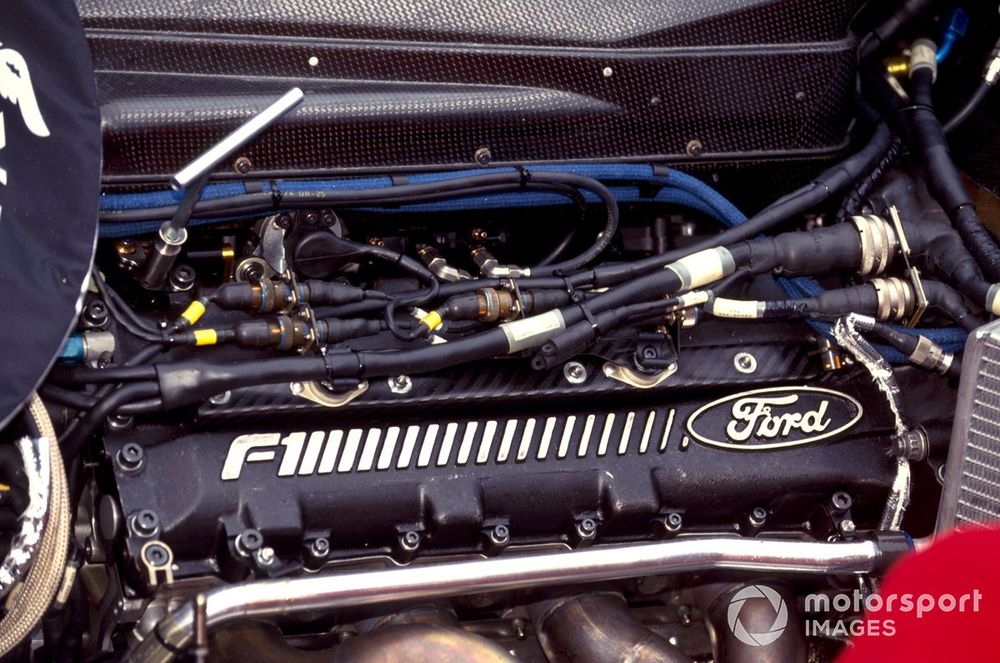
Photo by: Sutton Images
Symonds conceded the Ford Cosworth engine used in 1993 "wasn't very good at all"
“McLaren had customer engines, so if Cosworth said ‘don’t do it’ they ignored them. They also had a very good electronics division, so they had massively better traction control than we did. Things like that were very frustrating.”
A political row between Benetton and McLaren, fuelled inevitably by Senna, coloured the season’s early months as the customer called for Cosworth parity on engines. “Niggle”, as Symonds describes it, had festered since 1984 when McLaren blocked Michelin from supplying the best of its tyres to what was then Toleman. Now the boot was on the other foot. But as Symonds argues, engine parity was something of a red herring when McLaren had superior electronics – and the freedom to use them.
“At the start of the year, as we were the works team we would have the latest engine and McLaren would get them after us,” he recalls. “Before long they were getting the same engines as us, which in itself I didn’t really mind. But it raised questions of supply: were you getting good engines or were they rushing to build new engines because they’d upgraded and now needed to build them for ourselves and McLaren?
"Even if they didn’t have the total assets of the others, they had a different style of energy that carried them through. And ultimately they had Michael, who wasn’t slow to deliver" Allan McNish
“I do remember Tom Walkinshaw saying that McLaren would only ever get the same engines as us over his dead body – but he didn’t die when they did get them.”
Beyond engines and electronics, Dernie also argues that Benetton was simply not yet fully cooked as a top-line team. “I likened winning the world championship to climbing a mountain,” he explains. “The first part is practically a vertical cliff, called having a fast car. The cliff varies from winter to winter in terms of snow and the weather – which is the rule changes – and once you have found a route, it isn’t always the best one because something changes. It’s such a difficult climb that almost nobody has been to the top of the cliff, and nearly everybody in motor racing thinks if they have got to the top they’ve made it.
“Benetton was like that when I joined. But when you get to the top of the cliff you can then see the series of peaks you’ve still got to climb, which represent finishing all the races, not screwing up pitstops – so many things you’ve also got to be able to do on top of having a fast car.
“And I think what I could offer was that: the fact that having a fast car wasn’t enough, we needed to finish the races, make the car driveable. And the things we didn’t do well we started doing well. I didn’t really contribute much to the potential of the car because that was Rory, but I think I contributed a lot to getting most of that potential out of it at the race track, which is what I sort of specialise in. It’s amazing how many cars go racing without being near their optimum settings.”
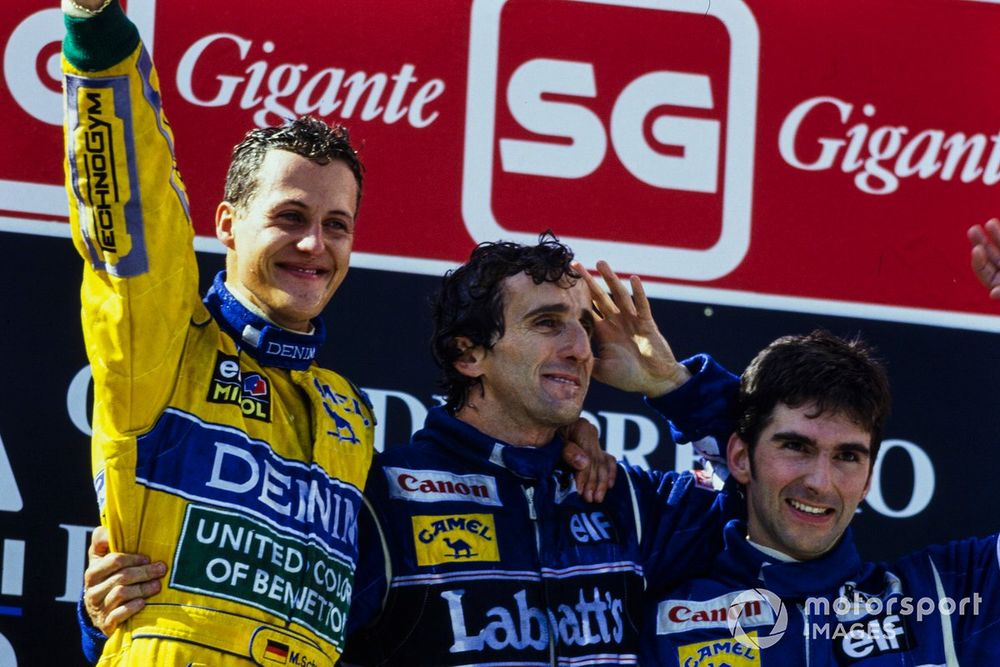
Photo by: Motorsport Images
Benetton could win on their day but world championship success would require perfection across an entire campaign
Recruited by Brawn, who had worked under him during his Williams ‘apprenticeship’, Dernie adds: “My contribution was sort of old-fashioned. They don’t need it today. I made sure the car finished the race. It doesn’t matter how fast it is if you don’t finish. Benetton had concentrated far too much until my arrival on doing a fast lap at a test.”
But even if the team wasn’t yet firing as it needed to, the blend was beginning to mature. Beyond the race team, a lucrative new sponsorship deal was pushed over the line with Japanese tobacco brand Mild Seven to replace Camel, which was heading for the F1 exit at season’s end. And the team responded quickly to the electronics ban for 1994. Symonds says focus on the B194, in which Schumacher would lead the team to both glory and infamy the following year, began as early as June. The only system that continued to be developed was the four-wheel steer – and that was only wheeled out for use at the final race of the season.
Test driver Allan McNish recalls completing 43 days developing the electronics – imagine that today! – and witnessed the evolution of a new superpower.
“You had Rory, Ross and Pat effectively as the engineering brains behind it all,” says the Scot, then 23. “They were all pushing massively. Everybody had that positive energy, a young team that maybe wasn’t as established in F1 as some of the competition, but they wanted a first taste of the champagne. They were eager, aggressive, and there was a sense of purpose about them.
“Even if they didn’t have the total assets of the others, they had a different style of energy that carried them through. And ultimately they had Michael, who wasn’t slow to deliver.”
“We were still quite a young team and we weren’t knitted together completely,” admits Symonds. “The one thing people often underestimate in a team is continuity. Williams and McLaren were pretty established teams and knew how to win, but we were still learning. By 1994 and 1995 we knew too.”

Photo by: Ercole Colombo
Patrese was dropped by Benetton following the Hungarian Grand Prix
Why Patrese crashed out of F1
At the risk of stating the bleedin’ obvious, Riccardo Patrese really should have stayed at Williams in 1993. In the knowledge that Alain Prost was on his way, he’d signed for Benetton. But then Nigel Mansell flounced off to Indycar. Patrese couldn’t have predicted that and could have partnered Prost – but to his credit kept to his word and new contract.
By the following April, he was already facing rumours of the axe after a poor start to the season. It hardly helped Flavio Briatore’s hair-trigger patience that any comparison was being made to a young and hungry Michael Schumacher.
In a season of few highlights, Patrese managed a third at Silverstone, sharing the podium with Prost and Schumacher, and a second in Hungary. But the Monday after the Budapest race he was released from his contract. Patrese saw out his 17th and final F1 season to log a then-record 256 grand prix starts. But it was a sad ending to a fine career, encapsulated by his collision with Derek Warwick’s Footwork at Estoril.
Today, Patrese is phlegmatic. “It didn’t work mainly because I think they underestimated the potential of Michael,” he states. “Michael was a little bit quicker, but he was younger and really determined. So Mr Briatore started to say that I had to go for my pension because
I was old and anybody he could put in the car would perform better than I did! In effect the next year they changed three drivers to replace me [JJ Lehto, Jos Verstappen and Johnny Herbert]. Now we know Michael was outstanding.”
“He [Patrese] struggled at the beginning because the 1992 car we started the season with had a gear lever and he couldn’t handle it" Pat Symonds
Patrese had been recruited largely for his experience with active ride, even if the Williams system was entirely different to Benetton’s. “I did the job that they asked me to do, to try to put everything together, because there was the active [suspension], the automatic gearbox, a lot of new things,” he argues.
“OK, maybe the performance was not… you know, it was my 17th season in F1! But don’t forget Schumacher finished fourth in the championship and I finished fifth, so it’s not that I was nowhere.”
Pat Symonds retains a lot of affection for Patrese. “He’s a nice guy, a lovely bloke to work with,” he recalls. “He struggled at the beginning because the 1992 car we started the season with had a gear lever and he couldn’t handle it. He’d had the luxury of being in a Williams with paddleshift. That was difficult for him.
“But the main thing was he was just totally fazed by Michael. At Silverstone, we’d had a problem in qualifying and you could use spare cars then. Michael’s car was not going to run, so we decided Patrese would do his laps, then Michael would get in his car and finish qualifying. Patrese set a reasonable lap, Michael got in the car set up for Patrese and went significantly quicker. Patrese just said, ‘I can’t do that’.”
So, is it fair to say that Schumacher finished Patrese’s F1 career? “He really did, didn’t he?”
Benetton: Rebels of Formula 1 by Damien Smith is published by Evro Publishing, ISBN 9781910505588, RRP £60

Photo by: Motorsport Images
Is the Benetton B193 a forgotten gem among the all-time greats?

Why this quintessential late-1970s F1 car stands out in the history of the Tyrrell team

The F1 title winner that was produced with an entirely different plan in mind

The man who shaped the Formula 1 car

When Alesi was reunited with his “dream” F1 racer

Why McLaren’s M26 wasn’t solely to blame for its decline

The crazy story behind a remarkable racing quadruple

Obituary: F1 team founder Ted Toleman dies aged 86

Prototype Winter Series Barcelona: Newcomer David defeats champion Soufi

Kelly's masterclass secures Leinster Trophy victory at Mondello Park

Spanish GP organisers promise Madring track changes following F1 criticism

What we learned from MotoGP’s decisive San Marino Grand Prix

Honda replaces F1 power unit boss in organisation shuffle
Subscribe and access Autosport.com with your ad-blocker.
From Formula 1 to MotoGP we report straight from the paddock because we love our sport, just like you. In order to keep delivering our expert journalism, our website uses advertising. Still, we want to give you the opportunity to enjoy an ad-free and tracker-free website and to continue using your adblocker.


Top Comments