


The off-track dramas that added spice to F1 2022
Who thought that once the fallout from Abu Dhabi 2021 was out of the way F1 could just get on with racing? That proved a forlorn hope, as once again political drama abounded in 2022. Here's how the year's biggest controversies played out

“The higher you rise, the sharper the knives. The quickest way to become unpopular in this paddock is to win consistently.”
Christian Horner is no stranger to Formula 1’s political jousting. During his 17-year stint as Red Bull’s team principal, he has outlasted and often outfoxed his competitors. But even he conceded that 2022 had proven to be one of the toughest seasons yet off-track through the various political battles.
“We’ve firmly had a target on our back this year,” says Horner. “We’re a race team. We’re not a political organisation. We just focus on going racing.”
The ‘we’re just a race team’ card is one that Horner has played before, most notably in the wake of the Abu Dhabi controversy 12 months ago, when Mercedes arrived at Yas Marina with a lawyer in anticipation of a post-race protest. And while this year was a world away from the bitter, sometimes nasty nature of that 2021 title fight between Red Bull and Mercedes, it did not stop F1’s political scraps raging on through a range of issues.
The political infighting was set against very different circumstances in 2022. The technical regulations were overhauled as part of F1’s bid to create more on-track action and closer competition, opening the door to different interpretations, and some unexpected issues that took everyone by surprise. F1’s financial regulations moved into their second year, but the FIA still had to complete its first-year audit – something that would ignite the biggest political row of the season.
The FIA had also undergone significant changes. At the very top of the organisation, new president Mohammed Ben Sulayem enjoyed his first year in the role after winning last December’s election, and saw his reform of race control come into force in the wake of its mistakes in Abu Dhabi in December 2021. But this was not without teething problems, making for another year of off-track wrangling that stayed true to F1’s ‘piranha club’ instincts: some got eaten up, others survived.
“I don’t think there were any more games or less games,” says Mercedes F1 boss Toto Wolff. “Everybody kind of lives to their own standards. It was pretty much business as usual.”

While Red Bull and Mercedes didn't clash too frequently on-track in 2022 they were still at each other's throats off it
Photo by: Mark Sutton / Motorsport Images
New rules, same rivalries
As with the start of any new technical era, there was the potential for 2022 to bring a shake-up of F1’s pecking order. It may not have quite worked in the way some had hoped, given the continued advantage of Red Bull, Ferrari and Mercedes at the head of the pack, but the fall of the Silver Arrows after eight years was a major storyline throughout the season.
A lot of this was down to the porpoising issue that caught almost every team by surprise in pre-season testing. The F1 paddock arrived at Barcelona with whispers of teams breaking floors and struggling for mileage, and the cause became clear when the cars were seen bouncing violently at the end of the main straight. And thus ‘porpoising’ became F1’s newest buzzword.
PLUS: How five tech battlegrounds shaped Formula 1 in 2022
It was something teams had to move quickly to remedy, raising rideheights and sacrificing performance in a trade-off they understandably were loathe to make. Drivers were willing to compromise their comfort in the cockpit in order to get up to speed but, as the early races ticked by, the safety issue came more into the spotlight. It reached its peak in Baku, where the high-speed nature of the bumpy street track left Lewis Hamilton holding his back upon getting out of the car, furthering the calls for intervention.
"We definitely don’t look at benefiting one more than the other or anything like that. But inevitably, the psychology of being in a competition is such that it makes you think always that somebody is out to get you" Nikolas Tombazis
Red Bull wasn’t buying it. The FIA took its first steps towards action the week after Baku, conducting a data-gathering exercise in Canada to measure the amount of porpoising ahead of a new metric for August’s Belgian GP that would ensure teams were within a certain limit. Horner warned at the time that it was a “dangerous avenue”, fearing it could set a precedent for F1’s rulemakers to start dictating other areas of set-ups.
When the FIA announced plans to make more wide-reaching rule changes for 2023 and enforce changes to the floor designs – a 25mm raise of the floor edges – Horner said safety was “a very easy card to stand behind” and there had been “an awful lot of lobbying to change the regulations significantly for next year so a certain team can run its car lower and benefit from that concept”. Clearly there was no love lost with Mercedes, even with Red Bull now a long way clear on track and the W13’s woes down to more than just porpoising.

Porpoising became the first F1 political football to be passed around
Photo by: Mark Sutton / Motorsport Images
The FIA has the remit to intervene on safety grounds without the support of the teams. Medical research into the impacts of porpoising drew comparisons with the forces NFL players face in tackles, warning of the risks of brain damage.
“The summary of the doctors is that frequency of 1-2Hz, sustained over a few minutes, can lead to brain damage,” said Wolff in Hungary. “We have 6-7Hz over several hours. So the answer is very easy: the FIA needs to do something about it.”
Horner was not alone in his uncertainty in the safety argument. At least five teams pushed back against the FIA’s planned 25mm raise of the floor edges, with Ferrari even thought to be considering use of its veto power. In the end, a compromise was struck: a 15mm raise for 2023, leaving no one entirely happy. Isn’t that how F1 politics should be?
By the end of the season, porpoising was barely a talking point, leading some team bosses to suggest it had been an overreach for a temporary issue.
“We all found solutions,” says Haas boss Gunther Steiner. “I always said, ‘We will find solutions, you don’t need to tweak the regulations’. That was done too hastily.”
But FIA technical chief Nikolas Tombazis reckons there was “no doubt” it had done the right thing, and refutes the suggestion that it had favoured one team.
“We definitely don’t look at benefiting one more than the other or anything like that,” he says. “But inevitably, the psychology of being in a competition is such that it makes you think always that somebody is out to get you.”
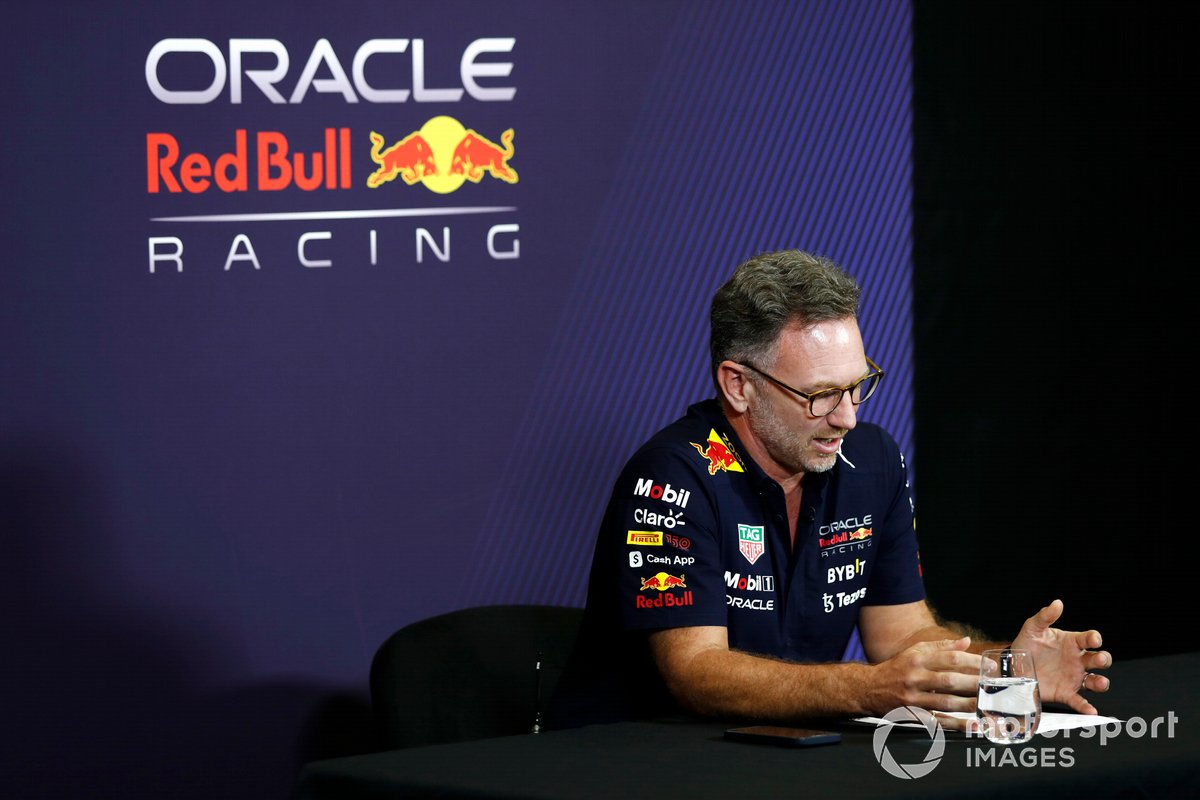
Red Bull faced the spotlight after breaching the F1 cost cap from 2021
Photo by: Carl Bingham / Motorsport Images
Red Bull pays the price
That psychology ties in with Horner’s feeling that Red Bull had a target on its back, and that was never truer than over its cost-cap breach for 2021, the details of which emerged in October. As the FIA completed its thorough audit of each team’s submission and bid to comply with the $145million budget cap for last year, the first whispers of a potential breach were heard at the Singapore GP. Red Bull was alleged to have overspent, leading rivals to quickly warn that any breach – not specifying Red Bull – had to be severely punished.
Horner came out swinging. He vehemently denied that Red Bull had exceeded the cap, saying its submission was well under the limit and that rivals were making “totally defamatory” statements – again, they hadn’t named Red Bull – all to try to take the spotlight away from Max Verstappen’s looming title win.
Twenty-four hours after Verstappen clinched his second title at Suzuka, the FIA issued confirmation that Red Bull had, in fact, breached the budget cap. The initial whispers that it could have been as much as $10m were proven wrong as the FIA confirmed it to be a “minor overspend breach”, in the region of 5% more than permitted.
With the news now out in the open, Red Bull’s rivals noted the significance that even a few hundred thousand pounds could have on development, and called for action. McLaren CEO Zak Brown went as far as saying that an overspend “constitutes cheating” and that it should be punished as severely as a breach of the sporting or technical regulations.
The first running of the cost cap audit may have been a success, but many saw room for improvement. Horner wanted answers over how the news leaked, while suggestions of bias emerged given the role of a former Mercedes lawyer, Shaila-Ann Rao, overseeing the process
It fanned the flames as talks between Red Bull and the FIA commenced, with Horner still insisting that the team had done nothing wrong in its submission. It didn’t stop ‘Costcappen’ entering F1 Twitter’s lexicon, or causing some frustration from the Dutch camp over the timing of the saga.
Red Bull and Horner always maintained that there would be transparency on the matter once an Accepted Breach Agreement, in which Red Bull would admit wrongdoing, was struck. Talks were delayed following the death of Red Bull founder Dietrich Mateschitz over the United States Grand Prix weekend, but an agreement was ultimately finalised ahead of the next race in Mexico. Red Bull was fined $7m and hit with a 10% reduction in its aerodynamic testing allowance for the next 12 months, a penalty Horner claimed was “draconian” given the circumstances of the breach.
The FIA found Red Bull had inaccurately excluded costs amounting to £5.6m, putting it £1.8m over the budget cap. These included areas such as staff catering costs, sick pay and the cost of power units. Red Bull also failed to apply a tax credit that would have meant its overspend only came to £432k, or 0.37% of the budget cap. Horner said that Red Bull only took the Accepted Breach Agreement for the good of F1, believing the saga could have rumbled on for another year had it not been settled. He also said the team’s rivals had lobbied for the aerodynamic testing restrictions “because they felt it hit us the hardest”.

Red Bull's cost cap penalty also brought up old grudges and spats from last year
Photo by: Mark Sutton / Motorsport Images
But there was little sympathy from the rest of the paddock. Most technical bosses agreed that a 10% cut wasn’t as dramatic as the half a second per lap Horner claimed. Ferrari sporting director Laurent Mekies also thought it didn’t make up for the possible gains from the overspend, as well as noting that it gave Red Bull freedom to spend money elsewhere.
“Our concern is that the combination of these two factors means the real effect of the penalty is very limited,” he said.
Wolff, Horner’s routine adversary, stayed relaxed, instead welcoming the fact that the FIA had taken meaningful action.
“There are big reputational consequences,” he said in Mexico. “That is why I believe no team is going to put a foot wrong over the line.”
In this regard, the first running of the cost cap audit may have been a success, but many still saw room for improvement. Horner wanted answers from the FIA over how the news leaked out in Singapore, while suggestions of bias within the organisation emerged given the role of a former Mercedes lawyer, Shaila-Ann Rao, overseeing the process. Rao has since left the FIA.
The fact that a decision didn’t arrive until 10 months after the end of the 2021 season was also a source of frustration – the FIA wants to speed this up to May next year – and, even now, some remain unhappy with the penalty.
“From now, we have to forget about minor and major overspends,” says Frederic Vasseur, the now former Alfa Romeo team boss. “Because for me, two or three million: it’s not minor, it’s mega, for development. We have to be much more strict and much more quick on the action.”
Ferrari and Mercedes may have been on the same page in the cost-cap battle against Red Bull, yet it would prove to be the final political saga involving Mattia Binotto. His exit was rumoured at the season-closing Abu Dhabi GP and denied by Ferrari, only for a statement to arrive one week later confirming the team principal’s departure. Binotto had spent only four years in charge at Maranello but it was not without controversy, particularly through the 2019 engine legality questions and the subsequent private settlement with the FIA.
Wolff now says that he and Binotto were “in a much better place” through 2022, having found common ground politically, but feels there was “too much broken” between them to ever consider him for a role at Mercedes. Binotto's replacement, Vasseur, is a good friend of Wolff’s, and his appointment will make for a fascinating political dynamic.

The F1 driver market erupted off the track when both Alonso and Piastri walked away from Alpine
Photo by: Carl Bingham / Motorsport Images
And the Oscar goes to…
If Red Bull and Mercedes weren’t going to lock horns directly this year, then other teams had to pick up the mantle and fuel the drama. That task fell to McLaren and Alpine in 2022 as they fought over 2021 Formula 2 champion Oscar Piastri in one of F1’s most spectacular driver-move stories.
As F1 left Hungary for its summer break, the driver market looked quite stable. Fernando Alonso was expected to sign an extension with Alpine; Daniel Ricciardo insisted he was committed to seeing out his McLaren contract; and Williams was being lined up to take Alpine junior Piastri ‘on loan’.
But in the space of 24 hours, Alpine lost not only its past great in Alonso, but also its future star in Piastri. Sebastian Vettel’s retirement announcement had opened the door for Alonso at Aston Martin, who were happy to give him the multi-year deal that Alpine would not. Alpine’s next move was to announce Piastri as Alonso’s replacement for 2023, albeit without any quote from Piastri – who then dropped his now-infamous tweet denying he would be racing for the team next year and that no contract was in place.
Alpine stuck to its guns. Team principal Otmar Szafnauer claimed over and over that Alpine had an agreement dating back to the previous November, and questioned Piastri’s integrity when F1 returned at Spa.
“I just wish Oscar would have remembered what he signed in November and what he signed up to,” he said. McLaren stayed quiet throughout, saying it would wait for the ruling of F1’s Contract Recognition Board.
"Let’s see how we do next year. I’m happy that our driving pairing with Esteban and Pierre is better than it would have been if we would have won that case" Otmar Szafnauer
It was an overwhelming win for Piastri and McLaren. The CRB found that Alpine never had a legally binding agreement in place with Piastri beyond 2022, the Australian’s camp baulking at a proposal to be placed at Williams for potentially another two years. McLaren swiftly confirmed him as Lando Norris’s team-mate for 2023, having already agreed to Ricciardo’s exit two weeks earlier. Alpine had already been putting the wheels in motion to sign Pierre Gasly. Winning the CRB case would have only resulted in a payout from McLaren.
The saga showed not only the fickle nature of F1 contracts, but the smoke and mirrors that can play out publicly. Alpine came out of the situation badly, yet Piastri – a driver whose junior CV is the envy of everyone bar Charles Leclerc – also found himself facing scrutiny. Mercedes chief Wolff even warned that it was not a good idea to burn bridges so publicly. It will make Piastri one of the most-watched rookies in years when he finally makes his debut next season, and he has already started work with McLaren after Alpine agreed to release him from his contract six weeks early.
But Szafnauer does not look back on the saga badly. He calls it “a process we had to go through” and suggests it actually worked out for the best.
“Let’s see how we do next year,” he says. “I’m happy that our driving pairing with Esteban [Ocon] and Pierre is better than it would have been if we would have won that case.”

Ben Sulayem's first full year as FIA president saw sweeping changes in F1 governance, but also some controversy and clashes
Photo by: Mark Sutton / Motorsport Images
The race to reform
When Ben Sulayem took over as FIA president last December, he vowed that it would be the start of a new, more transparent era. He would fix the issues that led to the Abu Dhabi controversy and the subsequent fall-out for F1.
Announcing the changes midway through Ferrari’s car launch in February wasn’t a great start, but the plans were promising. The race director role would now rotate between Niels Wittich and Eduardo Freitas, from DTM and World Endurance Championship respectively, and a Virtual Race Control Room similar to football’s VAR would be introduced.
Yet, as the season wore on, the teething problems continued. Drivers became increasingly frustrated with the inconsistency of decision-making between the race directors and the stewards. Alonso called the stewards in Miami “incompetent” and that he had not seen any improvement despite the changes, later apologising.
Hamilton found himself at the centre over a row surrounding jewellery, Wittich taking a hardline stance that left the seven-time world champion questioning why the FIA didn’t have better things to focus on. Verstappen said in Austria that it was important for the race directors to work with the drivers “instead of just keeping your stance and just being stubborn”, lifting the lid on tensions.
In the wake of the Japanese GP, where a decision to put a recovery crane on the track while cars were still circulating sparked justified anger from the drivers, the FIA returned to a single race director – Wittich – in a move the drivers welcomed. But teams were still left confused by the interpretation of the rules late in the season.
Haas had fallen victim to a black-and-orange flag over a loose front-wing endplate three times in the year, leaving it aghast when Alonso was allowed to continue at the US GP with his right-side mirror flapping around. Haas lodged a protest on principle, leading to Alonso’s exclusion five days later, only for Alpine to then counter-protest successfully. It emerged that there had been a total disconnect between race control and the stewards, and that Wittich had made a mistake in not issuing a black-and-orange flag, the rules of which are set to be revised for 2023.

Freitas and Wittich started the season as joint F1 race directors, replacing Masi, only for Wittich to take the role solely after more controversy
Photo by: Sam Bloxham / Motorsport Images
“That was the principle – your system is flawed because the rules are not the same for everybody,” says Haas boss Steiner, who adds there is “work to be done” to improve F1 officiating and “a lot of margin to do better”. Alpine counterpart Szafnauer feels that it will come in time, noting that people previously joked that it would take three people to replace the late, great Charlie Whiting. “As it turned out, those jokes were true,” he says.
It was a turbulent first year for Ben Sulayem, particularly when tensions between F1 and the FIA appeared to emerge. Plans to expand to six sprint races in 2023 being held up by the FIA, which wanted a greater payout for giving approval, didn’t help that image, but Ben Sulayem insists that there is a “marriage that is going to last” with F1 boss Stefano Domenicali. Yet, as F1’s boom continues and more fans flock to the series, tidying up the rulebook and getting rid of some of the quirks that only serve to alienate newcomers and infuriate purists is something that must be remedied sooner rather than later.
The numbers all read green for F1. But as the pie gets bigger, nothing will stop F1’s political animals from trying to get a bigger slice
But overall, F1 can look back on this year as a success. Its bosses managed to ease budget concerns in the wake of Russia’s invasion of Ukraine and soaring inflation to help teams; it got the 2026 engine regulations agreed and Audi’s involvement confirmed; and adding Las Vegas to the calendar from 2023 is a major coup.
The numbers all read green for F1. But even as the pie gets bigger, nothing will stop F1’s political animals from trying to get their teams a bigger slice, fuelling the off-track drama that keeps the series so colourful.

What F1 political storms will 2023 deliver?
Photo by: Steve Etherington / Motorsport Images


1998 Belgian GP: When the Schumachers went to war

F1 Monaco GP 1982 retrospective: Remembering F1's craziest finish

Has Alonso made the right choice gambling on Aston Martin F1?

Hamilton in the process of selecting Brad Pitt’s co-star for F1 movie

How ‘demanding’ Alonso has started life with Aston Martin

Ocon got "very sick" in F1 off-season due to bad lung virus

Brown: No reason not to expand F1 grid if new teams pay "fair" fee

Hamilton: Nothing will stop me speaking up on important issues in F1

F1 champion Norris completes first full test in McLaren’s Le Mans Hypercar

How Solberg lit up WRC title fight in Chile

F2 adds extra Baku feature race and insists Qatar, Abu Dhabi still on – what does this mean for F1?

Healeys, MGBs and Lotus Elans top Castle Combe Autumn Classic
Subscribe and access Autosport.com with your ad-blocker.
From Formula 1 to MotoGP we report straight from the paddock because we love our sport, just like you. In order to keep delivering our expert journalism, our website uses advertising. Still, we want to give you the opportunity to enjoy an ad-free and tracker-free website and to continue using your adblocker.


Top Comments