


The hidden cost cap rules hindering Williams' F1 progress
Since taking charge at Williams, James Vowles has taken time to assess the strengths and weaknesses of the Grove operation. But among the measures he wants to take to lift the team off the back, a subset of the cost cap rules will prove problematic to overcome

After years of success, championship victories, and occupying the highest echelons on the Formula 1 grid, the two declines that Williams has faced over the past two decades have been stark.
The first followed its divorce from BMW, as the team lurched from customer engine deal to engine deal over the next 10 years to vacillate between the upper and lower midfield. Its brief renaissance in 2014 was underpinned by a strong car design and an engine deal with Mercedes, which had dominated the early phases of the turbo-hybrid era.
But regression soon set in and, four years later, Williams had slipped to propping up the rest of the field. The team registered its first non-scoring season in 2020 and, while things haven't been quite as wretched since, the team has struggled to pull itself away from the magnetar of despair.
"20 years of underinvestment is why we are where we are today," mused team principal James Vowles, who has now had a few months in charge of Williams to draw his conclusions and chart a new path of progress. Brought in for this season to replace the departing Jost Capito in charge of the Grove squad, Vowles was one of the key components of Mercedes' all-conquering outfit, first as chief strategist before becoming the team's motorsport strategy director.
Williams needed Vowles arguably more than he needed Williams but, when the team principal role became available, he had to grasp it with both hands. With his arrival came knowledge and experience of a team built to win titles, and so dropping down the grid to a team lacking investment in its infrastructure was something of a culture shock.
When Dorilton Capital took over the team from the Williams family in 2020, the team was merely going through the motions to survive, and its existence was nothing more than a hand-to-mouth endeavour. The investment saved the team but, despite willingness to put more in to help Williams climb the order, it has lacked direction to do so.
Dorilton had hoped that Capito would be the man to lead it to glory, given his wealth of success leading racing operations in other championships, but F1 remains an incredibly tough nut to crack. Perhaps it was that Capito didn't quite have enough knowledge of F1's nuances and, although results improved during his tenure, the team needed to make the next step. Vowles, forged in the fires of Mercedes, could offer the direction that the team sorely needed.

Vowles has found the underinvestment at Williams something of a culture shock compared to his previous team, Mercedes
Photo by: Simon Galloway / Motorsport Images
Having conducted his analysis of the team and watching how it operates, Vowles identified clear areas that the team needed to focus its investments on. Although some areas related to hardware and facilities, noting that some of them hadn't been touched in 20 years, the Cranfield graduate explained that there were some gaping holes in its overall systems. Using one particular example, he explained that the software and systems used to track component designs were considerably outdated, resulting in designed parts falling into a "black hole".
"I'm in a fortunate position that my predecessors weren't, where we have significant investment behind us," Vowles said. "In fact, there is a strong desire to have Williams return back to a competitive position. But to do that requires investment. So the money's available and ready.
"But in many regards, where we are today, that money is disappearing on what I think is basic infrastructure. If I take an example of things that were in Williams, and this is being very transparent about it, when a designer releases a part it sort of goes into a black hole. And then there are emails going backwards and forwards between production to try and find out where their part is, how it's being upgraded, how big it is, and how long it will take.
"The numbers we're talking about here is hundreds of millions, not 10 million, or 20 million, but hundreds of millions to sort of catch up with the level of investment, from where Williams is today, to perhaps the most extreme expenditures you see" James Vowles
"Normally, that would go into a digital system that can be tracked, so you understand actually what the car gets made up of. And bear in mind, there are 17,000 components and by the time you have designers doing this 17,000 times, you get lost. So, you have inefficiencies. That software to fix that isn't £100, unfortunately - but millions, and even up to tens of millions if you get it right."
However, Williams cannot just throw money at improving its infrastructure. After all, there are rules governing capital expenditure, which is the money spent on expanding the team's assets on long-term infrastructure. Vowles says that this is about $36m available over a four-year period, which is far lower than what the team needs to spend to simply catch up to its rivals.
This doesn't extend to just updating some of its machines, but also improving its simulator technology and composites facilities to ensure that it can add performance to the car beyond simply trying to develop its aerodynamics package.
Vowles explained: "At the moment, my expenditure was more spent on trying to get some infrastructure in place. It's all publicly available. But if you actually go look at Companies House, you can sort of see that the numbers we're talking about here is hundreds of millions, not 10 million, or 20 million, but hundreds of millions to sort of catch up with the level of investment, from where Williams is today, to perhaps the most extreme expenditures you see in the sport. That's a big deficit.

Significant investment needed to improve not only the aerodynamics but the integral systems behind car performance is restricted by the cost cap
Photo by: Andy Hone / Motorsport Images
"Formula 1, the FIA and other teams have been supportive in this, what we're looking for at the moment is the ability to have sporting equity, the ability to have infrastructure that matches our peers, such that we're not fighting with one hand behind our back, but fighting in the same way as other people are.
"For us, certainly, where we are at the moment the numbers aren't small. In fact, they're scarily large and what we would have to spend on the site and on infrastructure… The site’s OK, that's actually external to the cost cap, interestingly enough, but on machines, for example, or simulators, or the software I was talking about here, or your composites facilities... What we're looking for is the ability to show where we are today, where the benchmark is, and the ability to spend in order to catch back up to that benchmark."
Vowles has earned sympathy from a number of other teams in its position, as the likes of McLaren and Alpine have also been hindered in their efforts to try and catch up. Along with McLaren principal Andrea Stella and Alpine's Otmar Szafnauer, Vowles supports the redefinition of the cost cap rules governing capital expenditure to create a more equal playing field in F1.
Although the cost cap has been a laudable pursuit and the restrictions on development it enforces have forced teams to box clever with their upgrade packages, it has also frozen some of the inadequacies of those teams who entered the cost cap era in place. As Formula 1's boom in popularity has allowed many of the teams to command huge values, many of the teams did not have the funds to exploit this prior to the cap being implemented.
With investment, Williams has been slowly improving and the situation no longer looks anywhere near as dire as the end of the Williams family's ownership of the team. Alex Albon's seventh-place finish at Montreal underlines the competitive potential of the team as it is, as it sought to take risks to get the Anglo-Thai driver well into the points. Although the race team remains a slick operation and was such during the difficulties of the late 2010s, Vowles knows that it cannot continue to excel if the facilities at home cannot produce stronger machinery.
PLUS: Canadian Grand Prix Driver Ratings
He reckons that the team being able to operate without that infrastructure demonstrates the "human glue" keeping the entire operation together, but notes that the team cannot lean on that forever.
"If you don't have a digital infrastructure where you know where a part is, how long it takes, how many parts you need, what is an assembly built up of, you are lost from the beginning," he said. "Actually, I think that's an accolade to what Williams was because you need a huge amount of teamwork in order to understand what you're doing with this. I would describe it as human glue, but very good human glue. And that's what was in place.

Williams has shown fluctuating form in recent seasons, but hasn't won a race since Pastor Maldonado notched its 114th victory at the 2012 Spanish Grand Prix
Photo by: Sutton Images
"Over the next few seasons, what's very clear is that our competitors are bringing tremendous amounts of performance to the car quicker than we're bringing it to the car. We have to address that and improve that.
"And very clearly as well, the car has some characteristics where it works well at some tracks, and at others it's quite poor. And we've got to really start addressing that through some base fundamentals. So I would say all areas of the organisation have targets for how we're going to improve, and all will deliver performance if we can get them right."
If the teams, F1, and the FIA can work together to tweak the rules on capital expenditure, then there's a much better chance that the fans will be treated to the close fields that it was promised by the current-day financial and technical regulations. The big teams won't want to cede their advantage, but Vowles has vowed to improve the situation for his own team.
Williams can only go so far in the current framework, and other teams are starting to realise their own limitations as they try to catch the championship's biggest hitters.

Albon scored points in Montreal with a strong seventh place that was the best dry weather result for Williams since the 2017 Brazilian Grand Prix
Photo by: Williams


Why Mercedes' latest 2026 F1 update is no downgrade

Singapore Grand Prix Driver Ratings 2026

What we learned from the 2026 F1 Singapore GP sprint race and qualifying

The political minefield set out by F1’s recent cost-cap grievances
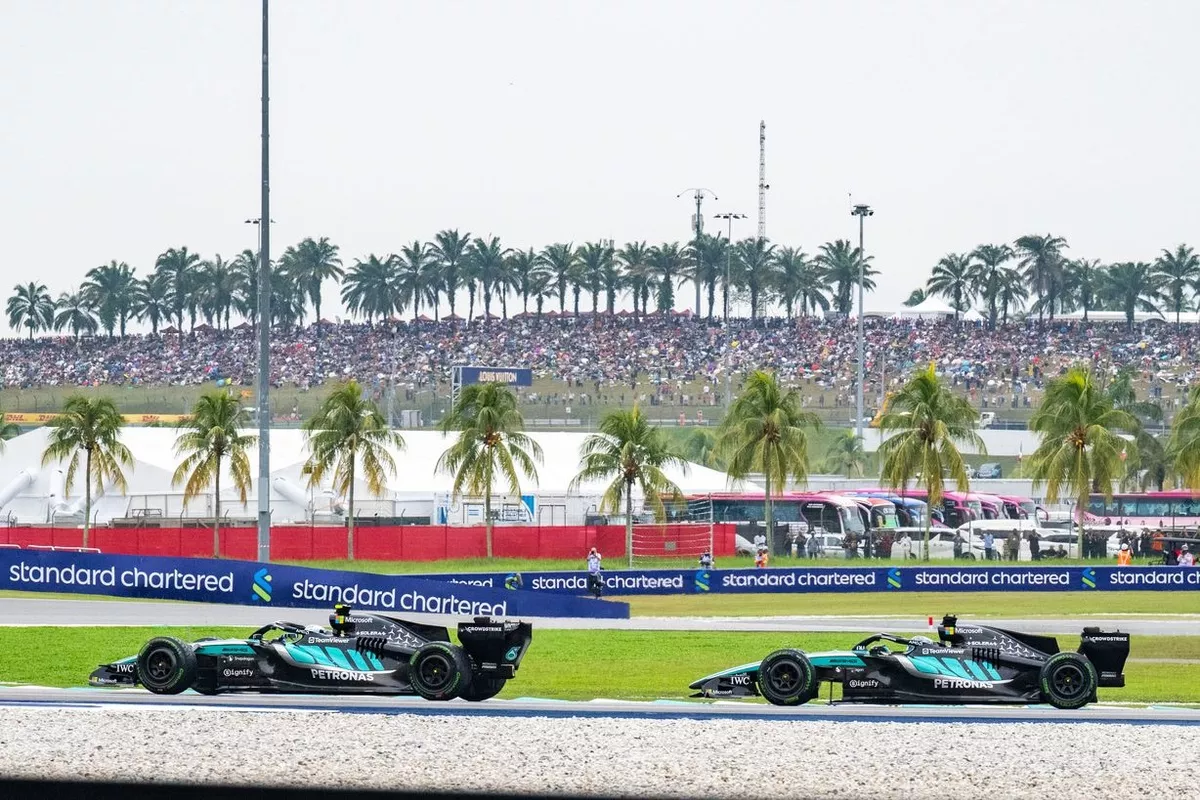
What caused Mercedes' pace deficit at Sepang despite upgraded W17?

Three kings: F1's generational stars shone at Sepang

Bahrain Grand Prix in Malaysia Driver Ratings 2026

The slick tyre gamble that hurt McLaren and Ferrari's chances in Bahrain GP in Malaysia

Five key takeaways from F1's big African Grand Prix reveal in Rwanda

IndyCar driver Harvey announces cancer diagnosis

Why McLaren cannot fix its F1 car handling until 2027

MotoGP riders could get what they want, and fast, if only they would stand together
Subscribe and access Autosport.com with your ad-blocker.
From Formula 1 to MotoGP we report straight from the paddock because we love our sport, just like you. In order to keep delivering our expert journalism, our website uses advertising. Still, we want to give you the opportunity to enjoy an ad-free and tracker-free website and to continue using your adblocker.


Top Comments