


The delay that quashed Aston Martin’s last F1 venture
Aston Martin’s only previous foray into Formula 1 in the late 1950s was a short-lived and unsuccessful affair. But it could have been so different, says NIGEL ROEBUCK
“Well, you could say that Jack made the right decision!” said a laconic Roy Salvadori of Brabham’s opting to stay where he was for the 1959 grand prix season.
Both had driven for John Cooper the year before and also competed in sportscars with the Aston Martin team. When it was decided that Aston would enter F1, team manager Reg Parnell was keen to keep them on board: both men agreed terms and shook hands on the deal.
Brabham, though, had misgivings. To this point, Coventry-Climax had built nothing bigger than a 2.2-litre engine, putting Cooper – and Lotus – at a disadvantage to such as Ferrari, Vanwall and BRM, who had the full 2.5-litres permitted by the regulations. For 1959, though, there was to be a 2.5 from Climax, and Brabham suspected rightly that this – in the only rear-engined car of the moment – would be the thing to have. His arm didn’t need much twisting, and when Esso came up with extra funding to keep him at Cooper, it didn’t need twisting at all.
“Jack and I talked about it,” said Salvadori, “and I said I thought he was probably right about the Climax 2.5, but I felt we’d committed ourselves to Aston. Jack, though, said he was definitely driving for Cooper, and thought I should do the same: ‘I’m going to ring Parnell to tell him – so you think it over…’
“I did, and although the happiest years of my career had been with Astons, I tried hard to get out of the agreement. But Reg said, ‘I’ve heard from Jack… Roy, you wouldn’t do that to me, would you?’ By the end of the conversation, I was still with them – and Brabham went on to win the next two world championships!”
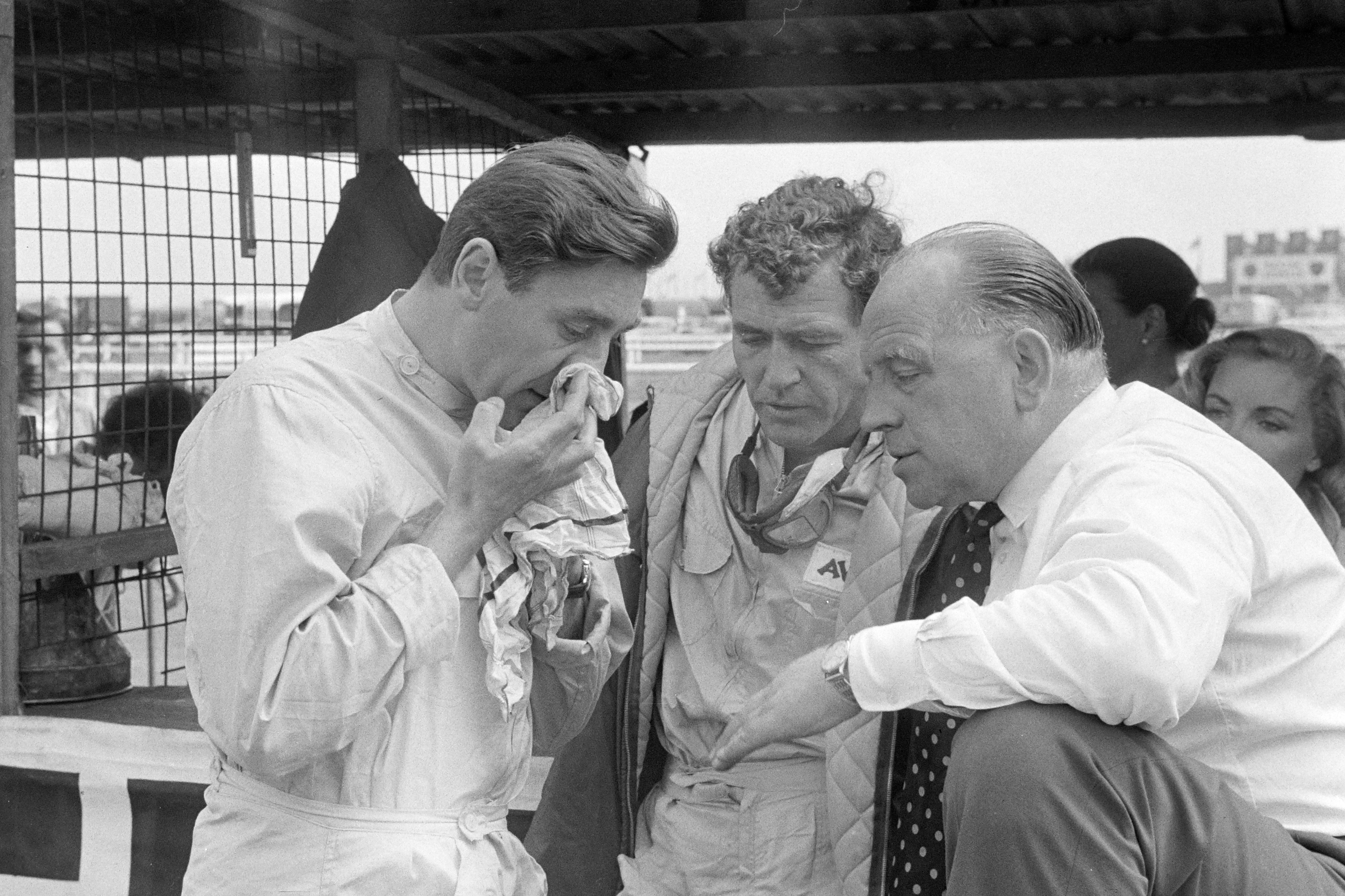
Roy Salvadori, Carroll Shelby, Reg Parnell 1959 British GP
Photo by: Motorsport Images
Salvadori wasted those seasons on a car outdated even before its debut. For several years grand prix racing had been in the mind of Aston Martin’s owner, David Brown, and in fact a lash-up single-seater had been built for Parnell to use in New Zealand in 1956. The following year a true F1 car was built, and tested by Tony Brooks, but the company’s focus remained on sportscar racing – in particular Le Mans, which it had never won – and throughout 1958 the F1 car sat in a corner of the workshop, a sheet over it.
“If we’d raced it in 1958, it might have been very good,” said Ted Cutting, its designer, “but we didn’t have the money or manpower to do both sportscars and F1. Brown’s obsession was winning Le Mans. We were optimistic we could do it that year – but in the event we didn’t.”
For 1959, therefore, there was a new plan. Aston Martin would not abandon its dream of winning Le Mans with the DBR1, but that would be the year’s only sportscar race: focus would otherwise switch to the DBR4 F1 car, which made its first appearance in May in the Daily Express Trophy at Silverstone.
A gorgeous-looking thing it was, too, reminiscent of Maserati’s iconic 250F – but therein lay the problem, for already the 250F was obsolete. That said, the Aston’s debut – while flattering to deceive – was unarguably impressive: Salvadori qualified third, and ran a very competitive race, at one point battling with Brabham for the lead. In the end Roy finished second, while the other Aston of Carroll Shelby ran fourth until retiring just before the flag.
“It was a good car simply overtaken by events. By the time it appeared, in 1959, everything front-engined was out of date, and we didn’t accept that early enough” John Wyer
“In testing I’d found it fabulous to drive,” said Salvadori. “Perfectly balanced, drifted beautifully (halcyon days!), and had better brakes than anything else. But the engine – a 2.5-litre version of the 3-litre in the sportscars – was definitely short of power.”
There was another problem, too, which caused Shelby’s retirement at Silverstone, and was never properly solved. The smaller engine was designed to rev higher – and that caused endless bearing failures, accounting for both cars in the team’s GP debut at Zandvoort.
Aston Martin raced only spasmodically in F1 in 1959, and there’s no doubt that development was hampered by the company going back on its decision to limit sportscar competition to Le Mans. Under pressure from the Sebring organisers, a DBR1 was sent to the 12 Hours, and then Stirling persuaded the management to run a car at the Nurburgring 1000kms.
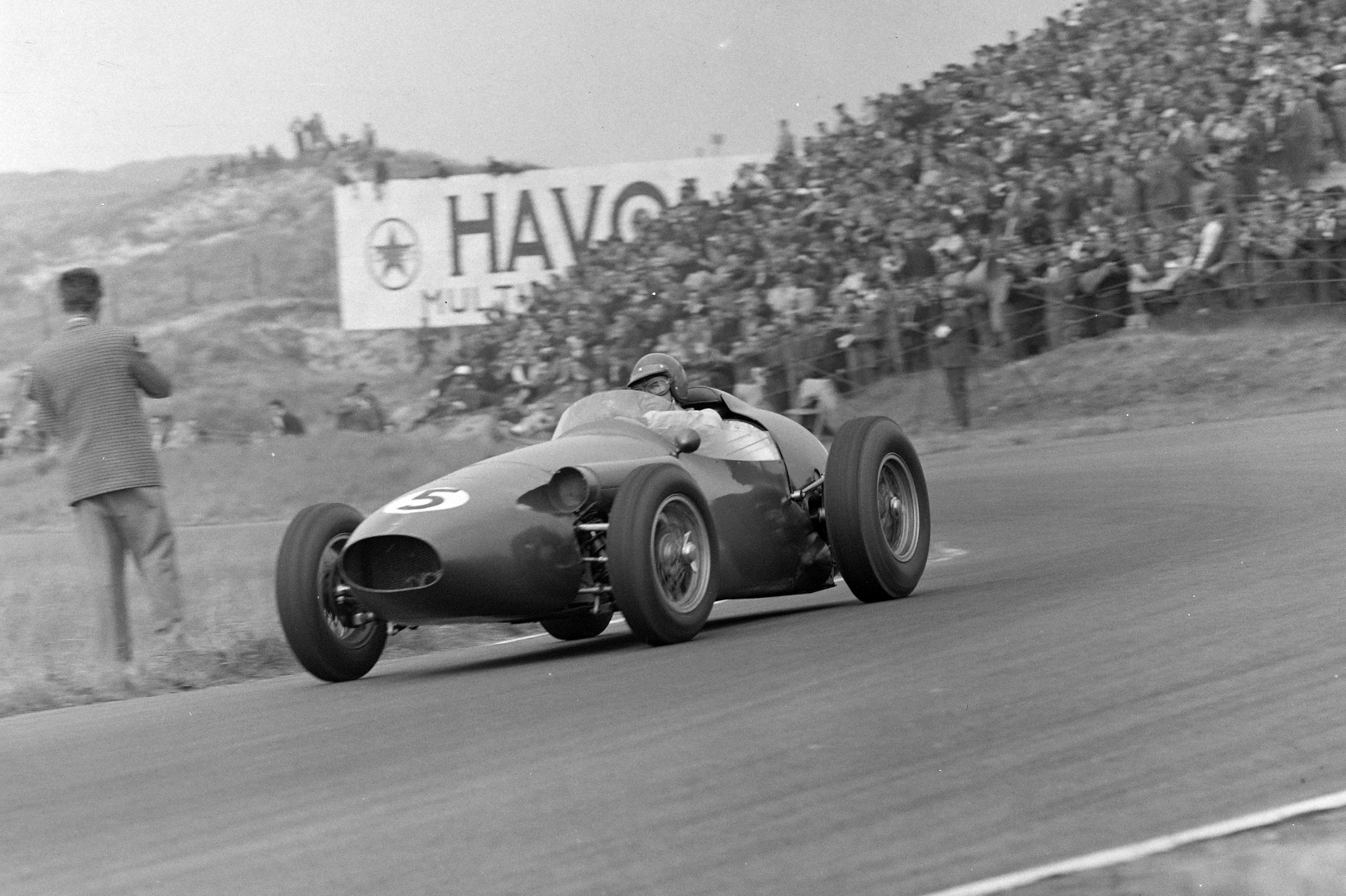
Carroll Shelby 1959 Dutch GP
Photo by: Motorsport Images
This was to rank among his legendary drives. Partnered by journeyman Jack Fairman, Stirling was in the car for 41 of the 44 laps – more than twice the length of the German GP – and single-handedly defeated a three-car Ferrari team.
PLUS: Stirling Moss' 10 greatest drives
When Salvadori and Shelby then won Le Mans, achieving the Holy Grail, there existed a shot at winning the World Sportscar Championship, and three cars were entered for the Tourist Trophy at Goodwood. Another brilliant drive by Moss won both race and title.
In the meantime, though, the F1 programme was floundering. Although Salvadori qualified second for the British GP at Aintree, he finished only sixth after an uncomfortable afternoon. “We hadn’t run the cars on full tanks in practice, and as soon as the race started fuel began seeping into the cockpit. Both Carroll and I came in early, thinking the tank had split, but we were told to carry on. I was sitting in a pool of fuel, which was a bit worrying – but I carried on because the car was going really well. After a spin I finished sixth.”
That would be the best grand prix finish Aston Martin ever achieved. In Portugal and Italy the cars were neither on the pace nor reliable, and that was it for 1959.
The following year came the revised, lighter, DBR5 – but by now only Ferrari was still using a front-engined car. Worse, the introduction of Lucas fuel injection reduced power slightly, and the adoption of independent rear suspension, rather than de Dion, had a disastrous effect on handling, previously its strong suit. The long-suffering Salvadori remained on board, partnered now by Maurice Trintignant.
Aston Martin would only start the British GP in 1960, and after that race it was decided to call it a day. John Wyer, the team’s general manager, reckoned that in hindsight it had been a fatal decision to concentrate on sportscar racing in 1958, and to delay the introduction of the F1 car by a year. Like Salvadori, he believed that in 1958 the DBR4 could have won races.
“It was a good car simply overtaken by events,” said Wyer. “By the time it appeared, in 1959, everything front-engined was out of date, and we didn’t accept that early enough. In mid-1960 I discussed it with David Brown, and we agreed that if we wanted to get anywhere we had to start from scratch with a rear-engined car. At that point we decided to scrap the project.”
Like anyone of my generation, to me the name of Aston Martin – like Jaguar – always meant sportscar racing, in particular Le Mans. Somehow neither marque sat well in F1, but now, 61 years on, the renaming of Racing Point (née Jordan/Midland/Spyker/Force India) brings Aston Martin back – albeit with a Mercedes engine. Sebastian Vettel will hope things go rather better this time.
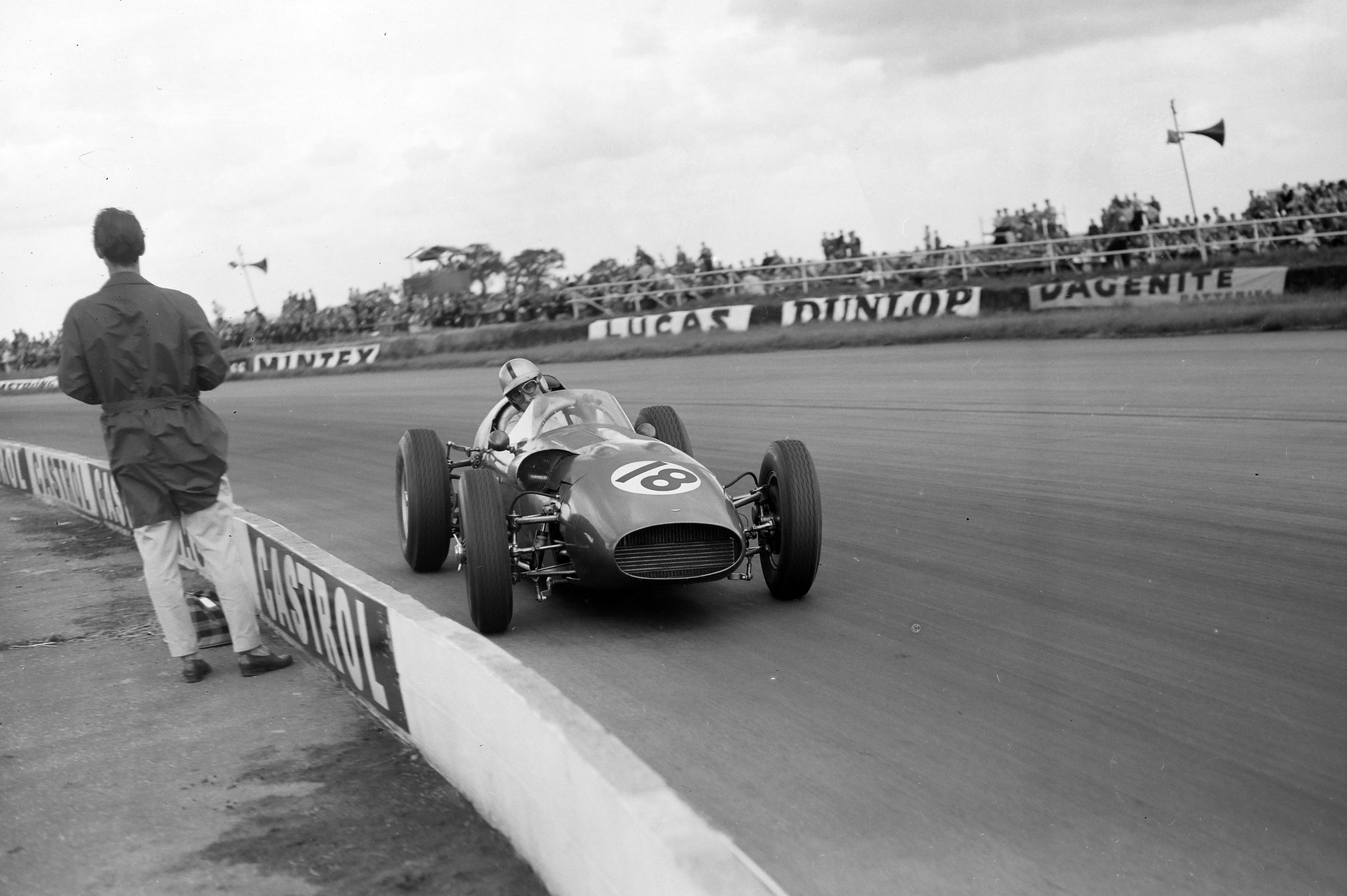
Roy Salvadori 1960 British GP
Photo by: Motorsport Images

How Ratzenberger beat the odds to realise his cruelly short-lived F1 dream

F1 uncovered: A weekend behind the scenes with a chief mechanic

When McLaren was pipped by Red Bull in a modern F1 classic

The big opportunity Sainz’s Williams switch affords to F1’s latest centurion

Inside the science of F1 fuel

How F1’s plan for rotating races could look in practice

The early decisions that set Sauber’s rookie for success

How F1 media coverage has evolved in line with its subject

How Antonelli levelled up his character to be F1 2026's world champion-elect

FIA set to close F1 cost cap loophole with new rules

Norris promises to make "better decisions" following fresh talks over Singapore GP clash

FIA expects F1 races in Qatar and Abu Dhabi to run as planned
Subscribe and access Autosport.com with your ad-blocker.
From Formula 1 to MotoGP we report straight from the paddock because we love our sport, just like you. In order to keep delivering our expert journalism, our website uses advertising. Still, we want to give you the opportunity to enjoy an ad-free and tracker-free website and to continue using your adblocker.


Top Comments