


The danger of reading too much into F1's clickbait radio messages
OPINION: After Lewis Hamilton responded to reports labelling him 'furious' with Mercedes following his heated exchanges over team radio during the Russian Grand Prix, it provided a snapshot on how Formula 1 broadcasting radio snippets can both illuminate and misrepresent the true situation

"F***, man, why did you give up that place? We shouldn't have come in".
Lewis Hamilton’s radio rant to his Mercedes pitwall in the Turkish Grand Prix prompted a fair bit of controversy last weekend, as it once again opened up interpretation on his relationship with the team.
On the one hand were those who suggested that he was rude, and that it exposed anger within the camp for the way that Hamilton felt let down by the strategy calls made, as he failed to grab a podium place that had been within touching distance. The other side of the debate was simply that Hamilton’s messages were all just part and parcel of the intensity of racing to the limit.
In F1, just as in other major sports, competitors often let off steam in the heat of the moment with emotions that don’t linger for long once the adrenaline has died down. For Mercedes and Hamilton, once the dust had settled on Sunday night, the radio outbursts were pretty much water under the bridge by the time they packed up at the Istanbul Park paddock and headed for home.
Insight: 10 things we learned from F1's 2021 Turkish Grand Prix
Hamilton himself took to social media on Monday and expressed some frustration that a host of publications had labelled him as being ‘furious’ with the team.
“Don't ever expect me to be all polite and calm on the radio when I'm racing,” he wrote. “We are all very passionate and in the heat of the moment that passion can come out, as it does for all drivers.

Lewis Hamilton, Mercedes W12 with Peter Bonnington, Race Engineer, Mercedes AMG
Photo by: Steve Etherington / Motorsport Images
"My heart and spirit are out there on the track, it's the fire in me that's got me this far but any angst is quickly forgotten and we talked it through, already looking ahead to the next race. Today's another day to rise and as a team. Still we rise."
Radio messages between car and pitwall have become an ever-present part of F1’s modern narrative. They set the tone for a race as it’s unfolding when they are broadcast on television, but can also add or change context when they are played out later on.
It’s important to state that, by most fans not having access to the full radio traffic that is going on between the car and the pits through the entire race, any messages they get on the international feed are selective. The words broadcast are only a small snapshot of all that is said throughout a race.
Most radio messages can be pretty dull. Listening to Hamilton’s radio for the 2019 Monaco GP, as he worked hard to keep Max Verstappen behind him, almost all of his conversation with the pitwall involved him repeatedly shouting ‘Blue Flag’
They are the TV equivalent of clickbait: selectively pulling out the most dramatic moment from two hours of conversation, and triggering something big from it to make it more spectacular. It’s not quite: “The top five strategy options we have today Lewis, and you won’t believe number two.” But the aim is still the same: make the show as it is played out on television the most captivating it can possibly be.
Often the radio messages are slightly delayed, and sometimes that can lead to them being played at a time when the interpretation of them has completely changed through events. That is why there is a duty of care from F1’s official broadcasters to ensure there is an element of fairness in what is shown.
As has been shown when Netflix embellishes the truth with some dramatic overplaying of radio conversations that were not actually said when the images the words are playing over are shown, so too F1 has to tread a careful line in not playing radio messages too much out of context.
At its extreme, for example, it would be wrong for a live feed to be showing off footage of one driver in action and a radio message coming out saying: "The guy’s an idiot", when his rival is actually referring to someone completely different.

Lewis Hamilton, Mercedes W12, in the pits
Photo by: Glenn Dunbar / Motorsport Images
The truth is actually that most radio messages can be pretty dull. This writer recalls at the 2019 Monaco Grand Prix listening to Hamilton’s radio for the entire race as he worked hard to keep Max Verstappen behind. Almost all of his conversation with the pitwall involved him repeatedly shouting ‘Blue Flag’ in a bid to get the message through to race control that they needed to start warning backmarkers to get out of their way. It would not have made good television.
Occasionally, though, the most golden moments on the radio come as the emotions do overflow. What often isn’t appreciated is the stress and intensity that drivers are going through during a race; especially in those moments when a whole race’s effort can be won or lost by how a conversation with the team is panning out.
Don’t forget that, cocooned away in their car, drivers are not especially aware of much that is going on beyond what they can see and feel. They sometimes don’t have a gauge for the bigger picture of a race or what other drivers out of sight are up to.
In Hamilton’s case at the weekend, he would not have known that Charles Leclerc had gone for the same tactic as him in sticking it out with the used inters, and that it had failed: forcing the Ferrari driver to come into the pits for a later than ideal stop.
What Hamilton did on Sunday with his radio complaint was no different to Lando Norris telling his race engineer to "shut up" over the radio in the closing stages of the Russian Grand Prix when they were debating about whether or not to stop for intermediate tyres.
Just as footballers scream and shout at their team-mates when passes go wrong or shots are fired off targets, so too it is fully understandable that drivers let rip when they feel that things are not going their way. In fact, such excessive emotions during moments of intensity like that are much more comprehensible than what Kimi Raikkonen unleashed on his team for a leaky water bottle in Turkish Grand Prix practice.
“I have water running in my f****** boots,” he moaned over the radio. “Because your drinking system is leaking like f***.”

Kimi Raikkonen, Alfa Romeo Racing C41
Photo by: Charles Coates / Motorsport Images
He later messaged: “How is it so f****** difficult to do simple things? The most f****** simple part in the whole car and we cannot f****** fix it.”
If I were an Alfa Romeo mechanic, I’d be pretty annoyed at such needless criticism that could have been put in a much better way.
Ultimately it doesn’t matter what the outside world thinks of the tone and nature of radio messages. Their purpose is not to entertain us, nor act as a portal of direction communication between the drivers and fans.
Instead, they are a simple tool that allows the race driver and the pitwall to speak to each other to try to deliver the best performance. Everything above and beyond that is just pure noise.
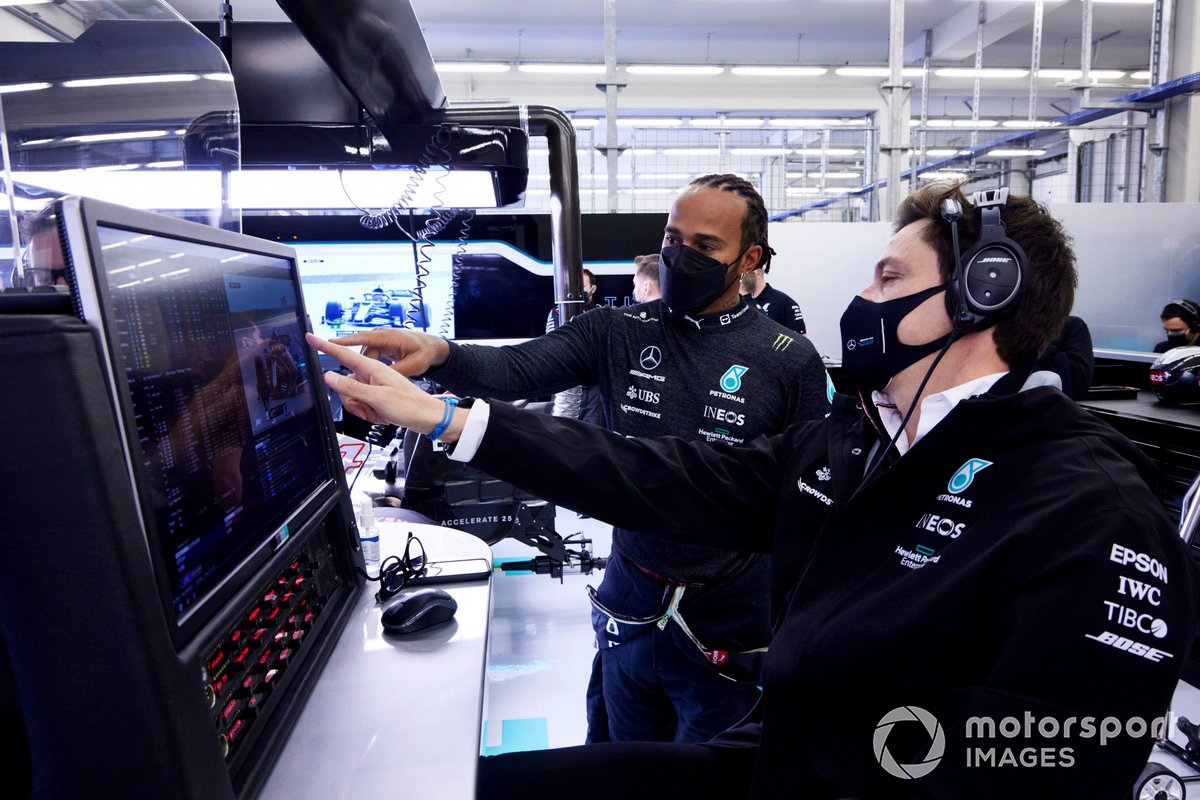
Lewis Hamilton, Mercedes, with Toto Wolff, Team Principal and CEO, Mercedes AMG
Photo by: Steve Etherington / Motorsport Images


Brundle awarded OBE in King’s New Year’s honours

The new rules dilemma that will define the 2025 F1 season

Verstappen issues Red Bull title warning in push for RB21 progress

Mercedes opens up on the factors that hurt Hamilton with the W15

How McLaren faced up to the misinformation, noise and distractions of being an F1 title challenger

Why Bottas is not letting the “worst-case scenario” end his F1 career

Jon Noble: An unfair perception or a genuine concern? Lifting the lid on Red Bull’s Tsunoda scepticism

Binotto on Audi's F1 reality check after finding team "frozen" with no plans

What we learned from Friday practice at the 2026 F1 Hungarian GP

Alonso delivers first verdict on Aston Martin F1 car upgrades

F1 Hungarian GP: Hamilton leads Ferrari 1-2 in FP2, Colapinto crashes for Alpine

LIVE: F1 Hungarian GP updates - Hamilton heads FP2 after Colapinto crash, Stroll sidelined for Aston Martin
Subscribe and access Autosport.com with your ad-blocker.
From Formula 1 to MotoGP we report straight from the paddock because we love our sport, just like you. In order to keep delivering our expert journalism, our website uses advertising. Still, we want to give you the opportunity to enjoy an ad-free and tracker-free website and to continue using your adblocker.


Top Comments