


The combination behind the Silverstone racing battles Hamilton called "F1 at its best"
OPINION: The late battling in the British Grand Prix wowed Formula 1 fans and surely represents the best racing action of the season so far. And there was a cocktail of factors that created the action, from which Carlos Sainz emerged as a popular new winner

“That was very reminiscent of the karting days. And I feel that that's Formula 1 at its best.”
That’s how Lewis Hamilton reflected on the brilliant 10-lap blast to the end of the British Grand Prix. Carlos Sainz, having decisively defied Ferrari’s instruction to try and make up for its baffling call not to pit leader Charles Leclerc for the fresh softs most ended up on, immediately seized his chance to finally take his first F1 race win.
PLUS: How Ferrari's Monaco headache became its Silverstone migraine
With Sergio Perez shooting by Hamilton in the race-winning move’s wake, Leclerc had quite the rear-guard action on his hands.
His defence against Perez was the act of a driver who knew they had no choice but to scrap for every point given their team had deprived them of more for, one way or another, the fifth race in a row. Hamilton got in on the act at Club and his eponymous straight, before Perez straightaway attacked back.
Then came the move of the season so far, Leclerc’s brilliant, bold around-the-outside move against Hamilton at Copse. It wouldn’t have come off without massive respect between the pair, highlighting their wheel-to-wheel quality once again.
That Hamilton soon despatched Leclerc with DRS into Stowe capped the fantastic atmosphere at the track, as the home fans were able to see their hero on the podium. Leclerc, meanwhile, was straight into words with Ferrari team boss Mattia Binotto…
This had all followed the early exchanges of the restarted race, where Max Verstappen was his excellent and robust self at Brooklands. How Red Bull’s call to originally start on the softs, part of a successful bid to quickly get Verstappen past polesitter Sainz, would have played out will never been known.

The frontrunners produced some stunning racing action after a late safety car
Photo by: James Sutton / Motorsport Images
And Verstappen’s misfortune to pick up a piece of AlphaTauri bodywork – reminiscent of Valtteri Bottas striking stray Ferrari bodywork and carrying it around in his floor at great downforce cost at Imola 2020 – was a factor in why the end of race was so entertaining.
It was a big shame for the Dutchman, who’s strong pace forced Sainz to eat into his second start mediums – already under strain from altered car handling by high-speed corner porpoising Ferrari hoped it had fixed after Sainz encountered the issue unexpectedly in FP3. He looked destined to win once he’d shot pass Sainz after the Spaniard’s Becketts off grappling with that extra bouncing in an already tricky turn.
Another factor that cannot be denied in the Silverstone finale being so good is that it only followed the safety car’s appearance. This altered many individual races.
Race winner Sainz also noted that the slipstream effect at Silverstone, while “not as big as last year” with the new car profiles, was “a very big effect also in having these interesting fights”
At Ferrari, once it had implemented team orders one can imagine Red Bull doing much faster if Perez was holding up Verstappen, Leclerc was left out on hards he had taken to a 4.2s gap over Sainz. This was despite his considerable downforce loss after his clash against Perez at the Loop early on.
We don’t have the evidence to say anything would’ve stopped Leclerc edging clear without the safety car, but it is a shame that once again other factors prevented the chance to see if the Scuderia really has cured the tyre wear struggles that cost it against Red Bull at Imola and Miami.
Leclerc nevertheless had enough tyre life left despite having carried the hards for 14 laps already (he would do 27 in total, the most of any driver) and lost the critical temperature range that compound requires under the safety car, to mount his defence and not fall further than fourth.
This is testament to Pirelli’s 2022 tyre design meaning the drivers can push on them harder for longer. There was also no sign the massively high forces the Silverstone track – and a green-ish one at that given Saturday’s rain – generates might lead to the dramatic blowouts of past years.

Hamilton sent the Silverstone fans wild when he overtook both Perez and Leclerc at Club in one move
Photo by: Mark Sutton / Motorsport Images
Hamilton reckoned he “would’ve been able to battle these two at the end” by the end of the race as “I was getting quicker and quicker as the [hard] tyres were getting stronger and stronger”. He had indeed gone from 4.3s behind Sainz after his slow pitstop to 1.8s adrift by the safety car. Sainz was though having to lift and coast, which is a big lap time drain at this high-speed venue.
But getting by even with the tyre delta Hamilton had worked well to build was not guaranteed, although perhaps a scintillating scrap along the lines of what did come in the pack late-on in reality may have played out. We’ll just never know, but the potential for Mercedes to create three-way scraps for the remaining race wins should be a boon to any fan.
So too, although this is admittedly even more subjective, should be how the decisions over intervening on hard racing was handled by the Silverstone stewards. While the merits of the outcome of moves will be argued by various partisan camps, the FIA outlining what is acceptable racing in a ‘Driving Standards Guidelines’ document sent to the teams at the start of 2022 appears to have been a big factor in how many drivers acted late in the Silverstone race.
Knowing being behind at a corner apex means the defending driver on the inside can run a rival to the edge of the tracks (as long as the defender stays within track limits), plus the reverse meaning an insider attack must have their front tyres level with the other at the apex to do a similar move (as Perez did on Hamilton at Village over second), meant there were no driver complaints from those involved.
That was bar an almost inevitable Fernando Alonso complaint about stewarding consistency, this time regarding on-straight weaving…
Indeed, Leclerc said his move at Copse was done “checking that Lewis was a bit behind at the apex to try and play with the rules” – again highlighting the wherewithal these supremely talented drivers have even when producing stunning racing.
Race winner Sainz also noted that the slipstream effect at Silverstone, while “not as big as last year” with the new car profiles, was “a very big effect also in having these interesting fights”.
“As soon as Max or Charles passed me,” Sainz explained, “I could stay within reach, thinking I was slower, but then suddenly you are behind and you gain four tenths or half a second of pace just because of the slipstream.”

Sainz felt both the DRS and slipstream effect lent itself to exciting on-track action
Photo by: Andy Hone / Motorsport Images
Silverstone was always going to be a key test of F1’s new car design rules. It has the first examples on the calendar of very high-speed corners, where the ground effect cars perform better over the ultra-high-downforce era cars and feel superior to the drivers from behind the wheel. Plus, the track’s layout usually rewards high-downforce and so faster packages, which increases a procession threat.
The safety car may have artificially bunched up the field, but the drivers were adamant “we were able to follow each other through the high speeds” – summed up there by Perez.
“Certainly this is a good test for this generation of cars,” he added. “Where we are able to follow each other and although you lose a position you can get it back by keeping fighting the other car. It was great what we've seen today in of these regulations.”
In any case, the main takeaway is that the Silverstone action was surely the best racing of the season and new era so far. But it’s important to remember that that ultimately cannot be expected at every race and F1 is all the better for it
One of the key architects of those rules – F1’s sporting boss, Ross Brawn – agrees.
“The frequency where cars are following for consecutive laps and challenging for consecutive laps is much better this year than in previous years,” he stated after the Silverstone race.
“What it demonstrates is the direction F1 and the FIA have gone in is absolutely the right direction to follow, and the sport can go forward with renewed confidence that this approach is what is needed for the future. It must always be a significant factor in the design and modification of these cars.”
It was pretty quickly obvious that the new cars had improved racing compared to the previous era following Leclerc and Verstappen’s string of wheel-to-wheel fights early in the 2022 campaign. But it was right not to get too carried away and declare them an instant success story, as indeed the impact of the safety car timing can’t be understated in explaining why the Silverstone race conclusion was so good.
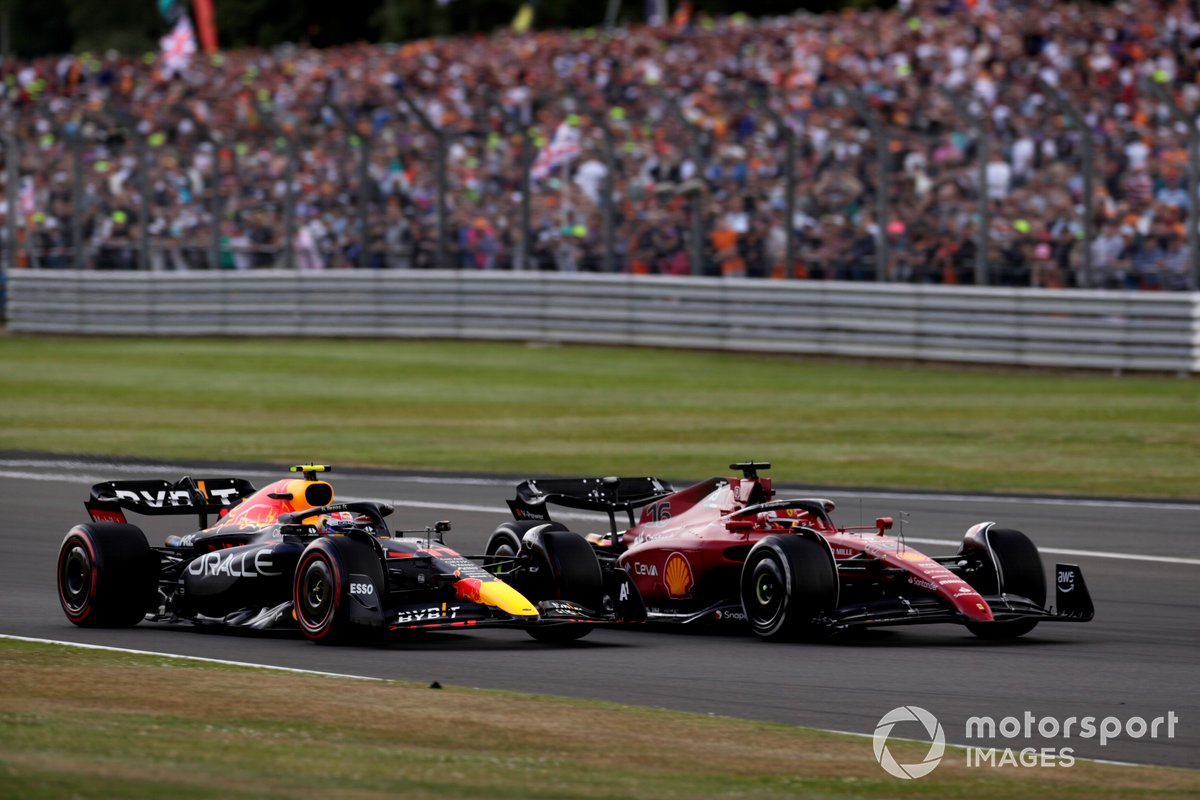
While the British GP action can be applauded, the influence of the late-race safety car cannot be understated
Photo by: Drew Gibson / Motorsport Images
Plus, those early race battles led to plenty of tedious discussion on the role of DRS – also a factor at Silverstone.
Brawn also states that “the introduction of raceability [as a factor in how the car design rules are made] is going to be a significant change for F1 for the future”.
Perhaps then, if future rules packages can be written so the racing is even closer and a safety car isn’t required to bunch up the field (yes, specific race circumstances will aways be different), then maybe DRS can be removed too…
In any case, the main takeaway is that the Silverstone action was surely the best racing of the season and new era so far. But it’s important to remember that that ultimately cannot be expected at every race and F1 is all the better for it.
A Monaco procession is often the price worth paying for brilliant driver bravery between the walls, while F1 needs the trend for high-speed city street tracks to unlock new markets and find new fans. This history and driver enjoyment of Spa or Silverstone is vital too.
It is the combination of it all that makes things so interesting and the highs so lofty when a racing delight comes around as it did last weekend.

F1's current combination of tracks and factors provides a key mix for the on-track action
Photo by: Glenn Dunbar / Motorsport Images


Why Britain’s role in Formula 1 endured a troubled start

Why Bottas believes his F1 reserve driver role is the fastest route back to a race seat

Why Norris is now ready for his final exam

The key advantage for Bottas vs Perez in the 2026 F1 return race

Why Ferrari's management is under pressure after its bad start to F1 2025, not Hamilton or Leclerc

Why Red Bull can’t solve its second F1 car problem with a simple paint job

Hirakawa replaces Doohan at Alpine for Japanese GP FP1 outing

How Alonso and Bortoleto can be F1 rivals in a unique driver management deal

WEC Barcelona: Genesis secures maiden series pole from Toyota
What drives Bortoleto as his junior rivals hit new heights in F1

How the M8B became the most dominant car in McLaren’s history

What Verstappen knew about Red Bull’s big upgrade when he signed his new F1 deal
Subscribe and access Autosport.com with your ad-blocker.
From Formula 1 to MotoGP we report straight from the paddock because we love our sport, just like you. In order to keep delivering our expert journalism, our website uses advertising. Still, we want to give you the opportunity to enjoy an ad-free and tracker-free website and to continue using your adblocker.


Top Comments