


The "50 cent coin" disaster risk that kept McLaren off the best Monza strategy
A famous Italian Grand Prix victory for Ferrari and Charles Leclerc resulted from superbly executing a one-stop strategy, which proved marginally faster than the two-stop approach favoured by McLaren. That Oscar Piastri and Lando Norris ended up as the pursuers in a race McLaren looked set to dominate resulted from a dire warning in practice

A contentious lap-one pass at the della Roggia chicane that had a Formula 1 title hopeful facing already slim chances in a proper pickle. The weekend’s fastest team eating into its tyres through the Italian Grand Prix and snatching defeat when victory was surely possible.
But unlike in the 2018 Monza race, Ferrari came out on top. This time, it was McLaren struggling to understand just how it had lost what looked to be a commanding position exiting the Rettifilo chicane on lap one with a secure 1-2. At this stage, not even eventual winner Charles Leclerc thought a second Monza victory for Ferrari was possible.
“I did not expect it going to the race," Leclerc says afterwards. "I thought that we would struggle a bit more compared to the McLaren, but also compared to the Mercedes…”
The Silver Arrows squad’s hopes disappeared at the first corner, where it all looked so good for McLaren and polesitter Lando Norris. He’d launched well enough to move right and cover off team-mate Oscar Piastri on the inside line, with the Australian’s move back left for the racing line at the approach to the Rettifilo stuffing third-place starter George Russell.
He “just got caught out by Oscar's braking point” and locked up, before slaloming around the Turns 1/2 escape road blocks and rejoining behind team-mate Lewis Hamilton. Red Bull’s Max Verstappen had been chasing his 2021 title rival from seventh on the grid and he shot around Russell’s right-hand side as Curva Grande unwound.
As the second chicane approached, Verstappen was gaining on Hamilton too but ran out of time even as the Mercedes drifted a tad right and there followed the lightest of touches between the W15’s right-rear and the RB20’s left-front. Then, on exit, Russell sustained front wing damage as his maintained momentum, along with Verstappen checking-up, meant the duo collided.

Norris had the better of the start to fend off Piastri into the first chicane, where Russell was caught out, moments before Piastri pulled his crucial pass
Photo by: Sam Bloxham / Motorsport Images
Verstappen complained “Lewis didn’t leave a car’s width” and wanted him penalised, but even this wasn’t enough to blot out the memory of a much more interesting moment at the della Roggia chicane just seconds ahead of a tediously familiar scrap story.
Norris had led through Curva Grande, but when he braked for the della Roggia suddenly Piastri was shooting alongside and sending his MCL38 into attack on the outside line. It was oh so Hamilton versus Sebastian Vettel’s Ferrari from 2018 here, albeit with Norris avoiding spinning despite full opposite lock between the apexes. “If I brake one metre later, I probably would have crashed,” he would later say.
Piastri, with the fourth-starting Leclerc having pounced on the delayed Norris on the run to Lesmo 1, shot to a 0.6-second lead at the end of lap one of 53. Now, the prospect of what a different contest Monza was this time really came to the fore. And it all centred on the resurfacing work completed all the way around this illustrious, famed blast.
The reason for Leclerc's unanswered incredulity was obvious given how the graining significantly enhanced the undercut’s power at Monza in 2024. But it was in fact a blessing in disguise…
“It’s a very different Monza because the track is now super smooth so you can run stiffer set-ups [and] closer to the ground,” McLaren team boss Andrea Stella said after qualifying, where the pole time, admittedly with cars a year more sophisticated, was nearly a second quicker year-on-year.
The jet-black surface all around the 3.6-mile course was also sizzling under the late-summer/early-autumn heatwave in Lombardy. Track temperature when the race got under way was 52C – the weekend’s highest.
Back on Friday, the teams had set about understanding how the combination of asphalt laid just 60 days earlier and the heat might impact the Pirellis. The result, in the traditional race simulations of the early Friday evening session, was severe graining on the medium tyres. And this was on both axles, which would later prove pivotal in the race’s outcome.
It was obvious the soft C5 tyre wasn’t ever going to be anything but a qualifying tyre, so the leaders had all started on the mediums. That’s for all bar the Red Bull pair – starting on the hard tyres that pre-race hadn’t been touched by the frontrunners. Had there been an early safety car Red Bull was screwed on strategy, given the time gain of a race neutralised service for rivals, but team boss Christian Horner explained “we had nothing to lose”.

Red Bull was never really in the fight at Monza and elected to start with hards, unlike the other front runners, as it had nothing to lose
Photo by: Simon Galloway / Motorsport Images
“We were at the back end of the front eight,” he added. “If the deg had been much higher, then the hard was better than the medium. But it wasn't significantly better.”
As Piastri led Leclerc through the opening stages – the McLaren’s gap never getting above 0.9s in the first nine tours as they lapped in the 1m24s – Pirelli was getting feedback that “we’re still graining,” per its motorsport boss, Mario Isola.
“[That’s] both on the medium and the hard,” he continued. “Probably a little bit less compared to Friday – more on the front-left, while Friday was both front-left and rear-left.”
At this stage, as the leaders tackled coping with the graining, Norris ran closely adrift of Leclerc. He’d just got the gap under DRS range on lap 13 when McLaren acted – undercutting the Ferrari on lap 14, with Norris’s smoky pitlane entrance resulting in a clipped marker board but no breach of the speed limit.
McLaren turned him around in 2.2s and he rejoined behind Alpine’s Esteban Ocon, who was immediately despatched at the della Roggia. From there, Norris’s scintillating out-lap speed got him easily ahead when Leclerc was brought in, also with a speed line lock-up, to cover the McLaren’s stop the next time by.
This infuriated the Ferrari driver, who raged to engineer Bryan Bozzi – “why did we pit if we are undercut?”. The reason for his unanswered incredulity was obvious given how the graining significantly enhanced the undercut’s power at Monza in 2024. But it was in fact a blessing in disguise…
Piastri came in one tour further on, lap 16, and rejoined comfortably still in the net lead. His advantage over Norris was now 2.4s, while his pre-service advantage over Leclerc had been 3.4s, as it had ballooned rather over the six tours before the Ferrari stopped.
“I think Leclerc was as fast as McLaren because he could stay with Oscar in the first stint,” Stella said. “And normally, when you have the dirty air and you can stay with the race leader, this normally leads to some more degradation – like Leclerc had in the final bit of the first stint.”

Piastri's move on Norris delayed the poleman enough to drop him behind Leclerc too, although Norris managed to undercut back into second after the leaders' first stops
Photo by: Andy Hone / Motorsport Images
Piastri’s gap to Norris shrank to 1.5s over the next six laps, while Leclerc gamely hung on in third – once the yet-to-stop Carlos Sainz and the two-stopping Red Bull cars had finally come in – and his deficit was similar to the second McLaren.
It didn’t look like it, but the race was already changing. Piastri then pressed on to try and ensure no McLaren team order arrived to allow Norris back to the lead, with the Briton also hustling to either make a move or see what his team might decide, being told racing was free so long as it was clean within McLaren’s nebulous “Papaya rules” guidance. And Leclerc was happier on the hards.
“Before the race, the one-stop was definitely the thing I wanted to do,” Leclerc explained of what became his race-winning strategy. “After 10 laps [of stint one], we saw that Red Bull started to struggle with the front left on the hard. And there we started to doubt the one-stop. However, as soon as I put [the hard on], I still thought that this was a possibility.”
Once both McLarens stopped again, Leclerc “actually picked up quite a lot of front grip, having free air”
Helping here was how, as Isola explained, the graining problem was lessening – “much, much lower”, in fact. At play was how the track evolution was easing things for the later-used tyres, with ever more rubber going down.
Cloud cover had also built up – to the point there was a 40% risk of rain and thunderstorms were spotted to Monza’s north-east, just without any wind to blow them in the circuit’s direction – and cooled the track by 12C through the race.
Up ahead, Piastri was pulling away from Norris again. The Briton couldn’t stop the graining on his left-front opening up the tyre and costing him grip lap after lap. This perhaps explained his lap 30 trip through the della Roggia run-off, with his additional sliding in dirty air and taking too much life out of the hards too early in this stint proving costly.
With Leclerc back within DRS range, McLaren made clear its intentions for Norris, as he was called in to take the second set of new hards and commit to the two-stopper on lap 32. For the next six laps, Piastri marshalled a near 6s gap to Leclerc behind, but the Ferrari driver felt “in the last two, three laps before Oscar pitted we were coming back a tiny bit”. Indeed, the gap shrank to 5.6s when on the 38th tour Piastri too headed for his second pair of hards.

Once in clear air after Norris had pitted for a second time, Leclerc's pace improved
Photo by: Sam Bagnall / Motorsport Images
He endured a near 4s service due to slow right-front change, which meant he came out just 2.4s ahead of Norris – over half his previous margin gone. At this stage, nothing but a McLaren win seemed certain, as Leclerc’s race might have been on the right trajectory, but hadn’t been completely transformed.
Indeed, the attention was back on Verstappen versus Norris, as the Dutchman, now running fourth, had asked for permission to mount a rear-guard action even from a net sixth place ahead of his second stop. Red Bull, which acquiesced to this request, had signalled this was always coming when it gave him and Sergio Perez more hards at their first services.
For eight laps, Norris chased his title rival, then when he got there was rebuffed at the first chicane on lap 40. He then passed with a DRS blast and seeing Verstappen off on the brakes on the inside line there the next time by.
After this, Verstappen pitted. He rejoined sixth and stayed there to the flag – his victory hopes non-existent through a combination of Red Bull’s lack of lowest-drag rear wing meaning it propped up the qualifying speed trap, its car balance being so off its graining was severe on both axles and Verstappen’s engine having to be turned down due to an issue for most of the race.
Verstappen ended up splitting the Mercedes cars – with Hamilton fifth after an anonymous run following that lap-one skirmish and Russell recovering from his early and long front wing-change first service to ended up seventh. Russell also beat Perez after a feisty battle early in the third stint of their two-stoppers.
As a result of the Verstappen/Norris battle, Piastri’s advantage over his team-mate was back up to 4.4s. But still in front of both McLarens was Sainz. And suddenly it became clear exactly what Ferrari was trying to do: one-stop.
Leclerc had felt when chasing Piastri “it was difficult for me to get closer, mostly because of the front left and I had quite a bit too much understeer”. Then once both McLarens stopped again, he “actually picked up quite a lot of front grip, having free air”.
At this stage on lap 41, Leclerc’s lead was 15.6s over Piastri, who had begun the chase by being warned he needed to “keep this pace, 22.0s”, by engineer Tom Stallard. He eroded Sainz’s 8s lead in six laps before getting by with a rapid DRS run into the Ascari chicane on tour 45. Norris then swiftly dispatched his former team-mate with an even easier fly-by down the main straight three laps later.

Try as he might, Piastri couldn't make up the deficit to Leclerc in the closing laps once free of Sainz
Photo by: Simon Galloway / Motorsport Images
By this stage there were six laps to run and Leclerc was still 9.1s in front. His pace across Piastri’s final stint duration came in 1.1s slower than the McLaren’s 1m22.458s average, but it was enough – because, try as he might, Piastri couldn’t hit his target lap time until the final two tours.
Leclerc, meanwhile, stayed metronomic in the 1m23s for 33 straight laps “really focusing” managing “my front left [graining]”. Piastri’s pace generally slipped up the 1m22s bracket and he wound up 2.7s short at the flag.
Also aiding Leclerc’s famous seventh GP victory was Piastri losing at least 0.5s lapping Lance Stroll at Ascari on lap 49, where the Australian complained the Aston Martin racer, who was worried his left front was “going to explode”, was “driving like it was his first go-kart race”.
In the FP2 long runs, “when [the graining] happened you basically couldn't hit the brake pedal because you turned your front-left into a 50 cent coin” – per Piastri
“I don't know what went through his brain when he saw his blue flag,” Piastri added. “I needed that stint to be perfect to win that race. I was pushing flat out to try and do it. I couldn't have gone any faster than that.”
McLaren lost due to factors combining – much of which was in its grasp.
It can’t be known how the race might have turned out had it imposed strict orders to preserve the short-lived 1-2, but it would have made things strategically more complicated for Ferrari and likely would have meant the Scuderia was the one needing an aggressive two-stopper to gain track position.
McLaren, “knew it was a quicker thing to do” the one-stopper on paper, per Norris, but committed to the opposite because of something it had seen in practice. This was how in the FP2 long runs, “when [the graining] happened you basically couldn't hit the brake pedal because you turned your front-left into a 50 cent coin” – per Piastri.
Pre-race, McLaren insiders had been fearing how the graining might again make lock-ups and offs likely. These had the possibility to destroy a race, so a one-stopper “seemed like a very risky thing to do”, again according to Piastri.

McLaren had already decided pre-race that a two-stop was the way to go after concerning graining in practice
Photo by: Steven Tee / Motorsport Images
Stella also revealed that the MCL38 “traditionally tends to be very good on the rear tyres, but when we deal with front graining, we tend to be on the aggressive side”. “So, this made us a bit nervous,” he added.
McLaren’s slightly bigger rear wing compared to Ferrari also meant higher speeds and load in Monza’s few fast corners – Lesmo 2, Ascari, Parabolica – which added stress to the left-front and exacerbated the orange team’s graining. Finally, Stella concluded “there was potentially more in the tyres than what we might have anticipated”.
“Obviously, everyone entered the race with doubts as to the tyres, because nobody ran hard tyres [in practice],” he added. “And when you are P3 [as Leclerc was], it's easier to say, ‘Let me try the one-stop’, than when you have the lead. If it doesn't work, then it's going to be a misery at the end of the race [for Leclerc].”
That this didn’t come to pass was also down to the winner’s actions. Yes, McLaren lost this race, but at the same time, Leclerc won it too.
The track gripping up and cooling lessened the graining on Leclerc’s hards, as did his set-up. This included Ferrari’s ‘Monza special’ rear wing package unleashed here in 2023. This provided “really good top speed”, per the Monegasque.
Critically, it also helped preserve his front tyres, as the lack of downforce placed the focus on the rear axle and meant higher speeds in the faster turns wasn’t opening the left-front a la the McLaren. Minimising sliding was key to keeping rear graining under control and Leclerc could do this because he felt “the balance of the car was also pretty good with that wing”.
For Ferrari team boss Fred Vasseur, Leclerc judged his driving perfectly on the strategy “we started for”.
“McLaren pushed a bit more than expected on the first stint,” he added. “Then Norris struggled before us, he had to pit, we wanted to cover him and stay in the same race as them because we had a feeling at this stage that we had an advantage on the tyres.

Leclerc managed his tyres perfectly, but was aided by a Ferrari set-up that stressed them less than McLaren
Photo by: Sam Bloxham / Motorsport Images
“The advantage was so good that after 10 laps with the hard, it was clear for us that we could go until the end. Then you never know because you can have a cliff at one stage…”
It didn’t because of Leclerc. He’d learned from his FP2 experience, where he’d caned his mediums going off a second quicker than his rivals and suffered a dramatic pace drop off.
In the race, aided by the fact he’d been undercut by Norris, he could “not overpush on the first couple of laps” of his long final stint, per Vasseur, after taking the hards. Leclerc’s first two laps on these were 1.5s and 0.8s slower than Norris’s, where Lesmo 2 and Parabolica had to be treated very gently to bed the left front in. Vasseur reckoned “that’s also what paid off at the end of the race”.
"Just like in 2019, the last three, four, five laps it was quite difficult to keep the eyes on the track and I was obviously looking a little bit in the grandstands"
Charles Leclerc
Sainz, fourth and 15.6s back at the flag, had insisted his podium rivals had initially come in too early and would “struggle to go to the end”. At the first round of stops, he came in four laps after Leclerc.
But Vasseur theorised, “perhaps Carlos anticipated a bit more the fact that we could do [the] one stop, and perhaps subconsciously, in his mind, he pushed a bit less” and so was too far back from Leclerc to capitalise when Ferrari’s strategy turned out to be the winner.
“Just like in 2019, the last three, four, five laps it was quite difficult to keep the eyes on the track and I was obviously looking a little bit in the grandstands,” Leclerc concluded. “I could see everybody was standing up and that was really nice to see. In 2019, I remember my mum was also in the grandstand because I didn't manage to have a paddock pass for her! This year, she did.
“Winning Monza again for Ferrari is a very special feeling.”
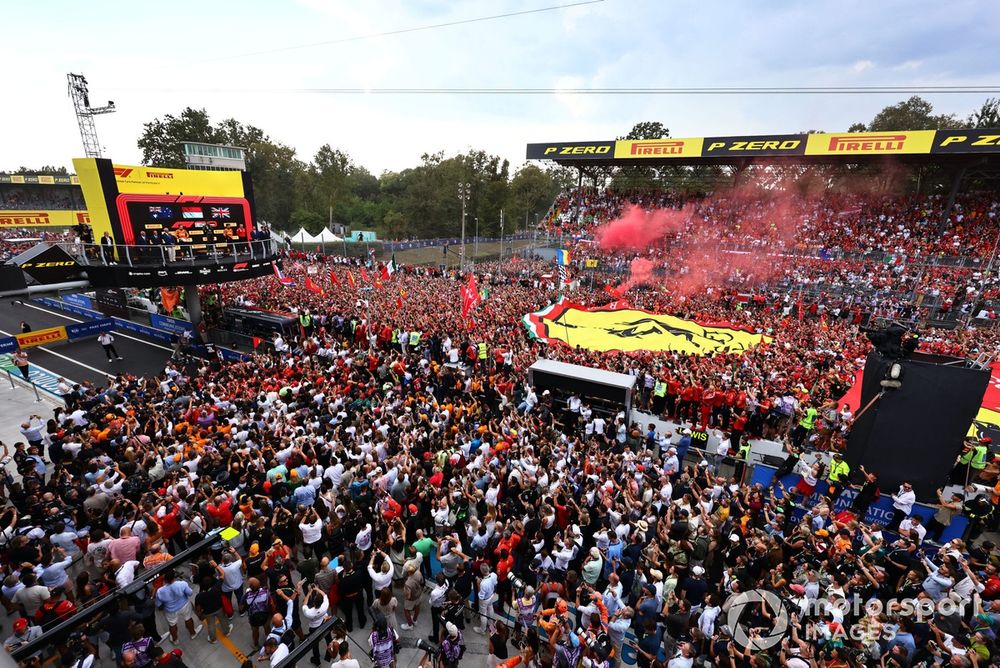
Ferrari's fans got the result they wanted as Leclerc celebrated a second Italian GP victory
Photo by: Steve Etherington / Motorsport Images


Why Britain’s role in Formula 1 endured a troubled start

Why Bottas believes his F1 reserve driver role is the fastest route back to a race seat

Why Norris is now ready for his final exam

The key advantage for Bottas vs Perez in the 2026 F1 return race

Why Ferrari's management is under pressure after its bad start to F1 2025, not Hamilton or Leclerc

Why Red Bull can’t solve its second F1 car problem with a simple paint job

Hirakawa replaces Doohan at Alpine for Japanese GP FP1 outing

How Alonso and Bortoleto can be F1 rivals in a unique driver management deal

Marquez: “In the first half of 2026, all I wanted to do on Sundays was lie on the sofa”

Vinales: “If I stay at home, I don’t get paid”

The unexpected issue Honda faced with upgraded F1 power unit

Supercars Gold Coast: Chaz Mostert dominates wet race for Walkinshaw Toyota
Subscribe and access Autosport.com with your ad-blocker.
From Formula 1 to MotoGP we report straight from the paddock because we love our sport, just like you. In order to keep delivering our expert journalism, our website uses advertising. Still, we want to give you the opportunity to enjoy an ad-free and tracker-free website and to continue using your adblocker.


Top Comments