


Technical analysis: Red Bull RB12
Red Bull is playing its cards close to its chest with the RB12, reckons CRAIG SCARBOROUGH, with plenty of new parts still to come - but some Mercedes inspiration evident
Red Bull's route to preparing for 2016 was fraught with indecision over its power unit.
It is invariably a team that leaves a new car's completion until the last minute anyway, so expect the RB12 to change a great deal over the two weeks of testing.
The car has shown some of its secrets so far, but there is also evidence that Red Bull is holding its final specification back to maximise development time and exploit all possible gains in the windtunnel.
Packaging a different engine is a huge mission. Despite the regulations mandating exactly the same mounting-bolt pattern for the engine and gearbox, nearly everything else differs. The size and shape of the V6 engine, turbo installation, even the ERS battery and the size of the radiators, will vary.
So when the team eventually agreed to stay with Renault for another year, the task of confirming the monocoque, gearbox and sidepod layout was immediately eased.
Renault has not been standing still. But its issues in 2015 extended from a lack of peak horsepower to poor reliability and the scale of its cooling requirements. Though improvements in the latter area will help Red Bull shape a sleeker car for this year, it knows that expecting the horsepower deficit to be eradicated is unrealistic and it will again face a straightline speed disadvantage. It's therefore still critical to get the chassis right.
No doubt this has led Red Bull to hold back many developments for after the first days of testing so they can be finetuned in the factory. Sure enough, the RB12's nose, front wing and turning vanes on day one are all reminiscent of the 2015 set-up. The nose lacks the S-duct raced last year, but this may be a temporary situation as many teams appear to be ready to run the duct system later in testing and are merely starting without it.
Some novelties have still appeared around the Red Bull's front end. The front lower wishbone design has followed Mercedes' lead and been formed into a single surface. By spacing the inboard pivots closer together, the two profiles can be legally conjoined into a single closed section.
This is an aero trick to manage front wing wake rather than a suspension or structural solution. Indeed from a stiffness point of view it is a less efficient set-up as the loads in the suspension legs and tub increase by being so close together.
Just behind this area, Red Bull has taken another leaf from Mercedes' book, but in this case with an idea that dates back to the Brackley team's Brawn GP days.
 Red Bull's vane is an idea first seen on the 2009 Brawn
|
It has added a snowplough-like vane on the T-tray splitter. This upturned vane runs across the splitter and acts as a vortex generator to direct airflow around the lower flanks of the sidepods.
A similar solution was raced by Brawn through 2009, Williams in '10 and in some respects is similar to the 'inverted bat-wing' Mercedes runs today.
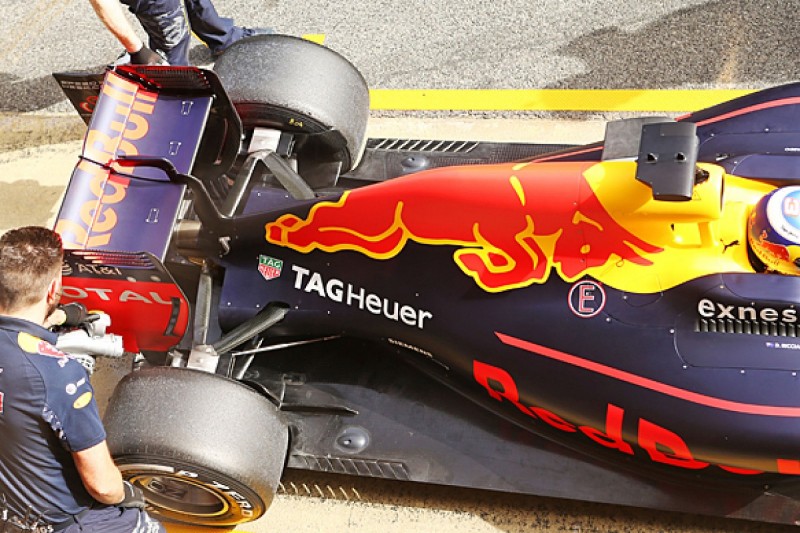
The new Red Bull's sidepods and rollhoop follow the size and shape of the 2015 car, which was already notably slim. No obvious repositioning of coolers or hardware is apparent with the current bodywork.
Red Bull says the Renault power unit still has a similar layout to 2015, with the turbo at the back of the engine, the MGU-H inside the V and the MGU-K alongside the engine. One important detail that remains to be seen is whether the needs for intercooling the charge air into the turbo has reduced. For the past two years Red Bull has had to run two very large air-to-air intercoolers in the sidepods.
It's also understood that meeting the minimum weight limit has been a bigger issue this year, so it's possible that Red Bull is following Ferrari and Mercedes' lead with a water intercooler, which takes up less sidepod volume, but adds several kilogrammes in weight.
Like most teams' cars the RB12 sports three exhausts for its Renault engine, the main turbo tailpipe being joined by two wastegate exhausts.
But its set-up differs from the works Renault car, which has only two tailpipes. Teams are free to develop their own exhaust tailpipes and Red Bull felt there was a small aero benefit with the trefoil arrangement, now referred to as the 'Mickey Mouse' set-up due to its similarity to the cartoon character's ears. It doesn't offer any major benefit, merely suiting Red Bull's preference.
By the end of 2015 it seemed Red Bull had conquered its handling issues and again had a chassis to match the best, lacking only horsepower.
While it's certain that Renault will deliver a better power unit, the team may need to wait until mid-season. Until then, Red Bull may again find itself having to wait for suitable circuits and circumstances to get close to Ferrari and Mercedes.


The perfect Formula 1 car from 2016

F1's new development war has already begun

F1 teams still pushing with an eye on 2017

A glimpse at McLaren's 2017 work at Austin?

Engine oddities and aero tweaks at Suzuka

The unexpected technical upgrades at Sepang

Mercedes' suspension under the spotlight again

F1 teams' low downforce secrets

Acosta's long road to his maiden MotoGP win

MotoGP Austrian GP: Acosta finally claims maiden win

Great debate: Which circuit should host the F1 2026 finale if the calendar has to change?

Live: MotoGP Austrian Grand Prix updates as it happens
Subscribe and access Autosport.com with your ad-blocker.
From Formula 1 to MotoGP we report straight from the paddock because we love our sport, just like you. In order to keep delivering our expert journalism, our website uses advertising. Still, we want to give you the opportunity to enjoy an ad-free and tracker-free website and to continue using your adblocker.


Top Comments